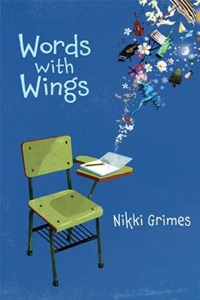
Review: Words with Wings by Nikki Grimes

words with wings

Words with Wings by Nikki Grimes

Gabby has always been a daydreamer, but when her parents started fighting and then separated, she started retreating into her daydreams more and more.  Now Gabby lives with just her mother, who is not a daydreaming type at all.  So the two of them clash.  Gabby also gets in trouble at school due to her dreamy ways and not paying attention to what is happening in class.  But along the way, readers will see that Gabby is much more than a daydreamer, she is a poet.  Eventually, her mother will come to terms with her way of thinking and she will find that she has a teacher who not only supports Gabby’s daydreaming but makes it part of his curriculum. 

Grimes writes in short free verse, some of the poems only a handful of lines long.  Yet because these are poems written by a master poet, they each speak truth.  There are poems that talk about moving and autumn, others that celebrate family members, and at the heart of the book are the many poems that celebrate dreaming, lingering and Gabby herself.  Grimes was clearly the sort of child who also daydreamed, since she captures it so well. 

I deeply appreciate that this book does not “fix” Gabby’s daydreaming.  Instead it is the adults who adopt a new attitude towards her once they realize that she is thinking and processing and writing in her head.  Gabby is expected to change some of her behaviors in class and is supported in doing this by a very engaged and kind teacher who promises that she will have time to dream and to record those dreams she has.  Gabby is the sort of heroine that one loves immediately, and she is also one that readers will cheer to see succeeding on her own terms.

Beautiful and strong poems support a world where imagination and creativity is accepted and poets survive their childhood intact.  Appropriate for ages 9-12.

Reviewed from library copy.

Review: Battle Bunny by Jon Scieszka and Mac Barnett

battle bunny

Battle Bunny by Jon Scieszka and Mac Barnett, illustrated by Matthew Myers

Gran Gran has given Alex a very saccharine sweet birthday book filled with bunnies as a gift.  But Alex is clearly not a fan of the original book since he takes his pencil and makes lots of changes so that it’s a book that he wants to read.  Birthday Bunny is turned into Battle Bunny, complete with helmet, utility belt and walkie talkie.  His goal is to unleash his evil plan on the forest and the world that only a boy named Alex can prevent.  Expect danger, cut-down trees, epic battles and much more as Alex tries to defeat the evil that is Battle Bunny!

Told and drawn in layers, this book is something very special. First you have the rather sickly sweet story underneath that celebrates Birthday Bunny’s birthday with lots of dancing and balloons.  It’s silly, friendly and pure sugar.  Over the top of that comes the brilliance of the writing of Scieszka and Barnett who manage by changing a few words in every sentence to make an entirely different story.  Most sentences just have a few words changed, but others towards the end are more edited to really let the story flow.  It works so well that one can forget the words underneath until you eye snags on one and you just have to read a bit of the silly story that has been edited. 

Myers’ art is equally successful.  He takes a dance scene and deftly turns it into an epic battle but one where you can still see the dancing underneath.  On some pages little comics are added in the white space so that more story can be told.  The cutesy nature of the underlying story is captured in his illustrations and one can feel the glee with which he reworked them just as a little boy would.

These three gifted book creators truly channeled their inner children to create this book.  It is funny, smart and immensely creative.  Appropriate for ages 4-7.

Reviewed from copy received from Simon & Schuster Books for Young Readers.

Review: Fraidyzoo by Thyra Heder

fraidyzoo

Fraidyzoo by Thyra Heder

It’s the perfect day to go to the zoo and the whole family is excited.  Well, maybe not the whole family.  Little T certainly is not, in fact she is frightened of the zoo.  But she can’t remember what in the zoo scares her.  So her family set out to find out what might be scaring her.  They start out at the beginning of the alphabet and acting out the animals.  It’s not alligator, bat or camel.  As they go on, the costumes they use become more and more elaborate and they all help act them out with plenty of laughter and silliness.  They make it all the way to zebras and still Little T can’t remember why she is scared of the zoo.  So they decide to go the next day.  But there is something very frightening at the zoo, and her older sister might just find it a little too scary.

Heder does a superb job here of creating costumes out of boxes and ropes that look like they just might work in real life.  As the costumes grow more and more outrageous and complex, they also get more beautiful.  Along the way, Heder does not name any of the animals being portrayed, so the book has a guessing-game element to it as well.  The ending is funny and satisfying.

Heder’s art really is the majority of the story here.  The text is almost secondary to the full-page images that gallop and dash across the page.  They are filled with motion, color and smiles.  This is art that will inspire children to play with boxes and rope.  Expect your living room to be strewn with cardboard and ideas.

Creative and a joy to read, this is much more fun than any visit I’ve had to the zoo.  Appropriate for ages 3-5.

Reviewed from copy received from Abrams Books for Young Readers.

Review: Line 135 by Germano Zullo

line 135

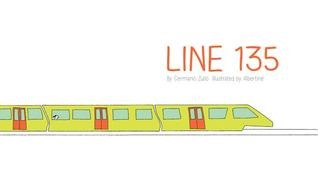
Line 135 by Germano Zullo, illustrated by Albertine

The duo that created Little Bird have returned with another lovely and fanciful story.  A little girl travels by train to her grandmother’s house.  The train starts out in the towering city and we are told at the beginning that her grandmother lives in the country.  The train travels from crowded cityscapes into more residential areas.  The little girl talks about all of the traveling she wants to do when she gets older.  As the pages turn, the landscape changes and eventually becomes very odd.  Flowers grow as tall as the train, strange creatures stand near a pond, then the pond itself looks very much like a beast of some sort and readers will know that they are on a surprising trip too.

Imported from Switzerland, this book starts out as a quiet thoughtful book about being comfortable living in both the city and the country and a love of travel.  Zullo’s text never changes from that musing tone, but it does speak to the right of a child to have opinions about how they want to live their lives. 

The girl’s dreams and imagination come to life in the illustrations.  The train is the sole zip of color on each page, while the surroundings are entirely in black and white fine-lined drawings.  They are detailed and lovely and the change from reality to dream world is done slowly and with deft pacing. 

This is a book that makes you want to start back at the beginning the minute you finish it so that you can see even more in the drawings.  Appropriate for ages 3-5.

Reviewed from library copy.

Review: A Moose That Says Moo by Jennifer Hamburg

moose that says moo

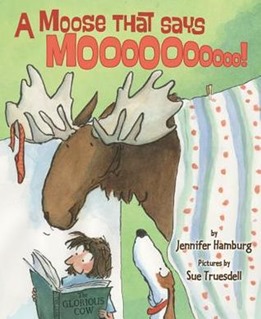
A Moose That Says Moo! by Jennifer Hamburg, illustrated by Sue Truesdell

Sitting near the laundry drying on the line, a little girl is reading books about animals.  She starts to think about having a zoo of her very own and what sorts of animals it would have.  It’s guaranteed that no other zoo has animals like hers!  There is a moose that says “moo,” bears that drive cars, tigers that swing in the trees, and sharks that read books.  At night, the animals have a big pillow fight that turns into one silly brawl with awakened goats, tap-dancing pigs that startle easily, tripping turtles, and even groundhogs that protest.  It will take one smart young girl to get everything put back together again even in this imaginary zoo.

Written in a rollicking rhyme, this book really celebrates the ridiculous and the silly.  Hamburg manages to create zoo animals with wild qualities that make the book a surprise on each page.  The result is a book that dances on the edge of losing control, but the firm hand Hamburg takes with the rhyme and rhythm keeps it within control and makes for a book that begs to be shared aloud.

Truesdell does an amazing job of managing to take all of the wild chaotic silliness of the book and turn it into illustrations that help it all make sense.  At the same time, she too revels in the silliness on the page and adds to it with small touches like a reading shark accidentally eating a book, the offer of many tissues to a sneezing tiger, and goggled bears in cars. 

Pure silliness, this book could merrily be wedged into many storytime themes.  Use it as a finisher since even antsy children will sit still for this wild ride.  Appropriate for ages 3-5.

Reviewed from copy received from Farrar, Straus and Giroux.

Review: Nino Wrestles the World by Yuyi Morales

Nino wrestles the world

Nino Wrestles the World by Yuyi Morales

Everyone cheer for the incredible, the amazing Nino!  He is challenged to fight by wild opponents like The Guanajuato Mummy who is taken down by a tickle attack.  Next to challenge Nino is Olmec Head whose stony face is walloped by a Puzzle Muzzle move.  He has tricky moves to use on each one, taking one down at a time using all sorts of toys.  But finally, his real serious opponents arrive, Las Hermanitas!  Nino is going to have to use all of his wrestling and mental skills to beat these two little sister opponents.

Bold and colorful, this book evokes Lucha Libre, Mexican wrestling, right from the get go.  Morales celebrates this aspect of Mexican culture but puts her own child-friendly spin on it with wrestling different monsters using toys in Nino’s room.  She mixes the history of Lucha Libre masks with the actual monsters and the joy of a child who loves to wrestle any comers. 

The book nicely mixes Spanish and English and also switches fonts to further evoke the marquee effect of wrestling.  Add in the comic-book fonts for the various moves that Nino does and you have one very dynamic and inspired book.

This book shows everyone that books with multicultural characters can be wild fun to read!  Morales wins!  Appropriate for ages 3-5.

Reviewed from library copy.

Review: The First Drawing by Mordicai Gerstein

first drawing

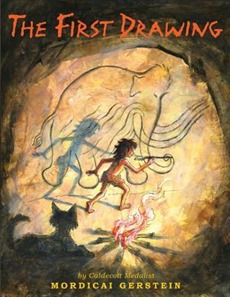
The First Drawing by Mordicai Gerstein

This picture book tells the story of how drawing first started.  Inspired by the the 30,000 year old paintings in caves in southern France, the story focuses on one boy who sees the world differently from everyone else.  When he looks at the clouds, he sees animals.  Everyone else just sees clouds.  When the firelight flickers on the walls of the cave as they go to sleep, he sees herds of beasts.  No one else does.  So he gets the name “Child Who Sees What Isn’t There.”  He tries to explain what and how he is seeing things, but it isn’t until he picks up a charcoal stick from the fire and actually draws the lines he is seeing that others can see it too. 

Beautifully told, Gerstein weaves the story of these caves into an exploration of how artists see the world in a unique and powerful way.  By choosing very tangible examples of how artists see, children reading the book will quickly realize that they are artists as well.  It is also helped by the use of  second person narrative, so that children are identified as the child who invented art.  The author’s note explains more about the caves as well as why Gerstein was inspired to tell the story of a child drawing. 

Gerstein’s art is bright and large.  He shows large swathes of sky filled with clouds, lands filled with animals, and makes sure that readers see the inspiration for the later art.  This contrasts with the tight closeness of the fire-lit cave that is all dancing flames and stone walls. 

A virtuoso picture book, this is a wonderful melding of history, possibility, and art.  Appropriate for ages 4-6.

Reviewed from library copy.

Review: Loula Is Leaving for Africa by Anne Villeneuve

loula is leaving for Africa

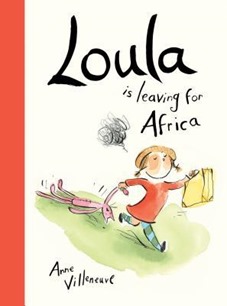
Loula Is Leaving for Africa by Anne Villeneuve

Loula has had enough of her mean triplet brothers and decides to run away.  She packs up her cat, tea set and best drawing.  She knows she wants to be far away from her brothers.  She announces to her parents that she is leaving for Africa, but neither of them seem concerned.  The only one who notices that she is running away is Gilbert, the family chauffeur.  Happily, Gilbert also knows just how to get to Africa.  It will involve riding camels, crossing a desert and taking a plane and a boat.  But most importantly, it also takes lots of imagination and one good friend.

Told with wonderful wit, this book starts out like many running away books and then takes a cheery turn.  Villeneuve tells the story with a light hand, allowing her illustrations to show the truth of what is happening while the text remains primarily dialogue.  The result is a book that has depth and creativity but reads quickly and effortlessly.

Villeneuve’s art evokes Madeleine and Babar somehow.  It has a timeless feel, swirls of watercolor.  One of the most effective images is the series of sky pictures as Gilbert and Loula sit along the river as the sun goes down.  The attention to color and the motionless pair next to each other capture those moments in life when all is perfection. 

A winner of a picture book, this is one that belongs in every running-away bag or bedtime stack.  Appropriate for ages 4-6.

Reviewed from digital galley received from NetGalley and Kids Can Press.

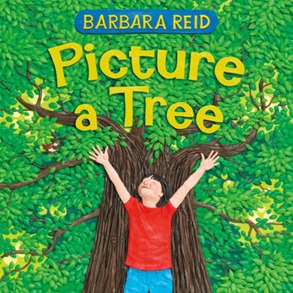
Review: Picture a Tree by Barbara Reid

picture a tree

Picture a Tree by Barbara Reid

How do you picture a tree?  Do you see a drawing on the sky?  A tunnel?  An ocean?  A sun umbrella to stop on your hot walk home?  What do you see?  These are just some of the ideas that Reid puts forward in her picture book that pays homage to trees and their ever-changing beauty.  Starting with the spring and moving through all of the seasons, this book will have you looking into the trees around you and noticing them even more.

Reid’s text here is simple but very effective.  She gets you dreaming of your own answers and also seeing trees from all angles and all seasons.  The true focus here though is her art.  Done entirely in Plasticine clay, they have a wonderful three-dimensional quality to them and are anything but simple.  In fact, the detail is amazing and will keep readers gazing long after they complete the words on the page.

An awesome addition to any Arbor Day, Earth Day, tree-related or seasonal story time or unit, this book should inspire all of us to wonder about trees.  Appropriate for ages 4-6.

Reviewed from library copy.

You can also see the trailer for the book for a glimpse of Reid’s art and words: