The Crane Girl by Curtis Manley

the-crane-girl-by-curtis-manley

The Crane Girl by Curtis Manley, illustrated by Lin Wang (9781885008572)

Released March 15, 2017.

Yasuhiro discovered an injured crane caught in a trap and freed it, the crane pressing its red crest to his cheek before flying away. The next night a girl came to his home where he lived with his father. She asked to stay with them and work for them. His father, Ryota, agreed to let her stay though they aren’t rich and have little to share. The girl, Hiroko, noticed the loom in one of the rooms and was told that it belonged to Yasuhiro’s mother who had died. Hiroko offered to weave silk for them to sell as long as they never opened the door while she was working. They agreed. She soon returned with fine silk that Ryota was able to sell for a nice sum, enough to stop him from having to look for work for awhile. Soon though, he needed more silk and then still more, faster and faster each time. As the demands grew, Hiroko was unable to recover between weavings, making each time take longer and longer. When Ryota finally opened the door, there was Hiroko as a crane, weaving on the loom and using her own feathers. Hiroko finished the weaving and then flew off, but it was up to Yasuhiro to decide what life he was going to choose going forward.

This picture book version is based on several versions of the traditional Japanese crane folktales. One theme in these stories is the concept of a debt that needs to be repaid. This version has a father who plays the impatient villain in the story, allowing real love to blossom and grow between the human boy and the crane girl. The writing here is superb. It is simple enough to be shared aloud well and yet rich enough that the story really comes to life. Manley uses haiku inserted throughout to speak the characters’ deepest feelings that they don’t share aloud in the story. This use of brief poetry embraces the Japanese setting of the tales in another way, enriching them further.

The illustrations are enchanting. They have a light to them, one that shines from the silk the girl creates and emanates from her body and feathers. Done in watercolor, they are filled with fine details, small touches of steam rising from a teapot and snow on shoulders draw readers further in.

A rich retelling of the Japanese crane folktale, this version offers great writing combined with wonderful illustrations. Appropriate for ages 4-7.

Reviewed from e-galley received from Edelweiss and Shen’s Books.
The Turn of the Tide by Rosanne Parry

The Turn of the Tide by Rosanne Parry

The Turn of the Tide by Rosanne Parry

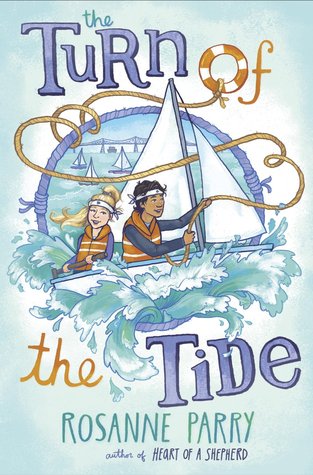
When an earthquake hits Japan, Kai tries to help his elderly grandparents escape the tsunami waves, but he is unable to get them to move fast enough. After the immediate crisis, Kai is moved from his home in Japan to the safety of Oregon to live with his cousins. His parents stayed behind in Japan to work on the nuclear power plant that was damaged in the storm. Jet is the cousin that Kai moves in with. She dreams of being the pilot of a boat on the Columbia Bar. One day she misses checking the tide though and puts her little brother in serious danger on the water. These two cousins, each wrestling with the results of their actions and the tug of their dreams, have to find a way to forgive themselves and move forward.

Parry, author of Heart of a Shepherd, has once again captured the courage of children on the page. The two protagonists are unique voices in children’s literature. Kai from Japan looks at everything in America as different and foreign. He struggles with his own role in his grandparent’s death and feels a loss of honor for leaving Japan and escaping to safety himself rather than helping rebuild. Jet is a courageous girl who struggles to make and keep friends. She is passionate about sailing and boats but also about her family. Jet doesn’t warm to people easily, and the two cousins face interpersonal issues between them that are organic and realistic.

The setting too is beautifully rendered. The Oregon coast and the Columbia River Bar add real drama and danger to the story. The ever-present weather and tides, the concerns with sailing and family honor, and the dreams of Jet herself meld together into a mix of adventure and destiny. The book has facts at the end about the Columbia River Bar Pilots and about Captain Deborah Dempsey who appears as a character in the book, the only female Columbia River Bar pilot.

Realistic and dangerous adventure in a beautiful and unique part of the United States, this book speaks to working to forgive yourself and overcoming adversity by doing the right thing. Appropriate for ages 9-12.

Reviewed from e-galley received from Random House Books for Young Readers and Edelweiss.

Review: The Last Leaves Falling by Sarah Benwell

Last Leaves Falling by Sarah Benwell

The Last Leaves Falling by Sarah Benwell (InfoSoup)

Sora has ALS, a disease that will slowly ravage his muscles and eventually kill him. There is no cure and no slowing the disease’s progression. Sora’s mother takes care of him and he spends his days at home, unwilling to leave and expose himself and his mother to the pitying gazes of strangers as she pushes him in his wheelchair. Then Sora joins an online chat room for Kyoto teens and after lurking for awhile, accidentally posts a very big scream to one of the rooms. Some people reach out to him and he becomes online friends with two of them, Mai and Kaito. His mother thinks they are friends from school, and she insists that she meet them too. But Sora hasn’t revealed his diagnosis to them at all, pretending instead to be a regular school-attending teen online. What will happen when they discover his illness? Will be begin to treat him differently just like everyone else?

Benwell has written a stunning read in this teen novel set in Kyoto, Japan. The setting is beautiful and a sense of Japan runs through the entire novel, making sure that western readers will never lose the sense of the setting. Benwell grapples with many issues here and yet the book is intently focused on Sora and his journey. Sora wants answers to questions that have none, like why people treat those with disabilities differently and what happens to you after you die. With those issues weaving throughout the book, Benwell also offers up a look at a devastating disease and its effect but also still reminds us all the it is each day that matters and the small things that delight.

The three teen characters are very well drawn. There is Sora, the central character and a boy who is serious and studious. He searches for deep answers and has lots of time alone to think. Yet he is still approachable, friendly and caring, never becoming a stereotype of any kind. Mai is a girl who loves art but is unable to explain to her mother that she’d rather be an artist than a lawyer. Through her reaction to meeting Sora for the first time, Benwell offers one view of courage and the willingness to try again. Kaito is a boy who loves coding and computers, but struggles to do it as well as he would like. He is impatient and clever. The two teens learn much from Sora, but not right away allowing them the time and space to be truly motivated by Sora.

This is a powerful novel that speaks to the beauty of life and calls teens to make the most of their dreams. Have your tissues ready! Appropriate for ages 12-16.

Reviewed from copy received from Simon & Schuster.

Review: Kenta and the Big Wave by Ruth Ohi

kenta and the big wave

Kenta and the Big Wave by Ruth Ohi

When the tsunami sirens sounded, Kenta headed up the big hill to the school just as he had practiced.  But along the way, he lost hold of his soccer ball and it rolled down the hill.  Kenta’s parents were already at the school and when they returned to their house, it was ruined.  They had to sleep in the school gym and search in the rubble for things to salvage.  But Kenta’s soccer ball had been carried off by the water.  Kenta tried making a soccer ball from scraps but it didn’t work well.  Meanwhile, his ball was being carried by the ocean until it reached another country.  Would it ever find its way back to Kenta?

Ohi has written a very simple but compelling look at surviving a natural disaster.  Her focus on a single beloved possession works particularly well.  I also appreciated that it was not a doll or a stuffed animal but rather something that older children can relate to.  It was also a good choice to not have Kenta and his family in direct peril and survive.  The safe status of everything but the ball and other material objects makes it easier for the ball to be important and mean more.

Ohi’s illustrations are filled with color.  The yellows of the grass pop against the blues of the ocean.  Kenta wears a bright red hoodie and stands out on each page.  The time the ball spends in the ocean is particularly lovely and quiet compared to the mess of the town.

Based on true accounts of objects appearing in other countries after the tsunami in Japan, this book celebrates the connection people can have without ever having met.  Appropriate for ages 4-6.

Reviewed from copy received from Annick Press.

Review: Drawing from Memory by Allen Say

drawing from memory

Drawing from Memory by Allen Say

Released September 1, 2011.

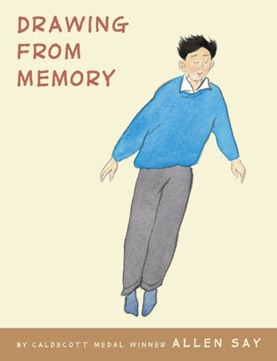
This is a captivating look at the life of Allen Say and his journey to become an illustrator.  It begins with his childhood in Yokohama, Japan which he had to flee when the bombings started in 1941.  As a child, his mother kept him safe at home and not out playing near the water.  He learned to read early and fell in love with comics, deciding at a young age to become an artist.  His father dismissed his dreams, wanting him to follow a more respectable path.  Say lived with his grandmother while he went to school until at age 12, he moved and lived alone in a rented apartment in Tokyo.  Following his dream, he approached the famous cartoonist, Noro Shinpei in the hopes of becoming his student.  Say found his sensei and a new father figure in his life.  Readers will discover the long hours, hard work, and talent that made Say the artist he is.

Say weaves photographs, drawings and paintings together into an extraordinary look at his life.  The text blends humor  with  brutal honesty about his family’s lack of support for his endeavors.  Always the book is optimistic, exploring the dedication that it takes to attain greatness.  It will serve as inspiration for young artists who may themselves be being ridiculed for their dreams.

More than a graphic novel, this is an autobiography told in images and words that is surprising, moving and luminous.  Appropriate for ages 9-12.

Reviewed from ARC received from Scholastic.

Also reviewed by

My Japan

My Japan by Etsuko Watanabe

This book provides a fascinating look into the life of a 7-year-old Japanese girl named Yumi.  Readers get to see her house, her room, what school is like, the public bath, and the holidays she celebrates.  There are so many things that are similar to our lives in the United States and so many that differ.  The illustrations are friendly and offer the reader additional information.  Personally, I am intrigued by the trapdoor in the kitchen floor that opens to an extra storage area.  Children will find their own things to be intrigued about, ask questions about and explore.  Most American children will be amazed by the concept of the public bath.

Watanabe does an excellent job of showing how similar we are and yet allowing readers to really see the differences in the societies we live in.  The illustrations are done in a very welcoming style that invites readers to look closely at the details.   This is a very nice introduction to Japan and its modern culture through the eyes of a child.

Recommended for children studying Japan or Japanese as well as children who are interested in other cultures.  With its friendly, inviting style, this book is a welcome addition to any library.