Review: The Inker’s Shadow by Allen Say

The Inker's Shadow by Allen Say

The Inker’s Shadow by Allen Say

Released September 29, 2015.

This companion book to the author’s Drawing from Memory continues the story of Say’s life. In this book, Say arrives in the United States as a teenager. His father had arranged for him to attend a military school where he would work to earn his keep. He was expected to learn English and prove that be could be a success. But Say was the only Japanese student at the school and soon racism had become an issue. His father helped kick him out of school and sent him on his way. Say managed to find a safe place to live as well as a school that would let him graduate along with his peers rather than moving him back to classes with much younger students. Say continued to work on his art in the United States and at this new school he gained the attention of several important people who arranged for him to attend art classes and art school at no charge.

This autobiographical picture book is an inspiring story of a teen given up by his father who discovers a way forward towards his dream. Say does not linger on the more painful moments in his story, allowing them to speak for themselves since they are profoundly saddening. His honesty in this book is captivating and allows readers to deeply relate to his story.

The Caldecott medalist paints landscapes from his past as well as providing multiple images of people he held dear. There are often both photographs and renderings of people in line drawings and full paintings. One gets to witness from this the skill of Say’s art as he perfectly captures these beloved people from his past.

A coming-of-age story that is bittersweet and imbued with hope for the future. Appropriate for ages 7-10.

Reviewed from digital galley received from Scholastic and Edelweiss.
Review: The Thing about Luck by Cynthia Kadohata

thing about luck

The Thing about Luck by Cynthia Kadohata

Summer Miyamoto is positive that her family is completely out of luck.  Nothing is going right for them at all.  Her parents had to return to Japan because of a family emergency, leaving her behind with her grandparents and little brother, Jaz.  Now the four of them are heading out to do harvest season for the first time without her parents.  Summer and Jaz have to get all of their homework assignments, so they really don’t have the time off.  Summer is also expected to help her grandmother cook for the others working on the harvest, so she is very busy.  But she isn’t so busy that she doesn’t notice the very cute son of the people they work for or the problems that her brother has making friends.  She is also worried about her grandparents from the pain in her grandmother’s back that incapacitates her at times to the exhaustion that her grandfather seems to be suffering from.  All of this weighs on Summer who just wants the bad luck to end but it may take Summer being something her grandmother would not approve of to save the family in the end. 

Kadohata has created a very compelling story of a family who travels the United States harvesting wheat with giant combines.  She offers just enough details about the machinery and the process for readers to understand it which helps make the work much more understandable.  But this book is far more about this particular family and its dynamics.  The grandparents offer a unique mix of sage advice and confusing world views.  Jaz, the younger brother, is a great example of a very smart child who has almost no social skills.  All of these characters are written as complete people, not ever stereotypical.

Summer herself is equally well drawn.  She is at a confusing time in life in general, being a pre-teen who is starting to notice boys.  That is complicated by her grandmother’s old-fashioned take on boys and girls as well as her own responsibility for her family that puts her in situations that require her to be more adult and less child. 

A beautiful and intense look at a Japanese-American family struggling with an interesting lifestyle and just surviving a year of bad luck.  Appropriate for ages 9-12.

Reviewed from copy received from Atheneum Books for Young Readers.

Review: Take What You Can Carry by Kevin C. Pyle

take what you can carry

Take What You Can Carry by Kevin C. Pyle

This graphic novel explores connections between generations and across races, in an innovative way.  It is the story of two teenage boys.  One is a Japanese American who is sent to the internment camps during World War II.  His part of the story shows the displacement of his family, the loss of their rights, and the realities of the camps.  In alternating chapters, we also get the modern story of a teenage boy who moves to a new community and gets in with the wrong group of boys.  Soon he is robbing stores and eventually ends up in real trouble.  The man whose store he robs was the Japanese teen, who also resorted to stealing in the camps. 

At first, readers are not sure how the two stories will ever come together into one, or if they ever will.  They seem so remote and separate from one another.  Then when they do, there is a great satisfaction is realizing why the modern boy is given a chance to remedy what he has done.  It is a story that deals with two very personal stories, but that also has a more universal message about displacement, theft and redemption.  Both of the teen boys find ways to make things right in their lives, to accept their conditions, to rise above. 

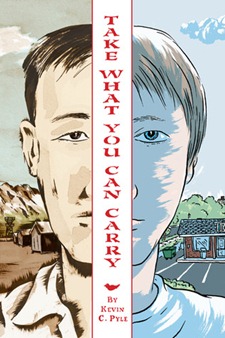
Pyle’s two stories are shown in different color palettes as you can see from the cover.  The sepia tones work well for the historical story, also emphasizing the wasteland of the internment camps.  The blues of the modern story give it a cool feeling that suits a story where a boy is not making the right choices and where his world is devoid of warmth. 

This intriguing graphic novel is a compelling read that will show young readers not only about history but also about themselves and their own choices.  Appropriate for ages 12-14.

Reviewed from copy received from Henry Holt.