Life in a Fishbowl by Len Vlahos

life-in-a-fishbowl-by-len-vlahos

Life in a Fishbowl by Len Vlahos (InfoSoup)

When Jared Stone discovers that he has terminal brain cancer, he decides to sell his life to the highest bidder on eBay. He gains the attention of a nun, a psychologically-disturbed man of leisure and wealth, a video-game playing teen, and a TV producer. When his posting is pulled down on eBay, only one person is left, the TV producer. So Jared and his family become the focus of a reality TV show and lose their privacy entirely. Jackie, Jared’s 15-year-old daughter, will not willingly participate in the show, figuring out how to avoid the crew and the cameras. But perhaps there is even more that she can do as she starts her own behind-the-scenes YouTube show that tells the truth about the editing and manipulation of her family by the reality show.

Vlahos tells a story of our time, about the dangers of believing in what we see on TV, of the siren call of money and the problems and advantages that come with using the internet for connections. Told from a variety of points of view, including Jared’s tumor, the book has a dark sense of humor throughout. Despite that humor, there is a sense of claustrophobia that pervades the novel as well, one that is built on the invasion of privacy from the TV cameras and then exacerbated by the manipulation and deviousness that surrounds the family.

Still, there is not despair here, even with a terminal illness as a central theme. It is instead a book about fighting back, being true to yourself and finding a way forward against the odds. A large part of that is Jackie, a girl who doesn’t fit in at school and appreciates her privacy. This is her nightmare scenario as the TV cameras roll and it forces her to reach out for help to people who are like her and can aid in fighting back. Through Jackie, we see how the Internet is more than darkness, it is also a source of hope and connection. It is both things at the same time.

A book of complex issues, the fakery of reality TV, and the dual sides of the Internet, this is a riveting read. Appropriate for ages 13-16.

Reviewed from ARC received from Bloomsbury.
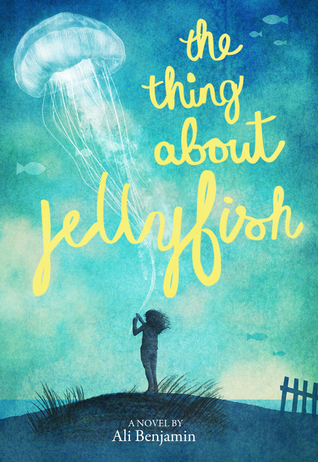


Review: The Thing about Jellyfish by Ali Benjamin

The Thing about Jellyfish by Ali Benjamin

The Thing about Jellyfish by Ali Benjamin (InfoSoup)

Suzy knows that things happen for a reason. She loves nature and all of the facts about it and the way that science makes sense. But when her best friend drowns, Suzy just can’t make sense of it. They had fought before Franny left on vacation and now there is no way for Suzy to fix that. Suzy retreats into silence, refusing to speak to her parents or to anyone at school. As Suzy searches for a reason, she discovers that Franny might have been stung by a jellyfish. It is up to Suzy to prove that that is what happened and to let everyone see that there was a cause for Franny’s death. Filled with natural wonder and tangible grief, this book is an elegant and powerful look at how one child copes with loss.

Benjamin writes about nature with such awe, sharing facts about animals as if they were precious jewels. The facts about jellyfish alone are profound and concerning, allowing readers to understand Suzy’s fascination with them. Yet though these facts are in the book, it is Suzy’s inability to cope with reality that shines. Her unwillingness to accept that death can be an accident without any reason at all will speak to all readers.

Suzy is a great character. Filled with a powerful and all-encompassing grief, she becomes silent and yet somehow does not withdraw from life. Instead her silence allows her time to be more creative, more thoughtful about the loss she has experienced even while she is in denial about what has happened. Benjamin also beautifully tackles the grieving process, mingling it with the difficulties of middle school. Filled with flashbacks about the changing friendship of Franny and Suzy, this book addresses the way that even best friends grow apart.

Beautiful and luminous, this book is a powerful look at grief, loss and the way that we process our lives. Appropriate for ages 9-12.

Reviewed from library copy.

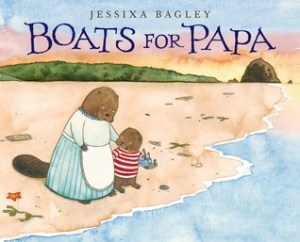
Review: Boats for Papa by Jessixa Bagley

Boats for Papa by Jessixa Bagley

Boats for Papa by Jessixa Bagley (InfoSoup)

Buckley and his mother live together in a little cabin near the ocean. Buckley loves to explore the beach near their house, collecting driftwood to build little boats. One day he sends a favorite boat out to his father, whom he thinks about often. He decides that if the boat never returns that it means his father received it. The boat doesn’t come back. From then on, on special days, he and his mother send a boat off to his father. Buckley’s boats get better and better. Then on his birthday, Buckley forgets to put the note on his boat that says that it’s for his father and how much he loves him. Buckley heads inside to find paper for the note and discovers that his mother has been collecting all of the boats Buckley has sent to his father. So when Buckley sends his birthday boat out onto the ocean, he’s made one big change.

Bagley’s book grapples with some huge issues like grief and loss but it does so in a way that allows children to approach the situation at their own level. It never forces emotions onto the reader, instead making those emotions much more intense by having characters who internalize much of their grief. The use of boats to send a message is beautiful and moving in itself. The fact that the mother is collecting them, yet allowing her son his own grieving process is also very special.

The artwork in the book is done with pen and watercolor. It offers so much detail, creating a setting that is rich and warm. It suits the story so well, giving the reader a chance to realize on their own that the mother is also sad and grieving in her own way even while supporting her young son and protecting him. The natural setting is awash in watercolors, giving it flow and a luminous quality that lets light shine from the sky and ocean too.

Grief and loss are made beautiful and tangible in this picture book that offers such grace and nurturing. Appropriate for ages 3-5.

Reviewed from copy received from Roaring Brook Press.

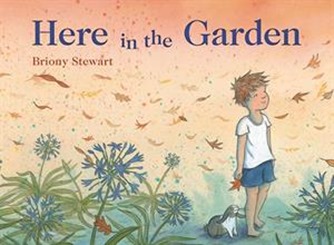
Review: Here in the Garden by Briony Stewart

here in the garden

Here in the Garden by Briony Stewart

Released March 1, 2015.

This import from Australia tells the seasonal story of a boy and his garden.  A boy spends time in his backyard, but is missing someone.  The wind blows, he plants seedlings in the garden, and dreams of his special someone joining his side.  When the rain comes, he watches from the back steps, still missing the one who would love to see the garden turn so green.  Summer comes with its sunshine and heat and the boy continues to feel his loss but begins to realize that he can still be in touch with the one he misses by being out in nature and enjoying the same things they used to do together.

Stewart beautifully allows the book to speak to anyone who has experienced loss.  In the end though, this book is clearly about the loss of a pet rabbit, the same one who is pictured at the boy’s side throughout the story.  That reveal is done tenderly and gently, clearly tying the boy to nature and to his memories of all the times they had together.  It’s beautifully and caringly presented.

Stewart’s art is washed in watercolors, colors that sweep and blow across the page, evoking the movement of air and the freshness of outdoors.  Though the book is filled with loneliness, the art remains resolutely lovely and cheery.  Even the one in the dark of night is filled with a light that illuminates.

A quiet story of grief, loss and the healing power of nature, this is a lovely little foreign title.  Appropriate for ages 4-6.

Reviewed from digital galley received from Kane Miller.

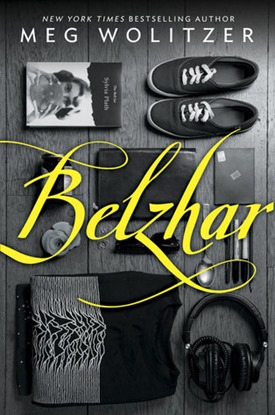
Review: Belzhar by Meg Wolitzer

belzhar

Belzhar by Meg Wolitzer

Jam has been taken by her family to The Wood Barn, a boarding school in Vermont for fragile teens.  After losing her British boyfriend, Reeve, Jam has been unable to function at all.  She just wants to be left alone with her grief and loss.  Jam spends her days sleeping and thinking about Reeve and how in only a few weeks their relationship grew into love only to have him die suddenly.  At her new school, Jam finds herself selected for a small and exclusive English class where they will read one author for the entire semester.  They are also given journals to record their feelings and ideas, old books that look ancient and valuable.  As Jam starts to write in hers for the first time, she is transported to a world where Reeve is still alive, where they can spend a brief time together, and where they can relive their experiences with one another.  All of the students in the class are having this experience and together they decide to only write in the journals twice a week to make them last, because no one knows what happens to this strange world of the journal when the pages run out.  By the end of their experiences in the place they call Belzhar, Jam must face the truths of her loss and her grief.

Wolitzer has earned acclaim as the author of adult literary novels and her short works of fiction.  Those skills really show here as she turns what could have been a novel about teenage love and loss into a beautiful and compelling work of magical realism.  When I started the novel, I had not expected the journals to be anything more than paper, so that inclusion of a fantasy element thoroughly changed the novel for me.  It made it richer, more of an allegory, and lifted it to another level. 

Jam, the protagonist, is a girl who does not open up readily.  The book is told in her voice and yet readers will not know her thoroughly until the end of the book.  It is because of Wolitzer’s skill as a writer that readers may not even realize until the twist comes that the book has even more to reveal.  Jam is also not particularly likeable, and I appreciate that.  Instead she is lonely, prickly, eager to please and complex.  That is what makes the novel work.

This is a particularly deep and unique novel for teens that reveals itself slowly and wondrously on the page.  Appropriate for ages 14-17.

Reviewed from copy received from Dutton.

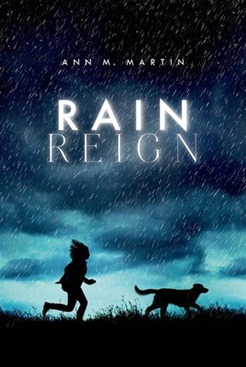
Review: Rain Reign by Ann M. Martin

rain reign

Rain Reign by Ann M. Martin

Rose loves homonyms.  She spends her days looking for new ones to add to her list, and then once she gets home adding them or rewriting the entire list if she runs out of space.  Her dog Rain has a name that has two homonyms: reign and rein, which is why she picked it.  Her father also gave her Rain on a rainy night.  He found Rain wandering around after he left the bar one night.  Rain is one of the best things in Rose’s life, since her father spends most evenings drinking at the bar and Rose spends them alone.  Luckily, she also has her uncle in her life.  He takes her to school, helps her find new homonyms, and protects her when necessary from her father when he loses patience with Rose.  Then a fierce storm hits their town and Rose’s father lets Rain out into the storm and she disappears.  Rose’s father refuses to explain why he let Rain out in a storm and also refuses to help Rose find her dog.  It is up to Rose to find Rain so she devises her own plan and calls on her uncle for help.  But when she finds Rain, she also discovers that Rain has other owners and Rose has to make a heartbreaking choice about right and wrong and love.

Martin captures a truly dysfunctional family on the page here.  Rose’s father is brutal, cruel and a constant threat in her life.  At the same time, the book glimmers with hope all of the time.  Rose herself is not one to dwell on the shortcomings of her life, preferring to immerse herself in her words, her dog and her time with her uncle.  Martin manages to balance both the forces of love and fear in this book, providing hope for children living with parents like this but also not offering a saccharine take on what is happening. 

Rose is an amazing character.  She talks about having Asperger’s syndrome and OCD.  She is the only child in her class with a full-time aide and it is clear from her behaviors in class that she needs help.  Yet again Martin balances this.  She shows how Rose attempts to reach out to her classmates and then how Rain helps make that possible and how Rose manages to use her own disability as a bridge to help others cope in times of loss.  It’s a beautiful and important piece of the story.

A dark book in many ways, this book shines with strong writing, a heroic young female protagonist and always hope.  Appropriate for ages 9-12.

Reviewed from copy received from Feiwel and Friends.

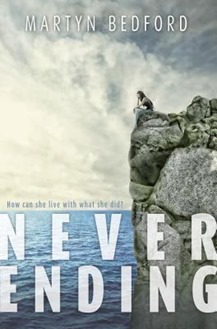
Review: Never Ending by Martyn Bedford

never ending

Never Ending by Martyn Bedford

Shiv is unable to live with her brother Declan’s death, particularly her own role in it.  So she is sent to the Korsakoff Clinic where she hopes to be cured and be able to continue her life.  Unable to see past her own guilt and loss, Shiv finds herself in an unusual clinic where she is first forced to focus on her brother and then forced to look directly at his death without turning away.  She is joined in the clinic by several other teens who all lost people in different ways but all feel as responsible and guilty as Shiv does.  As they are forced to see the truth of their loss, all of them react in different ways.  When hope is highest though, the ground falls out below Shiv and she must figure out that saving someone else may be the answer to saving herself.

Bedford has created a very compelling read.  He slowly reveals Shiv’s life before Declan’s death.  Along the way, readers get to know Shiv and Declan and their warm and loving parents.  They see directly what grief and loss do to people and the way their relationships are torn asunder.  They also see how hard it is to return to life after such a loss.  Bedford maintains a large level of complexity throughout the novel, moving into flashbacks and also showing Declan as a human rather than a lost angel.  The relationship between the siblings is good until a gorgeous young man enters their lives and creates waves for both of them.

As the flashbacks to Declan’s final days continue, the tension in the book mounts.  The pressure is also building in Shiv’s recovery as she starts to recover and then suffers setbacks.  There are no easy answers here.  Declan’s life as well as Shiv’s are complex.  The therapy she undergoes is unusual but it is up to Shiv to really do the work of recovery. 

Beautifully written and structured, this novel of recovery, pain and guilt weaves a mesmerizing web for the reader who is never quite sure how things are going to end.  Appropriate for ages 15-17.

Reviewed from copy received from Random House Children’s Books.

Review: And We Stay by Jenny Hubbard

and we stay

And We Stay by Jenny Hubbard

Emily has been sent to a private board school in Amherst so that she doesn’t have to face all of the questions at her public high school.  Her boyfriend, Paul, brought a gun to school.  Emily is sure that Paul never meant to hurt her, though he did threaten her with the gun.  She is also sure that he never planned to kill himself with it, though that is what he did.  At her private school, she doesn’t quite fit in.  She doesn’t wear the right shoes and her reluctance to talk about what happened and why she is there mid-term doesn’t lead others to get closer to her.  Emily finds herself more and more interested in Emily Dickinson whose home is in Amherst.  She starts writing poems herself, putting her grief and confusion on the page in poems that she plans to never share with anyone.  But as the days go by, she becomes closer with her room mate and other girls on campus, including one of the teachers.  It is now up to Emily to figure out how much she is willing to share of her own role in Paul’s death.

Hubbard’s writing is crystalline and brilliant.  She captures the stunned nature of sudden loss with clarity and understanding.  Emily could easily have become and inaccessible character to readers as well since she is prickly and shut down.  Instead though, Hubbard creates a space around Emily for readers to understand her and feel her pain.

A large part of this is through her poems which honor Dickinson, follow her structure and voice closely at times, and other times reveal Emily’s soul in brief lines that shine.  These poems serve as islands in a sea of pain and grief.  They are concrete and dazzlingly good.  They are bright with hope as one can see in each one Emily moving forward toward the future after putting her pain on the page. 

Beautiful writing, a strong heroine, and plenty of poetry make this a very unique and exceptional book about loss and suicide.  Appropriate for ages 14-16.

Reviewed from digital galley received from Edelweiss and NetGalley.

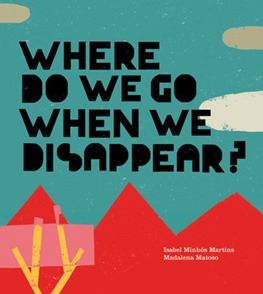
Review: Where Do We Go When We Disappear? by Isabel Minhos Martins

where do we go when we disappear

Where Do We Go When We Disappear? by Isabel Minhos Martins and Madalena Matoso

I recently reviewed My Neighbor Is a Dog, another new book by this author and illustrator duo.  In this book, the question of where people and things go when they disappear is explored thoroughly.  The result is a book that asks big questions and attempts to answer them or at least provide a framework to answer them.  The book begins with people disappearing and the idea that you must be missed in order to disappear, so disappearing takes two.  Then it moves on to other things that disappear like sunshine and clouds, socks and puddles, snow and noise.  It ends with the fact that everything disappears, even the most solid things like rocks over time will disappear. 

Translated from the Portuguese original, this book is thought provoking and fascinating.  Martins manages to right a book about big questions that answers them in a way that is exploratory and insightful and doesn’t turn quickly to a religious answer.  Instead she stays in the questioning place, allowing different ideas to surface and be discussed.  She does not provide any easy answers, meeting children right where they want the discussion to stay, where it leads to more and more questions.

Matoso’s illustrations are vibrantly colored and filled with strong shapes.  They appear to be block printed which adds to the organic feel.  She uses negative space brilliantly.  One example is her snow image with the background white and the flakes cut out circles that merge directly into the white and stand out against the other bright objects.

Challenging, thought-provoking and a book that will inspire discussion and help children find their own answers.  Appropriate for ages 5-7.

Reviewed from library copy.