Review: Mrs. Noodlekugel by Daniel Pinkwater

mrs noodlekugel

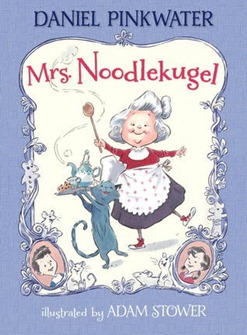
Mrs. Noodlekugel by Daniel Pinkwater, illustrated by Adam Stower

Siblings Nick and Maxine have just moved into an apartment building where they live on an upper floor.  Soon after they moved in, they discovered a tiny house behind their apartment building, but they could not figure out how to get there.  They decided to ask the janitor of the building who told them they had to go through the boiler room.  But their parents told them not to bother the woman who lived in the house and not to visit.  Of course, the two children just had to meet her.  So they traveled through the dark, pipe-filled boiler room and off to the sweet little house where they met Mrs. Noodlekugel and her talking cat, Mr. Fuzzface.  She fed them apple cookies (baked by Mr. Fuzzface) and tea.  She insisted that the four mice be invited to the tea, because you can’t have tea without mice.  And that was just the first time that the children came to visit!

Pinkwater has created a jolly book for beginning readers here.  It has the wonderful charm of an old-fashioned story filled with baked goods, talking animals and more than a touch of magic.  At the same time, it takes place in an urban setting of apartment buildings and the city.  Pinkwater’s writing is as solid as ever, creating a strong foundation for the story. 

Stower’s art adds to that feeling of the juxtaposition of vintage and new.  There are full-page illustrations and then others that offer just small images on the page.  The illustrations have a wonderful sweetness to them, especially as the magic starts.

A cheery book for new readers, this is a confection of a book for children starting to read chapter books on their own.  Appropriate for ages 5-7.

Reviewed from library copy.

Review: Extra Yarn by Mac Barnett

extra-yarn-cover

Extra Yarn by Mac Barnett, illustrated by Jon Klassen

In the bleakness of winter when the town was all white from snow and black from chimney soot, Annabelle found a box that contained yarn of every color.  She knit herself a sweater and still had more yarn, so she knit a sweater for her dog too.  There was still yarn, so she started knitting sweaters for everyone or hats for those who didn’t want sweaters.  Still there was more yarn, so she knit sweaters for all of the animals around.  She still had not run out of yarn, so she started knitting for objects that don’t wear sweaters, covering houses and mail boxes with yarn.  That’s when Annabelle attracted the attention of a vain archduke who wanted the unending box of yarn for himself.  When she refused to sell it to him at any price, he stole it from her.  But we all know the rules about magic things, and soon the box was back in Annabelle’s hands.

This book is filled with magic and not just in the form of the unending yarn.  Barnett’s storyline is a combination of gentle storytelling and subtle humor.  It manages to be both fresh and also pay homage to traditional tales. 

Klassen’s art has the starkness of his previous book, I Want My Hat Back, but the brightness of the yarn adds an entirely new dimension.  It glows in all of its color and texture against the rest of the illustrations, bringing not only color but also a robust life into the images.  His use of digitally scanned textures to create the knit effect is ingenious. 

A delight of a picture book that references the traditional while creating something completely new and magical.  Appropriate for ages 3-5.

Reviewed from library copy.

Review: Anton Can Do Magic by Ole Konnecke

anton can do magic

Anton Can Do Magic by Ole Konnecke

Anton has a real magic hat that he wears to do real magic.  He tries to make a tree disappear, but it doesn’t work.  So he decides that a tree is too big for the magic to work on it.  He tries to make the bird in the tree disappear.  His hat falls forward over his eyes, and when he lifts it again the bird is gone!  He believes he has made it disappear, but the reader knows that it flew away instead.  Anton tells Luke that he can make things disappear, but Luke does not believe him.  So Anton does magic to make Luke disappear.  The hat falls forward, Luke walks away, and Anton thinks he has done magic again.  But this time he regrets making Luke disappear.  He tries and tries to bring him back, but instead the bird reappears.  In the end though, Anton just might prove he is magical after all.

Originally from Germany, this picture book does have a feel of a European tale.  There is a great simplicity to the story and the illustrations.  Being in on the joke of what is really happening when Anton thinks he is doing magic, makes this book very enjoyable.   The story is told in a straight-forward way, the words never revealing the truth that the illustrations are showing.  The illustrations too are simple and they are responsible for conveying the reality of the magic.  Done in a limited palette of yellows and oranges, the illustrations have a 60s vibe to them.

A funny, playful picture book that will get audiences giggling and is a great pick for a magical story time.  Appropriate for ages 4-6.

Reviewed from copy received from Gecko Press.

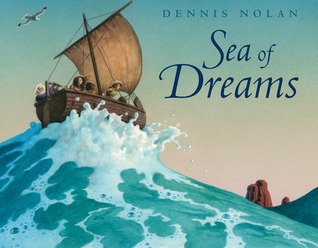
Review: Sea of Dreams by Dennis Nolan

sea of dreams

Sea of Dreams by Dennis Nolan

This wordless book begins with a normal scene of a girl building a sand castle on a beach.  When the sun sets, she reluctantly leaves the castle with its turrets behind.  As the tide comes in and the waves batter the ramparts, a light turns on in one of the sandcastle windows.  Then faces appear as the waves surge again.  A boat heads out to sea, rescuing the stranded people.  It heads into the waves and one of the small people is lost in the sea, tempting large fish to eat him.  Happily, the boy is discovered underwater by some mermaids who rescue him and return him to the boat.  They make it safely to a beach where there’s a cave.  The scene changes to the girl returning to the beach to build a second castle.   Once again, she leaves it behind on the beach at sunset, the waves roll in, and a light turns on.

Nolan has created a captivating story line here that blends real life and magic together seamlessly.  When one starts the book, there is no sense that it will suddenly change into something utterly different.  Part of this is the success of the realistic paintings that illustrate the book.  It seems grounded in reality until that amazing light turns on. 

A wondrous book that entrances and delights, this is a great read to share on a trip to the beach or in any quiet time where there is room to dream.  Appropriate for ages 3-5.

Reviewed from library copy.

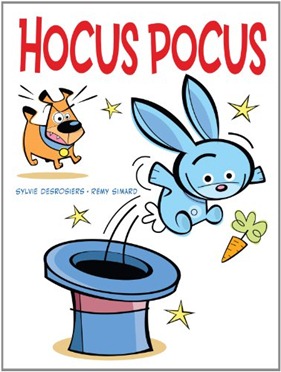
Review: Hocus Pocus by Sylvie Desrosiers

hocus pocus

Hocus Pocus by Sylvie Desrosiers and Remy Simard

This wordless picture book has the feel of a graphic novel, but one designed for very small children.  It tells the story of Mister Magic who heads home with his pet dog, feeds the dog, and then settles in listening to music with his headset.  Once he has fallen asleep, the rabbit jumps out of his hat.  On the counter is a grocery bag and he spots some carrots up there.  But he has to sneak past the sleeping dog to get there.  He has the great idea of wearing slippers to be quieter, but then he crunches on a peanut.  The dog wakes up and discovers the rabbit’s activity, but the rabbit is able to soothe him back to sleep with some violin music.  But that is only the first round, as the dog and rabbit try to outwit each other.

This is a very funny picture book that emerging readers will enjoy.  It’s not a wordless book for toddlers who would miss the humor of the story, but rather one for slightly older children who will read this book like watching a silent cartoon.  The humor is pure slapstick fun, channeling the Daffy Duck and Bugs Bunny feel with plenty of physical gags. 

The art here is crisp and clean with a modern vibe.  The colors are vibrant, bright and very appealing.  Children who pay close attention to the illustrations will see some of the jokes coming, making it all the more fun to read.

A modern picture book that is full of classic humor, this book has great appeal.  Appropriate for ages 4-6.

Reviewed from copy received from Kids Can Press.

Also reviewed by 100 Scope Notes and Sal’s Fiction Addiction.

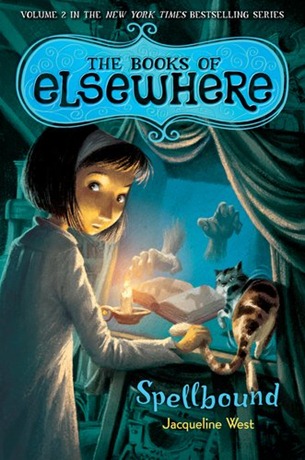
Book Review: Spellbound by Jacqueline West

spellbound

Spellbound by Jacqueline West

Released July 11, 2011.

This second book in The Books of Elsewhere series is just as magical as the first.  Olive is still searching for a way to save Morton, the boy trapped inside a painting.  Now that the spectacles are broken, Olive must rely on the permission of one of the three cats to enter the paintings.  But nothing she tries is working.  So when her new neighbor, Rutherford, mentions that there may be a spellbook left by the McMartins, Olive immediately begins searching.  When she finds it though, she may not be ready for what it brings with it.  Plenty of adventure, magic and surprises await the reader.

West writes with an ease, a comfort that makes the book read quickly.  At the same time, she does use imagery very well, especially when describing characters.  Olive continues to be a great protagonist.  She is far from perfect, allowing her pride to get her into further scrapes in this book.  I am a fan of a flawed protagonist and Olive manages to be human and relatable throughout the novel.

As Olive spends more time outside the house, the neighborhood begins to come to life in this book much more completely than in the previous novel.  Olive’s parents are also more involved in this second book, though they do continue to leave Olive alone often, much to the delight of the storyline.

This is a charmer of a series filled with witches, magic, cats, and danger.  Fans of the first novel in the series will be clamoring for this second one.  A perfect summer read for ages 9-12.

Reviewed from ARC received from Dial Books.

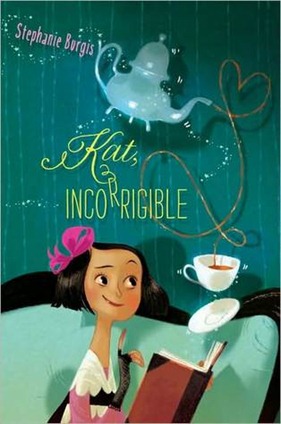
Book Review: Kat Incorrigible by Stephanie Burgis

katincorrigible

Kat Incorrigible by Stephanie Burgis

Mix a Regency setting with plenty of magic and one smart, sassy heroine and you have this winning novel for children.  Kat never knew her mother, since she died when Kat was born.  She does have a stepmother who is far more interested in the wealth her stepdaughters will bring with strategic marriages than with their future happiness.  Kat is the youngest of the three sisters and she discovers early in the novel that she has inherited her mother’s magical talents.  One of her older sisters, Angeline, has also gotten magical talents of a different sort.  As the eldest sister, Elissa, is about to be betrothed to a grim fiancé, the younger two get deeper into trouble as they explore their magical gifts.  All too soon, Kat will be called upon to use her magic to save those she loves, while trying to act graceful and polite in society.

I’m a huge fan of mixing historical settings with fantasy, and this novel does it very well.  Readers never lose the fact that they are reading a Regency novel, thanks to the elements of society that are woven successfully throughout the novel.  At the same time, the fantasy elements are tantalizingly and beautifully done as well.

The characterization is superb, especially Kat, who is a Regency girl that modern children will relate to happily.  She is intelligent, irreverent and irresistible.  From the first glimpse readers get of Kat with her short-cut hair and her desire to save her family, Kat is an intriguing character.  Happily, Burgis has incorporated plenty of humor into the novel as well.  There are scenes that are filled with genteel sarcasm and bites but sometimes the story merrily heads closer to farce with delightful results.

Highly recommended, this is a book that children will adore with just the right mix of humor, fantasy and style.  Sounds like ideal summer reading to me!  Appropriate for ages 9-12.

Check out the book trailer:

Reviewed from copy received from Atheneum Books.

Also reviewed by:

Lucy and the Green Man: Gentle Green Magic

61T3 uW2KPL._SL500_AA300_lob_big


Lucy and the Green Man by Linda Newbery (first published as Lob in the UK)

Lucy loves spending time with her grandfather in his garden where he tells her stories of a mysterious helper who lives in his garden named Lob.  Lob is a Green Man who is rarely seen but his presence is felt in the energy in the air, the thriving garden, and the little jobs that are mysteriously finished.  Her grandfather tells her that only special people can see Lob, and Lucy works hard to try to see him.  Eventually she catches moving leaves, then bright green eyes, but little more because Lob is so shy.  Lob has been working in that garden for years, but when a sad event happens to her grandfather and to the garden and his home, Lob must find a new place to live.  Lucy, mourning her grandfather, hopes that Lob will come to her home in London and live in the park nearby.  After months of waiting, she wonders if Lob was really real after all.  Meanwhile, Lob has been struggling to find a place to live and work where he is understood.

Newbery has written a novel for young people that has a lovely old-fashioned feel to it.  After the changes at the garden and cottage, the story has alternating chapters of Lob and Lucy.  Readers will never question that in this book, Lob is most definitely real.  The adventures that Lob has in getting to a garden where he can work and be appreciated really carry the book forward.  Additionally, the wonder of gardens and growing things is a special element here that weaves throughout the book.  It is a joy to read a modern book for children that has its roots so firmly in the soil.

In the Lob chapters, Newbery has created verse that speaks in Lob’s voice directly.  They are wonderful poems, with an ancient quality and a firm tie to nature.  Set aside in a larger font, they are moments of stillness in the book that one looks forward to as a reader.  Newbery’s prose is equally evocative.  Take for example this passage when Lucy heads out into the dark evening on Page 41:

The gap between indoors and out, tameness and wildness, lightness and dark, stretched wide and wider in the flittery dusk.  Lucy didn’t want to go in, not yet.  Stars were pricking the sky, tree branches stretching out to muffle them.

In this book, one visits the wonder of nature again and again.  A beautiful book to share in the spring of the year with a class that will stretch imaginations and will have everyone looking for friendly green eyes in the bushes.  Appropriate for ages 8-11.

Reviewed from copy received from Random House.

Chavela and the Magic Bubble

9780547241975_lres

Chavela and the Magic Bubble by Monica Brown, illustrated by Magaly Morales

Chavela loves chewing gum and blowing bubbles.  One day she finds a kind of gum in the store that she has never seen before: Magic Chicle.  Her mother explains that gum is made from the sap of the sapodilla tree, called chicle.  Her mother’s father was a Chiclero who harvest the chicle and care for the trees.  When Chavela popped the gum in her mouth, she was able to blow a huge bubble that carried her out of her room and from California into Mexico to Playa del Carmen.  There she got to see the sapodilla trees and met a little girl with a special doll who greeted her warmly.  The two girls played until dark when Chavela had to chew chicle to return home again.  Once she got home, her mother told her that she too knew of the magic, and showed her daughter the special doll she had had when she was a girl.

Brown’s prose reads aloud nicely and the story has plenty of action and interest to carry it along.  Children will love seeing where gum came from and will also enjoy the magic of the gum.  The real star of the book is the illustrations, done in candy-bright colors that also have a great depth to them.  The author’s note at the back offers more in-depth information on chicle and gum. 

A treat of a book that is nicely seasoned with Spanish, this book will appeal to candy-lovers of any language or background.  Appropriate for ages 4-6.

Reviewed from library copy.

Also reviewed by TheHappyNappyBookseller.