Thirty Talks Weird Love by Alessandra Narvaez Varela

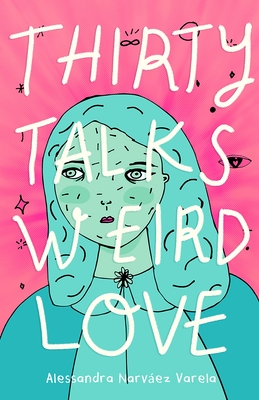
Cover image for Thirty Talks Weird Love.

Thirty Talks Weird Love by Alessandra Narvaez Varela (9781947627482)

In 1990s Ciudad Juarez, Mexico, girls were being kidnapped from the streets, so Anamaria’s parents were very careful about where she was in the city and what she was doing. She spends most of her time studying and trying to get top rank in her class at a private middle school, since she plans to be a doctor. Then one day, a limping woman who claims to be Anamaria from the future arrives to change the past. She is by turns frightening, cheesy and just plain strange. The woman also says that she is a poet, not a doctor, something that Anamaria can’t even comprehend. She also insists that Anamaria needs help and needs to change the way she is living and get help.

The wild title and cover lead readers to an exploration of depression and overwork in young people in schools. Written in verse, the book also shows the power of being willing to take a chance and find a way to express yourself in poetry and words. Varela chillingly captures the smallness of Varela’s world, a toxic trudge of schoolwork and messed up friendships and working for her parents. Even as everyone works to protect her from the dangers of the streets, they are unaware that the real danger may be invisible and inside Anamaria herself.

The writing here is marvelous. Varela shows how halting first attempts at poetry grow into true self expression and a way to release internal pressures. Anamaria shows herself to be deep and thoughtful, far more interesting than the girl striving to beat everyone at school. The author uses clever poetic formats to transform larger poems into something altogether different and drawings combined with words to create apologies and new connections.

A deep delve into depression and the power of poetry. Appropriate for ages 10-13.

Reviewed from e-galley provided by Cinco Puntos Press.

Cece Rios and the Desert of Souls by Kaela Rivera

Cover image for Cece Rios and the Desert of Souls.

Cece Rios and the Desert of Souls by Kaela Rivera (9780062947550)

Cece lives in Tierra del Sol, a town at the edge of the desert where criatura, powerful legendary beings, roam. Devoted to the Sun, the town stands against the influx of these beings. Cece though is unique in her town. She has a water spirit, given to her when she was young, that is considered a curse by the rest of the residents, including her own family. When her older sister is stolen away by a criatura to become his bride, Cece blames herself for bringing her sister into the desert. Now Cece must figure out how to rescue her sister. She decides that the only way is to become a bruja herself and control the soul of a criatura. The first criatura she meets is the legendary Coyote, who agrees to join her in her quest. As Cece joins the brutal contests of the bruja, she must find her own way, a way that may just change the relationships between criatura, bruja and humans.

Rivera’s novel is entirely immersive and engaging. She invites readers into the world of Mexican folklore, highlighting several legendary figures both kind and cruel. Still, the world she creates is also entirely her own with the small community of humans standing in the way of the powerful criatura and the disdain that those people have for Cece and what she becomes. The world of criatura, bruja and humans is a delicate balance where power if vied for and battles are commonplace. Just knowing who to trust is difficult and may lead to ruin.

The characters placed in this world are beautifully written. From Cece herself, who is courageous, caring and unwilling to lose herself in order to gain power. To Coyote, who is funny, wild and true. The soft spot that Coyote has for humans is one that will be shared by readers towards him. His character is complex and so much a heart of this book.

A great middle-grade fantasy full of magic, legend and individuality. Appropriate for ages 9-12.

Reviewed from library copy.

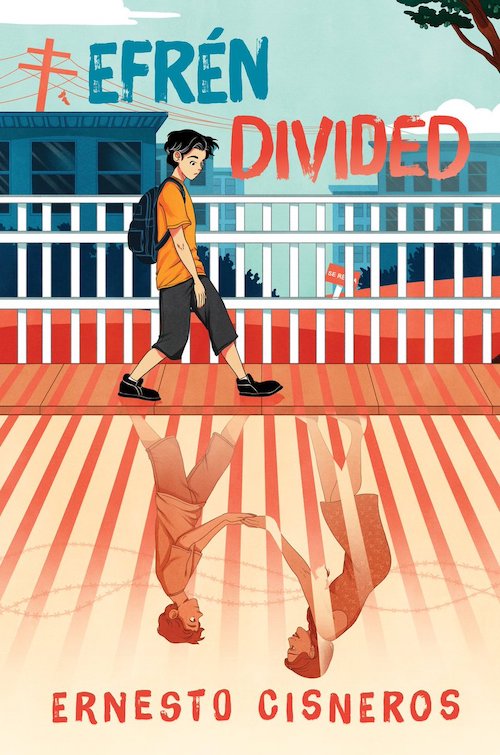
Efren Divided by Ernesto Cisneros

Efren Divided by Ernesto Cisneros

Efren Divided by Ernesto Cisneros (9780062881687)

Efren’s family works hard all day to provide for him and his younger twin siblings, Mia and Max. Efren’s mother, Ama, really holds the family together, creating delicious meals from leftovers every day. He thinks of her as “Soperwoman” because of the delicious sopes she makes. When Ama is seized by ICE and deported, it falls to Efren to watch his younger siblings, getting them ready in the morning, to bed at night, and trying to distract them from missing Ama. Efren’s father is working two jobs and not sleeping at all, just to send money to his mother in order to get her back into the U.S. As Efren’s school work and friendships start to suffer from the pressure he is under and his worry for his entire family, he looks for ways to make sure that his little brother and sister still feel loved, the way his mother would want them to.

Cisneros has created an ownvoices novel for middle graders that grapples with the state of immigration in the United States. The book is timely, speaking directly to situations that children across our country face every day if their parents are undocumented. The level of fear and dread that ICE has for these families, the danger of being deported, and the risks of returning to their families is all captured here, 

Efren is a marvelous protagonist. He is smart and has a huge heart as well as an astounding amount of patience towards his little brother and sister. Living in real poverty, his only wish is for his family to be whole, not for a phone, a bigger TV or anything but having his mother back. 

A gripping and rich look at the impact of current immigration policies on children of undocumented families. Appropriate for ages 9-12.

Reviewed from e-galley provided by HarperCollins.


Review: Photographic by Isabel Quintero

Photographic by Isabel Quintero

Photographic: The Life of Graciela Iturbide by Isabel Quintero and Zeke Pena (9781947440005)

This breathtaking graphic novel tells the story of the renowned photographer, Graciela Iturbide. Graciela is a Mexican photographer who was worked at her craft for over fifty years. Raised in a large family, she discovered theater and film when she went away to school. Her photography didn’t begin until the tragedy of her daughter dying. She took a photography class and found her mentor, Manuel Alvarez Bravo. Traveling with him, she soon started to take her own photographs. She photographed the desert, cacti, people and her recurring theme of birds. This graphic novel follows her steps of finding her voice through photography and becoming an icon.

This graphic novel caught my attention when I turned past the first few pages and realized that they had incorporated Iturbide’s photographs into the book. Throughout, there are images drawn directly from her photographs and then the photograph itself is revealed. It’s a stunning way to show the skill and art that went into the photo and then display it with its incredible lighting, softer edges and composition.

The story here is beautifully told as well. Graciela is an example of someone who has an incredible gift and eye for images. She dislikes her photographs being called “magical” and throughout the graphic novel things that could be seen as “signs” of the future are rejected as anything other than simple events. It’s this forthright confidence that infuses the entire work with her personality.

One of the best biographical graphic novels I have read, this one is a stunning look at an impressive woman. Appropriate for ages 13-18.

Reviewed from copy provided by Getty Publications.

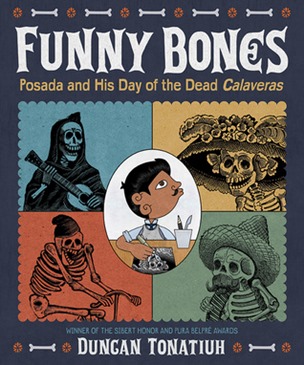
Review: Funny Bones by Duncan Tonatiuh

Funny Bones by Duncan Tonatiuh

Funny Bones: Posada and His Day of the Dead Calaveras by Duncan Tonatiuh (InfoSoup)

Award-winning author and illustrator, Tonatiuh brilliantly tells the story of Jose Guadalupe Posada. Called Lupe by his family, he showed artistic promise early in life. At age 18, he went to work in a print shop where he learned lithography and engraving. Lupe starting doing drawings for the small local paper, including political cartoons. Lupe eventually opened his own print shop and starting to create illustrations for books and pamphlets. After his shop was ruined in a flood, he moved with his family to Mexico City where he opened a new shop. Lupe began creating broadsides and that is where he started creating his calaveras or skeletons. Some have specific meanings while others are unknown, many of them make political commentary on Mexican society. Lupe was soon recognized for these prints more than any of the rest of his work. Posada continues to be known for these images thanks to other Mexican artists like Diego Rivera who investigated who had drawn the etchings.

Tonatiuh does a great job of telling the story of the full life of Posada while focusing on making it accessible to children and also making it a compelling tale. Readers will recognize some of the images in the book, creating a firm connection between the artist and the images. The story of Posada’s life is a mix of tragedy and accomplishment, rather like the images he created. The Author’s Note at the end of the book adds details to the story of Posada and his art.

Tonatiuh’s art is as unique and marvelous as ever. He uses his stylized characters, usually shown in profile. They have a wonderful folk-art feel to them and work very nicely with Posada’s own skeletons. His illustrations are a rich mix of collage and line drawings, mixing textures and colors very effectively.

A great book to share for Dia de Muertos or Day of the Dead, this will be a welcome addition to all public library collections, but particularly those serving Hispanic populations. Appropriate for ages 5-8.

Reviewed from library copy.

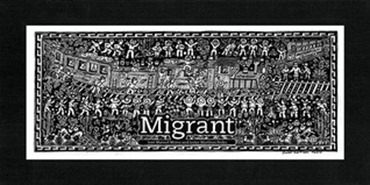
Review: Migrant by Jose Manuel Mateo

migrant

Migrant: The Journey of a Mexican Worker by Jose Manuel Mateo, illustrated by Javier Martinez Pedro

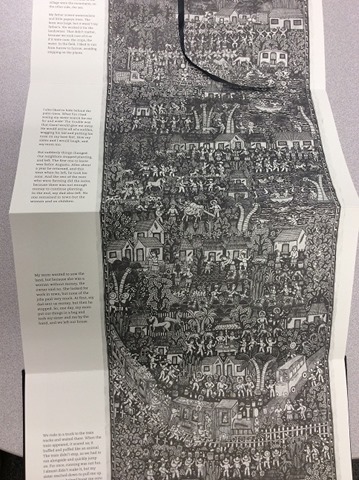
In this bilingual book, a boy from Mexico talks about the changes in his family and his village as people leave Mexico to find work in the United States.  The story begins with the boy speaking about his village and how it used to be as a farming community with small farms where he would play.  But then things changed and soon the village was just women and children with all of the men gone to find work elsewhere.  When his mother was unable to find work in the village and his father’s money stopped arriving, the had no choice but to leave too.  The story changes to one of escape, hiding and running, one that mirrors that boy’s games as a small child, but they are no longer fun here.  The family makes it safely to Los Angeles, but there are new barriers in the way with the new country.

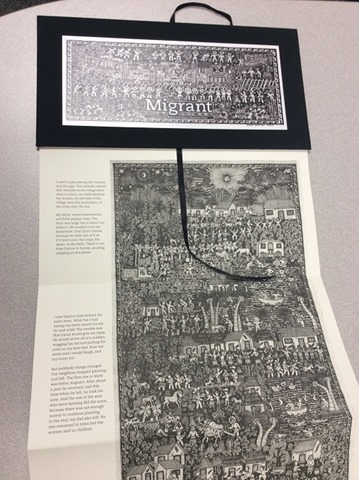
migrant inside

Told in a unique vertical format that echoes the ancient codex, this book uses its format to great effect.  First, it mirrors the sense of a journey across distances, across cultures.  Just opening this book feel different and special and then the length of the single page captures that sense of travel and quest.  The voice of the book is also exquisitely done.  The boy looking back on his childhood, seeing the changes and then the contrast of his childhood with the frightening present is filled with a taut tension that never goes away.

migrant pages

Even as I gush about the writing, I can’t say enough about the art.  Done in a single pane that continues through the entire vertical book, it shows the village, the train that allows their escape, and finally LA.  The art has an ancient feel to it, filled with tiny details, many people, plants, houses, and more.  It’s a tribute to the history of Mexico, the thousands of people who cross the border, and the beauty of their courage.

Unique and incredibly lovely, this book is one that won’t work in public libraries due to the format.  But it’s one that is worth celebrating despite that limitation.  Get this in special collections!  Appropriate for ages 7-10.

Reviewed from copy received from Abrams Books.

Dear Primo

Dear Primo: A Letter to My Cousin by Duncan Tonatiuh

One cousin in America and one cousin in Mexico write letters back and forth describing their lives.  Carlitos lives on a farm in Mexico with all sorts of animals.  Charlie lives in a city filled with skyscrapers and lights.  The lives of the two boys are contrasted with one another from food and games to shopping and celebrations.  Underlying the differences though are the similarities between the boys with their energy and strong communities.  Tonatiuh’s art strengthens this tie between the boys, making this book a cohesive whole.

Students learning Spanish will find the words peppering Carlitos’ part of the story interesting and useful.  They serve to add more than flavor to the text, strengthening the text and tying it more closely to Mexico.  Tonatiuh’s text is simple and interesting, allowing for a glimpse of two different lives.  It is his art that will really get this book off the shelves.  He combines a primitive feel in the characters faces and bodies with a modern collage technique that uses digital components.  The juxtaposition of the two makes for dynamic art that show both boys living with tradition and modern components to their lives.

A successful book about cousins who have plenty of differences but also lots in common, this book will be useful for young students learning Spanish.  Appropriate for ages 4-6.

Reviewed from library copy.