Review: The Town Mouse and the Country Mouse by Helen Ward

town mouse and country mouse

The Town Mouse and the Country Mouse by Helen Ward

Never has there been such a beautiful example of this Aesop Fable.  This is the classic tale of the county mouse who is happy in the simplicity of the country until his cousin from the city comes to visit with his claims of the wonders there.  The country mouse goes to visit, discovering things like elevators, electric lights, and enormous banquets.  But when they are both chased by a city pet, in this case a little dog, the country mouse realizes that while the city is fast-moving and filled with bright lights, he misses his quiet life in the country.  Merrily, the book ends with an image of the city mouse asleep in a wheel of expensive cheese.

It is the illustrations here that make this such a noteworthy book.  Ward takes special care in depicting the beauty of the countryside and the country life.  She moves between seasons, the apple tree decked in pink blossoms and then hearty with ripe apples.  The two mice are shown without any little clothes or any anthropomorphic touches.  Instead these are two sleek and life-like creatures. 

The illustrations are sumptuous, rich and superb.  They invite you to explore the county and the city and see beauty in both.  They bring you into the cozy winter nest of the country mouse.  They linger on the many blossoms of the country landscape.  They focus you close in from a mouse point of view. 

Highly recommended, this book belongs in library collections for both its beauty and the simple way it is written.  Appropriate for ages 3-5.

Reviewed from library copy.
Review: More by I. C. Springman

more

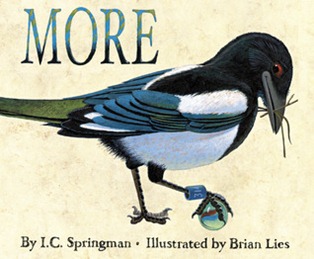
More by I. C. Springman, illustrated by Brian Lies

The book opens with a dejected magpie who has nothing at all.  Then a mouse gives him a marble that he takes to his nest.  Soon the marble is joined by a few other toys.  Then more and more, until there are so many things that the magpie has filled all sorts of nests in the tree with them.  Finally, the magpie adds one little penny to a nest and the branch cracks.  He has much too much now!  Everything tumbles to the ground, burying the poor magpie in his treasures.  The mice appear to dig him free and the pile becomes less and less as they work.  In the end, the magpie selects a few items to keep and lets the rest go, leaving with just enough.

This book is written in very spare language with only a few words per page.  They are all concept words, moving from nothing to everything to enough.  In between, there are terms like more, much, and less.  The dynamic illustrations really carry the story.  The magpie’s facial expressions range from greed to shock to satisfaction, all playing out nicely just in the shine of an eye and the curve of a bill.  Space is also played with in the images, speaking to the freedom of having just enough and the clutter of having too much.

This picture book deals directly with the idea of downsizing or having just enough toys and not too many, something that many children struggle with.  It is also a creative concept book that will work to teach those concepts through humor.  Appropriate for ages 2-4.

Reviewed from library copy.

Review: Penny and Her Song by Kevin Henkes

penny and her song

Penny and Her Song by Kevin Henkes

Joining the beloved Chrysanthemum, Lilly, Owen and Wemberly is a new mouse character from the incredible Kevin Henkes.  This mouse is named Penny and she has a song to sing.  Unfortunately when she gets home, the babies are sleeping and she’s not allowed to share her song with her mother or father.  Later, she tries to share the song during dinner, but her parents ask her to wait until they are done eating to sing.  Finally, after dinner, Penny shares her song.  Her parents sing it too, they dress up in costumes, and the babies have a surprise reaction too!

Done in short chapters, this is more a beginning reader than a picture book.  Penny is a delight of a character, who when told she has to wait does not complain but tries to find new solutions that will let her sing without breaking the rules.  The final scenes with her parents happily joining in singing demonstrates the love that comes with rules and structure without any harshness being needed.  The illustrations are done in Henkes’ signature style, which is sure to delight all. 

A happy welcome to Penny as she joins this beloved mouse family.  Appropriate for ages 4-6.

Reviewed from library copy.

Review: Secrets at Sea by Richard Peck

secrets at sea

Secrets at Sea by Richard Peck

A wonderful mix of Upstairs Downstairs and The Borrowers, this is the first animal story from the incredible Peck.  Helena is the eldest of the Cranston family of mice.  Her parents are both dead as are her older sisters.  It is 1887 and the human Cranston family is planning a trip to England to get their eldest daughter wed.  So the mouse family also has to decide.  Do they travel across the dangerous and deadly water with the family or stay behind in an empty house.  Helena hopes that the trip will help with some of the problems she has been fretting about.  Her younger brother is always getting into scrapes and needs some direction.  One of her younger sisters is far too attached to one of the human daughters.  So the family embarks on a trip where they discover the large impact a family of mice can have on their humans.

Peck writes with a sly humor here that takes on the establishment and the constraints of society in the late 1800s.  The same sort of tiers that make up the human society are found reflected with the mouse society as well.  It makes for a delight of a novel that has depth and a lot of heart.  Peck’s young heroine, Helena, is a mouse burdened with many cares but who also starts to see herself differently as her travels continue.  She is an engaging and richly drawn character.

Peck has also vividly created the setting of a Victorian ship at sea.  From the lavish parties to the lifeboat drills, the mice are involved throughout.  This is a world of privilege that is gloriously redrawn mouse sized complete with royalty and romance.

Highly recommended, this is a dazzling book that will find a place among other great animal stories.  Peck has amazed me once again.  Appropriate for ages 8-11.

Reviewed from ARC received from Penguin Young Readers Group.

Also reviewed by:

Review: Mouse & Lion by Rand Burkert

mouse and lion

Mouse & Lion by Rand Burkert, illustrated by Nancy Ekholm Burkert

This classic Aesop fable is told with exceptional ease.  The story focuses more on Mouse than other versions, even giving him top billing in the title.  Mouse scampers right over Lion before he even realizes he is not a mountain.  And as the tale goes, Lion grants Mouse a reprieve from being eaten and sends him on his way.  In this story, Lion is captured in a hunter’s net and Mouse gnaws him free.  Set in Africa, this story features a four-striped African grass mouse rather than the expected little brown mouse.  Combined with the baobab trees, it all works to evoke Africa completely. 

Burkert’s text is beautifully done.  At first blush, his writing reads aloud so well that it seems simple.  But instead it is just written by a storyteller, who realizes exactly how words play and how to create a mood.  When Lion has captured Mouse, there is a gorgeous moment when Burkert leaves Mouse literally dangling:

Mouse spun slowly as he dangled.  He dangled as he spun.  He squinted into Lion’s mouth, feeling his warm breath, noting his yellowed teeth.

This is just one of many such times when the writing sings, the moment stretches, and the story is illuminated. 

Add to this skilled writing, the illustrations and you have quite the book.  The illustrations are strong at the same time they are delicate.  Done with fine lines, each hair on the animals is individual.  Mouse’s nose and whiskers seem to twitch.  Lion seems to snore.  There is life here in these illustrations, life that moves and breathes.  The illustrations are captivating.

Who would think that after last year’s Caldecott Award winner, libraries would want another version of Aesop’s fable.  They definitely should get this one with its beautiful combination of writing and illustration.  It too is a winner.  Appropriate for ages 4-6.

Reviewed from copy received from Scholastic.

Also reviewed by Cracking the Cover.

Review: The Cheshire Cheese Cat by Carmen Agra Deedy

cheshire cheese cat

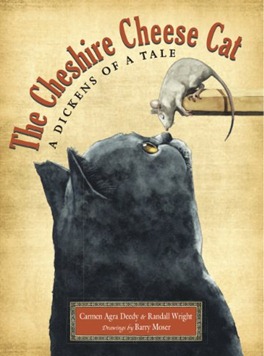
The Cheshire Cheese Cat: A Dickens of a Tale by Carmen Agra Deedy & Randall Wright, illustrated by Barry Moser

Skilley is an alley cat who is down on his luck, he has a broken tail, tattered ears, and has grown used to dodging brooms and wheels.  So when he hears that Ye Olde Cheshire Cheese, a local inn, needs a mouser, he concocts a plan to become that cat.  But Skilley has a horrible, shameful secret that he carries with him: he doesn’t eat mice.  Instead he prefers a good nibble of cheese.  Discovering this, a mouse named Pip strikes up a deal.  The mice of The Cheese will provide Skilley with the cheese he needs in exchange for him pretending to nab them and eat them.  The plan is perfection for a short time, until an evil cat named Pinch enters the inn and more secrets start coming out.  Add some historical British figures and you have an engaging romp of a novel for middle readers.

The authors have created a historical fiction novel that is also an animal novel.  It has figures like Charles Dickens and Thackeray, but mostly focuses on the animals themselves.  It is a novel that explores friendship and accepting yourself even if there are things that you might be ashamed of.  These messages are woven skillfully throughout the story and never become overbearing.

The pacing of the novel is also skillfully done.  There are quieter moments in the novel, but the foreshadowing makes even those uneasy ones.  Once the story really gets going, it reads quickly.  I couldn’t put it down in the last few chapters because I was so caught up in the story.

I’m not a huge animal story fan.  It seems that they tend to be tearful, overly emotive, and generally tragic.  That is not the case here.  Instead readers will cheer on the heroes, worry for their safety, and find themselves in the midst of a grand adventure in Elizabethan England.

Highly recommended, this book is one delicious read with a pleasing mix of sweet and savory.  Appropriate for ages 9-12.

Reviewed from copy received from Peachtree Publishers.

Also reviewed by:

Review: The Bear Who Shared by Catherine Rayner

bear who shared

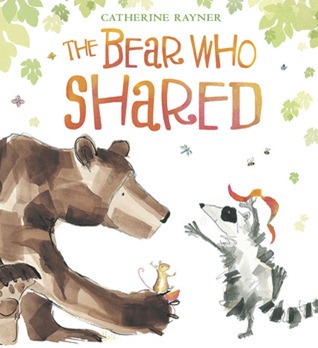
The Bear Who Shared by Catherine Rayner

Norris, the bear, knew that the plorringes were the best fruits.  So he waited under the plorringe tree because he knew something special was going to happen.  Tulip and Violet, a mouse and a raccoon, knew that plorringes were the best too.  They were able to climb up in the tree to get closer to the single hanging plorringe.  They could see how delicious it looked and smell its delicious scent.  They listened to it and hugged it too.  They were just about to lick it when it fell off of the tree and down right onto Norris’ head.  Now Norris was closest to the plorringe and had it all to himself.  But just as Norris was patient, he was also a very nice bear.  The type of bear who would not only share but would make some new friends doing it.

The story here is one that has been shared in many picture books.  Rayner’s writing has a gentle repetition that is almost not noticeable.  She has a playfulness and a warmth to her writing that makes it a pleasure to read aloud.

It is the illustrations that make this book something extraordinary.  There is the brawny brown of the bear done in overlapping paint that show his girth and weight, but also his sturdiness and steadiness.   Then the raccoon is a mash of black and grays, blending and merrily mixing, capturing the dynamic movements.  The mouse is all delicate line and a whisper of pink expression for the tail.  The plorringe is yellows, reds and pinks, a mix of mango, plum, and guava.

A book about sharing and friendship that will be loved due to the illustrations.  Appropriate for ages 3-5.

Reviewed from copy received from Dial Books for Young Readers.

Book Review: Hopper and Wilson by Maria van Lieshout

hopper and wilson

Hopper and Wilson by Maria van Lieshout

Hopper and Wilson try to imagine what is on the other side of the big sea.  Wilson, the mouse, thinks there will be lots of lemonade there.  Hopper, the elephant, imagines a staircase to the moon!  So they decide to head out in their boat and see what actually is on the other side of the sea.  They bring their red balloon with them too.  They sail through the day and night, until they are awoken by rain and wind.  Soon the waves are huge and dangerous.  When the sea calms, Wilson is alone in the boat.  As he sails on alone, he asks animals if they have seen Hopper, but neither the turtles, nor the penguins, nor the whale had seen him.  Finally, Wilson sees a bird with a familiar red thread and discovers Hopper afloat on the balloon.  Happily after that they reach the other side of the sea.  And there they find they are home, what luck that home is at both the end and the beginning of the world.

This is a warm and lovely book about friendship and the meaning of home.  It has a great adventure at its center too.  Van Lieshout’s writing is friendly and welcoming.  There are small, sweet touches like the two characters saying farewell to their pet cactus before heading out, the reaction when the friends are reunited, and the moment they discover they are back home again.  This all adds up to a story that has a genuine heart.

A large part of the appeal of the book are the illustrations.  They are done in a mix of watercolors, ink, collage, colored pencil, crayon and acrylics “with some technology to pull it all together.”  They have the appealing liquidity of watercolors, the texture of pencil and crayon, and the deep black edges of ink. 

Highly recommended, this book has a radiant, timeless appeal.  Share it with your small adventurer who will also be happy to come back home at the end.  Appropriate for ages 4-6.

Reviewed from copy received from Philomel Books.

Also reviewed by On My Bookshelf… and You Know, For Kids.

Book Review: Little Mouse’s Big Secret by Eric Battut

littlemousesbigsecret

Little Mouse’s Big Secret by Eric Battut

When Little Mouse discovers a juicy red apple on the ground, he decides that it will be his secret.  So he hides it in a hole in the ground.  Once it is safely hidden, his friends appear one-by-one and ask him what he’s hiding.  Little Mouse insists to each animal that he will not tell because it’s his secret.  As Mouse talks with animal after animal, his back is to the apple and the hole he hid it in.  Soon a sprout appears from the hole, then a stalk and finally a tree.  Apples appear on the tree just as Little Mouse declares that he will keep his secret forever!  Then the apples fall to the ground.  All of the animals reappear and Little Mouse discovers that some secrets are even better when shared.

Battut has created a picture book perfect for very young children.  From the simple, friendly illustrations that have plenty of whitespace to the repetition built into the animals asking what the secret is, this book has lots of child appeal.  Each double-page spread has only two lines of text on their own page, creating a book that is quite engaging and fast moving.

Children will immediately get the humor of a fast-growing apple tree that the mouse is completely oblivious to until the apples fall around him.  The book also has a high cute factor, with the animals dwarfed by the growing tree, all bright-eyed and merry.  They are on a buttery-yellow background that adds to the coziness of the title.

Add this book to your autumn and apple book lists.  The very little mouse and other animals make it more appropriate for small groups or individual sharing.   Appropriate for ages 2-3.

Reviewed from library copy.

Also reviewed by