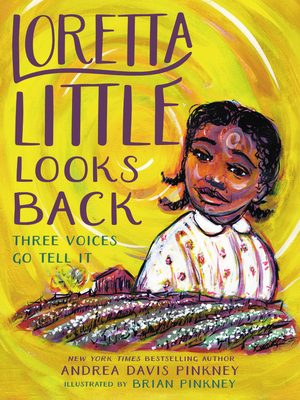
Loretta Little Looks Back by Andrea Davis Pinkney, illustrated by Brian Pinkney (9780316536776)
This novel offers first-person monologues from three generations of a Black family from Mississippi. They are a sharecropper family, caught in the aftermath of slavery and the cycle of poverty that resulted. Starting in 1927, Loretta tells the story of growing up picking cotton on land her family did not own. Her loving father died from exposure to the pesticides they sprayed in the fields. He gave her sapphire socks made with his own hands and she placed her other most valuable possession inside them, a marble that glowed like the sun. Loretta found Roly left outside as an infant. He grew into a boy who had a way with plants and animals. When the family got their own plot of land, they were attacked at night by someone who brutalized their animals, killing most of them, and poisoned their land. Roly slept out in the fields, hoping to draw the poison out and return the land to fertility. Then he caught the eye of Tess, a girl who he eventually married and had a daughter with. Aggie was that daughter, a girl who would not back down, much as her father would not make a hasty decision. Aggie fought for the right to vote even when she was not old enough to. She and Loretta worked together to pass the racist voting test and then to pay the toll tax. Beaten by police, Aggie finds comfort in the sapphire socks and the glow of the marble passed down to her. Just like the others in her family, she never stopped and never gave up.
Told in three distinct voices that speak directly to the reader, this novel takes a direct look at the systemic racism that has created such privilege for some and injustice for others. The use of monologues is brilliant, as the voices come through to the reader with real clarity, each speaking from their personal experience and from history. There is a sense of theater to the entire novel, helped by the introduction to each chapter that give stage directions and offers a visualization of how this would appear on stage. Often these are haunting images, transformative and full of magical realism.
The three characters are marvelously individual, each with their own approach to life, each facing daunting challenges and each ready to take those on, though in their own way. It is telling that as each new generation entered to become the new main narrator, I felt a sense of loss as the other moved off stage, since each was such a compelling character and each had more to share. I was pleased to see they stayed as part of one another’s stories all the way to the end of the novel.
Incredible writing, important civil right history, and a brilliant cast of characters make this novel glow. Appropriate for ages 9-12.
Reviewed from library copy.
 Waking Brain Cells