The White Cat and the Monk by Jo Ellen Bogart

Groundwood Logos Spine

The White Cat and the Monk by Jo Ellen Bogart, illustrated by Sydney Smith (InfoSoup)

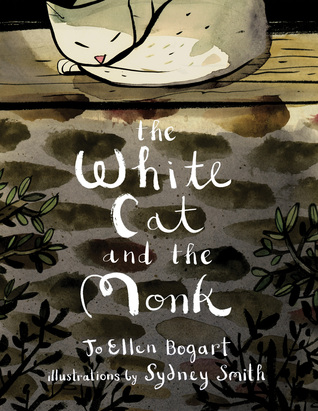
A white cat named Pangur and a monk live together. At night, by candlelight the two work side by side. The monk quietly studies his books. The cat hunts mice along the walls, examining a mouse hole. The two do not disturb one another. At the end of the night, as day comes, they have both found what they were seeking. One searching for the joy of an answer to a puzzle and the other for the satisfaction of a successful hunt.

This picture book is a retelling of a classic Old Irish poem “Pangur Bán.” It is a tale that is contemplative and quiet. It offers space to simply be, a world of solitude and study, and also one that is filled with richness of the most simple forms. Bogart captures the power of a man’s simple monastic life accompanied by an animal companion. In particular, it is the interplay of their evening activities that demonstrate the impact of the natural world on even the quietest of evenings.

Smith’s illustrations evoke a period of time that is filled with illuminated texts, thick stone monastery walls and the light of several candles. They are done with rich blacks and subtle colors, the light playing across the page as the cat seeks dark corners.

A beautiful look at the power of contemplation, mindfulness and cats. Appropriate for ages 5-7.

Reviewed from library copy.
Review: Brother Hugo and the Bear by Katy Beebe

brother hugo and the bear

Brother Hugo and the Bear by Katy Beebe, illustrated by S. D. Schindler

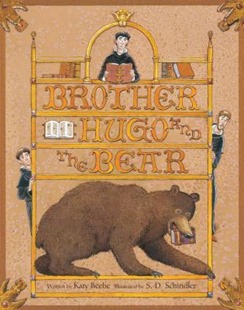
Brother Hugo’s library book is due, but he can’t return it because it was eaten by a bear!  So Brother Hugo is instructed that he must create a new copy of the book.  First, Brother Hugo has to go to the monastery of the Grand Chartreuse where they have a copy of the book.  On the way, he can hear the bear snuffling behind him, but manages to reach the monastery and safety in time.  On his return to his own monastery, he can hear the bear snoring in his sleep, so he hurries back.  Then the real work begins, but he has the help of his fellow monks.  They must get a sheepskin, stretch it and scrape it, get parchment paper, and get them ready to write upon.  Then comes making the pens and inks that will be required.  Finally, Brother Hugo must sit and copy the book word for word.  Finally, the book has to be bound.  As he worked, Brother Hugo could hear the bear and the snuffling.  When the book was completed, the monks offered Brother Hugo a clever way to get to Grand Chartreuse safely despite the word-hungry bear, but even with their help Hugo finds himself face-to-face again with the great beast looking for books.

In this book, Beebe has created a fascinating look at the treasure and value of books and the efforts that it once took to create them by hand.  By inserting the question of the bear into the book, the story moves ahead very effectively, offering a nice plot point in what could have been a much quieter tale of book making.  The bear also offers a touch of humor into the story, for even those of us who agree that books and words are as sweet as honey will be amazed at this bear’s appetite for books.

Schindler’s art incorporates word art that hearkens back to illuminated texts such as the one that Brother Hugo recreates in the book.  Done in fine lines and with precision, the art is detailed and adds much to the story.  I particularly enjoy the scenes of Brother Hugo crossing the countryside, because they clearly evoke a different time and place.

This historical fiction nicely incorporates how books were once made into a tale filled with gentle humor and one hungry bear.  Appropriate for ages 4-6.

Reviewed from copy received from Eerdmans Books for Young Readers.