Starfish by Akemi Dawn Bowman

Starfish by Akemi Dawn Bowman

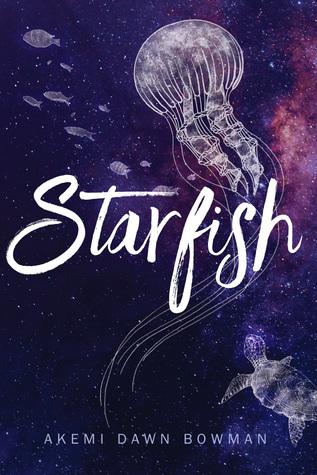
Starfish by Akemi Dawn Bowman (9781481487726)

Kiko struggles to find her own voice in many ways. She can’t seem to be herself in crowds, even small ones. She certainly can’t tell her mother what she actually thinks, particularly when her mother lets her uncle return to their home after Kiko had accused him of molesting her as a child. It is only in her art that Kiko tells her own story and speaks the truth. She plans to finally get away from her mother by attending art school in New York City. When she doesn’t get in, Kiko is trapped in a life of seeing her molester in her home, being with her horrible mother, and seeing her best friend head off to school. That is when a childhood friend comes back into her life and she begins to see what a future filled with art and honesty looks like.

I read only the first few lines of this debut book and realized that I had tumbled into the world created by a very talented storyteller. It is a world of abusive mothers, where the abuse is emotional rather than physical. Bowman draws the abuse clearly and subtly, allowing readers to realize the depths of the damage along with Kiko herself as her mother not only fails to protect her but also hurts her directly. It is a world of art, where art pieces end each chapter, the image capturing the emotions that Kiko was just feeling with an accuracy that lets you see it before your eyes.

This is a book that explores being different, particularly Kiko, who is half Japanese and half Caucasian, looking different than her blonde mother. Her mother has specific cruelties related to Kiko’s appearance that are particularly awful. As Kiko begins to think for herself, readers will be able to start breathing along with her and see just how strong Kiko is as a young woman on her own.

A book that celebrates individuality, art and survival, this novel is fresh and deeply moving. Appropriate for ages 15-18.

ARC provided by Simon & Schuster.
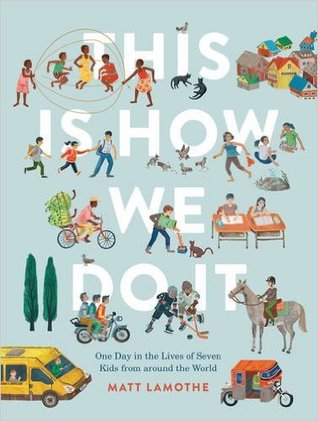
This Is How We Do It by Matt Lamothe

This Is How We Do It by Matt Lamothe

This Is How We Do It by Matt Lamothe (9781452150185, Amazon)

The lives of seven children from around the world are documented in this engaging nonfiction picture book. A child each from Italy, Japan, Iran, India, Peru, Russia and Uganda share their daily lives. They talk about what they eat, where they live, their schools, how they play and where they sleep. This is an intimate look at these children and their lifestyles that offers a way to look at how cultures are different but also how certain things are universal as well.

Lamothe worked with seven real families to create the book, showing photographs of them at the end of the book. The focus on concrete things that make up our lives offers a tangible way for children to see cultures and explore differences and similarities. It’s a clever way to invite children to explore and learn.

The illustrations are phenomenal and with their fine details offer the same sort of window as photographs. While it is great to see the photographs at the end, they offer a sort of confirmation that the illustrations truly have captured the lives of these children. These are illustrations to pore over and enjoy, allowing them to transport you around the globe.

Wonderful for classrooms and libraries, this nonfiction picture book is exceptional. Appropriate for ages 5-9.

Reviewed from copy received from Chronicle Books.


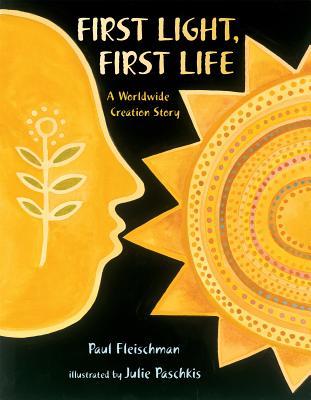
First Light, First Life by Paul Fleischman

First Light First Life by Paul Fleischman.jpg

First Light, First Life: A Worldwide Creation Story by Paul Fleischman, illustrated by Julie Paschkis (InfoSoup)

A companion book for Glass Slipper, Gold Sandal, this picture book looks at creation stories from around the world. From the very beginning of how the universe was formed, then how the earth was formed, how human beings came about and then the animals as well, this book combines a myriad of different cultures into one story with various voices and points of view. With all of the differences, the book still manages to show the universal elements of creation stories and how looking at different cultures allows us to celebrate our humanity as one.

Fleischman captures phrases from different cultures in the book. Structuring the elements into a story all of its own, he allows each culture’s differences to show but also focuses them into a cohesive whole as well. While cultures may differ on how the universe was formed, there is a sense of wholeness in looking at it from so many points of view. The universal aspects shine and the differences ensure that we are still seeing the cultures themselves and their uniqueness.

The illustrations by Paschkis are beautifully elemental, showing each culture, celebrating each one separately. The illustrations also label each culture or region of origin for the story fragments, allowing readers to see the roots of the different stories and how they reflect the area they come from.

Vividly presented, this picture book look at creation itself is a dynamic view of our world’s cultures as well. Appropriate for ages 5-7.

Reviewed from library copy.


Review: My Basmati Bat Mitzvah by Paula J. Freedman

my basmati bat mitzvah

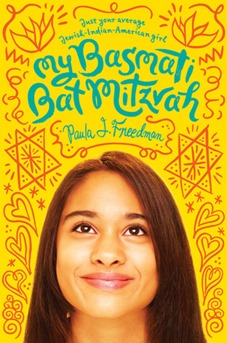
My Basmati Bat Mitzvah by Paula J. Freedman

Tara’s father is Jewish and her mother is East Indian, so Tara has mixed feelings about her upcoming bat mitzvah.  Some of the kids in her Hebrew class even wonder if she is actually Jewish at all.  Tara though is more concerned with whether she actually believes in God and if she doesn’t, does that mean that she can’t have a bat mitzvah?  She also worries about what celebrating this side of her family says to the other side.  So Tara decides to make sure that both sides of her family are represented by wearing a family sari that had been passed down for generations.  Unfortunately though, the sari is accidentally burned and Tara has to figure out how to tell her mother about it.  But that’s not the only complexity in Tara’s life.  Her best friend Rebecca seems to be spending more time with another girl, someone that Tara doesn’t get along with.  Her other best friend Ben-o seems interested in being more than friends sometimes but other times spends a lot of time with another girl.  It’s up to Tara to navigate all of the confusion and make her bat mitzvah her own.

Freedman very successfully tells the story of a young woman dealing with two distinct family heritages.  Happily, she doesn’t feel the need to build heightened angst about it, allowing Tara’s personal doubts to really drive this part of the story.  Her family around her does not have the same feelings, sharing holidays with one another and enjoying the same foods, most of the time. 

The book has a lightness of tone that makes the book very enjoyable.  Freedman explores bullying with a perfect touch, but less successfully explores the underlying issues.  Tara is a strong heroine who is far from perfect.  She has a temper, responds physically at times, and can be too self-absorbed to really see what is happening with her friends.

Hurrah for a book with a brown-skinned girl right on the cover that explores her multicultural heritage in such a straight-forward way!  Appropriate for ages 11-13.

Reviewed from ARC received from Amulet Books.

Mirror: A Reflection of All of Us

mirror

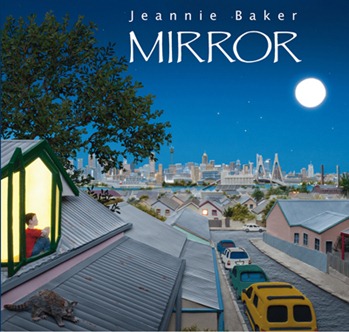
Mirror by Jeannie Baker

This book tells two stories at the same time from two distinctly different cultures.  Each story focuses on a family and a day in their lives.   One story is set in Sydney, Australia where a boy lives with his family and baby sibling.  They drive a minivan to the hardware store to get more materials to renovate their home.  The other story features a family in Morocco.  Here too a boy lives with his family and his little sibling.  They travel to the market by donkey to sell a rug, some sheep and some chickens.  That same rug is the one picked out by the Australian family at a rug store to have in their home.  The entire book is a celebration of the interconnected nature of our lives no matter what nation we live in.

The book can be read in several ways, either both stories at the same time, or each one completely separately.  It opens with the Australian story with an English introduction on the left which is read from left to right.   The Moroccan story is on the left with an introduction in Arabic.  The entire Moroccan section is read right to left just like Arabic.  Each story has its own separate pages bound together with a shared spine and cover, which I see as very symbolic of the entire book concept.

After the introductions, the bulk of the book is wordless.  Through Baker’s incredibly delicate and detailed collage illustrations, readers will discover the universal nature of the two cultures and also their differences.  Baker shows different foods, different pets, different transportation, different lands but the stories are so similar, the families so alike, that the focus is never on the differences but on the similarities.

This is a masterpiece of a picture book.  While not appropriate for a story time, it is a book that should be shared for its celebration of diversity, multiculturalism, and humanity.

Reviewed from library copy.

To get a better sense of the structure of the book, take a look at the video below:

Also reviewed by:

The Sandwich Swap

The Sandwich Swap by Queen Raina of Jordan and Kelly DiPucchio, illustrated by Tricia Tusa

Lily and Salma are best friends.  They do a lot of things together very happily.  But one thing they did’t agree on was the sandwiches they had for lunch.  Lily brought peanut butter and jelly on white bread every day.  Salma brought hummus on pita bread every day.  Each girl thought that the other girl must be suffering eating that icky looking sandwich every day.  One day, Lily blurted out what she thought of Salma’s sandwich and then, feeling very angry, Salma told Lily that her sandwich looked gross and smelled bad.  The two girls didn’t play together that day.  Their argument started a larger one in their school and then a food fight!  The next day, they sat together and each offered the other a taste of their sandwich which once again led to the whole school getting involved.

The writing in the book has a delightful rhythm to it, using nicely subtle repetition to underline how similar the girls are even in their differences.  The glimpses of their home life as each girl thinks about how their sandwich is made by loving hands adds a lot to the story as well.  Tusa’s illustrations are done in her signature style with plenty of emotion.  They also have a lovely interplay of white space and color washes that make them eye catching and work well when placed with little text or a page filled with text. 

Highly recommended, this book is ideal to start a discussion of differences in a classroom, especially cultural ones.  I love that the book uses food to bring children together, because it can be such an ambassador for different cultures and even different families in the same culture.  Appropriate for ages 4-6.

Reviewed from library copy.

Check out the book trailer below:

Also reviewed by:

Nebeel’s New Pants: an Eid Tale

Nabeel’s New Pants: an Eid Tale retold by Fawzia Gilani-Williams, illustrated by Proiti Roy

Nabeel had a busy day selling shoes, now he was ready to buy his family gifts for Eid.  He purchased a burqa for his wife, a dupatta for his mother, and bangles for his daughter.  On his way out, the shopkeeper recommended that Nabeel buy himself some new pants since his were worn and patched.  Nabeel agreed, but the only pants there were 4 fingers too long.  Once he got home, Nabeel gave his wife her gift but she was too busy to shorten his pants for him.  His mother was given her gift, but she was also too busy to shorten his pants before Eid.  Mariam, his daughter also was too busy.  So Nabeel went home and shortened the pants himself, 4 fingers.  His wife found time too to shorten the pants 4 fingers.  His mother came over and also shortened them 4 fingers.  Finally, his daughter too shortened the pants.  Now what was Nabeel to wear to Eid?

With the feel of a classic tale, this book offers a universal style of folktale with plenty of repetition and cumulative action.  Children of all cultures will immediately feel at home here.  Gilani-Williams has kept the text tight and focused, making a great read aloud Muslim story.  Even when the humor is unfolding, the text keeps a straight tone that adds even more humor.  Roy’s illustrations have a classic feel to them merged with a cartoon style. 

A clearly Muslim tale with a universal feel, this book is perfect for any public library collection.  It will fit in well with story times or units about clothing or celebrations.  Appropriate for ages 4-7.

Reviewed from copy received from Marshall Cavendish.

Star of the Week

Star of the Week: a story of love, adoption, and brownies with sprinkles by Darlene Friedman, illustrated by Roger Roth

It is Cassidy-Li’s turn to be star of the week in her Kindergarten class.  She and her mom are making brownies with sprinkles and she also has to make a poster about herself.  As she looks through photographs, Cassidy-Li’s history as an adopted baby from China is told.  Her parents holding her in China, the first person to meet her at the airport, her cousins, her best friends, and her pets.  But she doesn’t have any pictures of her birth parents, so there is a hole in her poster.  She fixes it by drawing a picture of these people she has never met.  She is nervous about her poster and about answering questions about her adoption.  But by the end of the day, she realizes that she really is a star.

The beauty of this book is that Cassidy-Li is a wonderfully normal kid with the same sort of worries that others have about their star week.  And yet she has a unique background, multicultural friends, connections to China, and a more complicated story to tell.  Friedman does a great job in balancing the two, creating a character who is unique but universal.  The story is told in very brief prose, with the illustrations telling a lot of the tale too.  Roth’s pictures also create a bridge between Cassidy-Li’s special background and her being a regular American kid. 

Recommended for all families, this book is about connections, understanding, and being special.  Appropriate for ages 4-6.

Reviewed from library copy.

Also reviewed by A Year of Reading and A Patchwork of Books.