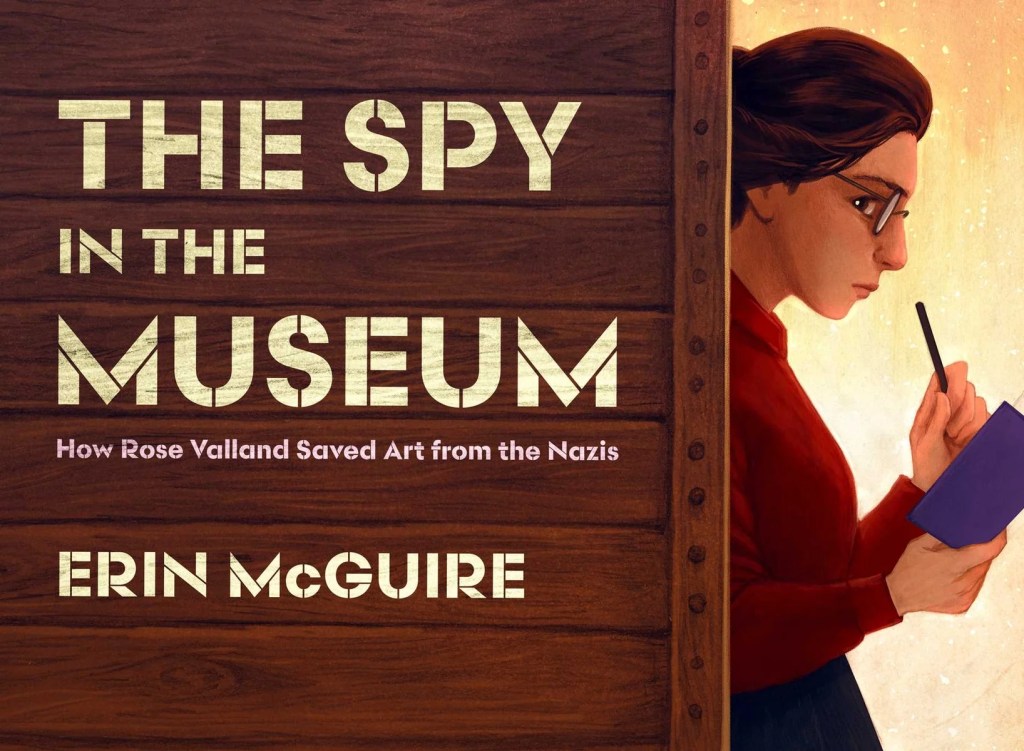
The Spy in the Museum: How Rose Valland Saved Art from the Nazis by Erin McGuire – Book Recommendation

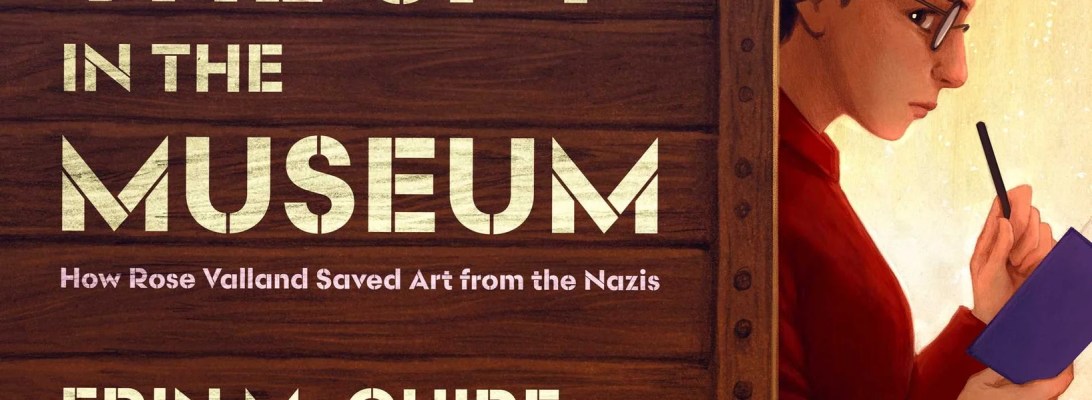
The Spy in the Museum: How Rose Valland Saved Art from the Nazis by Erin McGuire

Publisher: Beach Lane Books

Publication Date: September 16, 2025

Reviewed from copy provided by publisher

ISBN: 9781534466173

Rose Valland lived in Paris and was the curator at the Jeu de Paume Museum. She loved all kinds of art, but Hitler and the Nazis did not approve of modern art and destroyed it in their war across Europe. When they reached France, they used the Jeu de Paume Museum as a staging area. All the staff of the museum left except for Rose. She stayed, quiet and shy, often unnoticed by the soldiers. But Rose could understand the German they spoke and soon started taking notes about their plans to move precious art via train. Rose became a spy, sharing her knowledge with the French Resistance and allowing many pieces to be saved. When the war ended, many art pieces were missing, and Rose still had her many notes about where that art had been sent, saving even more.

Told in a way that children will understand the preciousness of the art, the violent hate of the Nazis, and the importance of standing up for what is right, even in a quiet way. This book celebrates the reserved heroes who made a huge difference simply by noticing what was happening and being brave enough to share information. The art in the book celebrates art but also celebrates Rose Vallard, quiet and drab, courageous and integral. 

A timely nonfiction picture book of resistance and the importance of art. Appropriate for ages 6-9.
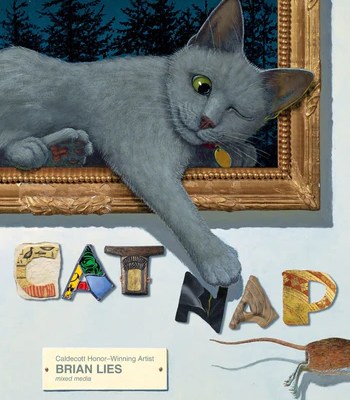
Cat Nap by Brian Lies – Book Recommendation

Cat Nap by Brian Lies (9780062671288)

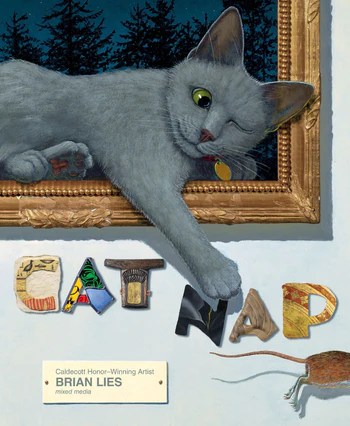
This picture book is pure visual joy. A cat naps in the warm afternoon sun. Awoken by a mouse, the kitten follows the mouse into a poster about Egyptian Antiquities at the Metropolitan Museum of Art. The first place they land is a sculpture with hieroglyphics. They run through the sculpture, taking on the art style as they pass by. They leap to the next, this time an illuminated manuscript. Then the next where they become clay sculptures. They pass through paintings, past wooden masks, into stained glass, and Japanese ink. Finally, Kitten realizes he is lost and can’t see the mouse anywhere. A kind monk from a gold leaf painting suggests he listen for home. Kitten can hear the food being poured into his bowl! 

The final pages of this picture book show the Caldecott Honor-winning artist working on the art for this book. Instead of doing the various styles digitally, Lies created the art, including all of the pottery, stained glass, gold leaf, paintings and sculpture. It’s such a rewarding read where the physicality of the art he created truly shows on the page. These are illustrations that will stop you and make you feel.

A romp through art, this picture book is one to inspire more exploration. Appropriate for ages 4-7.

Reviewed from e-galley provided by Greenwillow Books.

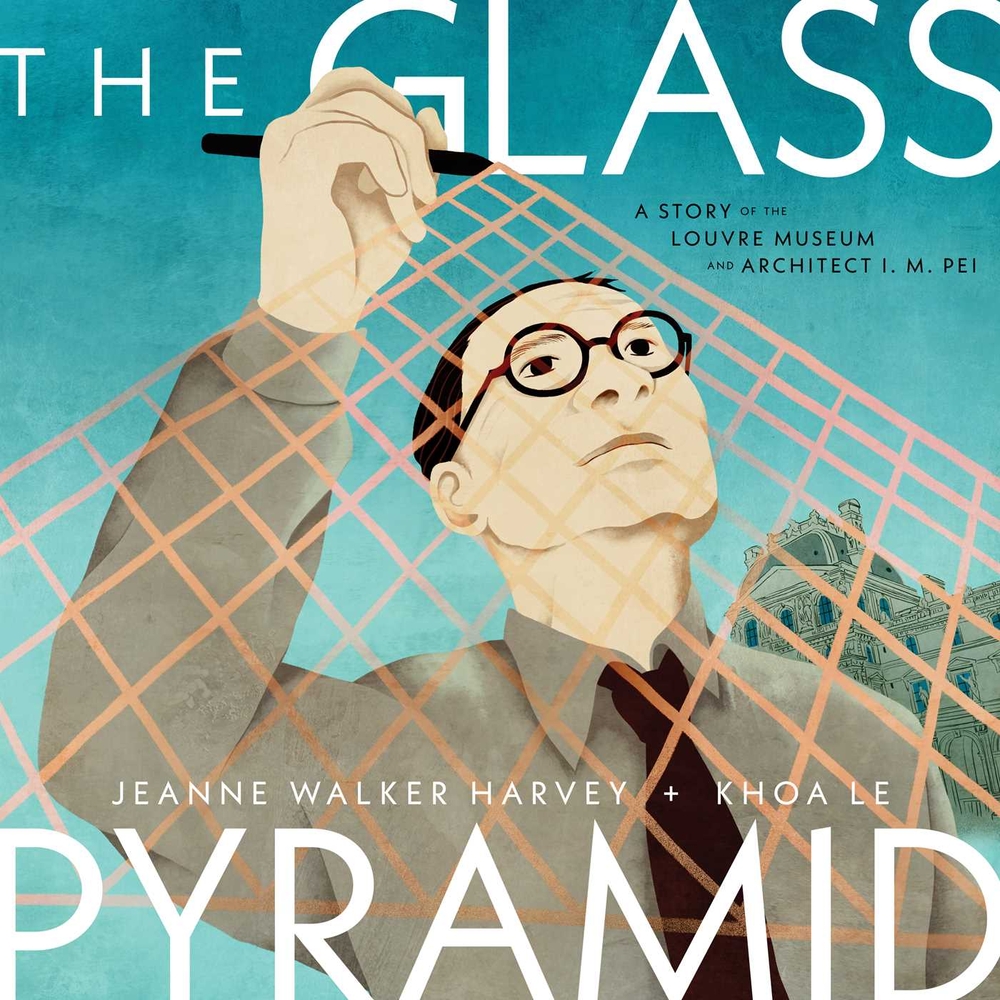
The Glass Pyramid by Jeanne Walker-Harvey – Book Review

The Glass Pyramid: A Story of the Louvre Museum and Architect I. M. Pei by Jeanne Walker-Harvey, illustrated by Khoa Le (9781665953337)

I. M. Pei, a renowned architect had successfully redesigned part of the National Gallery of Art in Washington, D.C. But when the President of France asked him to work on the Louvre, Pei decided to keep the project secret. The Louvre had many issues as a museum with people unable to find the entrance and the long walk to reach the art once they did enter. So Pei set out to create a new way to enter the building. It was unclear what would work, but eventually he designed a glass pyramid. The French people though didn’t love the idea and argued that they should have hired a French architect. Pei stayed the course, doing interviews and calmly explaining his design. Could he win over the French people? 

A look at the design process of a gifted architect allows young readers to see the resilience and persistence that design takes. Even when the design was finalized, there were issues with the construction that arose and then the arguments about the design itself. This nonfiction picture book explores process and results, engaging the reader in Pei’s childhood visits to China and what he learned there. The digital illustrations are a filled with crisp edges and renderings that capture Pei’s calm pride in his work. The book provides more information on the building at the end as well as sources and online resources. 

A strong nonfiction picture book about one of the top architects in the world and one of his most famous projects. Appropriate for ages 6-10.

Reviewed from e-galley provided by Atheneum Books for Young Readers.

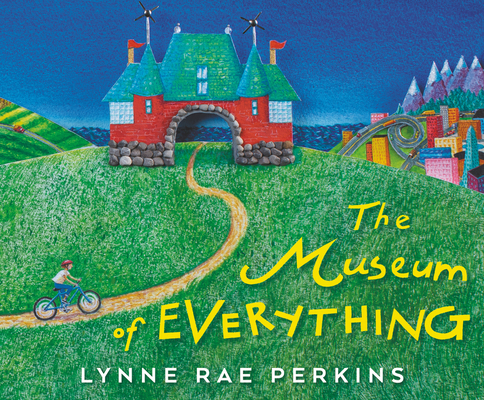
The Museum of Everything by Lynne Rae Perkins

Cover image for The Museum of Everything.

The Museum of Everything by Lynne Rae Perkins (9780062986306)

When the world gets too busy and big, you can look at the smaller pieces around you. You can put those things in a quiet place like a museum in your mind. Or maybe it could be a real museum. It could have things like a Museum of Islands because there are so many kinds and sizes. A Museum of Bushes could have skirts made out of different bushes and then real bushes too. A Museum of Shadows could have usual shadows but also ones that you don’t expect. The Sky Museum is already right over your head, ready to be seen every day. All these small pieces fit together in one large puzzle, creating the Museum of Everything all around us all the time.

Newbery Medalist Perkins has created a picture book exploration of imagination that invites readers to look around themselves and see the elements that are worthy of placement in their own museums of everything. She takes expansive ideas and turns them firm and real with her examples given through the perspective of the child narrator of the book. The result are charming stories of bushes, hiding places, shadows and much more. The everyday is turned amazing.

Her illustrations are done in a wide variety of media. Some pages are done in collage, the paper elements overlapping into a layered world. Other pages are filled with objects that celebrate bushes and hidden places. These are 3 dimensional dioramas or sculptures that draw readers right into them.

Celebrating the extraordinary ordinary, this picture book is a lesson in imagination and creativity. Appropriate for ages 4-6.

Reviewed from e-galley provided by Greenwillow Books.

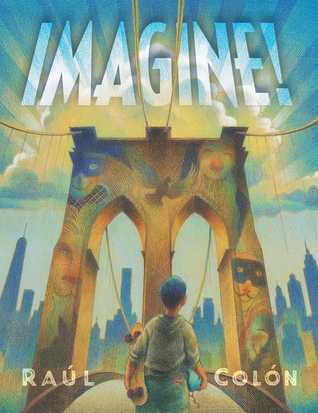
Review: Imagine by Raul Colon

Imagine by Raul Colon

Imagine by Raul Colon (9781481462730)

This wordless picture book invites readers to be inspired by fine art in a playful yet profound way. A boy skateboards over to the Museum of Modern Art. He views several paintings that make him stop and look. Soon the paintings have come to life with the boy entering the scene and the characters in the paintings entering the real world. Together they all traverse New York City and have several seminal experiences together. They climb the Statue of Liberty, ride the Cyclone, take the subway, and even stop for a hotdog. After a visit to Central Park, they return to the museum. On his way home, the boy is inspired to create a mural on a blank wall near his home, inspired by the three paintings.

Don’t miss Colon’s Author’s Note at the end of the book where he speaks to the power of fine art to inspire young artists. Colon saw master artworks later in his life and was still inspired by them, yet he wonders what impact seeing them as a child would have had. Colon has created a picture book that is a tribute to the power of art and the ability for it to inspire creativity and new ways of thinking. It is also a tribute to New York City as they tour around the sights and enjoy a day on the town.

In a wordless picture book, the onus is on the art to carry the entire book. As always, Colon’s art is inspiring itself. His use of texture through lines and softening by using dots makes his work unique in the picture book world. His illustrations glow with light, whether they are interior images or out in Central Park.

An exceptional wordless picture book, this one is a must-have for libraries. Appropriate for ages 4-6.

Reviewed from copy provided by Simon & Schuster.


The Time Museum by Matthew Loux

the-time-museum-by-matthew-loux

The Time Museum by Matthew Loux

Released February 21, 2017.

Delia thinks she is just heading to her uncle’s house for the summer, but instead finds herself competing for an internship at the Time Museum, a museum that contains items from across human history. There are other teens competing against her, including a girl from future Japan who loves robots, a boy from ancient Rome, and a boy from the far past. While the internship at first seems to focus on physical fitness and school work, quickly the missions become real time travel. Each mission judges the interns individually as competitors, but they quickly learn that they need to work together to survive traveling through time!

Loux is the author of several award-winning graphic novels. In this latest work, he has created a world where history and the future mingle. Time travel wristbands, magical stones, and body-free brains all appear on the pages, each more wonderful than the last. It’s a setting where you are never sure what the next adventure will contain and that makes it immensely appealing.

Loux’s art adds to that appeal. His characters are vibrant and charming. Even the villainous character is complicated and has a clear history with others in the story. Delia herself is perhaps the most straight-forward character which makes the book an exploration of those around her even as Delia discovers her own bravery and ingenuity on the page.

Clearly the first in a series, this graphic novel has mass appeal and plenty of smarts. Appropriate for ages 10-13.

Reviewed from copy received from First Second.


Review: The Museum by Susan Verde

museum

The Museum by Susan Verde, illustrated by Peter H. Reynolds

Verde captures the energizing nature of a visit to an art museum.  Told in first-person verse, the young female protagonist dances and spins through the gallery, drawing inspiration and emotion from the art around her.  As she moves to a new piece of art, it evokes a new reaction that is entirely in keeping with the art in front of her.  Finally, faced with a blank white canvas, she discovers that her own mind starts to fill in the art on its own.  As she leaves the museum at the end of the day, her world is transformed by the art she has seen that she now carries along with her.  This is an engaging story of a museum visit that is sure to inspire young readers to want to try it for themselves.

Verde’s verse is filled with motion and zing.  While some may see visiting a museum as a more sedentary and intellectual activity, Verde fills it with motion and emotion alike.  She conveys through the young girl’s physical reaction what is happening to her mentally.  It is a very successful take on the transformational quality of art and how it can speak on many levels to viewers.

Reynolds’ art adds to the feel of motion and engagement in the book.  His young figure is constantly in motion, even when she takes a short break, she is inspired by art.  Reynolds’ illustrations are done in his signature fluid style, yet he is able to capture different art periods very effectively.

Ideal to use with a class before a museum exhibit or with children before a family visit to a museum, this is also a book that will inspire reflection about art during a regular day.  Appropriate for ages 4-6.

Reviewed from copy received from Abrams.

Review: Mossy by Jan Brett

mossy

Mossy by Jan Brett

Mossy loved living at Lilypad Pond.  She spent so much time along the banks that moss and then small plants started to grow on her shell.  She became a walking garden and liked to look at her reflection in the water to see how her garden was growing.  On day, she met a male turtle named Scoot at the pond.  The two were smitten immediately.  But just as they were about to meet, Dr. Carolina, who owned a museum, picked up Mossy and took her away to be the center of a new display.  Mossy spent several seasons at the museum, missing Scoot but being well cared for.  She was a very popular exhibit.  So when Tory, Dr. Carolina’s young niece, noticed how sad Mossy seemed and how lonely, there was a big decision to be made.

Brett’s story speaks to the importance of leaving living creatures in their native habitat to live their own lives.  It is a subject handled delicately here with no abusive storyline at all, just a general sense of sadness, which is perfect for young children.  The book is set at the turn of the century with the clothing and use of horse-drawn carriages giving clues.

As always, Brett’s artwork is simply beautiful.  In each two-page spread, she gives the main image a frame and then has several additional pictures that either add to the story or the setting.  We get to see different plants up close, glimpses of the museum even when it is not in the storyline, and Scoot waiting at the pond. 

This is not a book to be read quickly or with a group, instead it’s one to linger over and see the details of the artwork.  Appropriate for ages 4-6.

Reviewed from copy received from G. P. Putnam’s Sons.

Salted Fish–A Taste of Singapore

61KQ3qd1s-L

Salted Fish by Yeo Wei Wei, illustrated by Ye Shufang

Lynn is visiting an art museum for the first time.  She knows that the National Art Gallery will have lots of art inside it.  She and her toy bunny find a painting of fruit and then set out to see if they can find one with strawberries in it.  As they are looking, they smell something strange coming from one of the paintings.  As she counts things in the painting, she and her bunny hear a voice speaking from the painting.  Lynn finds herself drawn into the painting and learning about the way they are making salted fish.  The taste of the salted fish reminds her of her grandmother’s home.  As she leaves the painting with a bundle of fish to take with her, she promises to return to the art museum again.

The story here is told with a quiet, gentle voice.  Lynn’s interaction with the painting is not frightening at all, but an enthralling moment of connection.   It is what one hopes a child will experience at an art museum.  The story is built around a famous painting by Cheong Soo Pieng called Drying Salted Fish.  At the end of the book, information on the painting and the artist is shared. 

Shufang’s art is engaging with the bright-eyed child and the strong architectural lines of the building itself.  A muted palette that has pops of bright color at times adds to the quiet appeal of the book. 

This book gives young readers a small taste of Singapore which they will probably appreciate much more than the smell of salted fish!  Appropriate for ages 4-6.

Reviewed from book received from The National Art Gallery, Singapore.

Enhanced by Zemanta