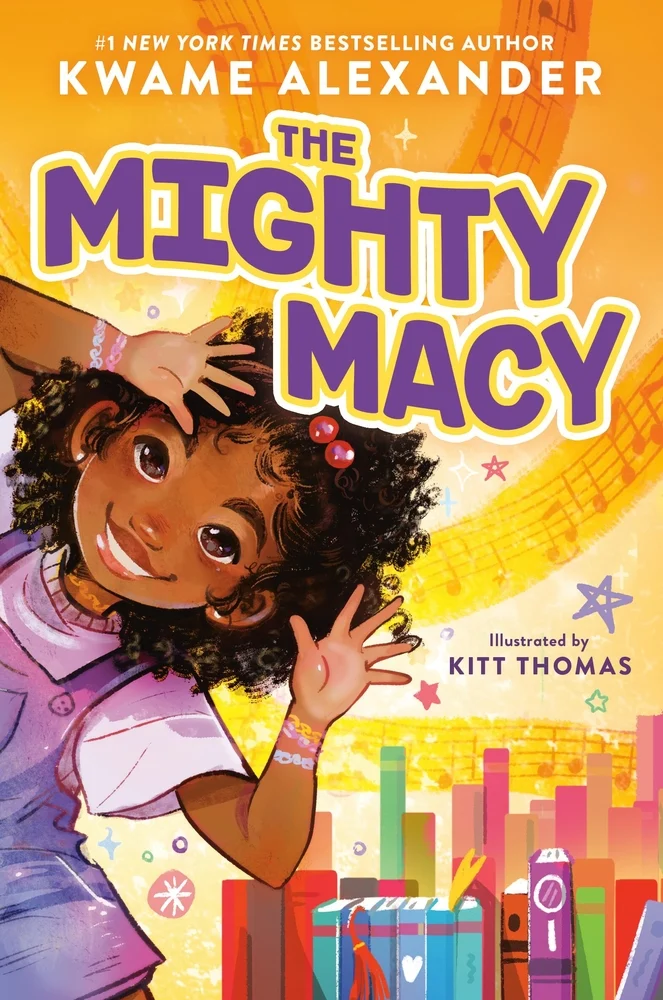
The Mighty Macy by Kwame Alexander, illustrated by Kitt Thomas
Publisher: Little, Brown Books for Young Readers
Publication Date: February 3, 2026
Reviewed from library copy
ISBN: 9780316442169
When Macy gets the first book in the Mighty Zora series for her birthday, she stays up late reading. The next day, she rushes to the school library to get the second book in the series. But the school library is closed due to budget cuts. Now the school library will only be open two days a week instead of all week long. Macy has to figure out how to save the school library while also learning her minuet for her violin concert. It’s all happening at once, but with help from her poet father, her pancake-providing mother and her friends she might just get it all done.
Alexander is a virtuoso of children’s literature. He writes with such warmth here of Macy, a little girl filled with the drive to speak up and finding the courage to do so. Alexander demonstrates that children have a place in social justice work and giving them a voice in processes is vital to making change happen. Written primarily in verse, this book is approachable for readers newer to chapter books. The illustrations add to the joy of the book, sharing Macy’s life and family.
A great new chapter book that speaks up about taking action.
An Iranian boy is woken up by his grandmother. They have breakfast together on the old frayed rug before taking a meal out to Grandpa in the field where he is herding sheep. The three start planning to make a new rug. They wash the wool and card out the tangles. They spin it into wool that is dyed with local flowers. Then the design is plotted out on graph paper. Next they start weaving on the loom, creating Persian knots to hold tight. The boy learns to create knots and not tangles, until midway his grandmother adds the Persian flaw to keep it from being perfect. The new rug is finished and ready for new memories to be made.
Nayeri shows the art of Persian rug making through the eyes of a child, making not only the art itself accessible but also showing the love of grandparents along the way. The boy learns the craft and also the heart of making rugs, with specific emphasis on the Persian flaw and the lack of perfectionism. The art in the book captures the colors of the wool, the beauty of the flowers, and the lovely designs of both rugs that the family uses.
Family, warmth and art combine in a winning title. Appropriate for ages 3-5.
Jack lived with his grandfather in a house filled with music. There was music on the record player plus his grandfather played several instruments, including the guitar. Jack particularly loved it when his grandfather played the guitar, especially the song about the blackbird. Jack asked his grandfather to show him how to play the blackbird song, but first it took a lot of help and practice to even play a single chord. With encouragement from his grandfather, Jack kept at it and learned to play the guitar. As Jack got bigger and the guitar got smaller, he left home and played music all over the world. When he returned, his grandfather was different and this time it was Jack who showed him how to play.
Throughout this book, I could hear the song about the blackbird in my head, haunting and lovely. Children will want to hear that song after reading this book. The touching relationship between the two characters comes full circle by the end of the story as the grandfather grapples with dementia. The power and connectivity of music is on full display throughout the tale. James’ art is deeply organic yet accessible, showing the two characters as their relationship evolves and changes in the small blue house.
Sure to strike the right chord. Appropriate for ages 5-7.
Publisher: Simon & Schuster Books for Young Readers
Publication: July 1, 2025
Reviewed from copy provided by publisher
ISBN: 9781665938129
In 1980, Vision was a teen pop star, singing in front of large crowds. Today, Margot is trying to catch the attention of people online with her music, but her ukulele isn’t cutting it. Margot finds a synthesizer on the side of the road with a sign saying that it’s not haunted. She hauls it home, hoping for her father to teach her to play. But her father deserts Margot and heads to California to become a star once he gets enough online fans. Left behind, Margot starts to learn to play keyboard and that’s when Vision, whose spirit is trapped in the synthesizer, appears. The two girls start to play music together, but is something darker involved with the keyboard and what is the price of chasing external fame?
A marvelous graphic novel for middle-grade readers, this book successfully combines modern online attention culture with throwbacks to the 1980s. The haunted, or not, synthesizer forms a bridge both in music and connection between the two girls, one a ghost and one alive. The message of finding your own happiness rather than seeking external validation is offered in a variety of ways through the story, via Margot’s father, her friends and Vision herself. The art is bright and popping and veers dynamically into horror lighting at times.
A great graphic novel with a message for our times. Appropriate for ages 8-12.
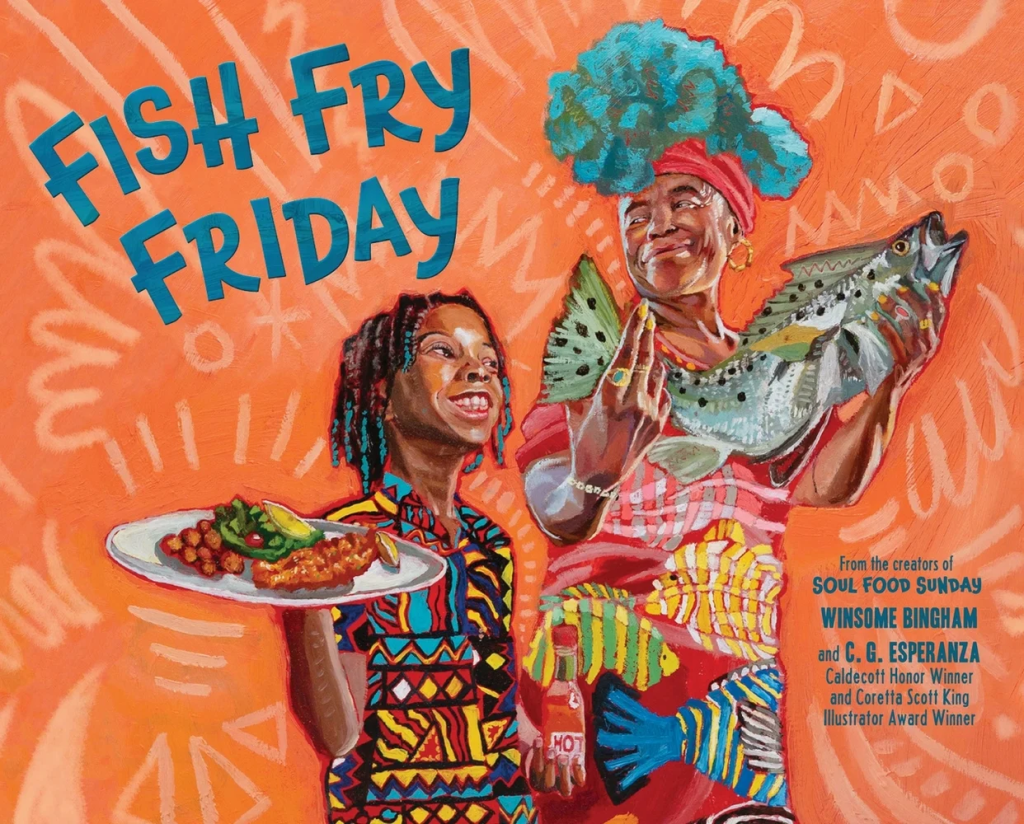
Fish Fry Friday by Winsome Bingham, illustrated by C. G. Esperanza (9781419766930)
In this companion book to Soul Food Sunday, a grandson gets to spend his day off of school with his grandmother fishing. She is known as a lucky charm at the pier and is one of the best fishers out there. Everyone cheers when she arrives and she waves like a queen. After the two catch all sorts of fish, each out declared his grandmother’s favorite, they head back home to clean and filet them. Next comes the batter and finally the real favorite, hushpuppies!
This picture book is a celebration of how food brings people together and transcends generations. The joy of the two characters spending time together and loving one another is just as filling as the meal they create together. Children will love the time spent on the pier fishing as well as the time in the kitchen. Award-winning illustrator Esperanza captures the colorful characters and their cooking with energy and detail.
A delicious addition to the soul food celebration. Appropriate for ages 4-6.
Reviewed from e-galley provided by Abrams Books for Young Readers.
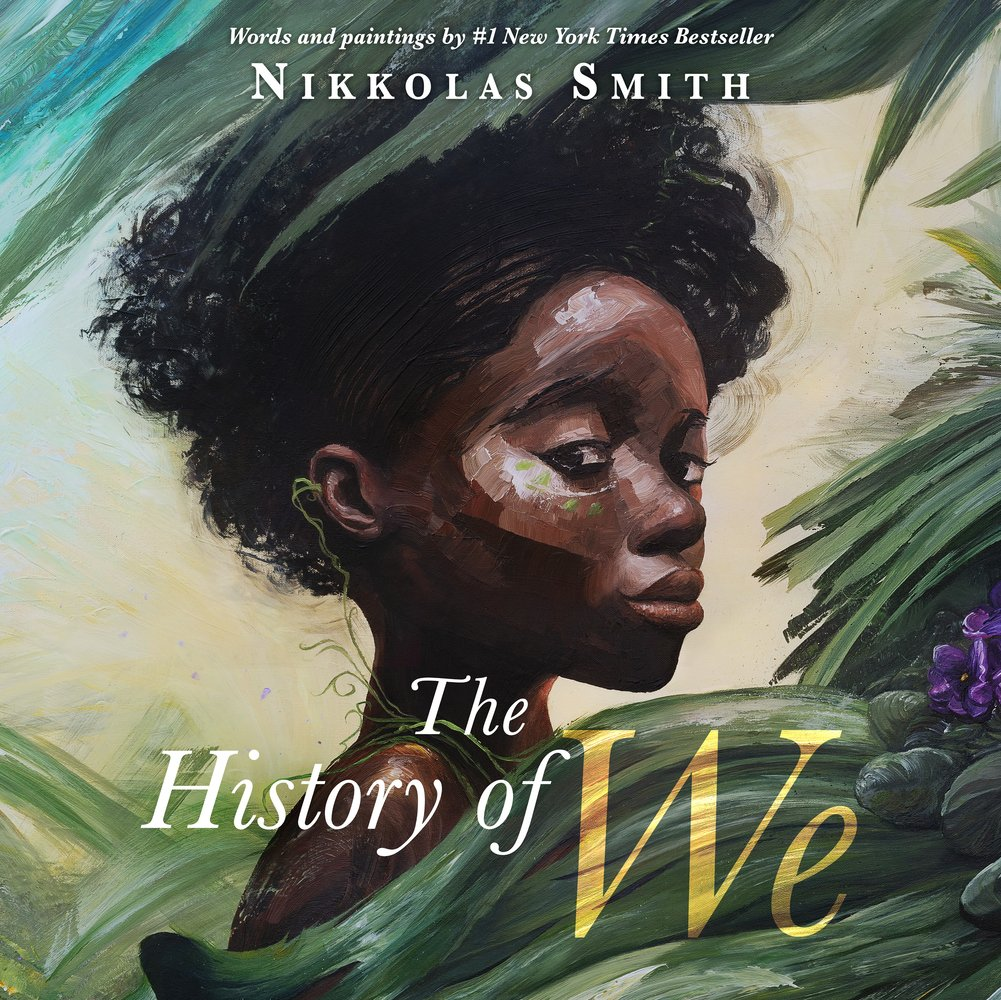
This remarkably beautiful picture book tells the history of where human beings started, Africa. It is the story of where language began and where art started on cave walls and faces. It speaks to the creation of music and dance. It tells of survival, of invention, of building and planting. It was where people traveled from using their boats to cross watery divisions and to populate the world. It is our story, of our origins and the many gifts created in Africa.
Smith has crafted such beauty on these pages with his art. The paintings are done in acrylic and offer a gorgeous textural experience to the reader that creates depth and wonder. This book is a clear response to the erasure of Black history and the origins of humans as reflected in the author note. Throughout the book both in text and image, there is joy and pride. There is a richness in both as well, a focus on the achievements, the impacts and the importance of that history.
Beautiful and impactful, this book belongs in all libraries. Appropriate for ages 5-9.
Reviewed from library copy.
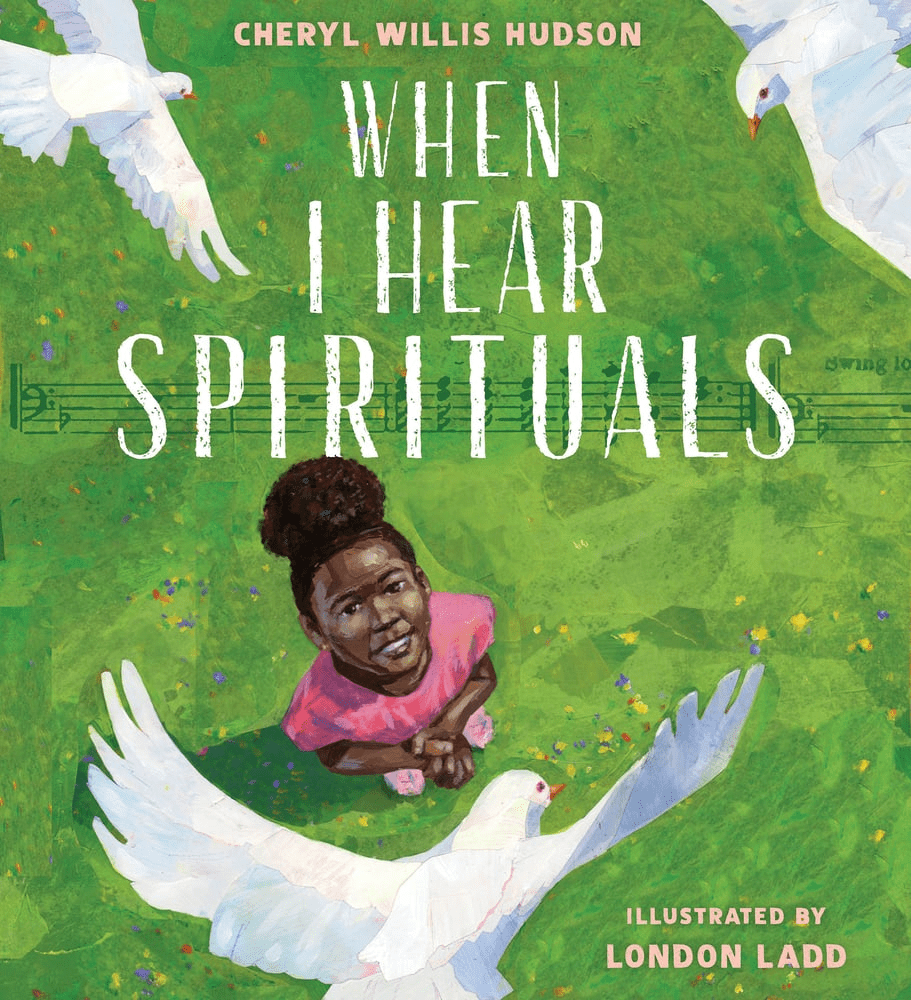
When I Hear Spirituals by Cheryl Willis Hudson, illustrated by London Ladd (9780823453801)
In a glorious combination of verse and lines from well-known African-American spirituals, this picture book soars. A young girl expresses what hearing spirituals does to her emotionally and readers are along for the journey. From tears to joy to wanting to dance to acknowledging heroes and movements of the past, this book explores the power of music to connect and convey.
The incorporation of a verse of a corresponding spiritual is particularly effective, allowing the book to be not just read aloud but sung aloud. The illustrations add to the emotional journey, using deep colors, famous African-American figures, and a connection to church.
A great introduction to spirituals as a music form or a celebration for those already familiar. Appropriate for ages 5-9.
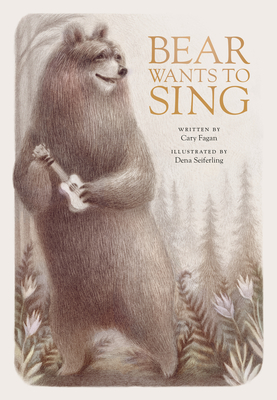
Bear Wants to Sing by Cary Fagan, illustrated by Dena Seiferling (9780735268036)
This is a follow up to King Mouse from the same creative team. Out on a walk, Bear discovers a ukulele in the grass. Bear plucked a string and thought of a song. Mouse was there on a stump, all ready to listen. Then a crow arrived an found a tambourine in the grass. She immediately sang her song for Bear and Mouse. Snake arrived next and discovered a drum, which she used to sing her own song before Bear could start his. Tortoise was next with a horn and a song. Then Fox appeared and thought they should start a band and she could be their manager. Finally, it was time for Bear to sing his song. When the others didn’t praise it, he headed away. But one friend isn’t ready to let him leave entirely.
There is a beautiful delicacy to the story and the illustrations that work deliciously together as a whole. Fagan uses repetition in the story with the series of interruptions before Bear can sing his song. There is a wonderful tension that readers and the bear feel as he is preempted again and again. It’s also a treat to have a moment of such humor in the center of this thoughtful book which then returns to its previous tone but retains a wry grin.
The illustrations are done in graphite and colored digitally. The digital color is so pale that it is a whisper of color at the edges of the scenes with pale green leaves, a brown bear, and some flowers with a glimmer of pink. They are subtle and lovely, offering space for song and performance.
Thoughtful and lovely, this book explores friendship, sharing the limelight, and being true to yourself.
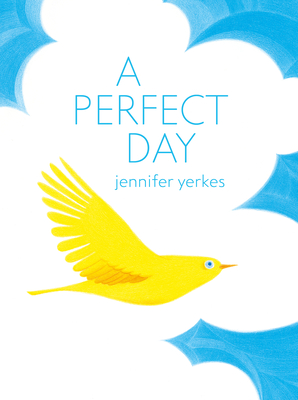
The day starts with a peaceful song of birds and crickets. The hornets buzz in and out of their paper nest and the frogs croak from the lily pads. The melody continues through the morning, until the weather changes. Dark clouds enter the sky accompanied by the crash of thunder cymbals. The rhythm of falling rain takes up the beat. The rain drives down, filling the air. Then it ends with plunks of drops into puddles. The symphony is complete.
This picture book is beautifully simple. The text is carries the theme of music throughout the day, applying it cleverly to the sounds of the meadow. The various noises made by the animals will have children joining into the noise and creating their own music along the way. Admirably even with the onset of the storm, the pacing and feel of the book stays the same. There is no panic at the natural storm but a calmness that accompanies the noise and rhythm.
The illustrations are done with lovely fine lines that celebrate the vegetation and inhabitants of the meadow. Most of the animals are given a color that is their own from the orange fox to the green frog to the yellow bird. This will invite conversation about the illustrations, colors and what is happening on the pages. Some of the pages are wonderful in their simple drama such as the spread of rainfall that covers the meadow.
A musical look at nature. Appropriate for ages 2-4.
Reviewed from copy provided by Eerdmans Books for Young Readers.
Jazz for Lunch! by Jarrett Dapier, illustrated by Eugenia Mello (9781534454088)
A boy heads with their Auntie Nina to a jazz club for lunch. The musicians play while the chefs in the kitchen cook, their sounds mixing together. But it’s so crowded that they can’t get to the front and can’t get any food either. It gets hot too, so the two head out and Auntie Nina has a new plan. The next day, the two of them set up in the kitchen. They listen to jazz on the stereo and start cooking together. There is cinnamon, peanuts, chicken, cheese, and much more, as they name the dishes after jazz icons. Soon it is the boy’s turn to have a drum solo played on the pots and pans. A knock comes on the door, and it’s all of the jazz musicians from the club. They share a great meal together. Now what’s for dinner?
This book cleverly demonstrates the improvisation of jazz music through having to change their plans for the day. That theme is also part of their cooking as their free-flowing style continues there with plenty of style. The text throughout the book has rhyme and rhythm. Dapier uses repetition of the phrase “Jazz for lunch!” throughout the book to great effect.
Mello’s illustrations are filled with bright colors of saffron, tomato, melon and blueberry. The illustrations swirl with movement, whether it is music moving through the air or ingredients dancing into the pan.
A delightful jazz riff on food. Appropriate for ages 3-6.
When Shaheen can’t find her father anywhere, she and her cousin Tannaz try to figure out where he might have gone. They check out the vintage record store he loves, but it’s closed and the owner is nowhere to be found either. The two girls decide to break into the store and discover an unplugged jukebox. When they play one of her father’s favorite records, the jukebox takes them back in time to when the songs were being performed at a concert. At the end of the record, they are taken back to their regular lives. As the girls work to figure out why Shaheen’s father hasn’t returned, they also learn that there is a cost to time travel and one that they may have to risk to save him from the past where he is trapped.
This graphic novel for middle grades is a wonderful mixture of music and time travel. The various songs that they time travel with feature well-known musicians and then are artfully combined with social justice moments in history. The story centers on the two Indian-American protagonists who are different from one another but willing work together to solve the mystery. With a look at race and civil rights, the two girls traverse time learning a lot along the way.
The art is fresh and colorful. Using a time travel visual as well as record covers, it has a clear distinction between the modern part of the story and the historical events the girls witness.
A groovy graphic novel worth a spin. Appropriate for ages 9-12.
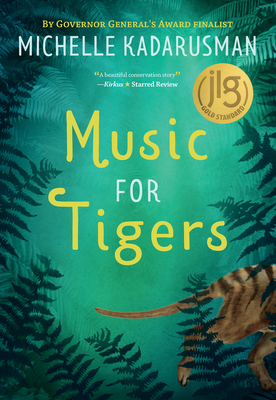
A musician in a family of conservationists and scientists, Louisa finds herself sent away from her home in Canada for the summer to spend time in Australia with her mother’s family. In the remote Tasmanian rainforest, the family has a camp run by her Uncle Ruff. She has brought along her violin, determined to spend time practicing so that she can successfully compete, something her nerves when she plays publicly haven’t allowed her to do. A local resort owner’s son quickly becomes friends with Louisa, who is one of the first teens not to mock his autism and his quirky behaviors. Louisa also learns more about the camp, which is actually a sanctuary created by her great-grandmother to protect the Tasmanian tigers, thought to be extinct. At least one of these large dog-like marsupials may still live on Convict Rock, an island nearby. With a mining operation soon to destroy the sanctuary and the island, they have to work quickly to save this last tiger. By reading her great-grandmother’s journals, Louisa realizes she may be the key to its survival.
This book transports readers into the Tasmanian rainforest. Written with a focus that keeps its length nicely manageable, the novel doesn’t ever feel rushed. Instead it is a journey personally for Louisa through her own fears of performing to a desire to save a creature from true extinction. Her steadily building connection to the Australian wildlife and environment allows readers to explore it as well, falling just as hard as Louisa has for its unique habitat.
This is an environmentalist book that takes a different path. It doesn’t lecture at all, instead allowing immersion within a singular place to really speak to its importance, the vitality of threatened species, and the need to take action. All of the characters are well drawn and complete, filled with multiple dimensions that make them interesting to spend time with in this beautifully described natural wonder.
Amazing writing, vivid characters and lost species come together into a marvelous read. Appropriate for ages 10-13.






 Waking Brain Cells