Echo Echo by Marilyn Singer

Echo Echo by Marilyn Singer

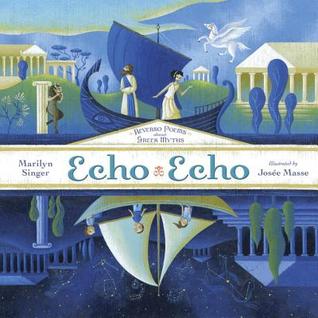
Echo Echo by Marilyn Singer, illustrated by Josée Masse  (InfoSoup)

Singer returns with another collection of her amazing reverso poems this time focusing on Greek mythology. The format which has poems which read one way read forward and another way read in reverse, looks at myths from two divergent points of view. This is particularly effective with Greek myths because they so often have two points of view embedded in them. The poems focus on myths such as Pandora’s box, King Midas, Medusa, Icarus and Narcissus. Though brief, these poems capture the essence of each myth, exposing their complexity in a few choice words and phrases.

Singer has done it again. Her amazing reverso poems must be read with care by young readers who have to pay close attention to punctuation to see the difference in meanings between the two poems. The poems are dazzling as they lay open the themes of each myth, the drama being played out in the story and the differing points of view of the main characters. This is one intelligent display of word play that is incredibly difficult to even imagine doing.

Masse’s illustrations each play upon the theme of different sides or points of view. With visual lines down the middle, the two sides both work together as a whole and show the differences between the two poems. The illustrations echo the poems closely, offering a visual feast in addition to the richness of the words.

Another winner for Singer and her reverso poetry, classrooms teaching mythology will love to have this book on hand for accessible and bite-sized looks at many myths. Appropriate for ages 6-9.

Reviewed from copy received from Dial Books.

Review: A Song for Ella Grey by David Almond

A Song for Ella Grey by David Almond

A Song for Ella Grey by David Almond

The Greek myth of Orpheus and Eurydice is transformed into a tale of modern English teens in this masterful novel. Claire and Ella are the closest of friends, in fact Claire is in love with Ella. The two spend all of their time together and with their larger group of friends. When Ella is forbidden to go on the trip with all of the friends to the beaches of Northumberland, Claire goes without her. Throughout though, Claire is longing for Ella. Then she meets Orpheus, a strange and handsome musician whose music is so powerful that all of nature seems to stop when he plays. She calls Ella and holds the phone out so that Ella can hear the music too. That one impulsive moment sets in motion a story of profound love, deep loss, death and beyond.

Almond’s own writing is like the music of Orpheus. It creates an intoxicating blend of timeless Greek myth and wild modern teens. The girls become legends, their longing the desire of ages, their love the love to last all time. Orpheus is directly from myth, a wanderer who is captured in a love that seems to have been in existence for all time. There is such beauty here, not only in the myth itself but in the characters too. This book speaks to the power in each of us to live a story, a legend, a myth and to love in that way too.

Almond’s language is exquisite. His writing flows around the reader, inviting them into the magic that is happening on the page. He focuses on small things, showing how the tiny things in life are the most profound from falling rain to trees in the wind to sand drifting by. It is Orpheus’ music that brings these things to life for his listeners. And the reader falls in love with him alongside Ella, never having heard the music itself but having felt its impact to their bones.

Beautiful, mystic, and mythical, this book is a love song for young people, capturing the tumultuous feeling of tumbling into love and the tenuous nature of life and death. Appropriate for ages 14-17.

Reviewed from ARC received from Delacorte Books for Young Readers.

Review: Antigoddess by Kendare Blake

antigoddess

Antigoddess by Kendare Blake

Published September 10, 2013.

From the author of Anna Dressed in Blood comes the first book in a new series, The Goddess War.   The Old Gods have been around forever and knew that they would be around for eternity.  But then Athena started to sprout feathers under her skin and in her lungs.  Hermes started to lose weight and become emaciated.  They started to do the impossible: they began to die.  Desperate to find a solution, Athena and Hermes search out Cassandra, the prophetess, who is an regular teenager but one who has visions and is linked to the ancient Cassandra from Troy.  There are more Gods involved though.  Apollo is there to protect his beloved Cassandra.  Hera is moving to survive while the other Gods die and Poseidon is throwing his considerable power behind her.  This is one God-sized epic throwdown that you will not want to miss!

Blake’s world building is incredible here.  While she builds off of Greek mythology, she has created a scenario where the Gods are humanized through their mortality.  They are still amazing, wondrous beings, but somehow Blake manages to mix that with a fragility that makes them accessible in a new way. 

Her writing is fresh and vivid both in character development and in the many action scenes.  Danger seems to lurk everywhere and there are wonderful moments where the shock of violence after being lulled away is breathtaking. The book is so filled with violent action scenes that it is completely compelling to read. 

Vivid and dazzling, this book will appeal to fans of Greek mythology and fantasy novels.  Appropriate for ages 15-18.

Reviewed from ARC received from Tor.

Review: Mouse Bird Snake Wolf by David Almond

mouse bird snake wolf

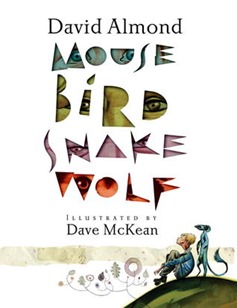
Mouse Bird Snake Wolf by David Almond, illustrated by Dave McKean

From the author and illustrator who brought us The Savage comes this new book.  Three children, Harry, Sue and Little Ben, live in a world that is calm and lovely, but also incomplete.  They look around and see gaps where objects or things could be, but are not.  Up above, the gods are sleeping.  They are quite proud of the world they have created and spend lots of time bragging about what they have already done.  None of them are interested in creating anything new or filling any of the empty spaces.  The children though do have the drive to do just that.  So they create creatures out of twigs and leaves and dirt.  Their ideas start small but quickly grow to a frightening level.  Can anything be done once a thing is created?

Almond is not afraid to head right to the strangeness that keeps others at bay.  In fact, that’s right where he takes readers: to those dark and dangerous spots that others steer from.  Here he comes at that place through a mythological tale of bored gods and sparklingly intense children.  From the title alone, you know there is danger ahead, but what a ride it is! 

McKean takes those dark ideas and makes them visible to all.  Lest we think that Almond is speaking in broad terms and using metaphors, McKean’s art makes it all completely real and tangible.  Done in sharp angles and lean faces, there is a marvelous hunger throughout these images that shows in the eyes and postures.  It’s such an ideal fit for the story. 

Dark and dangerous, this book is not for everyone.  Fans of Almond and McKean though should cheer this new book from the team.   And once you start, I dare you to be able to look away!  Appropriate for ages 8-12. 

Reviewed from library copy.

Review: The Year of the Beasts by Cecil Castellucci

year of the beasts

The Year of the Beasts by Cecil Castellucci and Nate Powell

Told in chapters that alternate Castellucci’s writing with Powell’s graphics, this is the story of two sisters.  When the summer carnival comes to town, Tessa, her younger sister Lulu and her best friend Celina get to go to the carnival without their parents for the first time.  After meeting up with a group of boys they know, the three girls and the boys head to the sideshow tent with its darkness and opportunities.  But Tessa’s plans don’t quite work out, and the boy she has a crush on, Charlie, ends up entering the tent with Lulu instead.  Tessa is left to go in with Jasper, a boy who is known as a strange loner.  When they exit, Tess has rebuffed Jasper’s attempts to kiss her, but something has obviously happened between Charlie and Lulu that has sealed them together as a couple.  Now Tessa has to deal with her jealousies and their dark results.

Castellucci’s prose is lush and wild.  The emotions in the book sizzle, coming right off the page.  On page 97, there is a great example of this:

If there were such a thing as a dark cloud over someone’s head, Tessa had one.  It was a stormy little thing.  With hail and lightning and thunder.  And no silver lining.

She explores the feelings of confusing lust and potential love, the ability for those same feelings to alienate and discourage, and the intensity of sisterhood.  The book is character-driven with Tessa at its center in all of her confusion, desperation to not be jealous, and constantly feeling as if she is second best.  There are no easy answers here, nothing is let go of easily, and emotions twist and turn.  It is a beautiful storm of a book.

Then you have the other chapters done in graphic novel format that show Tessa as Medusa with her nest of snake hair.  The graphic portion moves along in advance of the text portion, foreshadowing things that are yet to come.  Medusa finds that her school is also filled with other monsters, her best friend is a mermaid, and Charlie is a centaur.  She has turned her parents to stone with her gaze and now must live with the consequences of that unless she is able to reawaken as a human again. 

The pairing of these two makes this book even more original and powerful.  It also makes the book much more welcoming for reluctant readers or those who have discovered Castellucci through her graphic novels. 

An emotional ride of a teen novel done with beauty and power, this book has an innate appeal thanks to its graphic novel portion and the dynamic writing.  Appropriate for ages 13-16.

Reviewed from copy received from Roaring Brook Press.

Odd and the Frost Giants

Odd and the Frost Giants by Neil Gaiman, illustrated by Brett Helquist.

Odd’s father died on a Viking ship, leaving Odd and his mother behind.  A few weeks later, Odd tried to chop down a tree with his father’s axe and ended up shattering his leg.  Now he still walks with a limp and is teased and mocked at home.  Tempers are rising in the village because spring should have come but winter continues its hold on the land.  Odd heads off to his father’s hunting lodge to escape the increasing teasing.  There he meets three animals: an enormous bear, a fox and an eagle.  The three turn out to be Norse gods who are trapped in animal form and banished from Asgard which has been invaded by Frost Giants.  Can one limping boy and three animals get back into the land of Asgard, bring peace and return spring to the land?

Neil Gaiman has written a small jewel of a book about an unexpected hero.  It is a focused story told in a voice that is meant to be shared aloud.  Odd is a pleasing character.  A smart boy with a sad past who is braver and stronger than anyone knew.   Gaiman’s language here is plain and simple, the story short and fast-moving.  Yet at the same time this is not a shallow piece.  It has heart and plenty of depth.  The occasional illustrations by Brett Helquist add to its friendliness for young readers and offer tantalizing glimpses of Odd’s world.

Any teacher doing a unit on mythology should add this book to your list.  It will also be useful with reluctant readers who will enjoy the direct story and the fast pacing.  Appropriate for ages 8-11, younger for reading aloud.  This is a perfect book for cold winter nights.

Reviewed from library copy.

Reviewed by Tor, Charlotte’s Library, Eva’s Book Addiction, and Chasing Ray.