Waiting for High Tide by Nikki McClure

Waiting for High Tide by Nikki McClure

Waiting for High Tide by Nikki McClure (InfoSoup)

On a summer day, a boy waits for high tide. He’d love to swim but he’d just get muddy or even stuck. The other animals on the seashore are waiting for high tide too, six long hours. But today is a special day, the boy and his family are going to build a raft. They found a big log and have cut it into three sections. The boy plays on the shore, finding treasures along the way including a pair of pink glasses with one eye covered in barnacles. They work hard on the raft as the water comes in closer and closer. When they stop for lunch, the boy sees birds eating too. The raft is finally ready but there is still time before high tide, so they eat cookies and wait. Finally the raft floats and there is time for jumping, swimming and enjoying the perfect summer day.

McClure proves here that she is as much a writer and poet as an artist. She writes with a depth that is lovely to see in a picture book, offering real insight into the natural world. She also writes with a childlike eye and attitude, drawing parallels between the human world and the natural one. There is an engaging mix of fonts in the text, some of the text large and capitalized in a way that conveys excitement and time passing. The passage of time is such a focus here as the tide slowly comes in. It is a book that celebrates slower times, lingering before enjoying the reward of your hard work.

As always McClure’s art is exceptional. Her cut paperwork is filled with details. The scene of the boy in the barnacle glasses as he explores the shoreline is filled with such tiny details that one can look for some time before you see the chipmunk peeking over the log or the five dollar bill. This is a book for spending some slow time of your own on.

Based on McClure’s own family, this picture book is a quiet look at nature and spending time outside. Appropriate for ages 6-8.

Reviewed from copy received from Abrams.
Maybe a Fox by Kathi Appelt and Allison McGhee

Maybe a Fox by Kathi Appelt and Allison McGhee

Maybe a Fox by Kathi Appelt and Allison McGhee (InfoSoup)

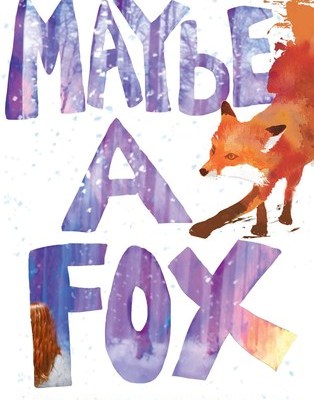
Jules and Sylvie are sisters, just one year apart. They live with their father in a house that backs onto a woods with a river. There is one part, the Slip, where the girls are forbidden to go, since it’s so dangerous, where the river goes underground. When the girls awaken to late spring fresh snow, Sylvie just has to run down to the river to make a wish. Her wishes are always the same, to run faster. Jules is left behind at home after the two make their snowman family together. Jules waits and waits, but Sylvie does not return. That’s when Jules discovers that Sylvie has disappeared into the river. It’s also when a pregnant fox feels a spirit enter her female cub, a special spirit that has a connection to humans, specifically Jules. Two young females, a fox and a girl, both searching for what is missing and both unable to turn away from their shared bond.

Appelt and McGhee have written a blazingly beautiful novel that pairs adept writing with a powerful connection to nature. The book begins on a spring day filled with snow, a magical time. But even at the beginning there is foreshadowing that something is going to happen, there is the danger of the Slip, the speed of running, a certain desperation, a dead mother. It all adds up gracefully and powerfully to danger and then death. It’s the glorious writing that allows that to be both shocking and also entirely expected too.

The part of the story with the fox brings a richness to the story, another piece that falls into place of animals that have connections and even responsibilities. It too is written with a beauty and a combination of real understanding of foxes and wild animals and then also a haunting connection to death. The entire book also relies on its setting that is shown from human point of view and then again with different terms in the fox viewpoint as well. That element helps to sew the two halves of the book tightly together into a whole. A whole that sings about death, about loss, about grief, and about the power of nature to heal.

Incredibly moving and richly detailed, this novel is a powerful read. Appropriate for ages 9-12.

Reviewed from copy received from Atheneum.


Little One by Jo Weaver

Little One by Jo Weaver

Little One by Jo Weaver (InfoSoup)

As Big Bear leaves her den in the spring, she has a tiny baby cub along with her. The two explore their world together as the baby bear learns to survive in the landscape. They swim together, eat berries, catch fish and play. The baby bear grows and thrives alongside Big Bear. The seasons keep changing from spring to summer to the blustery weather of autumn and the geese flying overhead. Big Bear leads her Little One back to their den, but not before they take a long last look at their world, sitting on a high hill and seeing the water, the forest and their domain below.

The text of this picture book is gentle and lovely. The tone is pure warmth and care, a mother bear who is not going to leave her little one’s side and one who is dedicated to the safety and growth of her little cub. The text celebrates the connection between the two bears and then their connection to the natural world around them. It’s a touching look at a family and then at their world too.

The illustrations are simply stunning. Done in charcoal, they are filled with light, with flowers that seem to bob on the page. Often there are sprigs of leaves and grass done in white in the foreground, caught in a sunbeam coming from off the page. This luminous effect is particularly effective and breathtaking.

A simple and gorgeous book about mothers and children and the incredible beauty of nature. Appropriate for ages 2-4.

Reviewed from library copy.

Tree by Britta Teckentrup

Tree by Britta Teckentrup

Tree by Britta Teckentrup (InfoSoup)

The seasons pass as an owl looks out of a hole in a tree in this engaging picture book. Beginning in winter, owl is alone in the cold landscape. When spring comes, the snow melts and buds form on the tree. Baby bears play and climb the tree’s trunk. Leaves and blossoms form and squirrels, birds and fox cubs arrive. With summer, the apples start to form on the tree and the tree spends long warm nights swaying in the breeze. Autumn comes with colder temperatures and the animals start to leave. Apples fall to the ground and the tree’s leaves turn red and fold. Snow comes and winter arrives. Soon everyone is gone, even the owl. But he is peeking out again soon as spring comes once again.

Teckentrup uses simple rhymes to tell the story of one large tree and the ways that it supports the ecosystem around it. The seasons are clearly noted in the rhymes, the changes explained and each one is celebrated for how unique it is. The various animals too change what they are doing as the weather shifts. This is a dynamic book about weather and seasons.

It is the illustrations that make this book so noteworthy. Teckentrup’s cut out designs allow each page turn to show the owl for most of the book but also to add the other animals as they appear in the story. Then as the story reverses and the animals leave, the cut outs play out that way too.

A clever and striking look at one tree, one ecosystem and many seasons. Appropriate for ages 2-4.

Reviewed from copy received from Random House.

The Perfect Tree by Chloe Bonfield

The Perfect Tree by Chloe Bonfield

The Perfect Tree by Chloe Bonfield (InfoSoup)

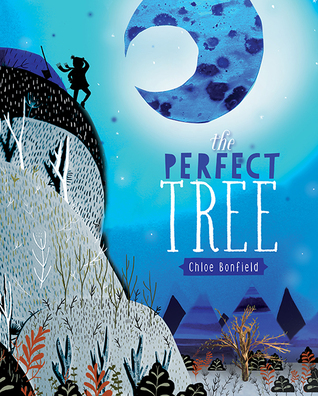
Jack headed out to find the perfect tree, one that was just right to chop down for firewood. But he was having trouble finding that perfect tree. Jack finally sat down under a tree in the forest in despair. Then a woodpecker offered to help Jack find the perfect tree. She flew to a tree and after knocking on a branch all sorts of birds flew out of it. Then a squirrel said that he too could show Jack the perfect tree. Taking Jack into a great oak tree, the squirrel revealed his stash of nuts and berries for the winter. Next a spider showed Jack her favorite tree where a web hung filled with water drops. It was then that Jack was inspired by the rain to find another perfect tree that was just right to stay dry under.

Bonfield has written an ecology picture book that focuses not on how wrong it is to cut down trees, but instead how the definition of “perfect” means different things to different creatures. And how your appreciation of an object in a new way leads to changes in the way you see the world. I appreciate that the book does not lecture about the environment or appreciating nature. Instead the book focuses on the beauty of nature and how it can transform us if we pay attention.

Bonfield’s illustrations are amazing. Done in papercut images and collage, they form two and three dimensional structures and then are lit so that there are shadows that play against other parts of the illustration that glow. The result is a picture book landscape that feels immersive and tangible.

A clever look at the pursuit of perfection and the power of nature. Appropriate for ages 4-6.

Reviewed from library copy.


Glow by W.H. Beck

Glow by WH Beck

Glow: Animals with Their Own Night-Lights by W. H. Beck (InfoSoup)

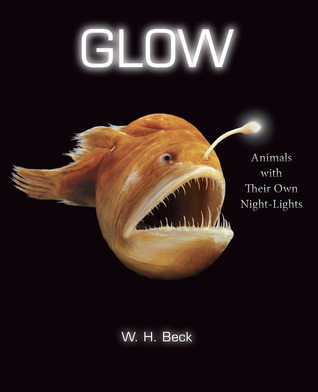
This nonfiction picture book invites young readers to explore the world of bioluminescence. Set against black backgrounds these glowing creatures pop on the page. The book not only shows different organisms that glow, but also explains why they glow too. Children will learn the terms for the chemicals that allow the light to be created and also see that there are some creatures who glow but no one knows quite why. Filled with dazzling photographs, this is a book that will fly off the shelves of public libraries as kids are hooked by the fish on the cover.

Beck has the book written at two levels. The larger font offers a less specific look at the organisms themselves and therefore a simpler experience. The smaller font allows readers to learn more about each creature. More information on each is also found at the end of the book where size, Latin name, and the depth they live at is given for each. This is a book that is engaging and fascinating. The text is restrained and focused, offering enough information to appeal but never standing in the way of the dazzling creatures themselves.

The photographs in the book are exceptional. Each shows the light of the creature against a black background, allowing that creature attention by the reader. The photos were taken by several different photographers, yet they make for a cohesive book thanks to their similar nature and the beauty they depict. I particularly enjoyed the firefly photo and the glowing shoreline.

An awesome book that is sure to appeal to children who enjoy nature and bizarre creatures, this is a winning science book for public libraries. Appropriate for ages 4-7.

Reviewed from copy received from HMH Books for Young Readers.

What in the World? by Nancy Raines Day

What in the World by Nancy Raines Day

What in the World?: Numbers in Nature by Nancy Raines Day, illustrated by Kurt Cyrus (InfoSoup)

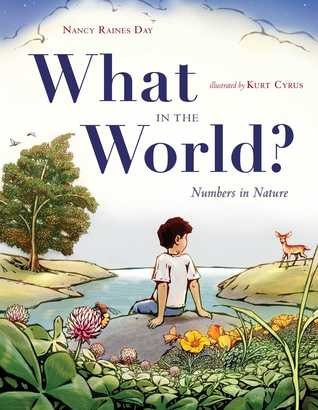
In this rhyming counting book, the concept of numerical sets is introduced. The book opens asking “What in the world comes one by one?” It then answers, explaining that the moon, your nose and your mouth come in singles. Then the book counts upwards, each time asking the question of what comes in that set and answering it. The book ends by looking up at the stars and the infinity of them. It invites young readers to start to think about the patterns in the natural world around them.

Day has created a rhyme that makes this book an engaging mix of poetry and science. As the rhyme dances along, the book will inspire conversation and thinking of more things that come in that type of set. The book is wisely limited to a coastal area where a young boy plays, dangling his toes and fingers in the water, sets of ten.

The art is simple enough to allow this book to be both a counting book and a book about sets. Smaller children will merrily count the nine spines on the back of a fish while older children will start to think about other things in their world that match the set. The digital art is bright colored, and cheery.

An engaging math book that can be read at different levels, this rhyming science book will be enjoyed by several ages of child. Appropriate for ages 3-5.

Reviewed from copy received from Beach Lane Books.

Review: Amazing Places by Lee Bennett Ho

Amazing Places by Lee Bennett Hopkins

Amazing Places selected by Lee Bennett Hopkins, illustrated by Chris Soentpiet and Christy Hale (InfoSoup)

This collection of fourteen poems celebrate various places throughout the United States. The poems celebrate moments spent in these places, from a visit to Chinatown in San Francisco to camping in the Denali National Forest. Each area has its own flavor, captured both in words and in the rich illustrations that accompany each poem. There is a dynamic mix of nature and man-made places that take the reader on a journey that will inspire future visits and exploration.

The poets included in this anthology are exceptional and include Nikki Grimes, John Bruchac, Janet S. Wong, Alma Flor Ada, J. Patrick Lewis, and Prince Redcloud. The diversity of these authors is exceptional and their voices weave together into a rich tapestry that remind all readers that this is what our nation is all about. The beauty of these different perspectives on these beloved parts of our nation adds yet another layer to the effectiveness of these poems. More information on each place is offered at the end of the book.

The illustrations are rich and filled with diversity too. Some images evoke nature and the movement of water and wind while others are filled with fine lines that create very realistic and detailed images. People of different races filled the pages, none of them placed in the more stereotypical settings but instead diversity is expanded as children explore museums and sites from different backgrounds than their own.

Chock full of diversity on a variety of levels, this book embraces the rich tapestry of America. Appropriate for ages 7-9.

Reviewed from e-galley received from Edelweiss and Lee & Low Books Inc.

Review: North Woods Girl by Aimee Bissonette

North Woods Girl by Aimee Bissonette

North Woods Girl by Aimee Bissonette, illustrated by Claudia McGehee (InfoSoup)

A girl tells about her grandmother who is not like other grandmas. She dresses in Grandpa’s old flannel shirts and she’s bony. She doesn’t bake cookies or pies, but she does take long walks out in nature. With her trusty walking stick, the two of them explore the little paths near Grandma’s house. Every season there are new things to see, things in the garden to do. The two love winter best of all, especially winter nights with a full moon when they explore the snowy woods. Grandma may not be like other grandma’s but she’s pretty special and a north woods girl to the quick.

Bissonette captures the spirit of a north woods woman beautifully in her picture book. From the no-fuss long grey braid, the flannel shirts, the stout boots to the way that nature speaks to her and that she knows it so well. This book is a celebration of the north woods too, the ways that the woods changes in different seasons, the animals that fill it, and the glory of a winter woods.

McGehee’s scratchboard illustrations have a rustic beauty. The colors are deep and lovely, and they capture the spirit of the woods. In fact, there are moments when you can almost smell the pines and the grass. There is a subtle multiculturalism here too with the little girl’s darker skin tone and curly hair. The pages are crowded with details of the woods, filled with animals and insects.

A lovely look at the northern woods, this picture book celebrates unique grandmothers living in a unique place. Appropriate for ages 3-5.

Reviewed from copy received from Minnesota Historical Society Press.