Review: Miss Maple’s Seeds by Eliza Wheeler

miss maples seeds

Miss Maple’s Seeds by Eliza Wheeler

This book will sweep you up like a breath of brisk autumn air.  Miss Maple is a little woman who spends her entire summer searching for seeds that have not gotten planted in the spring.  She brings them back to her maple tree and nurses them back to strength.  She washes them off, warns them to take care because they are so small, takes them on field trips to learn about being a seed, and reads them bedtime stories.  In winter they all burrow down together and fill the time with songs and stories.  Then when spring arrives, the seeds learn to dance in the rain and sink into muddy ground.  In May, it is time for the seeds to find the places they will grow, so Miss Maple launches them off.  Miss Maple then starts her journey with the seeds all over again, heading off on the back of a bluebird to find another year’s worth of stranded seeds.  Lovely and warm, this picture book is a joyous celebration of the seasons and the plants around us.

Wheeler has created a tiny motherly figure in Miss Maple, someone who loves and cares just for the good of the earth.  As the book progresses, she becomes almost a Mother Earth figure as her world turns with the seasons.  Wheeler’s writing is filled with wonderful small moments and details.  Miss Maple reads bedtime stories “by firefly light” and during the winter her animal neighbors share “supplies of hot maple syrup, old corn husks, and juicy fruit rinds.” 

Her illustrations show that same attention to detail.  This small world is filled with little touches that make it come alive.  The frogs in the nearby pond have a house in a log complete with front door and paned windows.  The seeds all sleep in small, cozy beds that are perfectly designed for seeds their size.  Then when Miss Maple launches the seeds off, she does it with winged baskets and other vessels that glow and float on the water.  This is a completely formed world that all readers will want to linger in.

Cozy and lovely, this picture book is a celebration of seasons and the earth, but it is also a reflection on the skill and care of nurturing.  Get this one for your Earth Day units and pull it out when covering seasons too.  Though I think it would be best of all curled up under warm blankets and watching autumn arrive.  Appropriate for ages 3-5.

Reviewed from copy received from Nancy Paulsen Books.
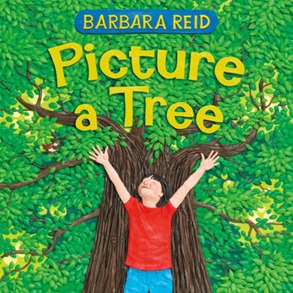
Review: Picture a Tree by Barbara Reid

picture a tree

Picture a Tree by Barbara Reid

How do you picture a tree?  Do you see a drawing on the sky?  A tunnel?  An ocean?  A sun umbrella to stop on your hot walk home?  What do you see?  These are just some of the ideas that Reid puts forward in her picture book that pays homage to trees and their ever-changing beauty.  Starting with the spring and moving through all of the seasons, this book will have you looking into the trees around you and noticing them even more.

Reid’s text here is simple but very effective.  She gets you dreaming of your own answers and also seeing trees from all angles and all seasons.  The true focus here though is her art.  Done entirely in Plasticine clay, they have a wonderful three-dimensional quality to them and are anything but simple.  In fact, the detail is amazing and will keep readers gazing long after they complete the words on the page.

An awesome addition to any Arbor Day, Earth Day, tree-related or seasonal story time or unit, this book should inspire all of us to wonder about trees.  Appropriate for ages 4-6.

Reviewed from library copy.

You can also see the trailer for the book for a glimpse of Reid’s art and words:

Review: What Will Hatch? by Jennifer Ward

what will hatch

What Will Hatch? by Jennifer Ward, illustrated by Susie Ghahremani

This simple little book builds tension through the use of a guessing game and the wonder of waiting for an egg to hatch.  On one page, the habitat and a little description of the eggs are given, with the question of “What will hatch?”  Take a guess, turn the page and find out the answer.  There are lots of surprises along the way.  The clever use of die cuts in the pages that peek through in egg-shaped holes adds to the fun.

Eight different animals are shown here with basic information.  Nicely, there is more information at the end on each of the animals as well as information on chicken egg development.  Ward’s text is particularly simple, just a few phrases with a skip of repetition.  It is the illustrations here that really make the book.  Done in gouache on wood, the images have a lovely texture to them that combines beautifully with the swirling nature of the art.  The texture also reinforces the natural subject matter in a subtle way.

A great pick for toddlers, this book  will keep them guessing as the pages turn.  Expect to have to share it again and again.  Appropriate for ages 2-4.

Reviewed from library copy.

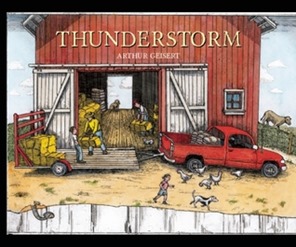
Review: Thunderstorm by Arthur Geisert

thunderstorm

Thunderstorm by Arthur Geisert

Geisert leaves behind his signature little pigs and instead tells the story of a storm rolling through the Midwest.  Follow the course of a red truck filled with sacks and bales of hay as they race the storm to get unloaded in a variety of places.  As the sky darkens, readers also get a glimpse of animal life both above and below ground.  The wind stirs and then roars, a funnel cloud forms and threatens destruction until the wind lowers and the sky clears and it is time to start cleaning up. 

Geisert tells his story with the only words being timestamps below some of the images.  His art is filled with details that make one linger and wonder.  He changes lighting and feeling with tightness of line and colors.  What is most fascinating about the book is that all of the illustrations fit together into one long illustration without any breaks.  It makes me wish that the book unfolded so that I could see it as one long line, but it is very interesting to look at the book in a new way, viewing it differently on a second reading. 

This is a celebration of the power of nature and the way that light changes through the course of a storm.  Geisert mixes in plenty of action and the tension of a family at risk.  Appropriate for ages 4-7.

Reviewed from copy received from Enchanted Lion Books.

Review: My Father’s Arms Are a Boat by Stein Erik Lunde

my fathers arms are a boat

My Father’s Arms Are a Boat by Stein Erik Lunde, illustrated by Oyvind Torseter, translated by Kari Dickson

Published on February 5, 2013.

There are some picture books that you read the first few lines and you realize you are somewhere new and unknown.  This is that sort of book.  It is the story of a young boy who is unable to fall asleep.  His father is there, sitting in the living room by the fire.  The boy returns to his father and climbs onto his lap.  His father talks about cutting down a big spruce together the next day.  The boy asks about the red birds that they left bread for.  He worries about the fox stealing their bread too. His grandmother told him that the red birds are dead people and then the book turns and is about the loss of his mother and grief.  It is handled with such care and delicacy and the young boy is surrounded with such obvious love that it is achingly exquisite.

This book is not really about what I captured in the paragraph above.  It is about sorrow and grief, the sort of sorrow that can only be fleetingly captured in a silent flight of birds or a lone fox in the snow.  It is about the loss of a mother, but also about the days following when grief is all you can bear and think of.  This book reads like a beautiful ache, a heartbeat of grief where life must go on.  The writing is expressive and poetic, just like the title.

Torseter’s illustrations are also unusual and amazing.  Done in folded paper and collage, they have a 3-dimensional quality to them that invites in shadows.  Most of the images are black, white and grey, though the red birds and the orange fox are pops of color.  Beautiful and delicate, the slumps of the shoulders of the characters tell of the sad truth before the words do.  The winter setting too is cold and a bit wild, reflecting the mood of the story.

Stunning in its writing and illustration, this is a picture book that is noteworthy and memorable.  Appropriate for ages 6-8.

Reviewed from copy received from Enchanted Lion Books.

Review: Frog Song by Brenda Z. Guiberson

frog song

Frog Song by Brenda Z. Guiberson, illustrated by Gennady Spirin

This is one breathtaking nonfiction book about frogs.  The book takes a look at various fascinating species from around the world, explaining what makes that species so special.  Delving deeper than skin deep, the strawberry poison dart frog from the cover is celebrated for the unique way she lays her eggs:  five at a time and then when the tadpoles emerge she carries each of them to their own pool of water up in the trees.  Each turn of the page brings another strange and amazing frog with its own unique approach to life.  This is a celebration of frogs that is sure to enthrall any young biologist.

Guiberson has carefully selected frogs that are incredible and unique.  Her writing is filled with frog noises, motion, and even the sounds that whipping a gooey mass of eggs into a ball of bubbles would make.  This adds a certain zing to the writing, making it great fun to read aloud.  You must have your ribbit on to pull this one off.

Spirin’s illustrations are simply amazing.  Filled with more all the great details you would get from a photograph, they are superbly realistic.  Turning the pages shows the breadth of frog life on our planet.  The vitality and also the fragility of these animals is highlighted in her art.

Beautiful, intriguing and great fun to read, this book is an impressive testament to the importance of frogs in our ecosystems.  Appropriate for ages 7-10.

Reviewed from copy received from Henry Holt and Company.

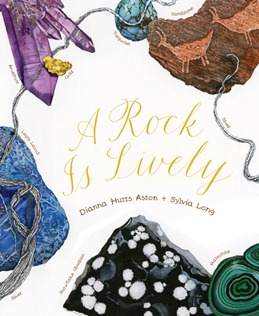
Review: A Rock Is Lively by Dianna Hutts Aston

rock is lively

A Rock Is Lively by Dianna Hutts Aston, illustrated by Sylvia Long

Another stellar collaboration by the team that created An Egg Is Quiet, A Seed Is Sleepy, and A Butterfly Is Patient, this nonfiction picture book focuses on rocks and minerals.  The book begins with rock melted as magma beneath the earth.  It talks about what makes up rocks and how old they are, as well as the rocks that we find in space.  Rocks as tools and weapons are explored, mixed in with the amazing rock interiors that surprise and delight. The different types of rocks finish off the factual piece of the book, but the bright and beautiful illustrations continue all the way to the final lapis lazuli endpages. 

Aston manages to write nonfiction as if each sentence is filled with delight.  Her enthusiasm for the subjects she writes about is evident in her writing, inviting young readers to get just as interested as she is.  The art carries that same enthusiasm in its bright colors and details.  Done in watercolor, the colors are surprisingly deep and lush. 

If you have the first three books from these amazing collaborators, this is a must-buy.  It should be on the shelves of any school or public library, sure to get young people exploring a new subject.  Appropriate for ages 7-9.

Reviewed from copy received from Chronicle Books.

Review: Island: A Story of the Galapagos by Jason Chin

island

Island: A Story of the Galapagos by Jason Chin

Follow the birth of a group of islands to the present day in this book that beautifully documents the wonders of the Galapagos.  Opening with the drama of a volcanic eruption six million years ago, the book shows how plants and animals arrive at a new island in the ocean.  As time goes by, the island turns from barren rock to a place of lush green.  Specific attention is paid to the evolution of creatures and plants that are found only on these islands.  Young readers will fully understand why finch beaks grew larger, seagulls got larger eyes, and tortoise shells changed shape.  The book ends with Darwin arriving on the shores of one of the islands.  This book is a celebration of these islands and the wonders of nature.

Chin’s book offers information that is solid and fascinating packaged with illustrations that capture the details of what is being explained.  It makes for a book that is bright and energized and that is clearly nonfiction as well.  The story of the birth and life of an island makes for a magnificent tale that readers are sure to respond to.

In his art, Chin brings the reader up close to what is happening on the island.  We get to look between the mangrove roots at sharks, watch pelicans feast on fish in the lagoons, and see land iguanas float on logs to reach the island.  Even better, as I mentioned earlier, the process of evolution is detailed so that readers can see the gradual but necessary changes that occurred.

This is one incredible nonfiction book that teachers, parents and students will enjoy looking through and learning from.  Appropriate for ages 6-8.

Reviewed from library copy.

Review: Mossy by Jan Brett

mossy

Mossy by Jan Brett

Mossy loved living at Lilypad Pond.  She spent so much time along the banks that moss and then small plants started to grow on her shell.  She became a walking garden and liked to look at her reflection in the water to see how her garden was growing.  On day, she met a male turtle named Scoot at the pond.  The two were smitten immediately.  But just as they were about to meet, Dr. Carolina, who owned a museum, picked up Mossy and took her away to be the center of a new display.  Mossy spent several seasons at the museum, missing Scoot but being well cared for.  She was a very popular exhibit.  So when Tory, Dr. Carolina’s young niece, noticed how sad Mossy seemed and how lonely, there was a big decision to be made.

Brett’s story speaks to the importance of leaving living creatures in their native habitat to live their own lives.  It is a subject handled delicately here with no abusive storyline at all, just a general sense of sadness, which is perfect for young children.  The book is set at the turn of the century with the clothing and use of horse-drawn carriages giving clues.

As always, Brett’s artwork is simply beautiful.  In each two-page spread, she gives the main image a frame and then has several additional pictures that either add to the story or the setting.  We get to see different plants up close, glimpses of the museum even when it is not in the storyline, and Scoot waiting at the pond. 

This is not a book to be read quickly or with a group, instead it’s one to linger over and see the details of the artwork.  Appropriate for ages 4-6.

Reviewed from copy received from G. P. Putnam’s Sons.