Review: Step Gently Out by Helen Frost

step gently out

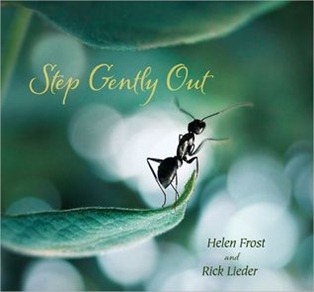
Step Gently Out by Helen Frost, illustrated by Rick Lieder

This picture book celebrates looking closely at the small things in the world around us.  Through a poem that focuses on the insects that you can notice if you slow down and take the time, Frost quietly reminds us all that there is another world beside our own that we often ignore.  Ants are climbing up stems, honeybees buzz past, crickets leap and spiders spin webs.  Children will get to see these insects up close, larger than life in the gorgeous photography that accompanies the poem.  It’s a perfect invitation to take a closer look.

Focusing on the more common insects in our gardens, the poem celebrates the ants, bees and moths that surround us.  Frost speaks about them very poetically, bathed in golden light or shining with stardust. 

Her gentle poem pairs beautifully with the artistic photography that features close ups of the insects in the poem.  The images are stunning and lovely, each focusing closely on an insect.  The morning dew image alone is a breathtaking photograph, but there is one after another that are exceptional.

Combining nature and poetry, this book celebrates both.  It also inspires mindfulness and a slower pace, so that children can make discoveries like this of their own.  Appropriate for ages 4-7.

Reviewed from library copy.

Review: Green by Laura Vaccaro Seeger

green

Green by Laura Vaccaro Seeger

Wow.  That could be my entire review, just WOW.

Let me try to do better than that though.  Seeger looks at the different sorts of green that surround us.  There is sea green, shown with a turtle gliding through not only green but purples, reds, oranges and yellows too.  Lime green, pea green, faded green and fern green.  There are odd sorts of green too like wacky green, slow green and even no green at all.  The book is written simply with only a couple of words per page, making the focus of the book the illustrations.  And what illustrations they are.  This is my pick for the Caldecott winner so far this year. 

The illustrations are paintings that are done with plenty of thick paint, the brushstrokes visible making the pictures tactile.  They have a great depth of color and maintain a playful lightness that speaks to the young audience.  Turn the first page and you will be astonished to find die cuts in the page, done so smoothly and carefully that they don’t ever look like holes in the page until the page is turned. 

The book is a delight of surprises, new perspectives, and just speaks to everything that this format can be for children.  It is an unrivaled success as a concept book.  Appropriate for ages 2-4.

Reviewed from copy received from Roaring Brook Press.

Review: North: The Amazing Story of Arctic Migration by Nick Dowson

north

North: The Amazing Story of Arctic Migration by Nick Dowson, illustrated by Patrick Benson

This poetic look at the amazing Arctic starts with the deep winter and the few animals who survive there year round.  Then spring comes to the Arctic and the sun comes back along with some warmth.  Plants start to appear from under the snow.  Soon more animals will arrive.  The first to head out on their journey are the gray whales, that swim from Mexico to the Arctic Circle.  Birds head north too in flocks.  Herds of pregnant caribou journey north, followed closely by the gray wolves looking for weakness.  Walrus, narwhal, schools of fish, all of this life crowds the Arctic summer until the weather turns cold and brutal again, and once more they head back around the world.

Dowson’s words are poetry in this book.  Not only written in verse form, they also speak to the soul of the Arctic, the beauty of the place and the glory of the creatures who live there.  At the same time, the words are scientific and filled with information about the place and the animals.  It is an elegant combination of poem and fact.

Benson’s art is striking.  He created paintings that are both natural and accurate but also have a sense of artistry.  Much of the art is about the landscape, the place itself and the grand amount of space there.  The illustrations of bitter winter are cold and bleak with dim, gray light.  Then the reader turns the page and it is spring with its lemony light and sprigs of green.  The change is striking to the reader and beautifully captured.  There are moments like this throughout the book.

A striking mix of poetry, art and science, this book will speak to a range of different children looking to understand their world a little better.  Appropriate for ages 5-7.

Reviewed from library copy.

Review: Outside Your Window by Nicola Davies

outside your window

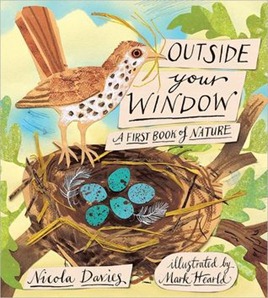
Outside Your Window: A First Book of Nature by Nicola Davies, illustrated by Mark Hearld (InfoSoup link)

Explore nature through the seasons in this lush book of poetry that starts with the first moments of spring with melting icicles and the green shoots of bulbs.  Summer is filled with butterflies, chickens, baby birds and bees.  Autumn comes with leaves, wind, geese and acorns.  And winter ends the year filled with snow, deer and ducks.  The poems range from merry verse with lighter tones to atmospheric pieces that make you stop and think.  It is this range of moods and depth that makes the book so very readable and enjoyable. 

Davies’ poems are all very child friendly, offering new perspectives on familiar things.  Her poem, “Night”, is one of my favorites of the book, though there are many to choose from that are incredible reads.  It capture the movement of the night, the feel of the quiet, and the sense of the world turning beneath you.  It’s quiet, beautiful, and captivating.

Add to these dynamic poems the art of Hearld and you have a real jewel of a book.  Illustrated with collage that combines paper cutout work, layers of texture, and realistic depiction of nature.  This realism emphasizes the beauty of nature, its diversity, and our own place in the world.  These are images that make you dream but also put your feet squarely on the earth and your connection to it.

Gorgeous illustrations combine with vibrant poems, creating a book to treasure.  Appropriate for ages 7-10.

Reviewed from library copy.

Review: A Leaf Can Be… by Laura Purdie Salas

11505

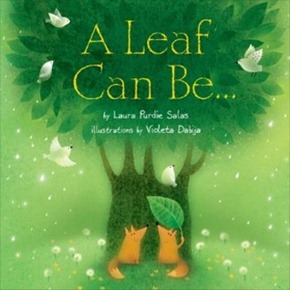
A Leaf Can Be… by Laura Purdie Salas, illustrated by Violeta Dabija

Explore leaves throughout the seasons in this work of poetry.  The book focuses less on the science of leaves and much more on their impact, their dance on the wind, the shade they spill, and the color they give.  Told in verse that will work very well with young children, this book captures the wonder of nature.  

This is a dance of a book with rhymes and rhythms that really sparkle.  Much of the book is done in two-word lines that encapsulate one aspect of leaves, “sun taker” and “food maker,” and then in the autumn, “pile grower” and “hill glow-er.” 

Dabija’s art is jewel-toned and dynamic.  Her work is infused with merriment and joy.  She uses layers and transparency to great effect, capturing the beauty of nature.  One particularly striking page is her “frost catcher” where the layers of her work shine and the details are luminous. 

A great book to use in a unit about trees, this is also a book that invites exploring a poem.  Exquisite writing is well matched with rich art in this book.  Appropriate for ages 3-6.

Reviewed from library copy.

Review: Zig and Wikki in the Cow by Nadja Spiegelman

zig and wikki in the cow

Zig and Wikki in the Cow by Nadja Spiegelman and Trade Loeffler

This is the second Zig and Wikki book, featuring two little aliens who find their way to Earth.  In this book, the two friends lose their spaceship when they return Zig’s pet fly its native habitat.  On the way, the two discover that flies eat poop, that dung beetles use it as well, and that cows have multiple stomachs.  It’s all a matter of learning things up close and personal, right down to being swallowed by a cow.  This humorous mashup of scientific fact, alien appeal, and comic format makes for an engaging read for young readers.

It is really the blend that works so well here.  The writing is light and funny, combined with scientific facts that are highlighted with photographs.  Readers learn about food cycles, ecology and habitats without even realizing it.  Add in the humorous poop factor and the graphic novel format, and this is one appealing package.

A graphic novel series that is a lot of fun and also informational, this second book is a winner, winner, cow dinner.  Appropriate for ages 7-9.

Reviewed from copy received from Candlewick Press.

Review: Secrets of the Garden by Kathleen Zoehfeld

secrets of the garden

Secrets of the Garden: Food Chains and the Food Web in Our Backyard by Kathleen Weidner Zoehfeld, illustrated by Priscilla Lamont

Alice loves it when spring arrives and they can start planting the garden.  Her dad gets the soil ready for planting and then she and her brother start putting the seeds in.  It seems like a long time before the seeds finally sprout.  Then other seedlings are transplanted from pots and potatoes are sown.  Lettuce and radishes are ready to eat first, and Alice spots a rabbit munching on them too.  She also thinks a mouse might be eating the fallen corn.  Hawks hunt in the garden and there are plenty of insects too.  Autumn nears and harvest begins, and the food cycle of the garden is complete for another year.  Throughout the book, the chickens offer commentary about the cycle itself with information about herbivores and carnivores, compost, worms and much more. 

This is an outstanding example an information book for children.  The chickens give the book a lighter tone, even though they are the ones offering the hard science.  The story celebrates gardening, the food cycle, and having a place connects one with nature.  Zoehfeld’s writing is breezy and cheerful, setting just the right tone of exploration, wonder and science.

Lamont’s illustrations add to the delight.  They have a similar feel to Michael Rosen’s with the friendly characters.  The colors tend towards the subtler side, inviting close inspection and learning.

This is a choice book for units on the food cycle or for children looking for information that they will enjoy learning.  Appropriate for ages 5-8.

Reviewed from copy received from Alfred A. Knopf.

Review: The Humming Room by Ellen Potter

humming room

The Humming Room by Ellen Potter

When Roo’s parents are murdered, it’s her ability to hide that saves her, as she retreated to her favorite spot under their trailer.  There she can look at the items she has “collected” or stolen, and she can press her ear to the ground to hear the tiny movements of animals, worms and roots.  After spending some time in foster care, Roo is taken to live on an island with her wealthy uncle who looks very similar to Roo’s father but with none of the carefree spirit her father had.  The island is on the St. Lawrence and the house used to be a tuberculosis sanatorium.  Now Roo is left there with little attention from her often-away uncle, and two servants.  The island is filled with life, including tantalizing glimpses of a wild boy who seems to live on the river.  Roo has to discover the truth of the strange house and the many secrets it holds.

Potter has stated that this is a novel inspired by The Secret Garden, and readers familiar with that work will definitely see it woven into this story.  At the same time, this book stands on its own beautifully.  It is a delightful blend of character and setting.  Roo is a prickly child, one who would be difficult to relate to except for her connection to nature.  That small piece of her character alone makes her human and accessible for the reader.  She is also prickly for very good reasons, including her parents’ death but also her misery of a life before their death.  The reader understands Roo deeply.   The secondary characters are all quirky and fascinating as well, especially the wild boy.

Then there is the setting.  Potter brings the St. Lawrence, the island, and this house to life.  This story could not be set anywhere else, as the setting is so closely married to the story.  The river is a large part of the book, including Roo’s growing understanding of its moods and the isolation of the island.  The house is central to the story as well, brooding and huge, its very walls hiding secret doors to wonders.  Then there is the garden itself, because of course there is a secret garden, and its rebirth that echoes Roo’s. 

Haunting and lovely, this book unfolds like the petals of a flower as each new discovery is made.  Environmentalism permeates the book in a gentle, green way that leaves readers wanting to connect with nature and preserve it without ever being preached to about the issue.  This is a delicate, wondrous read that is sure to be a hit with fans of The Secret Garden or those of us who are already fans of Ellen Potter.  Appropriate for ages 9-12.

Reviewed from copy received from Feiwel & Friends.

Review: The Camping Trip That Changed America by Barb Rosenstock

camping trip

The Camping Trip That Changed America: Theodore Roosevelt, John Muir, and Our National Parks by Barb Rosenstock, illustrated by Mordicai Gerstein

Teddy Roosevelt and John Muir had little in common growing up except for one thing: they both loved the outdoors and the wilderness.  So in 1903, when President Roosevelt read a book by John Muir that pleaded for people to save the trees, he couldn’t stop thinking about losing all of the trees in the mountain forests.  Roosevelt set out to meet with Muir in Yosemite.  After a few pictures, the two men rode off together with no entourage or photographers along.  Roosevelt got to see the giant sequoias, listen to Muir’s stories, see valleys carved by glaciers, and awaken under inches of snow.  Together the two men dreamed a new dream for the United States and its wild areas, one where they were protected for generations to come.

Rosenstock tells this story with a wonderful joy that permeates the entire work.  She captures the differences between the two men clearly but binds them together through their love of the outdoors.  The natural parts of the story are also captured in imagery and distinct moments where the men connect with each other and with the wilderness itself. 

Gerstein’s illustrations have a depth to them that nicely captures both the men and the natural beauty.  The quiet of Roosevelt’s life is shown in deep colors and stillness.  It contrasts powerfully with the blues, golds and greens of the natural world that is light filled and also full of action. 

This is a celebration of two men and the difference they made in our lives by creating the National Parks.  It is also an invitation to head out and explore the parks for yourself, looking for your own moments of connection to the wilderness.  Appropriate for ages 7-10.

Reviewed from copy received from Dial Books.