Secrets of the Loon by Laura Purdie Salas

Secrets of the Loon by Laura Purdie Salas

Secrets of the Loon by Laura Purdie Salas, illustrated by Chuck Dayton (9781681341583)

On the edge of a quiet lake, an egg hatches with pecks and wiggles. Out comes Moon Loon, who learns quickly that she can float in the water. Her parents feed her minnows and crayfish, then Mama takes her baby birds onto her back to protect them from predators. As days pass, the chicks grow too large for a parent’s back and stay in the water. When an eagle flies nearby, Moon realizes that she can dive down underwater to escape. Humans come too close and Moon’s parents move to defend her, but the humans move away. Soon it is time to practice flying. When Moon can fly, her parents leave. But once autumn comes, Moon knows just what to do and heads south.

Salas’s poetry rhymes with a lovely effortlessness that keeps the focus on the loons. She beautifully describes the loon’s habitat in just a few words, sharing details of the loon’s growth process and how they evade predators. The fascinating nature of their first migration is detailed further in the author’s note that offers more loon secrets as well as selected resources.

Dayton’s photography is done in a fascinating way. His clear and brilliant photos layer together to form forests, lakes, trees, reeds and more. Done through cleverly cut edges, the images form a complete picture of the loons and their lives.

A poetic glimpse of the Minnesota State Bird and its northern habitat. Appropriate for ages 5-9.

Reviewed from e-galley provided by Minnesota Historical Society Press.
The Nest That Wren Built by Randi Sonenshine

The Nest That Wren Built by Randi Sonenshine

The Nest That Wren Built by Randi Sonenshine, illustrated by Anne Hunter (9781536201536)

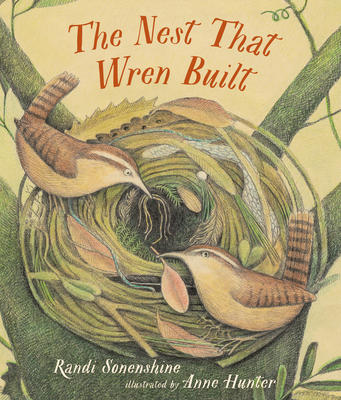
This gorgeous picture book introduces the art and skill of building a wren nest. Told in a folktale style, the book follows a Wren building her nest in a tree. Papa wren brings sticks, then twine, pine needles and small roots are added. A spider sac will help with keeping the mites eaten and a snakeskin wards off predators. Soft moss is gathered from the shade as well as feathers, petals and thread to make a soft bed. In this beautiful nest, eggs are laid and soon hatch, emerge onto branches, and fly away.

Sonenshine’s writing is exquisite. She focuses on the elements of the nest, lingering on beautiful language like “velvety moss” and “a scaly and thin reptilian charm” and “snippets of twine, spidery rootlets, and needles of pine.” This rich language is presented lightly on wren wings as they hurry back and forth creating their work of art and home.

Hunter’s illustrations are done on a rosy warm background that echoes the richness of the language. Done in fine lines and lots of detail, readers can pore over the illustrations to see the twine, needles, feathers and more. Hunter makes sure to take readers in nice and close, allowing them to peep at the eggs safe in the nest

A great readaloud pick, this book is a celebration of birds, nests and nature. Appropriate for ages 3-5.

Reviewed from copy provided by Candlewick Press.


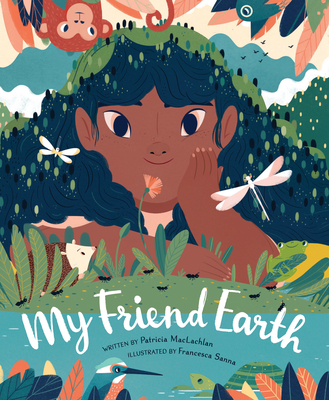
My Friend Earth by Patricia MacLachlan

My Friend Earth by Patricia MacLachlan

My Friend Earth by Patricia MacLachlan, illustrated by Francesca Sanna (9780811879101)

Newbery-award winning author MacLachlan writes a lyrical story about her friend earth. Earth awakens in the spring to the busy sounds, seeing the seeds, insects and birds around her. She tucks in animals, reunites mother and child, and tends to the rich prairies. She visits the tundra and heads underwater where she guards all of the creatures. She creates rain to fill the streams and blows autumn winds across the trees. She sprinkles snow on the land in winter, watching over the hibernating animals. Then she falls asleep herself until spring comes again.

Earth here is shown as a young girl, playful in her relationship with nature and the seasons. MacLachlan’s text is marvelously detailed, pulling small elements of each season out to linger over along with Earth herself. This book is specifically focused on Earth Day without it only being able to be used then. It’s a book that celebrates our earth any day.

Sanna’s gorgeous illustrations are built into cut pages here. Readers awaken Earth themselves, glimpse her peeking through leaves, peer underwater at her side, and blow in the wind with the leaves. The cutouts are cleverly done, representing the changing locations and seasons with their forms. Sanna’s art is bold and lovely, showing a young brown-skinned Earth playfully interacting in the world.

Lush and lovely, this is an Earth Day charmer. Appropriate for ages 3-5.

Reviewed from copy provided by Chronicle Books.

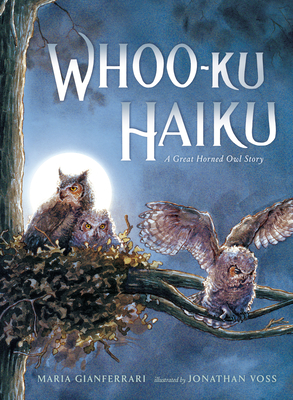
Whoo-Ku Haiku by Maria Gianferrari

Whoo-Ku Haiku by Maria Gianferrari

Whoo-Ku Haiku by Maria Gianferrari, illustrated by Jonathan Voss (9780399548420)

The story of a great horned owl family is told in dramatic fashion using only haiku poems in this picture book. A pair of great horned owls find a squirrel’s nest and claim it as their home. The mother bird lays three eggs in the nest, losing one when the crows attack her. Now there are two eggs left to guard and keep warm. Soon two owlets emerge from their eggs, eating the prey that Mama and Papa bring to them. The woods has lots of dangers like hunting hawks and foxes waiting for an owlet to fall. Mama is there to protect them though, until it is time for them to take wing and find a home of their own.

Through her series of haiku poems, Gianferrari creates moments that build on one another into a full story of the first months of egg laying and owlets growing up. Focusing on the strength and power of the most commons owls in North America, along with their exceptional parenting skills, the book also reveals the dangers they face despite their size.

Voss’ illustrations are a gorgeous match to the beauty of the poetry. Illustrated in sepia ink and watercolor, with digital color added, these illustrations captures the various moments with skill and drama. The quiet moments are just as powerful as the action ones, filled with dappled forest light and the incredible creatures.

A marvelous book of nature poetry for children. Appropriate for ages 6-9.

Reviewed from e-galley provided by G. P. Putnam’s Sons.

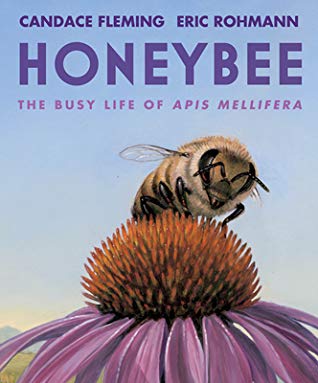
Honeybee: The Busy Life of Apis Mellifera by Candace Fleming

Honeybee The Busy Life of Apis Mellifera by Candace Fleming

Honeybee: The Busy Life of Apis Mellifera by Candace Fleming, illustrated by Eric Rohmann (9780823442850)

On a summer morning, a new bee hatches in a hive. She is Apis mellifera and must rest before she can do anything. She eats and grows stronger, her color changes from gray to a yellow orange. Though she is destined to fly eventually, first she must do many other jobs for her hive. She tends to the larvae, checking on them and feeding them with liquid from her glands. After eight days, she changes jobs and starts tending to the queen bee. At 12 days old, she heads to another job and starts building honeycomb then fills it with the nectar the other bees bring in. Her next job is to guard the hive from predators and other bees from different hives. Then finally, on her 25th day, it is time for her to fly. And does she ever fly! She flies for over 500 miles total and visits over 30,000 flowers! 

Frankly, I have never understood honeybees better than I do now after finishing this nonfiction picture book. Fleming writes in such an engaging way, inviting readers to wonder when Apis will actually get to fly for the first time. The various changes to Apis’ body as well as the variety of duties she has in the hive are very interesting and make the species all the more fascinating. 

Rohmann’s illustrations bring readers right into the hive, seeing it from a bee’s point of view. His rich illustrations are filled with honey gold and bright summer skies that beckon to readers, inviting them to lean in even closer.

A great science and nature book, there’s plenty of buzz about this one! Appropriate for ages 4-8.

Reviewed from library copy.

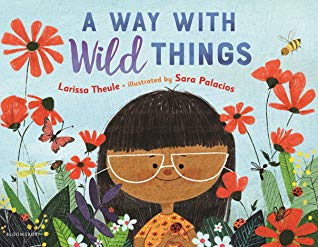
A Way with Wild Things by Larissa Theule

A Way with Wild Things by Larissa Theule

A Way with Wild Things by Larissa Theule, illustrated by Sara Palacios (9781681190396)

Poppy is a little girl who loves bugs and spending time alone outside. Around other people, she tends to fade into the background, disappearing into the potted plants and the wallpaper. At her Grandma Phyllis’ 100th birthday party, Poppy hides in the bushes. She enjoys watching the party from there, seeing the different people as colorful leaves. When a dragonfly enters the party, it lands on the birthday cake, and Poppy claps her hands in joy. One of her relatives leans in and calls her a wallflower. Poppy wilts, but the dragonfly darts over to land on her hand. Soon everyone is gathered around and Grandma Phyllis declares her a “wild flower” rather than a wallflower. 

Told with a great empathy towards Poppy and her need for quiet contemplation and connection with bugs and nature, this picture book celebrates solitude and being understood. All shy folks will recognize the rather pushy nature of relatives who suddenly notice a quiet child and call them out. The beauty here is that Poppy finds her own way forward with the help of an insect friend. 

The illustrations are done in cut paper, paints and digitally, combining layers together. This has created organic-feeling images that have a wonderful play of texture and pattern. The finer details of the illustrations contribute to the layered effect.

A quiet picture book just right for reading outside on a blanket. Appropriate for ages 3-5.

Reviewed from ARC provided by Bloomsbury Children’s Books.

Bear Goes Sugaring by Maxwell Eaton III

Bear Goes Sugaring by Maxwell Eaton III

Bear Goes Sugaring by Maxwell Eaton III (9780823444489)

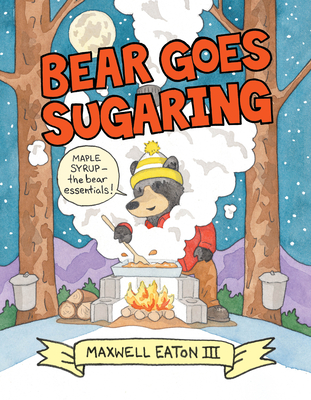
Join Bear as she goes through the process of making maple syrup. Joined by her friends, Fox and Squirrel, who are desperate for pancakes, Bear begins by getting her tools ready. Both Squirrel and Fox don’t really help much, offering a lot of side comments and once knocking a hole in one of the buckets. That hole though gives Bear a chance to show readers that all sorts of containers can be used to catch the sap as it drips from the trees. Readers will learn about the type of maple used for syrup making, about the tools used, and then the process of boiling down the sap into maple syrup. Bear does this outside with an open fire and a lot of patience. The end result is sweet, particularly for the impatient pair who have joined Bear throughout the book.

Eaton excels at making nonfiction subjects jovial and great fun. His use of Squirrel and Fox to offer comical asides makes the book great fun to read. Bear herself is knowledgeable and unflappable as she reacts patiently to her friends and buckets with new holes. The information shared here is fascinating and delivered in a way that allows readers to really understand things like why sugar maples are the best for syrup and how many gallons of sap it takes to make a gallon of maple syrup (40!) 

The illustrations are bold and colorful, inviting readers into the woods with Bear and showing in detail what the steps are to making maple syrup. Squirrel and Fox peek out from various places on the page, offering their opinions on what is happening. 

Funny and factual, this picture book is not syrupy at all. Appropriate for ages 4-6.

Reviewed from library copy.

Being Frog by April Pulley Sayre 

Being Frog by April Pulley Sayre 

Being Frog by April Pulley Sayre (9781534428812)

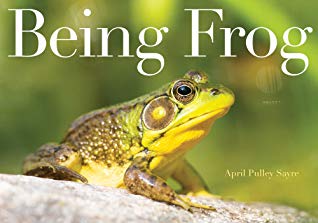
This gorgeous photo-filled picture book demonstrates that frogs are alive and that frogs are beings. Frogs have favorite things like we do, favorite logs and favorite rocks to sit on. Frogs hunt for food, jumping and leaping. They hide in the shadows and swim in the water. Frogs may have memories of when they were tadpoles. Perhaps they head on journeys over rocks before stopping to sun themselves for a bit. They might sit and think, letting time roll past, slow or fast. All just being a frog.

In her author note, Sayre speaks to the anthropomorphizing of animals in books for children and the importance of seeing animals as different but also important beings on their own. Inspired by her neighborhood frogs, she captured their days and wonders aloud about what they think, remember and do. It’s a picture book distinctly from a human point of view, wondering about nature and giving space for those moments of though for both the reader and the frog alike.

The photographs are stunning, filled with vibrant colors of yellows and green. The frog is center stage, eyes bulging and occasionally leaping towards its prey. The motions are captured rather like anyone at a pond sees frogs jump with glimpses of extended legs almost out of sight. 

Thoughtful and respectful of nature and our frog neighbors. Appropriate for ages 2-4.

Reviewed from copy provided by Beach Lane.

On a Snow-Melting Day by Buffy Silverman

On a Snow-Melting Day by Buffy Silverman

On a Snow-Melting Day: Seeking Signs of Spring by Buffy Silverman (9781541581180)

This picture book captures the joys of early spring. Using skilled photography as well as rhyming text, explore the various elements of spring’s arrival. Icicles begin to drip, snow becomes slushy, lakes thaw and snowmen droop. Animals react too with birds singing more and sipping from icicles, frogs peeping, and salamanders emerging. Crocuses start to bloom along with other flowers too. The entire landscape is waking up and celebrating spring!

The photos in this book truly capture that tantalizing moment where spring arrives. The majority of them combine ice and snow with signs of spring, offering those fleeting moments of discovery for readers of the book. The text is simple and reads aloud well. It lets readers get glimpses of animals in thrilling ways from piles of sleeping snakes to the chickadee in flight to snatch a drink.

Spring into action and grab this one to make your winter days a little shorter. Appropriate for ages 2-4.

Reviewed from e-galley provided by Millbrook Press.