The Ramble Shamble Children by Christina Soontornvat

Cover image

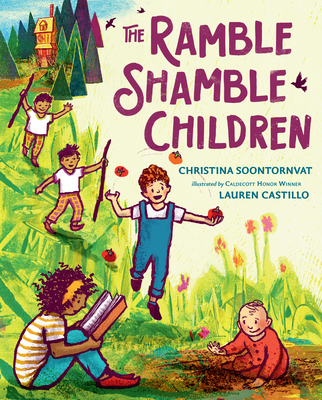
The Ramble Shamble Children by Christina Soontornvat, illustrated by Lauren Castillo (9780399176326)

From two award-winning artists comes this picture book about children who are definitely not the traditional family. Merra, Locky, Roozie, Finn and Jory all live together in their “ramble shamble house.” They have chickens in the yard, a nice big mud puddle that Jory loves to play in, and a bountiful vegetable garden. Their lives are merry and busy with working in the garden together. Then one day, they discover a picture of a beautiful pristine house that is far more proper than theirs. So they set out to make their rustic house into something closer to the lovely model home. Out go the carrots to make way for rose bushes. The mud puddle is covered up. The chickens get an ornate home of their own. They even make their own chandelier. Things may be proper, but they aren’t quite right the next day. The hens refuse to use their new house, the chandelier is carried off by crows, but worst of all, Jory has disappeared. They find him in a new patch of mud, helping them all realize that they may just need to accept they are a ramble shamble family.

As the proud owner of a wild natural garden outside my front door and a house covered in vines that please me immensely, I firmly embrace being ramble shamble. With this picture book, Soontornvat proves that she can write almost anything from children’s fiction to nonfiction to picture books. Her tone here is cozy and warm, embracing the way the children live from the very first page. The hard work the children do, their closeness and care for one another, and their desire to have a proper home all speak to the importance of having a family around one.

Castillo’s illustrations show the children arriving together at the house and then show how they live together. The children are diverse and range in ages from little Jory who is close to a toddler to Merra who is an older child. The illustrations show their connection to one another, how they all help out, and the beauty of their ramshackle life they have built together.

A charmer of a picture book sure to warm the heart and ease the need for a proper life. Appropriate for ages 3-5.

Reviewed from copy provided by Nancy Paulsen Books.
The Barnabus Project by The Fan Brothers

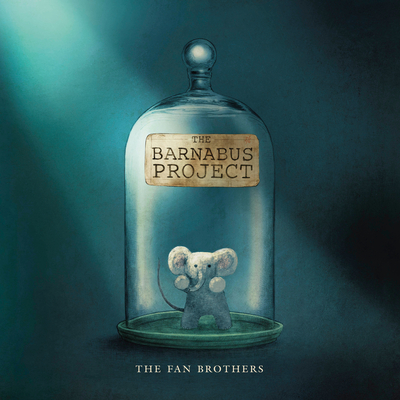
The Barnabus Project by The Fan Brothers (9780735263260)

Barnabus is a tiny creature who is half elephant and half mouse. He lives in the secret lab under Perfect Pets. The lab was where they made perfect pets, but they also had a section where they housed the creatures they made who were not quite perfect. That’s where Barnabus lived, in the Failed Projects section along with all the other imperfect pets. When the Green Suits came in and marked their glass housings with “FAIL,” Barnabus and the others found out they were being recycled. Barnabus was determined to escape, though the others thought it was impossible. He longed to see the world outside the lab. When Barnabus got himself free, he freed all of the other failed creatures. Together they made their way through the ducts. When they discovered one creature at the center of the lab who was still trapped, it was time to decide whether to save themselves or risk it all.

This is the first time that all three Fan brothers have worked on a book together. If they make things this great as a team, they should keep on working with one another. This book reads like a Pixar cartoon, full of heart and adventure and one tiny hero. Readers will fall hard for Barnabus, the unlikely mix of a mouse and elephant who is marvelously defiant and brave despite his small size. The story is particularly well done. It deals with deep issues such as what perfection is and what makes someone a “fail.” The story arc is strong and interesting with plenty of action and humor.

The art is phenomenal. It is colorful and full of small details that are fascinating to pore over. The differences between Barnabus and the “Perfect Pets” who are fuzzier and more colorful versions of himself are minute and everyone would want Barnabus on their side. The various creatures in the lab are interesting, some lovable, others squirmy, and some both.

A great picture book with a small hero sure to shatter your expectations. Appropriate for ages 4-6.

Reviewed from library copy.

Review: Perfect by Max Amato

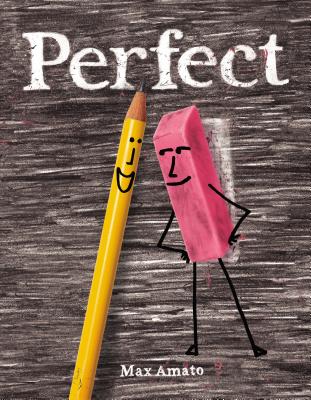
Perfect by Max Amato

Perfect by Max Amato (9780545829311)

An eraser wants to keep everything neat and clean on the pages of this picture book, but a playful pencil has other ideas. The pencil draws mocking images of the eraser, which are then erased. But the scribbles become a whirlwind that knock him into pages of even darker scribbles and marching pencils. The eraser escapes into a deep dark forest of pencil-drawn trees that become a solid darkness. Unable to fix all of the pencil marks, eraser discovers his own playful side and draws his way out onto a clean page. Though now he just might enjoy a bit of mess instead.

In his debut picture book, Amato demonstrates a real sense of play. The eraser character is tightly wound and rather obsessive and makes a great foil for the silliness of the pencil. The book has a great story arc that works well and makes a compelling and interesting tale. Children will enjoy both of the characters, since even the eraser gets in on the fun by the end of the book and leaves his complaints behind. The illustrations are particularly effective with both the pencil and eraser popping visually from the drawn backgrounds. Particularly funny is when eraser turns his back to the reader and one can see the butt print from his fall.

A great sense of humor and playfulness make this one worth sharing. Appropriate for ages 3-5.

Reviewed from library copy.


Review: Eventown by Corey Ann Haydu

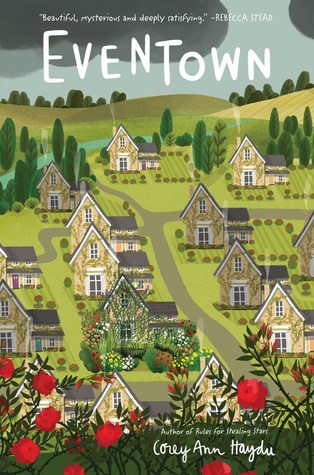
eventown by corey ann haydu

Eventown by Corey Ann Haydu (9780062689801)

Elodee’s family faced a tragedy this year and had trouble recovering from it. Elodee is always angry and her twin sister, Naomi, is getting quieter. Given those circumstances, moving to Eventown seemed like the best plan. The family had vacationed in Eventown and had great memories of being there. When they move into their house that is just like every other house in town, they discover a life filled with hikes into the hills, no cars, walking to school past a waterfall and woods, and rosebushes everywhere. Their lives find a comforting rhythm there. But things are a bit too perfect: there are no clouds in the sky, no rainy days, and ice cream doesn’t melt down your wrists. When the twins are sent to the Welcome Center, they are given a chance to tell six stories of their lives, days of their greatest sorrows and joys. Naomi goes first and tells her stories, but Elodee’s session is interrupted. Naomi is quickly fitting into the town while Elodee remembers more of their life before and starts to ask questions about their lives in Eventown.

Haydu’s novel takes a deep look at grief and pain and its purpose in our lives. It looks at what happens when bad memories are removed and perfection is put in their place. It is a limited perfection, one with no books to read, only one song to listen to, no cell phones, no Internet and no television. It is idyllic and eerie, a Stepford version of childhood. Horror is sidestepped neatly here, instead becoming a book about empowerment and making your own choices while asking important questions.

Elodee is a great main character. The fact that she is a twin is an important element in the book as it focuses on everyone in Eventown being the same but even then Elodee and Naomi are very different from one another. The twins make an interesting counterpoint to the entire town, with Elodee and her vivid anger, big questions and willingness to be different making an ideal person to expose what is really going on.

Filled with magic and mystery, this book is a compelling look at the price of perfection. Appropriate for ages 9-12.

Reviewed from e-galley provided by Katherine Tegen Books.

The Perfect Tree by Chloe Bonfield

The Perfect Tree by Chloe Bonfield

The Perfect Tree by Chloe Bonfield (InfoSoup)

Jack headed out to find the perfect tree, one that was just right to chop down for firewood. But he was having trouble finding that perfect tree. Jack finally sat down under a tree in the forest in despair. Then a woodpecker offered to help Jack find the perfect tree. She flew to a tree and after knocking on a branch all sorts of birds flew out of it. Then a squirrel said that he too could show Jack the perfect tree. Taking Jack into a great oak tree, the squirrel revealed his stash of nuts and berries for the winter. Next a spider showed Jack her favorite tree where a web hung filled with water drops. It was then that Jack was inspired by the rain to find another perfect tree that was just right to stay dry under.

Bonfield has written an ecology picture book that focuses not on how wrong it is to cut down trees, but instead how the definition of “perfect” means different things to different creatures. And how your appreciation of an object in a new way leads to changes in the way you see the world. I appreciate that the book does not lecture about the environment or appreciating nature. Instead the book focuses on the beauty of nature and how it can transform us if we pay attention.

Bonfield’s illustrations are amazing. Done in papercut images and collage, they form two and three dimensional structures and then are lit so that there are shadows that play against other parts of the illustration that glow. The result is a picture book landscape that feels immersive and tangible.

A clever look at the pursuit of perfection and the power of nature. Appropriate for ages 4-6.

Reviewed from library copy.


Review: A Poem in Your Pocket by Margaret McNamara

poem in your pocket

A Poem in Your Pocket by Margaret McNamara, illustrated by G. Brian Karas

The third in the Mr. Tiffin’s Classroom series, this book focuses on Elinor, a girl who just wants everything to be perfect.  Unfortunately though, poetry and perfection really don’t work together no matter whether you are talking haikus, concrete poems or rhyming stanzas.  A poet is going to be visiting their school and Elinor desperately wants to impress her with her poetry.  But as the time goes by, the pressure builds and Elinor becomes less and less able to write poetry.  When she finally does start writing, she’s not happy with any of the poems she has written.  Can the kind teacher Mr. Tiffin find a way to let Elinor know that it’s OK to make mistakes?  Maybe this is a job for a poet!

This is a wonderful addition to an already strong series.  McNamara “perfectly” captures the trap of perfectionism for students and the pressure that it builds in a person.  Tying it to poetry was inspired, something that doesn’t work with tension or pressure but instead relies on inspiration and creativity.  Elementary students will see themselves in both Elinor and her classmates who are more relaxed about the entire thing.  Watch for the poem that ties to How Many Seeds in a Pumpkin? for fans of the series. 

Karas’ illustrations continue in his signature style that is playful and friendly.  His drawings add to the accessibility of the entire book and the series as a whole. 

A winning addition to a popular series, this third book will delight during poetry units and may inspire a more relaxed approach to writing too.  Appropriate for ages 6-9.

Reviewed from digital galley received from Schwartz & Wade and Edelweiss.