Review: This Moose Belongs to Me by Oliver Jeffers

this moose belongs to me

This Moose Belongs to Me by Oliver Jeffers

Wilfred’s moose arrived a while ago and Wilfred just knew that the moose was meant to be his.  He called the moose, Marcel.  Wilfred had some serious rules if Marcel was going to be his pet, but Marcel didn’t seem interested in following them.  Some though, Marcel was very good at.  He did not make noise while Wilfred was listening to his music.  He provided Wilfred shelter from the rain and he knocked high things down so that Wilfred could reach them.  Then there were the rules that Marcel didn’t follow.  He didn’t stay near home and soon Wilfred had learned to carry string along with them so they could find their way back home after long jaunts.  It was on one of those long walks that Wilfred discovered that there was someone else who thought that THEY owned the moose! 

Jeffers once again captures a concept with solidity and grace.  He manages to take the idea of owning an animal and get readers to ask themselves about what ownership really means.  The character of Wilfred has to do some adapting of his own, quickly changing his own rules and beliefs to be more moderate and open-ended.  It also helped to share food.

The art here combines grand backdrops of mountains and plains with one small round-headed boy and a moose, dragging bright blue string behind.  It’s a wonderful juxtaposition that will have readers understanding immediately that this moose is certainly not a pet that belongs to anyone.

Another delight from Jeffers, this book is about wilderness, the wild, and owning a pet.  Appropriate for ages 4-6.

Reviewed from library copy.

Review: Charley’s First Night by Amy Hest

charleys first night

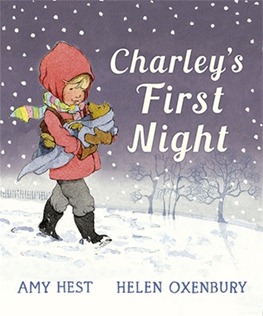
Charley’s First Night by Amy Hest, illustrated by Helen Oxenbury

Pure bliss, that’s what this book is.  This is the story of Henry who brings Charley, a new puppy, home.  When they get home, Henry makes sure to show Charley all around his new home, even showing him where his mother hides the birthday presents.  Henry’s parents inform him that he’s the one in charge of walking Charley and feeding Charley.  Henry is thrilled and can’t wait to do those things forever.  Then there’s the discussion of where Charley is going to sleep.  Henry knows that Charley wants to sleep in his room, but his parents want Charley to sleep in the kitchen.  Henry worries about Charley alone in the kitchen, but goes about setting up a pillow, a bear to keep him company, and a ticking clock for a heartbeat sound.  Henry stays with Charley until he falls asleep, but Charley doesn’t stay asleep for long.

Hest’s writing here is so dazzling.  She captures perfectly the swooning adoration of a child with a new puppy.  She shows the instant connection, the small memorable moments together, and the communication and understanding that flows.  Henry loves Charley with a purity that is piercing and Hest’s text makes it all the more real and true.  She uses quiet repetition and brings the reader into the intimacy of this new relationship, allowing them to notice the small things that Henry is seeing and feeling.

Oxenbury’s illustrations are classic and lovely.  They lift the story up, making it feel all the more timeless.  There is a beautiful warmth to her art that works particularly well for this subject.  The small images of Charley eating, romping and even making a mess will be sure to charm.

Two master picture book creators have come together to give readers a radiant book about the first love of child and puppy.  Appropriate for ages 3-5.

Reviewed from library copy.

Review: Ready for Pumpkins by Kate Duke

ready for pumpkins

Ready for Pumpkins by Kate Duke

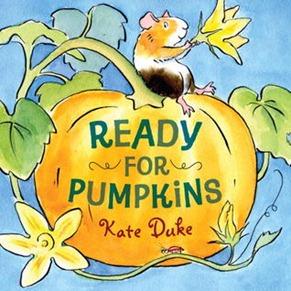
Hercules, or Herky for short, learned a lot being the classroom guinea pig in Miss MacGuffey’s first grade.  He learned to paint, he learned about Halloween, but best of all, he learned that he could plant a garden from seeds.  And Herky had seeds from the Halloween pumpkin that he had saved in his cage.  So when he was taken for the summer out to the country, he knew he just had to plant his own garden.  He met Daisy, a rabbit, who helped him find a sunny place to plant the seeds.  Herky dug up the dirt, planted the seeds, and watered them.  But then he had to be patient as they grew, and that was the hardest part!  The plants grew, flowers appeared, and finally pumpkins.  But Herky had to return to school before they turned orange!  Will he ever know how his pumpkins turned out?

This is a charming mix of classroom pet story and gardening.  Duke makes Herky quite a character.  He’s impatient to the point of digging up the seeds to see what is happening, angry when the birds and beetles attack his garden, and yet he is also hard working enough to make a garden in the first place.  The writing is simple and reads aloud easily, making this a good book to share with a fall class.

Duke’s art is full of simple lines and bright colors.  As the garden grows, she shows the wild beauty of the pumpkin vines, their many flowers and the slow process of pumpkins growing to maturity.  Daisy and Herky are engagingly drawn little creatures whose growing friendship mirrors that of the garden.

A great pick for pumpkin season or as an addition to spring growing books too.  Appropriate for ages 3-5.

Reviewed from copy received from Random House.

Review: Old Robert and the Sea-Silly Cats by Barbara Joosse

old robert

Old Robert and the Sea-Silly Cats by Barbara Joosse, illustrated by Jan Jutte

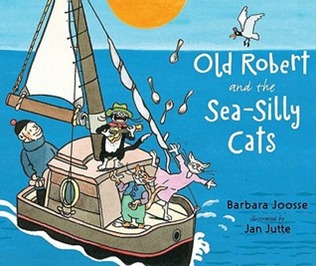
Old Robert sailed his ship at sea during the day and docked it at night because it was so dark.  At night, he prepared his dinner of toast in buttered milk and ran through his list of things that were all in their proper place, including clean socks, a clock, one dish and one spoon, and the moon.  He was all alone until one night when a dancing cat asked to come aboard.  Old Robert hesitated because there wasn’t much room aboard, but in the end he agreed.  So he made dinner of toast in buttered milk for both of them and when he went to bed, he noticed the moon was bigger.  Now his list included the cat in its hammock as he went to sleep.  On subsequent days, another two talking cats joined him on board, for dinner, and on his list.  And the moon got bigger still.  Finally, a cat that didn’t talk at all arrived and Old Robert let it on board too.  There was no room for a hammock, for Old Robert let it sleep on his chest.  Finally, the moon was full and Old Robert sailed off into the moonlit night with all of the cats. 

I expected quite a different book when I saw the cover.  I thought it was going to be silly, zany, and rather wild.  Instead, this book has a beautiful quietness to it, a thoughtfulness, and makes for a perfect bedtime read.  Joosse incorporates repetition so well here that it becomes a lullaby.  His listing of his belongings doesn’t change much, except for the size of the moon and the number of cats.  It speaks to the simplicity of his life, but also to how lonely he is.  This is shown rather than told, giving the book a lovely little ache that heads right for the heart.

Jutte’s illustrations too have a mix of silly and quiet.  They have a vintage feel, of old comic books that will make readers feel right at home.  They have great color with explosions of pinks, blues and yellows that pop and glow. 

A great read aloud, this would make a great bedtime pick but it is also a good one to turn into reader’s theater for children.  Appropriate for ages 3-5.

Reviewed from copy received from Philomel Books

Review: Bambino and Mr. Twain by P. I. Maltbie

bambino and mr twain

Bambino and Mr. Twain by P. I. Maltbie, illustrated by Daniel Miyares

In 1904, after losing his beloved wife, Mark Twain shut his door on the public life he had led.  Instead, he stayed indoors spending much of his time alone except for his daughter’s cat, Bambino.  The two of them grew closer as they played billiards together, shared ice cream for his birthday, and stayed together in a bed crowded with books and papers.  One day, after spotting a squirrel outside the window, Bambino leapt out and disappeared.  Twain put an ad in the paper and many people came with cats and kittens just to meet the famous author.  But none of the cats were Bambino.  Three days later, Bambino appeared on the doorstep as if nothing had happened.  Mark Twain took inspiration from his small companion, and started being part of public life again. 

This book explores the powerful relationship between people and animals.  It is also an exploration of grief and could be used with children in elementary school to discuss death and grief.  Maltbie includes many small touches about Twain, including those white suits, details about his wife, and traditions of their family.  Those little points create a much more human story, even though we are talking about one of the most famous authors ever. 

The black cat and the figure of Twain in his trademark white suit make for a great pairing visually as well.  Miyares’ illustrations are filled with great textures and colors, with the palette changing as the mood of Twain lifts.  The shadows are stronger when the grief is at its worst, but lightens and even brightens as the book continues. 

A personal look at a great figure of American literature, this book about Twain offers the depth of grief and the joy of connection with a pet.  Appropriate for ages 6-8.

Reviewed from copy received from Charlesbridge.

Review: My Rhinoceros by Jon Agee

my rhinoceros

My Rhinoceros by Jon Agee

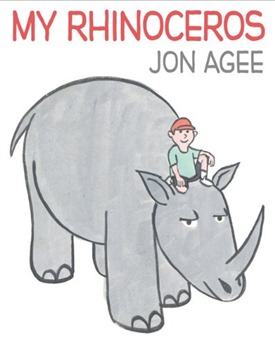
At an exotic pet store, a boy picks out a rhinoceros as a pet.   But when he gets the rhinoceros home, he realizes that his pet really doesn’t do anything at all.    He won’t chase balls, or sticks, or frisbees.  He doesn’t roll over.  He keeps to himself and is very quiet.  So the boy asks a rhinoceros expert what the problem is.  She informs him that rhinos only do two things:  pop balloons and poke holes in kites.  The boy thinks that that is completely pathetic, but he decides to test it out.  He heads to the park where there was a balloon vendor.  Nothing.  Then they walk past children flying kites.  Nothing.  Maybe his rhinoceros is a clunker?  Until their walk back home, then suddenly his rhinoceros does amazing things, but you will have to read the book to see what they are!

Agee has a wonderful knack for taking a simple idea and running with it to the extreme.  Here the concept of buying a pet and figuring out that pet is taken to a wild and amazing place.   Agee allows the situation itself to provide the humor, making it more subtle and understated than many children’s books.  So while this is a wild and zany book about rhinos, it also has an air of sophistication about it.

Agee’s illustrations are also an important part of his books.  His unique style is done in thick black lines and washes of color.  The illustrations are almost like coloring books at times, if coloring books were cool and about pet rhinos.

Another winner from Agee, children who read this book may want to find their own exotic pet, probably a rhinoceros of their very own.  It’s also a perfect surprise addition to story times about pets.  Appropriate for ages 4-7.

Reviewed from copy received from Scholastic.

Also reviewed by A Picture Book a Day.

Check out the book trailer with Jon Agee and his own pet rhinoceros:

Review: Baby Unplugged Board Books

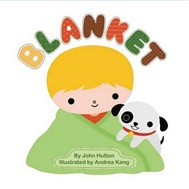
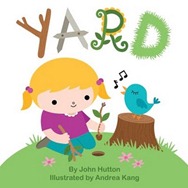
BlanketCoverweb HuttonPetsCover Web YardCoverBoxes

I rarely review books by self-published authors, but when I saw the covers for these books, I made an exception.  These are board books that have a particularly sunny and cheery point of view.  Each of these three books takes a subject and then spends time exploring many facets of it.  Blanket will surprise readers with a touch of humor and then ends with bedtime.  Pets talks about a wide variety of pets and ends with an emphasis on connection and love.  Yard, which is my favorite of the three, explores what children will find in their own yard as well as some of the wonder of wider nature. 

The illustrations of the books are done in a flat, friendly style where everyone is happy.  Filled with bright colors and done very simply, the illustrations are just right for the toddler or infant.  The books are written in rhyming pairs that work well, making reading aloud easy.

A particularly successful series of self-published board books, these books speak to the quality of some of the self-published work on the market.  They have a nice blend of modern illustration and timeless subjects.  Appropriate for ages 1-3.

Reviewed from copies received from Baby Unplugged.

Book Review: Prudence Wants a Pet by Cathleen Daly

Prudence-Wants-a-Pet

Prudence Wants a Pet by Cathleen Daly, illustrated by Stephen Michael King

Prudence wants a pet badly, but her parents tell her that pets cost too much and make too much noise.  So Prudence gets a pet: a branch.  She drags it to school with her so it gets plenty of exercise.  Branch doesn’t eat or drink much at all.  But when her Dad trips on Branch for the eighth time, he breaks branch into smaller bits and throws them on the woodpile.  Now Prudence has a new pet, Twig.  Twig is pocket-sized and doesn’t have to live out on the porch and trip people.  But Twig got lost in the wash and no one responded to Prudence’s lost pet sign.  Prudence gets a new pet, an old shoe named Formal Footwear because that’s what it says on its tag.  Formal Footwear can do tricks and goes for walks, but eventually Prudence gets tired of dragging him around and frees him back into the wild.  Prudence then tries keeping her baby brother as a pet, but he gets ill eating leaves.  The car tire doesn’t work either, too heavy and too unpopular with the neighbors.  As her parents watch her, they start to reconsider.  But just what pet will Prudence get?

Prudence is a young lady who will not give up on her dream.  In fact, she tries to create options again and again.  She’s creative and inventive, making for a book that is wry and funny.  There are lovely small touches throughout the book: the lost pet poster for Twig, the name of her pet shoe, the pink bow on her baby brother’s head, and the “pulp” that are the sea buddies. 

King’s art adds a lot to the picture book with his cartoon-like characters that have a modern feel.  Prudence’s hair alone tells part of the story, drooping in despair, perky with hope, curled in contentment.  King isn’t afraid to push a little, giving one big eye, showing little brother Milo a putrid shade of green after eating the grass.  The humor of the art matches the humor of the story well, complementing each other without one overpowering the other.

The elements here add up to a very wonderful read.  The quirky illustrations, the creative protagonist, the silly humor: all create a marvelous book that I’d be happy to read again and again to any young pet lover.  Appropriate for ages 4-6.

Reviewed from copy received from Roaring Brook Press.

Also reviewed by Jen Robinson’s Book Page.

Book Review: Melvin and the Boy by Lauren Castillo

melvinboy

Melvin and the Boy by Lauren Castillo

Released July 5, 2011.

A young boy wants a pet very badly, but his parents always say no.  A dog is too big, a monkey too much work, a parrot too noisy.  One day, he sees a turtle at the park who is looking at him and follows him.  So the boy asks if he can keep it as a pet.  His parents agree, and the boy names the turtle Melvin.  But back home, Melvin won’t play.  He won’t eat.  Walking the turtle doesn’t work either.  The only time Melvin comes out of his shell is when he takes a bath.  The boy can see that Melvin is not happy in their house.  So they return him to the pond, where the boy will be sure to visit him often.

This is the first book that Castillo has both written and illustrated.  Her writing is pitch perfect here, offering just enough detail and with the right phrasing and tone.  It really feels as if a child was speaking in first person without becoming distracting.  I particularly enjoy the fact that the boy himself realizes the turtle is unhappy.  His parents follow his lead with the turtle rather than them leading him to a decision.

As always, Castillo’s art is very successful.  Her art emphasizes the urban setting of the book, playing the greens against the concrete colors nicely.  Her use of thick lines and soft colors makes for a book that is welcoming and warm.

A great addition to any story time on pets or turtles, this is also a wonderful read to start discussions about pets and keeping them safe and happy.  Appropriate for ages 3-6.

Reviewed from copy received from Henry Holt and Company.