If We Were Dogs by Sophie Blackall – Book Recommendation

If We Were Dogs by Sophie Blackall (9780316581721)

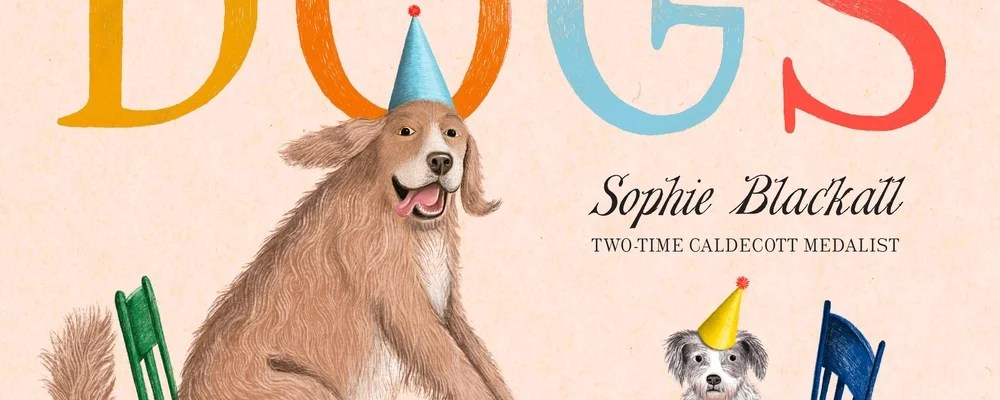
A merry look at two children playing together where one decides that they should be dogs. They will be the big dog and the other the little dog. They can wag tails, drink from water bowls, fetch big sticks and much more. Somehow though, the little dog keeps on not having much fun while the big dog is merrily playing. When even more dogs join them, the little dog has had enough! A clever look at how playing together means incorporating others’ ideas into imaginary scenarios. As always the illustrations by Blackall are charming. In particular, the little dog’s face captures his worry, doubt and how put-upon he feels.

A delightful doggy romp. Appropriate for ages 3-5. 

Reviewed from e-galley provided by Hachette Book Group.

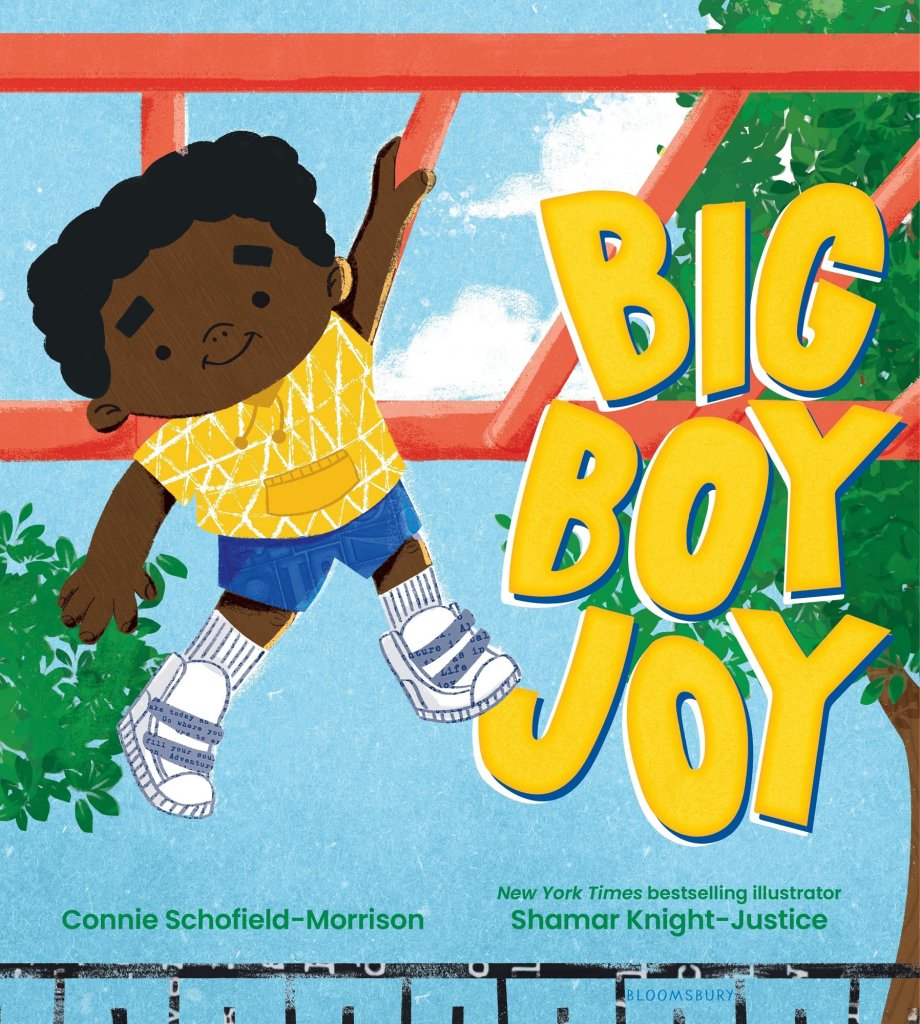
Big Boy Joy by Connie Schofield-Morrison – Book Review

Big Boy Joy by Connie Schofield-Morrison, illustrated by Shamar Knight-Justice (9781547611515)

A little boy visits a park and has a great time playing. Told with plenty of action words, he climbs and slides on the equipment. Then crashes into another child. Soon the two are sharing toys and playing with dinosaurs together. There’s another crash when the boy heads to the sandbox and a tire falls off a toy truck. But no worries, he can fix it himself. A snack is next, then some playing on the swings, some water play. It’s time to go home. A look at what a small child can expect when heading to a park told in a merry noisy and action-filled way that is sure to please. The Black characters and creators lean into the joy of a day of play. 

Appropriate for ages 2-4.

Reviewed from e-galley provided by Bloomsbury Children’s Books.

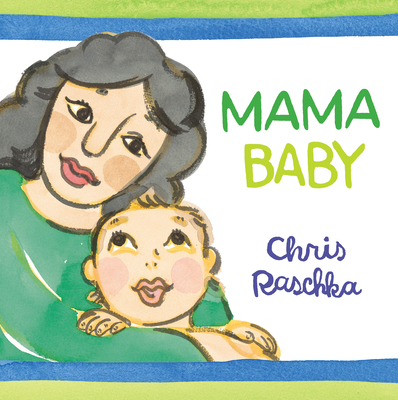
Mama Baby by Chris Raschka

Mama Baby by Chris Raschka

Mama Baby by Chris Raschka (9780763690601)

This very simple picture book is just right for infants and toddlers to share with their parents. It’s a story about a mother and baby who smile and then clap to each other. Eyes are then covered. Peek-a-boo and pat-a-cake games are played. But then a phone rings or alarm sounds, calling mama away. Now it is just baby on the page, looking surprised at the reader and then bursting into tears and asking to be picked up. Together again, held close, the two wave goodbye to the reader.

Told in only the barest of words, this picture book is much more about the illustrations which show a warm and loving relationship between mother and baby. The modern interruption of a musical sound happening off the page shows how the connection between mother and child stays strong. Done in watercolor, the illustrations are simple with emotions clear on the faces.

Bound to be a board book too, this is a great first picture book. Appropriate for ages 1-3.

Reviewed from copy provided by Candlewick.


A Bunch of Board Books

Here are some great recently-released board books to embrace this summer:

Antiracist Baby by Ibram X. Kendi

Antiracist Baby by Ibram X. Kendi, illustrations by Ashley Lukashevsky (9780593110416)

To raise an antiracist baby, you must understand that’s it’s all about showing them that society can transform. This is not a space to be neutral, but one to be an activist. This board book explores what it takes to raise a child who is not racist in our society. First, see all skin colors, don’t be artificially color-blind. Second, talk about race. Third, politics are the problem, not people. Fourth, there is nothing wrong with people, no matter their race, sex, gender, orientation or faith. Fifth, celebrate differences. This book continues through number none which is believing that we can overcome racism. With bright illustrations, this book takes a firm stand of hope and optimism as long as hard work is done and children are raised to see themselves as part of the solution.

Reviewed from e-galley provided by Kokila. 

Pride 1 2 3 by Michael Joosten

Pride 1 2 3 by Michael Joosten, illustrated by Wednesday Holmes (9781534464995)

Join in the happiness of a pride parade in this counting board book. There is one parade in June with two DJs playing music. Three families, four activists, five motorcycles. Six floats go by with seven divas posing. Eight signs are held high with nine people standing together in unity. The final ten are people waving a variety of pride flags. Incredibly inclusive, this board book welcomes everyone to pride parades and celebrations with open arms. The illustrations are bold and bright, featuring all sorts of characters and families who are part of the LGBTQIA+ family.

Reviewed from e-galley provided by Little Simon. 
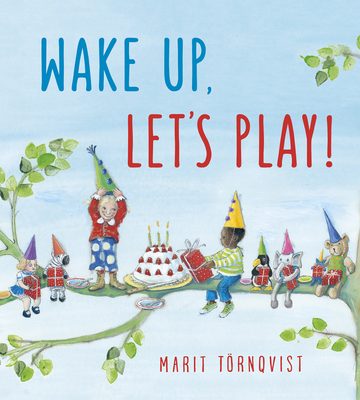
Wake Up, Let's Play by Marit Tornqvist

Wake Up, Let’s Play by Marit Tornqvist (9781782506263)

This dreamy board book invites children to join in the fun that two friends find together. They play all sorts of things, like birthday party and restaurant. They build sandcastles and play stormy seas in the bath. Busy towns with wooden tracks fill the room, and sometimes art wanders onto the walls. They play through snow and even into the night. Then it’s time to figure out what to play tomorrow! Told in very simple sentences, this board book has marvelous illustrations that are quirky and fantastical. At the same time, these are exactly the games that small children play, so it is rooted in reality. A marvel of a little book.

Reviewed from e-galley provided by Floris Books.
Review: Perfect by Max Amato

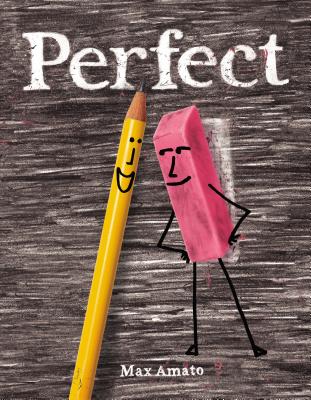
Perfect by Max Amato

Perfect by Max Amato (9780545829311)

An eraser wants to keep everything neat and clean on the pages of this picture book, but a playful pencil has other ideas. The pencil draws mocking images of the eraser, which are then erased. But the scribbles become a whirlwind that knock him into pages of even darker scribbles and marching pencils. The eraser escapes into a deep dark forest of pencil-drawn trees that become a solid darkness. Unable to fix all of the pencil marks, eraser discovers his own playful side and draws his way out onto a clean page. Though now he just might enjoy a bit of mess instead.

In his debut picture book, Amato demonstrates a real sense of play. The eraser character is tightly wound and rather obsessive and makes a great foil for the silliness of the pencil. The book has a great story arc that works well and makes a compelling and interesting tale. Children will enjoy both of the characters, since even the eraser gets in on the fun by the end of the book and leaves his complaints behind. The illustrations are particularly effective with both the pencil and eraser popping visually from the drawn backgrounds. Particularly funny is when eraser turns his back to the reader and one can see the butt print from his fall.

A great sense of humor and playfulness make this one worth sharing. Appropriate for ages 3-5.

Reviewed from library copy.


Review: Is That You, Eleanor Sue? by Tricia Tusa

Is That You, Eleanor Sue by Tricia Tusa

Is That You, Eleanor Sue? by Tricia Tusa (9781250143235)

Saturdays are the days that Eleanor Sue gets to do her favorite thing: dress up. So she dresses up, climbs out her window and knocks on the front door. When her mother opens the door, Eleanor Sue introduces herself as Mrs. McMuffins, the new neighbor. She is invited in for tea. Twenty minutes later, Eleanor Sue is back at the door as a witch. She is invited in for lunch. Then Eleanor Sue is a wise wizard, a ferocious bear, a delivery person, and a cat. Her next outfit is being dressed as a grandma, specifically her Grandma. But her mother may just get in on the act too, just in time for Grandma herself to appear and join the fun.

Tusa’s picture book is a delight. She shares not only the story of Eleanor Sue’s imaginative play but also a supporting mother and family who enjoy Eleanor Sue’s antics. The stories that Eleanor Sue tells as each character are a large part of the book, adding funny details that interplay between the various costumes. There is one fast-paced portion where Eleanor Sue has to hustle with costume changes that adds to the fun. As always with a Tusa book, the illustrations are beautifully done. She has a knack of capturing children at play complete with wrinkled, drooping cloth, and wry expressions.

Full of imagination and playfulness, this should be read while sipping tea. Appropriate for ages 3-5.

Reviewed from copy provided by Roaring Brook Press.


Review: Pass Go and Collect $200 by Tanya Lee Stone

Pass Go and Collect 200 by Tanya Lee Stone

Pass Go and Collect $200: The Real Story of How Monopoly Was Invented by Tanya Lee Stone, illustrated by Steven Salerno (9781627791687)

Explore the story of how the popular board game Monopoly was invented in this nonfiction picture book. Lizzie Magie was a talented woman, someone who was very concerned with fairness in the late 1800s. During that time, wealthy people bought up property in cities and charged high rents for them. Maggie invented the Landlord’s Game, an early version of what would become Monopoly, with two ways to play. One was buying up and owning lots of land and the other was working together and demonstrating how fairness worked better. The game was complicated but popular with different versions being created across the country. When Charles Darrow, a man down on his luck during the Great Depression, was introduced to the game, he worked to improve it. Then he started selling it rather than sharing it the way it had been done. Soon Parker Brothers was interested in selling it. But what of Lizzie?

Stone tells the poignant story of a woman with a real concern for society and the way it was headed. She created a complex game, shared it with others and was taken advantage of by the system that she was working against. Paid a nominal fee to give up her claim to the game, Darrow went on to become a millionaire in contrast. Make sure to read the author’s note at the end that shows how this book was originally about Darrow until Lizzie’s story emerged.

The illustrations have a wonderful vintage quality to them, suiting the period of setting of the book. It is very interesting to see close ups of the different boards of the Landlord’s Game and eventually the very familiar Monopoly board. Even those who don’t enjoy Monopoly, like me, will be fascinated by the complex tale behind the game.

A very intriguing tale that is a mix of women’s rights, ingenuity and economics. Appropriate for ages 8-12.

Reviewed from library copy.

3 Boisterous Noisy Picture Books

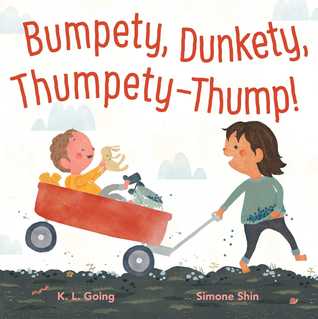
Bumpety, Dunkety, Thumpety-Thump! By K. L. Going

Bumpety, Dunkety, Thumpety-Thump! By K. L. Going, illustrated by Simone Shin (9781442434141)

Two young siblings, a brother and sister, head outside with their wagon. They play with pebbles near the pond, pick blueberries and then head home. Each thing makes it’s own noise: the wagon bumpety-bumps, the pebbles dunkety-dunk, and the plunkety-plunk. Back home, they bake the berries in a pie, eat, wash dishes, and then take a bath. These activities too are supported by a rollicking and noise-filled rhyme that carries the story forward with a jaunty vibe. The book ends with bedtime and everyone sharing stories and heartbeats together. This book beautifully combines noises of a day with a loving family story and creates a book that is a dynamic read-aloud for toddlers. Appropriate for ages 1-3. (Review copy provided by Simon & Schuster.)

Buster and the Baby by Amy Hest

Buster and the Baby by Amy Hest, illustrated by Polly Dunbar (9780763687878)

Buster, a little white dog, is hiding from the baby who is chasing him around the house. Buster tries different spots to hide, but each time, the baby comes and finds him. THUMP, THUMP, THUMP comes the baby, the same noise that Buster’s heart makes as he hides. Then the two dash off together in a wild chase until Buster finds his next hiding place and it begins again. This book begs to be shared aloud, as Hest has created moments of quiet tension and then uproarious frenzy that repeat again and again. The illustrations by Dunbar add to the joy, incorporating panels that let young listeners see the action across pages. A great pick for reading aloud to toddlers. Appropriate for ages 1-3. (Reviewed from library copy.)

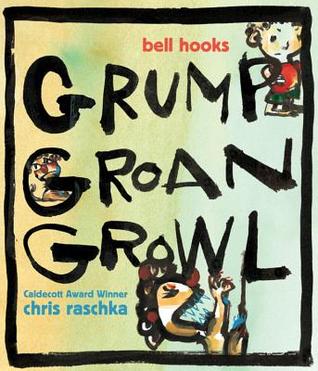
Grump Groan Growl by bell hooks

Grump Groan Growl by bell hooks, illustrated by Chris Raschka (9780786808168)

Explore a bad mood in this picture book that takes a look at being very very grumpy. The child in the opening images prowls like a lion, sharp claws at the ready as he grumps across the page. He groans and growls loudly, almost a roar. There is nowhere to escape his foul mood. He feels wild and out of control until he realizes that he can look inside, let that feeling be and let it pass. Hooks speaks to the process of mindfulness about emotions with few words, showing the emotion clearly and then moving into the process to allow that emotion to pass on. Raschka’s illustrations are dark with emotion, tinged with colors that become more tangible as the child regains control. A great pick for mindfulness with children, this book doesn’t reject negative emotions or cling to them either. Appropriate for ages 3-5. (Reviewed from library copy.)


3 Playful Picture Books

These three picture books are all about the joy and power of play.

Another Way to Climb a Tree by Liz Garton Scanlon

Another Way to Climb a Tree by Liz Garton Scanlon, illustrated by Hadley Hooper (9781626723528)

Lulu loves to climb trees. She saves cats, retrieves kites and climbs trees that others won’t. When Lulu gets sick though, she can’t climb trees for awhile. She misses the trees and the trees and birds miss her too. As Lulu looks out of her window, only the sun is climbing the tree. But then she notices the tree’s shadow on her bedroom wall and Lulu realizes that she can still pretend to be high in the branches. Scanlon’s writing is rich and simple at the same time. She speaks about the joy of climbing trees and then with poignancy shows how much Lulu misses being outside and being up in tree branches. The illustrations by Hooper are done with printmaking and have a traditional and organic feel that adds to the connection with nature felt on the pages. Get this into the hands of children with skinned knees and sunburned noses. Appropriate for ages 4-6. (Reviewed from library copy.)

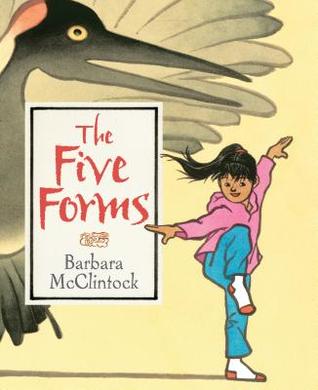
The Five Forms by Barbara McClintock.jpg

The Five Forms by Barbara McClintock (9781626722163)

When a girl discovers a book of martial arts forms, she ignores the warming in the book that says that “unexpected results” can happen if anyone other than a master attempts them. When the girl tries the crane form, a large crane appears in her room. The crane is quite problematic and destructive, so she quickly moves on to leopard form. As the two animals fight, she adds another and another with a snake and dragon joining the battle. Finally, she reaches the last form to turn things back to normal. She tidies up the mess of the house just before her mother comes in with tickets to the zoo. Perhaps it’s time for someone else to read that book! McClintock’s text is very simple here, with much of the action of the book happening in the images. The book moves from straight picture book to comic frames and back again with alacrity and in a way that flows naturally from form to form. The illustrations are filled with huge animals, messes and activity. This is a fun look at martial arts with a dash of magic. Appropriate for ages 3-5. (Review copy provided by Farrar Straus Giroux Books for Young Readers.)

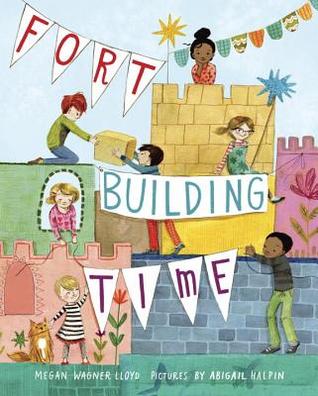
Fort-Building Time by Megan Wagner Lloyd

Fort-Building Time by Megan Wagner Lloyd, illustrated by Abigail Halpin (9780399556562)

Celebrate the seasons through play in this picture book that has different forts built by kids throughout the year. Winter starts the book with an ice and snow fort made merry with pine boughs for seating, berries and branches for decorations. Spring has a quiet fort filled with books to read, a cozy blanket hung between trees. Summer takes the fort to the beach with driftwood, towels, starfish and snacks. The fall fort is up in the changing trees with leaves falling all around. But sometimes forts go awry too! The only solution is a bigger, better fort next time. The text of this picture book is poetic and celebratory of each of the seasons with each season clearly depicted and then the fort shown in the illustrations. The images are filled with diverse children playing together. The fine-lined images are a mix of watercolor, colored pencil and digital that create a rich, warm setting. Have plenty of blankets, boxes and pillows around because little listeners will want to immediately build their own forts. Appropriate for ages 3-5. (E-galley provided by Edelweiss and Alfred A. Knopf.)