Review: The Lightning Dreamer by Margarita Engle

lightning dreamer

The Lightning Dreamer by Margarita Engle

Margarita Engle, award-winning author of verse novels, continues her stories of Cuba.  In this book, she explores the life of Gertrudis Gomez de Avellaneda, also known as Tula, who becomes a revolutionary Cuban poet.  Raised to be married off to save the family financially, Tula even as a young girl relates more closely with slaves and the books she is reading than with girls of her own age and her own social standing.  As she reads more and more, sheltered by both her younger brother and the nuns at the convent, Tula starts to explore revolutionary ideas about freedom for slaves and for women.  In a country that is not free, Tula herself is not free either and is forced to confront an arranged marriage, the brutality of slavery, and find her own voice.

Engle writes verse novels with such a beauty that they are impossible to put down.  Seemingly light confections of verse, they are actually strong, often angry and always powerful.  Here, Engle captures the way that girls are asked to sacrifice themselves for their families, the importance of education for young women, and the loss of self.  She doesn’t shy away from issues of slavery either.  At it’s heart though, this novel is about the power of words to free people, whether that is Tula herself, her brother or a family slave and friend.

Highly recommended, this is another dazzling and compelling novel from a master poet.  Appropriate for ages 12-15.

Reviewed from digital galley received from NetGalley and Houghton Mifflin Harcourt.

Review: Martin on the Moon by Martine Audet

martin on the moon

Martin on the Moon by Martine Audet, illustrated by Luc Melanson

Martin has just started school, but as he sits in class, his mind continues to wander.  His teacher reminds him of his cat due to her hair color.  Then he daydreams about the trip he and his mother took to the river and thinks about the water there.  He tries to pay attention, since it is the first day of school, but then his teacher reminds him of a seagull with the way she is moving her arms.  Martin remembers a time when he was out drawing and got to see a bolt of lightning in the sky.  When he shared that it looked like someone coloring outside the lines, his mother wanted to use the image in a poem. Martin then starts thinking about poems and kisses, until his teacher asks him who he’s blowing kisses to. 

Nominated for the Prix TD de littérature canadienne pour l’enfance et la jeunesse in its original French, this book works well translated into English.  The poetic language, the imagery and the creativity of young Martin all work together to create a beautiful unity.  This is a striking example of a picture book whose strength comes from its writing rather than its illustrations.  The writing is powerful, visual and uses imagery that children will easily relate to.  Tying in poetry itself to the story makes it all the more concrete.

Melanson’s illustrations have a soft texture and use a successful mix of vibrant and softer colors.  The illustrations don’t offer much detail, instead being more about color and texture than finer touches. 

Poetic and lovely, this picture book would work well in a unit on imagery or poetry.  I’d also get it into the hands of any young daydreamer.  Appropriate for ages 4-6.

Reviewed from library copy.

Review: Forgive Me, I Meant to Do It by Gail Carson Levine

forgive me i meant to do it

Forgive Me, I Meant to Do It: False Apology Poems by Gail Carson Levine, illustrated by Matthew Cordell

Based on William Carlos Williams’s “This Is Just to Say” poem, these poems borrow the form and the apology but build upon it with a wild array of situations.  In each poem, an apology is offered, but all of them are done conditionally and many are completely insincere.  There is an apology for eating all of the ice cream and replacing it with anchovies.  There is an apology for turning a bully into a fly and having a swatter ready to go.  Then there are many apologies based on fairy tales or songs that children will enjoy seeing from a new and inventive perspective.  This is a book to pick up and read out of order, unless of course you stumble upon one of the apologies the author has included that might make you reconsider that approach! 

I’m always on the look out for funny poems to share with children, since I’ve found that Prelutsky and Silverstein make a great ice breaker when talking with groups.  Even the jaded upper elementary class can be caught off guard by a charmer of a poem, especially one that elicits guffaws and merriment.  I can see these very short poems being shared in groupings as part of a class visit.  Perhaps interspersed with information about the library and its offerings.

The entire work is very funny, though some of the poems work better than others.  The illustrations hearken to Silverstein’s work with the ink drawings done without additional color.  They have a wonderful frenetic energy to them and also a delight at the situations. 

This will be a welcome addition in elementary classrooms that are working with poetry.  It also makes for a great giggly bedtime read.  Appropriate for ages 7-10. 

Reviewed from library copy.

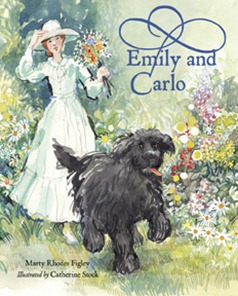
Review: Emily and Carlo by Marty Rhodes Figley

emily and carlo

Emily and Carlo by Marty Rhodes Figley, illustrated by Catherine Stock

When Emily Dickinson was 19 years old, she was lonely in the big home in New England since her siblings were off at school.  So her father bought her a puppy that she named Carlo.  The quiet and reclusive poet was an odd match with her bounding, huge Newfoundland.  Carlo gave Emily more courage to be out and about, visiting others.  He was with her always, a large drooling dog.  They explored Amherst together with its woods, meadows and ponds.  Their time together inspired her poetry, as shown in this book through stanzas that she wrote.  This friendship with a dog makes this literary figure much more human and approachable for children.  It’s a very special way to see an author.

Figley truly found the key to Emily Dickinson’s personality for children.  All it took was a large messy dog to break through into Dickinson’s quiet, contemplative world.  Interspersing the verse with the story also makes this a friendly window into Dickinson’s work.  The book maintains a fresh, light tone throughout, showing the two friends aging together.

Stock’s art is a radiant mix of playfulness and contemplation, matching the subject matter beautifully.  It shows the deep connection of woman and dog, the natural world they explored, and pays homage to the verse that is embedded in the book. 

A simply lovely look at Emily Dickinson through her love of a pet, this book should be used with anyone working with Dickinson’s poetry and children as a lens through which to view the person and her writing.  Appropriate for ages 6-8.

Reviewed from copy received from Charlesbridge.

Review: The Crossing by Donna Jo Napoli

crossing

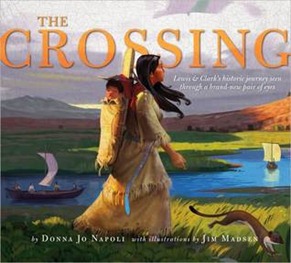
The Crossing by Donna Jo Napoli, illustrated by Jim Madsen

A gorgeous retelling of the Lewis and Clark story, told through the eyes of Jean Baptiste Charbonneau, the infant that Sacagawea carried on her back during their explorations.  Readers will see mountains, rivers and forests.  They will also meet bear, elk, cougars and more.  Napoli’s poem captures the rhythm of the journey, the stroke of the oars, the moments of quiet.  It is an immersive book where readers get to see the glory of the land that makes up our country, unspoiled by man-made structures.

Napoli’s verse incorporates many senses.  There are the sounds of the animals and humans that work to bring the entire setting to life.  There are the views that the baby sees, a wildness that is a large part of the story, a sense of expanse and freedom.   The author’s note adds much to the book, including the duration and length of the journey.

Madsen’s illustrations have a depth to them that adds much to this title.  He uses deep colors and uses the beauty of the land as the perfect inspiration for his work.  There are small moments of a child growing from infant to toddler, but also moments where the world is spread before them and reveled in. 

A beautiful and creative look at Sacagawea’s journey with Lewis and Clark, this book is a luminous look at the origins of our country.  Appropriate for ages 5-7.

Reviewed from copy received from Atheneum Books for Young Readers.

Also reviewed by The Fourth Musketeer and Kiss the Book.

Book Review: All the Water in the World by George Ella Lyon

All the Water

All the Water in the World by George Ella Lyon and Katherine Tillotson

“All the water in the world is all the water in the world” is the sentence that starts this picture book.  It tells the story of water through a poem, explaining where water comes from, the water cycle, and the importance of water for life on earth.  This is a celebration of water, from the puddles on the ground, to the grand storms, to the rivers and the clouds. 

Lyon’s words match the subject matter, which is delightful.  They drip from faucets steady and slow, they clump as clouds and fall as rain, they flow and dance.  Throughout the poem, the reader is referred to as “honey” which gives the poem a personal and homey feel where it could have been cool and remote.

Tillotson’s illustrations are done digitally and have the feel of watercolor mixed with collage.  Natural splashes of color mix winningly with straight edges.  The illustrations of the desert are also very successful, offering a clear contrast from the blues of water with the yellows of sand. 

Celebrate water and the environment with this refreshing book that explains the science clearly and also lifts it into poetic beauty.  Appropriate for ages 4-6.

Reviewed from copy received from Atheneum Books.

Also reviewed by

Book Review: Hurricane Dancers by Margarita Engle

HurricaneDancers

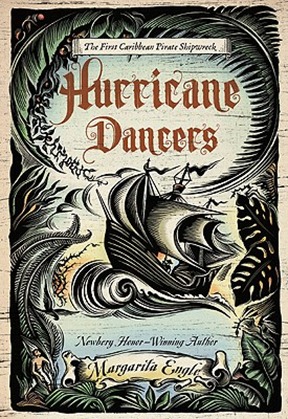
Hurricane Dancers by Margarita Engle

Engle’s latest historical novel in verse explores piracy in the Caribbean Sea in the 1500s.  It is the story of Quebrado, a fictionalized character, who is a slave aboard a pirate ship.  Also on the ship is Alonso de Ojeda who has been captured.  That ship, owned by real historical figure Bernardino de Talavera, becomes shipwrecked.  The story is populated by people from history, but told primarily through the voice of Quebrado.  It is a pirate story that removes the swashbuckling glamour and tells the bitter truth about what piracy was.

Engle captures such emotion in her verse, creating moments of pain, wonder and even delight in this brutal story.  The book is immensely engaging, thanks to its brisk pace and lively subject matter.  There is adventure and even a touch of romance in this story, giving light in the darkness of slavery and piracy. 

Engle pays close attention to the native people of the islands, allowing glimpses into their lives and their beliefs.  They make a great foil to the lying, manipulations of the pirates.  It is a story that is elegantly crafted and vividly written.

A great choice for late elementary and middle school students who are interested in history and pirates.  This is a book that is fast, fascinating and fabulous.  Appropriate for ages 11-14.

Reviewed from library copy.

Also reviewed by:

Guyku: A Year of Haiku for Boys

guyku

Guyku: A Year of Haiku for Boys by Bob Raczka, illustrated by Peter H. Reynolds

A brilliant combination of haiku poems, clever humor, and engaging illustrations, this book is sure to appeal to its target audience of guys and also to girls.  Celebrating the small things in life, each haiku takes a moment in time and then offers a grin to the reader.  The poems are arranged in seasons, fitting because so many of them are about nature and a boy’s relationship with it.  Whether it is flying a kite, skipping rocks, leaf piles or snowball fights, children will relate easily to these vignettes about the things that make life fun. 

Raczka’s haiku are light-hearted and enjoyable.  Thanks to the brief nature of the format, the poems are easily shared aloud.  Nicely, the poems stand on their own or work together as a larger piece of writing.  Reynolds’ art is equally engaging.  It too has a great humor about it but also a sense that a moment is being captured. 

A celebration of seasons, play and boyhood, this book is a treat.  If librarians are looking for something to take with them for summer reading program visits, the summer haiku here would make a great thing to share with boys of many ages.  Appropriate for ages 6-9.

Reviewed from library copy.

Enhanced by Zemanta

Little Black Crow

51grSiNp3IL

Little Black Crow by Chris Raschka

A little boy sits on a fence and wonders about the life of a little crow.  Where does the crow go in the snow?  Where does it go in a storm?  Who does it meet?  Does it ever complain about the cold and wet?  How does it sleep?  And most vital of all, is it really a boy, like him with similar feelings and wonders?  Raschka takes his spare verse and asks deep questions about animals and their relationship to humans.  Through it all, his watercolor images move, transitioning as the book continues from a black and brown palette to a glory of pinks, blues, oranges and yellows.  Even the illustrations have a minimalist feel to them, just like the verse they leave plenty of room for readers to insert themselves into the book.

Raschka has created a book that really works here.  It is a book that will lead to conversations and questions naturally.  It is a book that is beautifully designed, a book that invites exploration.  Raschka’s illustrations have a freedom, an exquisite carefree feel that works as a foil to the wondering tone of the boy as he tries to understand more clearly the world of the bird. 

A marvelous book, this picture book offers lots of wonder and depth.  Appropriate for ages 5-7.

Reviewed from copy received from Atheneum.

Enhanced by Zemanta