I Like, I Don’t Like by Anna Baccelliere

I Like, I Don't Like by Anna Baccelliere

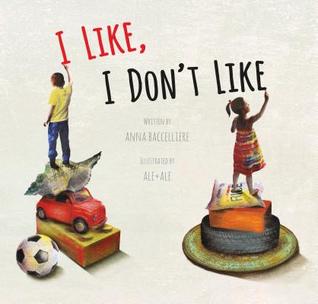
I Like, I Don’t Like by Anna Baccelliere, illustrated by Ale + Ale (9780802854803, Amazon)

This spare and focused children’s picture book tackles the issue of child labor in a way that children will immediately understand. Looking at one object at a time, a child first says how much they like it, then the child responsible for making or gathering that object states that they don’t like it. So one child likes shoes, another doesn’t like shoes. One child likes music, another who plays on the street doesn’t like music. One child likes phones, another doesn’t like phones as they take them apart. The book ends with a heart-wrenching combination where one child likes playing and the other asks “What is playing?”

The book never loses sight of its purpose, pairing wealthy children with those living in poverty and doing child labor is a way to make sure that the message resonates with children and that they learn about their privilege in the world. The book ends with information on poverty and child labor as well as information on the United Nations’ Convention on the Rights of the Child and tips on how children can help.

The illustrations are stylised photographs that are painted and textured. They look straight into the faces of children from both sides of wealth and poverty, contrasting broad smiles with a deep weariness. Washes of similar colors further pair the contrasting dyads together into one image.

This is a very important picture book that is sure to inspire conversations and a desire to help. Appropriate for ages 6-8.

Reviewed from copy received from Eerdmans.


The Cat from Hunger Mountain by Ed Young

the-cat-from-hunger-mountain-by-ed-young

The Cat from Hunger Mountain by Ed Young (InfoSoup)

On Hunger Mountain, there lived a great lord who was wealthy and had anything he ever dreamed of. He lived in the tallest pagoda, had his rice washed in the stream, ate only the first half of his food, and wore the most beautiful fabrics. Then drought came to his land, yet the lord did not stop his consumption. A second year of drought and famine came and the others left his land. The lord finally realized he would starve alone in his pagoda so he left the mountain and tried to find food. When he met two beggars, they told him of a generous monk who would give others food. The monk gave the lord food and the cat realized that this was lovely grain and some of the best he had ever eaten. He asked the monk where he had gotten the rice and was told that it was washed down the river from Hunger Mountain where a wealthy lord had wasted it.

Young writes this story with real precision. He keeps his prose short and child-friendly with a tone of a storyteller who offers just enough detail yet keeps the pace brisk. Young allows the story itself to stand, not adding judgment in the text about what should be learned from it.

The illustrations are the opposite of the pared down text with a rich opulence built from layered collage. Some of the collage is patterned paper while others are photographs of fur, water or mountains. They have a serious energy to them, filled with motion and expression.

A vibrant picture book that looks at waste, consumption and humility. Appropriate for ages 5-8.

Reviewed from library copy.


Flannery by Lisa Moore

Flannery by Lisa Moore

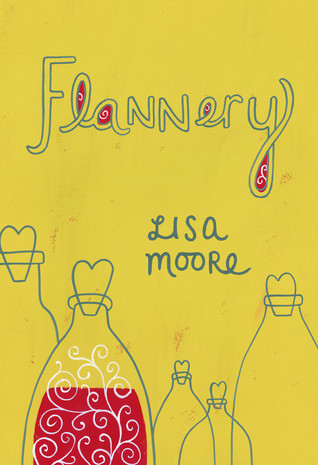
Flannery by Lisa Moore (InfoSoup)

At age 16, Flannery is dealing with huge issues. Her mother, an artist, is unable to pay for her biology book or heating bills. Her best friend, Amber, has a new boyfriend that Flannery does not trust because he is over-controlling and their friendship is falling apart. And now Flannery has been put into a Entrepreneurship class project with her long-term crush, a graffiti artist who seems to think he’s too cool for school. So she is left doing all of the work for their project herself. Flannery works to hold it all together, even managing to create a project that sells out: love potions. While Flannery may realize they are entirely pretend, everyone who drinks one seems to be finding love. As things start to shatter around her though, Flannery discovers who is there for her and who is not.

OK, everything I read about this book seems to focus on the love potion aspect. This book does have that, but oh my it is so much more. The writing here is strikingly unique. Moore does away with quotation marks, creating dialogue poetry on the page, the voices running together exquisitely and somehow becoming even more clear without the punctuation. That is great writing. She plays with the mysticism of love, the power of control, and the illusion of it as well.

Beyond the love potions, this is a book about a teenager finding her own strength, her own voice and her own way of living which is not about conforming at all. Flannery knows throughout the book that she is unique and in love and that everything is not what it should be. Still, there are revelations even as she lives her truth, ones that change her point of view and make her grow. That is done so naturally and organically. Beautiful.

A stunning teen read, pick this one up not for the love potions but for the deep story and strong unique heroine that you will want to meet. Appropriate for ages 14-18.

Reviewed from library copy.

Review: Crenshaw by Katherine Applegate

Crenshaw by Katherine Applegate

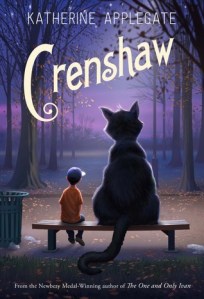
Crenshaw by Katherine Applegate (InfoSoup)

Jackson knows that it’s all about to happen again. His family is having a garage sale for a lot of their stuff, allowing Jackson and his little sister to just pick one bag of items to keep. There just isn’t enough money for rent and Jackson feels hungry a lot of the time. His father doesn’t want to ask for assistance, preferring to find a way through on their own. When Jackson was younger, the family had lived in their minivan for awhile and now Jackson sees the same signs as before. When they lived in their car, Jackson met his imaginary friend, Crenshaw. Now even though Jackson is older, Crenshaw is back and bigger than ever. Crenshaw is a huge cat with a deep purr, who tells Jackson that he is there to help and encourages Jackson to just tell the truth. As Jackson’s world gets more complicated though, how in the world can an imaginary friend make a difference?

This is Applegate’s first novel for children since winning the Newbery Medal for The One and Only Ivan. Applegate imbues this new book with a shining magic of imagination. She keeps the wonder of Crenshaw real on many levels, not only for Jackson himself but also creating moments where readers will know that Crenshaw is much more than imaginary. This luminous touch keeps the entire book dazzling for readers.

It is even more important given the issues that the book explores. Family poverty and homelessness are critical in our world today and so few books tell that story from the point of view of a child experiencing it. Applegate keeps the story real here, focusing on the impact of being hungry, on the fear that being homeless generates in a child. She also makes Jackson a real hero. A child facing immense problems who, with the help of his imaginary friend, manages to tell his parents what this kind of life does to him. It is powerful, heart wrenching and true.

An important book that mixes an imaginary friend with the harsh reality of homelessness, this is a top pick for young readers. Appropriate for ages 7-11.

Reviewed from copy received from Feiwel & Friends.

Review: Yard Sale by Eve Bunting

Yard Sale by Eve Bunting

Yard Sale by Eve Bunting, illustrated by Lauren Castillo (InfoSoup)

Callie’s family is moving from their house into a small apartment, so they are having a yard sale. It’s a bright sunny day but Callie is filled with mixed feelings as she sees all of the parts of their lives out in the front yard for sale. Callie has visited their new apartment and seen where she will sleep. It’s even a cool bed that pulls out of the wall. But she is going to miss her friends in the neighborhood and doesn’t really understand why they have to move except that it has to do with money. When Callie sees her red bicycle being purchased by someone she gets upset and then when a friendly woman asks if Callie herself is for sale, Callie gets alarmed. In the end after the sale in their almost-empty house, Callie and her family look forward to a fresh start together as a family.

Bunting beautifully and sensitively captures the mixed feelings of moving and the additional burden of being forced to downsize due to financial reasons. She shows from Callie’s point of view how upsetting it can be. At the same time, she shows supportive parents who work with Callie to discuss her feelings and validate her emotions. The yard sale is a strong image to have at the heart of the book, demonstrating the loss of so many items of property but at the same time strengthening the image of the family who is left strong and resilient.

Castillo has created a neighborhood of friendly people, bright balloons and lots of sunshine that works very nicely here. The deep feelings expressed by the protagonist play against the dazzling day and the contrast makes the emotions all the more real. The three members of the family are clearly a unit from their similar dark hair to the color palette that holds them together as well. It is subtly done, but very effective.

A powerful book about children caught in the impact of the economic downturn, this book is not bleak but rather filled with hope for the future. Appropriate for ages 4-6.

Reviewed from library copy.

Review: Gordon Parks by Carole Boston Weatherford

gordon parks

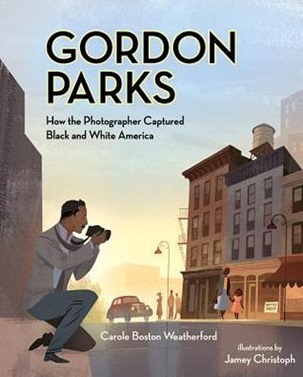
Gordon Parks: How the Photographer Captured Black and White America by Carole Boston Weatherford, illustrated by Jamey Christoph

Gordon Parks had a rough beginning to his life from being born almost stillborn to losing his mother at age 14. He was told by his white teacher that he and the rest of his all-black class would end up as either porters or waiters. Parks did do those jobs, but then he purchased a used camera and everything changed. He started photographing models and then turned his camera towards the struggling families in Chicago and Washington DC. He is pointed towards one specific subject who will create his most famous image, American Gothic, the picture of an African-American cleaning woman standing in front of the American flag with her mop in hand. Parks managed to show racism with a clarity thanks to just picking up a camera at first.

Weatherford keeps this book very friendly with a minimal amount of text in the bulk of the book. She does include an author’s note at the end that fills in more of the extensive career of Parks as a film director and Renaissance man. The focus here in this picture book biography is Parks’ photographic work and the impact he had on exposing racism and poverty in the inner city, showing hard working people who were still in poverty. Make sure to turn to the end of the book to see his photographs and their intense message.

Christoph’s illustrations are stellar. Using a subtle color palette, the images echo the photographs that Park took, but not too closely. Instead they build upon them, showing Parks taking the images and embracing the dark beauty of the back streets of urban spaces. He also beautifully captures emotions and the humanity of Parks’ subjects that also shines in his photographs.

An important picture book biography, this book shows how one person can make a difference and have a voice. Appropriate for ages 7-9.

Reviewed from library copy.

Review: Hold Tight, Don’t Let Go by Laura Rose Wagner

hold tight dont let go

Hold Tight, Don’t Let Go by Laura Rose Wagner

Magdalie lives in Haiti with her cousin Nadine and Nadine’s mother, but Magdalie considers them to be her sister and mother.  Her aunt works for a wealthy lady, cooking and cleaning, and the three of them live in the lower rooms of the house.  When the earthquake hits Haiti in 2010, the girls survive but Nadine’s mother is killed.  The two girls have nowhere to go but they are rescued by Magdalie’s uncle and move into the refugee camp.  Soon after they move, Nadine’s father gets her a visa and she moves to Miami to live in the United States.  Nadine promises to send for Magdalie as soon as she can.  Magdalie is left all alone, unable to afford to attend school any longer and mourning the loss of her sister and mother.  Magdalie holds tightly to the hope of heading to the United States, but eventually has to admit that she is staying in Haiti and figure out how to not only survive but thrive there.

Wagner writes with a passion that shines on the page.  She shows the beauty of Haiti, creating a tapestry of food, sounds and voices that reveals what is often buried beneath the poverty.  She does not shy away from the ugliness of poverty, from the waste, the violence and the impossible choices facing a girl like Magdalie.  Sex simmers constantly around her, offers are made to young girls, and in one instance Magdalie must make the choice of whether she is willing to be taken care of in exchange for sexual favors. 

Through it all, even when she is deep in despair, Magdalie is clearly a smart girl who loves to learn and wants to be something more than where she finds herself.  Magdalie is incredibly strong too, facing on a daily basis things that American readers will never have experienced.  And that too is part of Wagner’s amazing depiction of Haiti.  She makes it clear that it is because of the society of Haiti that there is immense poverty but also that people can survive that poverty.  When Magdalie visits a rural part of the country, readers revel right alongside her in the natural beauty.  When she longs to return to the camps and the filth, readers too will begin to understand what she sees there and the potential it offers her if she can just find a way.

This is a complex book that does not try to answer society’s issues in a pat or simple way.  Rather it stands as witness to the brutality, beauty and incredible strength of Haiti and its people.  Appropriate for ages 13-17.

Reviewed from ARC received from Amulet Books.

Review: In Real Life by Cory Doctorow

in real life

In Real Life by Cory Doctorow, illustrated by Jen Wang

After a woman gamer comes to present information on gaming and computer science to her class, Anda starts to play Coarsegold.  She starts to spend most of her time away from school playing the online multiplayer game.  Online she meets another player who encourages her to start killing gold farmers for real life money.  So Anda refocuses her battles online specifically on gold farmers, killing them even though they don’t fight back.  But something feels wrong about what she is doing and then Anda gets to know one of the gold farmers who has started to learn English.  He is a poor Chinese kid who is just trying to survive and loves playing Coarsegold even though he does it for hours as a gold farmer.  Anda soon finds herself questioning the morals of killing gold farmers and what is wrong and right in real life and in the game world. 

As a gamer girl myself, I applaud Doctorow for choosing to have a female lead in his book about online gaming.  It adds another dimension to a book that wrestles with tough questions about gaming and gold farming.  Gold farmers are people, usually from poorer countries, who are paid to play the online game, gather materials, and then sell them for real money, something that is against the rules of the games.  So the book gets to the heart of people from wealthy countries using those from poorer countries, it looks at working conditions in gold farming companies, and questions the real ethics of the situation, beyond the superficial ones. 

Wang’s illustrations are dynamite.  She shows Anda as a girl who is built like a real person.  She is rounded, comfortable in her clothes, and wonderfully not on a diet!  Wang creates an online character for Anda who is powerful but not busty and half naked.  It’s a great choice artistically. 

Gaming books that actually get the game worlds right are few and far between.  Gamers of any MMO will recognize the economy, the style and the play here while non-gamers will find themselves understanding gaming and game economies too.  Appropriate for ages 12-16.

Reviewed from copy received from First Second.

Review: Serafina’s Promise by Ann E. Burg

seraphinas promise

Serafina’s Promise by Ann E. Burg

The author of All the Broken Pieces returns with a new verse novel.  Serafina lives with her mother and father in Haiti.  She and her best friend dream of becoming doctors in order to help save people like her baby brother who died.  But Serafina’s family cannot afford for her to even attend school.  Instead she has to work hard to help her mother who is pregnant with another baby.  Serafina carries water for her family, empties chamber pots, sweeps the floor, and keeps the family fire burning.Her father is one of the lucky ones who has a steady job in the nearby city that he walks to every day.  There is no extra money for anything though, even with his work.  When a large storm comes, their small village is ruined and Serafina’s family moves to higher ground.  It is there that Serafina’s dreams start to come true with her new garden and the money it brings.  Then the earthquake strikes.

Burg tells a gripping story of  a young girl with huge dreams living in abject poverty.  Her family is strong and loving, just unable to lift themselves out of the poverty that surrounds them everywhere.  Burg shares small details of life in Haiti, nicely weaving them into the poetry so that it is revealed in a rich and natural way.  The Creole language is also used throughout the book, offering a rhythm and sound that enlivens the entire setting.

Serafina is a well-developed character.  Many of the poems show her own inner feelings in all of their complex beauty.  She is not a perfect character, sometimes showing stubbornness and jealousy, but that just makes her all the more compellingly human.  And the verse throughout the book is lovely, evocative and very effective.  Readers will know that the earthquake is coming and that also creates a tension that makes the book riveting.

This is a powerful look at the Haitian earthquake through the eyes of one extraordinary young woman.  Appropriate for ages 10-13.

Reviewed from ARC received from Scholastic.