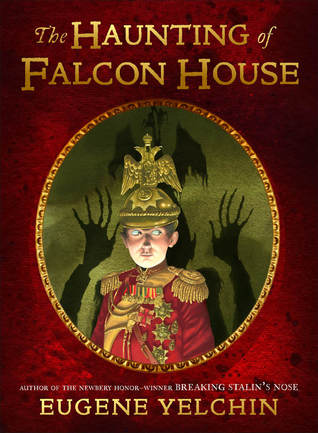
The Haunting of Falcon House by Eugene Yelchin

The Haunting of Falcon House by Eugene Yelchin

The Haunting of Falcon House by Eugene Yelchin (InfoSoup)

Twelve-year-old Prince Lev Lvov moves in with his aunt at Falcon House. It is a house that he will inherit as he is heir to the Lvov estate. Lev wants to be just like his grandfather, a general in the Russian army, stern and strong. Things are strange though at Falcon House where he finds wonders like an elevator in the home but also rooms that have not been touched in years. As he enters the home, Lev sees another young boy there, playing on the banister. Lev is sent to sleep in his grandfather’s old study where he can’t sleep and finds himself drawing and drawing with much more skill than he ever had before. In fact, he finds it nearly impossible to put the pen down. Slowly Lev starts to learn the secrets of his family and realize that some of the family secrets are more terrifying than ghosts.

Yelchin won a Newbery Honor for Breaking Stalin’s Nose. Here he very successfully merges historical Russia with a dark ghost story. Based on the premise of having found old notes and drawings from Lvov, the book is immediately mysterious and filled with wonder. There is the amazing setting of the huge mansion, filled with things like death masks and a basement of mothballed clothes. There are the servants who manage to work for his aunt despite her disdain and harshness. There is the ghost, who tells his own story but ever so slowly. They all create a world of darkness and beguilement.

Then the book turns and changes, becoming something deeper and more filled with emotion. It looks beyond the cranky aunt and into why she acts the way she does. It examines the death of a boy and eventually becomes about who is responsible for it and why. It looks at servants and royals, at status and power. It figures out what it takes to become someone willing to wield that power too.

Entirely gorgeous, haunting and deep, this novel is chillingly dark and wonderfully dangerous. Appropriate for ages 9-12.

Reviewed from library copy.


Review: The King and the Magician by Jorge Bucay

king and the magician

The King and the Magician by Jorge Bucay, illustrated by Gusti

There once was a powerful king who asked his subjects who the most powerful man in the kingdom was, and they replied that he was, of course.  The one day, the King heard about a man who had a different power than he had, a humble magician who had the power to predict the future.  Even worse, the King discovered that the magician was well respected and beloved.  So the King called the Magician before him after devising an evil plan.  He would ask the Magician if he could really tell the future.  If the Magician answered “No” then he proved he had no power.  If he answered “Yes” then the King would ask him to predict his own death.  Either way, the King would immediately kill him.  But then a strange thing happened and the Magician declared that he could see the future and that he would die at the same time as the King.  Suddenly, the King’s plan meant nothing.  He could not kill the Magician without hurting himself.  So instead he started protecting the Magician.  Still, the Magician had much more to teach him, if the King would listen.

Bucay has created a picture book that has depths to it.  It is a fairy tale of a king and a magician but it is also about creating one’s fate, listening to wisdom and being willing to change.  It is a book that continues even after some may have ended it with the Magician ensconced in luxury and being protected by the King.  Happily, it doesn’t end there, because the more profound part of the story follows when the relationship between the two men burgeons into friendship and deep caring for one another.  It is a story of how enemies become friends, how power can be used for good.  In a word, it’s exceptional.

Gusti’s illustrations add to that feeling of a very rich and amazing read.  Using paint and collage, the illustrations have a still regal bearing.  There is a strength and solidity to them that grounds this story, making it more realistic.  There are also touches of whimsy, like the teddy bear that accompanies the powerful king everywhere. 

Strong, enchanting and profound, this picture book will start discussions about power, enemies and truth.  Appropriate for ages 4-6.

Reviewed from library copy.

Sivu’s Six Wishes: A Modern, Traditional Tale

51O9ELiiCgL

Sivu’s Six Wishes by Jude Daly

A retelling of an old Taoist tale, this is the story of Sivu, a stonecarver.  Sivu could make amazing things from stone but despite his skill, he never made a lot of money and turned bitter.  One day, when carving a statue for a wealthy man, Sivu dreamed of how great that man’s life must be.  Suddenly, Sivu was the wealthy man.  He had plenty of power and wealth, but everyone despised him.  Then Sivu was stopped by the mayor’s procession and he dreamed of being the mayor with all of his power.  Suddenly, Sivu was the mayor.  But again, everyone hated him.  Sivu looked out over the gardens and saw the sun.  He wished he could be the sun, and he was.  He shone down, far too fiercely, and created a drought.  Then a storm cloud came over the sky and Sivu the sun could not move it.  He wished he could be the powerful rain cloud, and he was.  Now he rained too harshly and caused a flood.  Eventually, the wind blew him out to sea.  Sivu wished he was the wind, and he was.  He blew and blew, until one day he came across something that he could not move.  He wished he could become that, and he did.  He was a huge rock, completely unmovable until one day…

This is a story that makes the themes of power, wealth, and desire come alive.  Daly has created a very readable text that moves briskly from wish to wish, examining each one and then going on.  She has set the story in the present day, making it all the more accessible to modern children.  This is both an old story and a new one, vibrant across time.   Daly has illustrated the book with modern illustrations that are bright colored and busy.  They convey both the hustle of the modern day and the timelessness of the story with ease. 

Recommended as a way to get children talking about envy and contentment, need, wealth and power, this book leaves nothing to wish for.  Appropriate for ages 6-9.

Reviewed from copy received from Eerdmans.