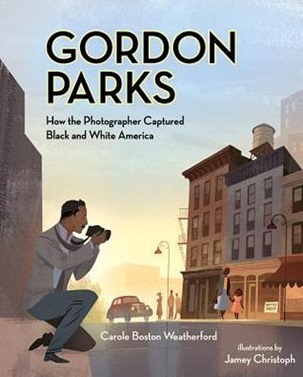
Review: Gordon Parks by Carole Boston Weatherford

gordon parks

Gordon Parks: How the Photographer Captured Black and White America by Carole Boston Weatherford, illustrated by Jamey Christoph

Gordon Parks had a rough beginning to his life from being born almost stillborn to losing his mother at age 14. He was told by his white teacher that he and the rest of his all-black class would end up as either porters or waiters. Parks did do those jobs, but then he purchased a used camera and everything changed. He started photographing models and then turned his camera towards the struggling families in Chicago and Washington DC. He is pointed towards one specific subject who will create his most famous image, American Gothic, the picture of an African-American cleaning woman standing in front of the American flag with her mop in hand. Parks managed to show racism with a clarity thanks to just picking up a camera at first.

Weatherford keeps this book very friendly with a minimal amount of text in the bulk of the book. She does include an author’s note at the end that fills in more of the extensive career of Parks as a film director and Renaissance man. The focus here in this picture book biography is Parks’ photographic work and the impact he had on exposing racism and poverty in the inner city, showing hard working people who were still in poverty. Make sure to turn to the end of the book to see his photographs and their intense message.

Christoph’s illustrations are stellar. Using a subtle color palette, the images echo the photographs that Park took, but not too closely. Instead they build upon them, showing Parks taking the images and embracing the dark beauty of the back streets of urban spaces. He also beautifully captures emotions and the humanity of Parks’ subjects that also shines in his photographs.

An important picture book biography, this book shows how one person can make a difference and have a voice. Appropriate for ages 7-9.

Reviewed from library copy.

Review: March: Book Two by John Lewis

march book two

March: Book Two by John Lewis, Andrew Aydin and Nate Powell

The powerful second book in the March graphic novel series continues the true story of the Civil Rights Movement. Told by John Lewis in the first person, this book captures the dangers and violence faced by the Freedom Riders as they headed into the deep south. The nonviolent campaign for civil rights faced beatings, police brutality, bombs, imprisonment and potential death. Yet they found a way to not only keep going but to continue to press deeper and deeper into the south. This book is a harrowing read that shows how one young man became a leader of in civil rights and politics in America.

Lewis’ personal story allows readers a glimpse of what was happening behind the scenes. Historical figures like Martin Luther King, Jr. and Malcolm X make appearances in the book, and their own personal perspectives on civil rights and nonviolence is shared. The pushback on the nonviolent aspect of the movement is also shown clearly on the page when new people joined the cause. This shift towards more reactionary tactics threatens to undo the progress that had been made to that point.

Thanks to the graphic novel format, there is no turning away from the violence. Beatings are shown up close and will a frenzy that is palpable. The dangers are not minimized nor overly dramatized, they are shown honestly. There are unforgettable moments throughout the novel, some of them small like a boy being encouraged to claw out a civil rights worker’s eyes.  Other moments are larger from the mattress protests in the jail to the march of the children and the police brutality that followed.

Immensely strong and powerful, this graphic novel series allows us to see how much progress was made thanks to these civil rights heroes but also inspires young readers to make more progress against the continued racism in our society. Appropriate for ages 13-15.

Reviewed from library copy.

Review: The Case for Loving by Selina Alko

case for loving

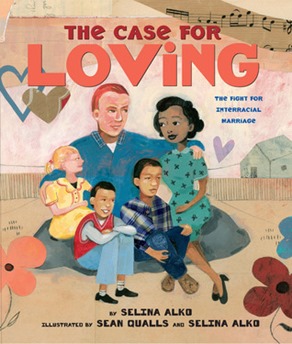
The Case for Loving: The Fight for Interracial Marriage by Selina Alko, illustrations by Sean Qualls and Selina Alko

This nonfiction picture book tells of a history that will surprise modern American children. It is the story of love and one family that was brave enough to stand up to a racist law. Mildred and Richard Loving fell in love in the small town of Central Point, Virginia. They had different colored skin and so they were not allowed to get legally married in Virginia. So they crossed state lines into Washington, DC and got married there. When they returned to Virginia though, they were arrested for violating the state law against interracial marriage. The two moved to Washington DC and raised their children there. Things started to change in the 1960s and the Lovings took their case all the way to the Supreme Court to win the right to marry one another in the state of Virginia.

This book is strikingly beautiful with a rich warmth that flows directly from the story and art. The author and illustrator are a husband wife team who are also interracial. Their passion for this subject shines on the page. Alko explains that subject matter with a vibrancy, offering information on the laws in a way that is suitable for small children. The drama of the arrest is also clearly captured, exposing the ludicrous law to today’s perspective.

The art of the book was done by both Qualls and Alko. Their styles marry into a beautiful richness that fills the pages. They are filled  will playful hearts and flowers that add a lighter note to the images. At the same time they have detailed paintings filled with texture and power at their center. The combination of both has created a stunning beauty of collage and painting.

An important piece of our civil rights history as a nation, this picture book documents one family willing to take up the fight for themselves and others. Appropriate for ages 6-9.

Reviewed from copy received from Arthur A. Levine Books.

Review: Echo by Pam Muñoz Ryan

echo

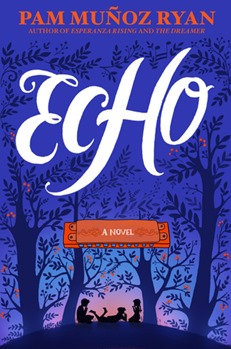
Echo by Pam Muñoz Ryan

Released February 24, 2015.

A stellar intertwined story that swirls around a magical harmonica, this book is one-of-a-kind in the best possible way.  When Otto meets the three girls in the forest, he sent on a quest that includes a harmonica that sings in different tones from normal ones.  Later, three young people encounter that harmonic and it changes their lives at critical points, bringing both peace and music into the darkness they are living in.  There is Friedrich, a boy in Nazi Germany, who is struggling to hold his family together.  There is Mike in Pennsylvania, placed in an orphanage when his grandmother can no longer care for him and his younger brother, desperate to find a place they can be together.  Finally, there is Ivy in California, excluded from the normal public school because she is Mexican-American and hoping that this last move is one that gets her family a permanent home.  The stories speak to the heart, each child facing the difficulties with immense courage and love for others. 

This book is a delight to read.  It marries the magic of the harmonica with more realistic historical fiction components very successfully.  Ryan explores some of the darkest times for families, put under excruciating pressure by the society they are living in.  She always offers hope though, allowing the harmonica and the power of music to pierce through and give light to the circumstances.  Beautifully, each story ends in a crescendo, leaving the reader breathless and worried about what will happen before starting the next story.  In the end, the stories weave together musical and luminous.

Ryan successfully creates four unique stories in this book and then brings them all together in a way that is part magic and entirely satisfying.  She writes of the cares of each child with such empathy, allowing readers to feel the pressure they are under.  Here is how she describes Mike’s responsibility for his younger brother on page 204:

That responsibility had become another layer of skin.  Just when he thought he might shed a little, or breathe easy, or even laugh out loud, it tightened over him.

She successfully does this with each of the stories, allowing readers to feel that tightening and the threat of well-being for all of the characters.  There is no shrinking from the racism and bigotry that these characters experience.  It is presented powerfully and appropriately for the younger audience.

A powerful book, this novel is pitch perfect and simply exceptional.  Appropriate for ages 10-13.

Reviewed from ARC received from Scholastic Press.

Review: Stella by Starlight by Sharon M. Draper

stella by starlight

Stella by Starlight by Sharon M. Draper

The author of Out of My Mind returns with a book that takes a hard look at racism in the United States.  Stella lives in Bumblebee, North Carolina during the Great Depression.  When her little brother wakes her up one dark night, they witness the KKK burning a cross in their town.  Their community is segregated, so Stella and her family go to a different school than the white kids in town.  It’s smaller and less fancy with one room but also one great teacher.  They also can’t use certain stores and many of the white people in town are rude and even violent towards them.  Stella’s father is one of the men in town who decide that they will push for their right to vote, even though they know the system is rigged, requiring tests for black people but not for white.  Stella gets to witness first hand the ignorance of people in power and their disregard for others, but at the same time there is reason to have hope too.

Draper writes a dynamic story here.  She evokes the time period beautifully, allowing readers to really experience the lifestyle, the poverty, and the deep racism of the times.  This is not a book that is just darkness though, Draper creates a strong African-American community in Bumblebee.  The neighbors look out for one another, help whenever possible, and face the worst of society together as a group.  The racism and segregation is presented with an appropriate level of violence for children this age, allowing readers to see that it runs far more deeply than is depicted on the page.

Stella is an extraordinary protagonist.  Her struggles with writing are presented cleverly on the page.  One immediately sees that this is a girl who struggles with the mechanics of writing like spelling and getting the words out, but once they are on the page she has a unique voice and a poet’s eye.  It is a subtle but strong message that if you struggle with something it certainly does not mean you are not gifted in it as well.  These passages of writing lighten the book as do the various stories inserted throughout the book, paying homage to the oral traditions but also to the community and its strength.

Powerful and wise, this novel for young readers will expose them to racism after the Civil War and the basis for many of the problems we continue to see today.  Appropriate for ages 9-12.

Reviewed from copy received from Atheneum Books for Young Readers.

Review: X by Ilyasah Shabazz and Kekla Magoon

x

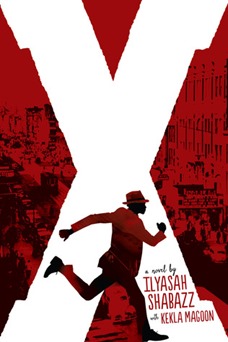
X by Ilyasah Shabazz and Kekla Magoon

This is the story of Malcolm X’s boyhood and teen years.  Malcolm Little grew up during the Depression, surviving on dandelion greens soup after his father is murdered.  When his mother gains the attention of social services, Malcolm is moved out of the family home and away from his days of stealing melons from patches and apples from stands to fill his belly.  When Malcolm gets a chance to leave his foster home and head to live with his half-sister in Boston, he jumps at the chance.  Boston and its neighborhoods are a buzz with activity and nightlife and Malcolm immediately joins the fray, turning his back firmly on the way he was raised.  Malcolm continues to explore the dangerous side of society by dealing reefer, drinking, and dating a white woman.  He moves to Harlem where the jazz is even more incredible and where he really gets into serious trouble.  This novel follows Malcolm from his childhood until he is imprisoned for theft at age 20 and eventually converts to Islam.

Shabazz is one of the daughters of Malcolm X and according to the Authors Note at the end of the book the story while fiction is firmly based in real life people and events.  The writing prowess of Magoon is also here in full force, directing a story that is a headlong dash into sex, drugs and jazz into something that speaks volumes about the intelligence and emotions of the young man at its center.  The result is a book that shines light on difficult years of Malcolm X’s life where he lost himself and then the tremendous results of having returned and found himself again. 

There is such emotion here on the page.  Malcolm’s heart shows in each interaction he has, each moment of losing himself that he manages to find.  It is a road map of hope for those who are lost to these moments in their lives that you can return and be better than ever.  It also shows the humanity behind the historical figure, the real boy behind the legend.

Powerful, gritty and honest, this novel expands what young readers know about Malcolm X and offers hope for those in their own crisis.  Appropriate for ages 14-17.

Reviewed from digital galley received from Candlewick Press and Netgalley.

Jacqueline Woodson Responds

H_WoodsonJacqueline_LG

I’ve already posted this via social media, and I want as many people to see it as possible.  This last week the children’s literature world has been taken over by one careless, thoughtless and thoroughly racist remark by David Handler at the National Book Awards.  It was directed at Jacqueline Woodson, an author I have had the pleasure to hear speak at ALA.  When you read her latest book, the one that won the National Book Award, you hear her voice on the page, in the poetry, in the powerful beauty of her words.

Now Jacqueline Woodson has responded in an Op Ed piece in the New York Times.  And she has once again put her voice on the page in words of beauty and strength.  Read it and know that as librarians and teachers we have to make sure that ALL of the people we serve can find themselves in the books we have.

Review: The Madman of Piney Woods by Christopher Paul Curtis

madman of piney woods

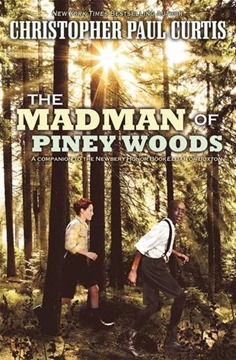
The Madman of Piney Woods by Christopher Paul Curtis

This companion novel to Elijah of Buxton continues the story of the town of Buxton and the people who live there.  This book, which takes place forty years after the first book, is the story of two boys, Benji and Red.  Benji, who lives in Buxton, dreams of becoming a newspaper reporter.  He has two pesky younger siblings who also happen to be gifted builders with wood.  That doesn’t mean though that Benji doesn’t try to put them in their place when they need it.  Benji also has a way with the forest, spending hours walking the trails and exploring.  He is one of the first to see the Madman of Piney Woods.  Red is a scientist.  He’s been raised by his father and maternal grandmother, who hates anyone who isn’t Irish like she is.  She is strict with Red, smacking him regularly with her cane hard enough to raise a lump.  When the two boys meet, they immediately become friends even though their backgrounds are so different.  But can their friendship withstand the brimming hatred of some people in their communities?

I loved Elijah of Buxton so much and I started this book rather gingerly, hoping that it would be just as special as the original.  Happily, it certainly is.  It has a wonderful feeling to it, a rich storytelling that hearkens back to Mark Twain and other classic boyhood friendship books.  Curtis makes sure that we know how different these two boys are:  one with a large family, the other small, different races, different points of view.  Yet it feels so right when the two boys are immediate friends, readers will have known all along that they suit one another. 

Curtis explores deep themes in this novel, offering relief in the form of the exploits of the two boys as they figure out ways to mess with their siblings and escape domineering grandmothers.  There are scenes that are laugh-out-loud funny.  Other scenes though are gut-wrenching and powerful.  They explore themes like the damage done to the psyche during wars, racism, ambition, responsibility and family ties.  It is a testament to the writing of Curtis that both the humor and the drama come together into an exquisite mix of laughter and tears.

A great novel worthy of following the award-winning original, this book will be met with cheers by teachers and young readers alike.  Appropriate for ages 9-12.

Reviewed from copy received from Scholastic Press.

Review: Sparkers by Eleanor Glewwe

sparkers 

Sparkers by Eleanor Glewwe

Marah lives in a world where the magicians are in power.  She helps out in the market at the book stall and has managed to teach herself many languages in the process.  There she witnesses the brutality of the magicians and knows to fear them.  But it is also where she meets a little girl who doesn’t mind that Marah is a poor Sparker.  Soon Marah is visiting their home, which is much more opulent than her own.  She meets the girl’s brother and discovers that he shares her love of languages.  When a plague hits their city and people whom both of them love are threatened, the key to figuring out the cure is in a forbidden language.  Marah has to find the courage to trust those she fears as well as her own intelligence in order to save the world she loves and those she holds most dear.

Glewwe herself has a background in linguistics, which means that when she writes about languages it all makes sense and really clicks.  The world she has created is complex with almost a caste system of rank within it.  Tied directly to magical ability, the differences are also racial, so the entire story ties closely to our own world’s struggles with racism and bigotry in a variety of forms.  Glewwe has created a story where the children are truly those who save the world.  They cross the barriers of their society and proceed to have the knowledge themselves to create the solution, but only because they worked together. 

The world building here is exceptional.  The society is unique but also frighteningly familiar at the same time.  The central theme of exclusion and privilege and abuse of power makes for a taut novel that will keep readers going.  The mystery of the plague carries the story forward, so that readers will be compelled to read to the end to figure out the extent of the deception and greed. 

A very strong middle grade fantasy that grapples with some of the most difficult of societal issues, this book is a magical and danger-filled read.  Appropriate for ages 11-13.

Reviewed from copy received from Viking.