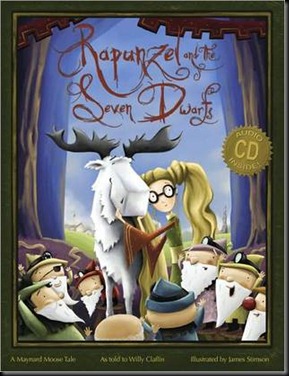
Book Review: Rapunzel and the Seven Dwarfs by Willy Claflin

rapunzelsevendwarfs

Rapunzel and the Seven Dwarfs by Willy Claflin, illustrated by James Stimson

This book is a Maynard Moose tale just like The Uglified Duckling.  This fractured fairy tale takes Rapunzel and Snow White and the Seven Dwarfs and mixes them wildly together into quite a story.  Readers who know both stories will enjoy this most, because of the silliness of the mash up.  Here Rapunzel is a girl who has trouble keeping her long tresses clean, so a helpful witch puts her in a tower.  She is discovered by a portly knight who attempts to climb her hair, but instead due to his bulk, launches her out of the tower and into a pond.  Enter the seven dwarfs, who rescue her from the water and solver her hair issues by shaving her head bald.  Meanwhile, the witch heads to the home of the dwarfs dressed as a kindly rhinoceros (yes, you read that right) and tempts her to each poisoned watermelon.  I’ll leave the final twists of the tale for you to discover, and my there are plenty of twists!

When I first started reading this book, I tried it silently to myself.  Told by Maynard Moose, the story has some odd language twists in it and some words that are new but will make sense.  The book doesn’t work read silently.  Happily, I tried it aloud and the elements all fell into place.  If you are wondering as someone who will read it aloud how to do it, there is a CD with the book where you can hear Maynard’s voice. 

The humor here is broad and great fun.  There are particular lines that had me laughing out loud.  I enjoyed the “eight or nine seven dwarfs” and the series of misunderstandings as the prince calls out to Rapunzel to lower her hair.  It all adds to the zaniness of the story.  The writing is crafted to be read aloud, giving any reader plenty of opportunity to shine.

Stimson’s art plays along with the humor of the book.  The homemade rhino costume, the Sleeping Punzel Museum, the rotund little prince, and the issues of long hair.  The art is computer smooth and sleek.

This will read aloud well to older elementary-age children who will really enjoy the humor.  Recommended for ages 7-9, though completely appropriate for younger listeners.

Reviewed from library copy.

Also reviewed by

What the Ladybug Heard

9780805090284

What the Ladybug Heard by Julia Donaldson, illustrated by Lydia Monks

All of the animals on the farm make their own type of noise, except for the little ladybug.  She never says anything at all.  That is until she hears two robbers planning how to steal the farm’s prize cow.  They know just where each animal on the farm sits and what noises they make so that they can find their way in the dark without alerting the farmer.  So the ladybug heads to the farm, tells the animals about the robbers, and comes up with a cunning plan to foil them.  Told in a wonderful romping rhyme and rhythm, this book has immediate appeal.

Donaldson has a great ear for rhythm and rhyme, never pushing it too far to become annoying.  She weaves in humor effortlessly.  The premise for the book is very clever, mixing animal noises with a barnyard mystery and a silent witness.  Monks’ illustrations are done in mixed media which makes them visually interesting.  The painted sheep has a wooly coat that is a photograph of wool.  The bushes around the farm are either photographs of leaves or fabric.  There is just enough of the mixed media to still have a very cohesive feel. 

Get this into your farm storytime and also for any insect unit or story time.  It is a winner of a read, just be prepared for plenty of animal noises and ask the audience to help!  Appropriate for ages 2-4.

Reviewed from copy received from Henry Holt.

Also reviewed by Pied Piper Picks.

Soup Day

Soup Day by Melissa Iwai

Today is soup day, so a little girl and her mother head to the store through the snowy streets.  There they buy the ingredients for their soup, careful to choose the vegetables with the brightest colors.  They pick out green celery, yellow onions, orange carrots, white mushrooms and more.  Back at home, they wash the vegetables and cut them into little pieces.  The little girl gets to help with a plastic knife and the softer veggies.  After sautéing the vegetables, broth is added and the soup cooks.  The mother and child play together as the smell of soup fills the house.  Finally spices and pasta are added and then they sit down to dinner with Daddy. 

Iwai has captured cooking from a child’s point of view.  The selection of vegetables mentioning their colors is done with a gentle tone, and most children will not notice that colors are being reviewed in that part of the story.  The focus on what the little girl is able to do is charming and affirming for children.  Seeing her pride and involvement is a large part of the story. 

Iwai’s illustrations are done with acrylics and collage and Photoshop.  They mix the textures of textiles with the crispness of photos and the brushstrokes of painting.  The result is a rich blend that makes for engaging illustrations.  The book is printed on nice heavy pages, making it welcoming for toddler hands.

This book is as warm and welcoming as a big bowl of homemade soup.  Add it to your recipe for a great story time or a unit on soup or food.  It would be ideal paired with a version of Stone Soup.  Appropriate for ages 2-4.

Reviewed from copy received from Macmillan.

Interrupting Chicken – Blog Tour!

I’m very happy to be the concluding blog on the Interrupting Chicken blog tour!

9780763641689

Interrupting Chicken by David Ezra Stein

Stein’s new picture book will earn him even more fans in the picture book world.  It is time for little red chicken to go to bed.  Her father agrees to read her a story, but tells her not to interrupt.  She promises not to.  So he begins Hansel and Gretel but just as they are about to enter the witch’s house, little red chicken interrupts and changes the story.  Her father tries again with Little Red Riding Hood with exactly the same result.  Finally, after little red chicken pleads for another chance, he tries Chicken Little.  She interrupts again and is still wide awake.  So her sleepy father climbs into bed himself and has her read him a story.  I wonder if interrupting runs in the family?

This book is a charmer and will have children laughing gleefully along as little red chicken continues to interrupt at just the right (or wrong) time.  Stein’s short introductions to the familiar fairy tales nicely set up each story and lead to a climactic point.  Then little red chicken’s interruptions add a great tone and speed to the text, filled with enthusiasm about the stories themselves.  My favorite part is that she is so drawn into the stories that she feels she must help the characters.  This book really is about the power of reading with a child. 

Stein’s illustrations are done in a great palette of colors with reds, teals, blues and greens that are vibrant and exciting.  The depth of color on the page is fantastic with few of the pages offering white space at all.  This gives it a very warm, cozy feel. 

A perfect read aloud, this book will be loved by anyone who hears it.  The comedic timing is built into the story and it is a pleasure to share it aloud.  Add this one to your pile of funny chicken books and your bedtime stories.  Appropriate for ages 3-6.

Reviewed from copy received from Candlewick.


Visit the other blogs that are part of the tour:

Aug. 9 – Picture Book Review, http://picturebookreview.com/

Aug. 10 – Katie’s Literature Lounge, http://katiesliteraturelounge.blogspot.com/

Aug. 11 – Readaholic, http://bridget3420.blogspot.com/

Aug. 12 – Two Writing Teachers, http://twowritingteachers.wordpress.com

Aug. 13 – Not Just for Kids, http://notjustforkids.blogspot.com/

Aug. 14 – Milk and Cookies, Comfort Reading . . ., http://janasbooklist.blogspot.com/

Aug. 15 – Bookworm’s Dinner, http://bookwormsdinner.blogspot.com/

Aug. 16 – Where the Best Books Are, http://wherethebestbooksare.blogspot.com/

Where Is Tippy Toes?

Where Is Tippy Toes? by Betsy Lewin

In the morning, everyone knows where Tippy Toes the cat is.  Even the mouse is aware Tippy Toes is right outside his mouse hole.  But once night falls, Tippy Toes sneaks around, blending in.  In fact, only one person knows where Tippy Toes disappears to late at night, but readers are invited to find out!  A very child-friendly format with cut-outs on the heavy pages that will have children engaged immediately, this book is sure to be enjoyed by fans of Spot.

Lewin keeps the words to a minimum here, using just enough rhyme to be enjoyable and just enough verse to keep the story moving.  It is an ideal amount of text for toddlers who will love the rhythm of the verse, they rhymes, and the game of turning the pages to find Tippy Toes.  Lewin’s illustrations are done in strong lines and bright colors that will work well with a group of children.  The pages are heavy enough and sturdy enough to withstand checkouts at a public library too.

Add this one to your collection of books to pull out when the toddlers get squirmy.  It is sure to get them settled again and ready to listen.  Appropriate for ages 1-4.

Reviewed from copy received from Atheneum.

The Cow Loves Cookies

The Cow Loves Cookies by Karma Wilson, illustrated by Marcellus Hall

Told in a jaunty rhyme, this book shows life on a farm through a funny, quirky lens.  Farmer feeds each animal every day.  The horse eats hay.  The chickens eat chicken feed.  The geese eat corn.  The pig eats slop.  The dog loves doggie treats.  As each animal is introduced along with the food it eats, the chorus chimes in with “the cow loves cookies.”  Then with each new animal, the previous ones are added to the rhyme, forming a fun, cumulative tale.  In the end, the reader will be pleased to find out exactly how the cow got a taste for cookies. 

This book is made to read aloud with its great rhymes that never grow stale and the wonderful rhythm that is built into them.  Even better, there is that chorus line that children will love to help repeat.  Hall’s illustrations echo the light-hearted tone of the text with their free flowing style and friendliness.  They are also large enough to work well with a group of children.

Add this one to your storytime reads for barnyard books.  Perhaps even concluding the stories with some cookies, you know that the children love cookies!  Appropriate for ages 3-6.

Reviewed from copy received from McElderry Books.

Animal Soup

Animal Soup by Todd H. Doodler

This book is pure silliness.  Pure.  There is not an educational item here, just lots of giggles and guesses.  Take one animal, add another and the result is a mixture of the two.  The book begins with “What would I be if I had wings to fly…” with a picture of a bird.  “…but walked very slowly instead?” with a picture of a turtle.  Then one lifts the flap to see the answer which is: Bird + Turtle = Birdle along with the image of the bird wearing a turtle’s shell.  Turn the page and it begins again and it is impossible to stop opening the flaps to see the silly combinations. 

Doodler has hit upon a winning combination here of humor and surprise.  His pairing of unlikely animals (who could resist finding out what a squirrel and a whale combine to become) along with the humorous names he calls them will have children laughing out loud.  His simple colorful art adds to the humor.  The animals are all googly eyed and the combination images are delightful. 

Hand this to a reluctant young reader and they will read it again and again.  It is an ideal choice for libraries with flaps that will stand up to most use and for storytimes where children are restless.  This will have them laughing and entranced in no time.  Appropriate for ages 4-7.

Reviewed from copy received from Golden Books.

Snore, Dinosaur, Snore

Snore, Dinosaur, Snore! by John Bendall-Brunello

Three little dinosaurs wake up from sleeping on their mother’s spiny back.  But their mother is still asleep.  She doesn’t move when they prod and pinch her.  She just continues to snore.  They try tickling, clawing and elbowing her.  More snores.  Then they roll her over and slide her down a hill!  Snores.  After rolling down and splashing into a muddy puddle, she just might be waking up.  But they won’t be sure until those snores turn into ROARS!

Simple and perfectly paced for a toddler audience, this book has the appeal of dinosaurs mixed with silliness and giggles.  The little dinosaurs are mischievous.  Children will delight in the thought of rolling a mother down a hill and into mud.  And the reaction at the end is just loud and surprising enough to cap off this fun romp of a book. 

Appropriate for ages 2-4, this book will be welcomed by young dinosaur enthusiasts and should not snore for long on any library shelf.  Not with little dinosaurs around! 

Reviewed from copy received from publisher.

Have You Ever Seen a Sneep?

Have You Ever Seen a Sneep? by Tasha Pym, pictures by Joel Stewart

Does a Sneep steal your picnic the minute you turn your back?  Does a Snook ruin your quiet time by being so loud?  Have you swung out over the water and landed in a Grullock’s throat?  Have you been surprised by a Floon?  Chased by a Knoo?  You haven’t? 

This funny and charming fantasy features a boy who lives in a land filled with creatures we have never seen before.  They are humanoid but strange with purple skin, large beaks, and many legs.  It is a great juxtaposition of a normal boy in what seem to be normal settings doing normal things and then an unusual creature arrives and the entire scene shifts.  Pym’s rhymes are effortless as they swing readers through the book.  Stewart’s art suits the subject perfectly with its gentle feel combined with wacky characters in wild colors. 

Highly recommended for preschool or toddler storytimes.  Children will love the fact they are being asked if they have seen such a creature themselves.  Adults reading aloud will find the pacing impeccable.  Appropriate for ages 3-6.

Reviewed from library copy.