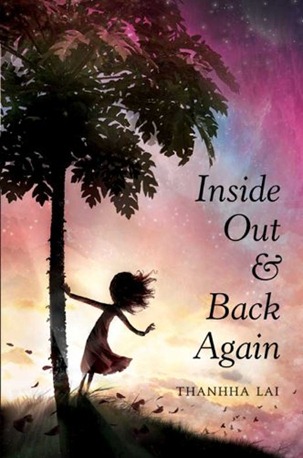
Book Review: Inside Out and Back Again by Thanhha Lai

insideoutbackagain

Inside Out and Back Again by Thanhha Lai

Debut author Lai has created a verse novel of fleeing Saigon for the United States.  The narrator is ten-year-old Ha, who speaks of the beauty of Vietnam, its culture and their lives there.  Her father was captured years ago in the war, so she lives with her mother and three older brothers.  Her mother has a good job, but when the prices begin to rise because of the war, the family can barely survive.  They are given a chance to flee Saigon by ship though when they do, they almost starve because their rescue by the Americans is delayed.  Ha describes her culture shock when they do arrive in Alabama as a sponsored family.   All is different from the taste of the food to the quiet of the neighborhood to the language.   Many of her classmates are cruel to her, but she does meet nice Americans who help her learn the language and who are willing to learn about Vietnamese culture as well.

Lai’s verse is precision, written tightly and beautifully, it changes mood from one poem to the next.  Some are sliver thin and crack like a whip.  Others are sinewy and strong, ropes that bind and connect.  Still others are emotions that unite us all, tying us closely to the story.  Lai herself also immigrated from Vietnam at the end of the war to Alabama.  Her book speaks to the personal journey that she had in its depth of feeling.

Ha is a character whom readers will immediately connect with and understand.  She is written in a universal way, even as she describes her homeland and evokes scenes that many readers will not have seen or experienced.  In the descriptions of Ha’s family, Lai creates characters who are vivid and profound.  One of my favorite passages is early in the novel where the family is deciding to leave Saigon.  Ha’s mother is described on page 54:

Who can go against

a mother

who has become gaunt like bark

from raising four children alone.

This a book that is so beautifully written.  It captures the journey both physically and emotionally of refugees to our country.  It is breathtaking and strong.  Appropriate for ages 9-12.

Reviewed from library copy.

Also reviewed by:

My Name is Sangoel

My Name is Sangoel by Karen Lynn Williams and Khadra Mohammed, illustrated by Catherine Stock

Sangoel’s father died in the war in Sudan and now he and his mother and sister are refugees headed for America.  Sangoel has little more than his name to take with him.  The family is put in a small apartment, dressed in donated clothing, and Sangoel starts school.  But no one ever says his name right.  They all say San-go-el and Sangoel worries that he has lost his name entirely.  That’s when Sangoel has a great idea and creates a t-shirt that uses symbols to tell them how to pronounce his name: a sun and a goal.  The children understand immediately and all of them start to create their own symbols for their names. 

This book concisely and concretely tells the story of a young refugee.  Though his life circumstances may seem distant and unique, readers will immediately relate to having their name pronounced incorrectly and the frustration and dilemma that it causes.  Williams and Mohammed have written just the right situation here to make Sangoel relatable and his circumstances universal.  They also explore the dizzying changes a refugee faces from not knowing how to cross the road to dealing with new appliances.  Stock’s illustrations are paintings that are colorful and realistic.  They work well with the story, as Sangoel and his family struggle to understand the new land they are in.

This is not an ideal story time book, rather it is best for longer discussions, building understanding, and learning about the world.  This would be well-used as a featured book in a unit or in a setting that allows discussion.  Appropriate for ages 6-9.

Reviewed from book received from publisher.

The Day of the Pelican

 
The Day of the Pelican by Katherine Paterson

Meli and her family are Albanians living in Kosovo.  They are in grave danger.  Her older brother, Mehmet is detained after leaving school one day.  He is finally returned home to his family.  So many people are being killed by Serbs that they are forced to flee their home, leaving their store and almost everything else behind.  The family is forced first into tents in the mountains where they are safe for a short time, sleeping in a single shared tent and living without running water or electricity.  Mehmet expresses interest in joining the Kosovo Liberation Party and the family leaves the mountains to keep him safe.  They then live with their uncle in the family’s small farm with many people living under one roof.  They live in constant fear of being discovered and turned out of their home with the tiny babies, elderly grandmother, and small children.  Eventually they are forced to become refugees and the family is forced to separate with Meli and her immediate family going to the United States.

Paterson tells a gripping story of heroism, courage and family ties in this brief novel.  As readers experience the fear and uncertainty through Meli’s eyes they will be moved by her story.  This book captures the emotions of war without allowing them to overtake the storyline.  Instead the book is about everyday people becoming heroes, small choices that mean living one more day, and endurance in the face of such hatred.  Paterson rights with an honesty and a tautness that makes the book easy to read but difficult to digest. 

This is an important book that is not just about the Albanians in Kosovo, but about all wars, all displaced people, and their courage and strength.  Paterson takes a single incident among many and makes it universal and true.  Highly recommended, this is a great book for classroom exploration and discussion.   Appropriate for ages 11-13.

Reviewed from ARC received at the ALA Conference.