Book Review: Clink by Kelly DiPucchio

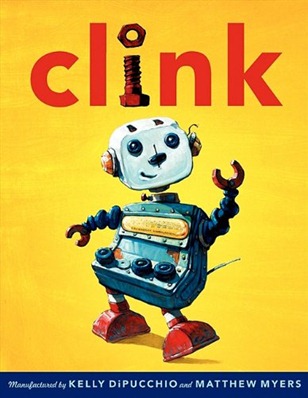
clink

Clink by Kelly DiPucchio, illustrated by Matthew Myers

Clink used to be a new robot, but now he is dusty and squeaky.  Even his ability to make toast and play music doesn’t attract the children anymore.  Instead they want newer robots with retractable arms or the ability to bake cookies.  When Clink tried to be like the newer robots, it never worked well.  Finally Clink just gave up and hid himself away.  A long time later, a boy came to the shop and wasn’t interested in any of the new robots.  As the boy left the store, he played a song on a harmonica.  When Clink heard the music, he came to life.  He began to sing and then to dance.  But just as he caught the boy’s attention, a spring popped free and hit the boy right in the face.  Had Clink lost his chance to finally find a home?

DiPucchio has created a world where robots are cool but only if they are new.  Her writing is long enough to really describe a full world.  The book reads aloud easily and has a great built-in appeal with the charm of Clink himself on the cover and the robot theme. 

Myers helps visually build the world that DiPucchio describes so well.  His depictions of the new robots are just as whimsical as Clink himself.  I especially enjoy the hair-cutting robot that moves around on a broom and the cookie-baking robot that wheels around on a rolling pin.  Myers uses bright colors and deep colors together.  He manages to make the robots feel physical and real.

A good pick for any young robot lover, who might enjoy designing their own robot on paper and giving it some interesting capabilities too.  Appropriate for ages 4-7.

Reviewed from library copy.

Wendell’s Workshop

Wendell’s Workshop by Chris Riddell

Wendell was very busy inventing things, so he didn’t have time to clean up his workshop.  When it finally became too untidy to bear, Wendell invented a robot named Clunk to help him.  Clunk did the housework, but in such a way that it made an even larger mess.  So Wendell threw him down the rubbish chute.  Wendell created a second robot to help clean.  This robot looked a lot like him, so he called him Wendelbot.  Wendelbot was great at cleaning, but too great.  Finally Wendel himself was the only untidy thing left, until Wendelbot threw him down the chute.  Wendel found Clunk there and they devised a plan to stop Wendelbot in his quest to tidy the world.

Riddell has created a robot picture book that has a great story yet resists being too wordy or complex for young children.  The book reads aloud very well, filled with great sound effects, wonderful big booms, and plenty of clutter.  It is a story that all children will relate to happily whether they love robots or not.  Riddell also laces his story with plenty of humor, which is carried directly into the illustrations.  Wendel himself is very cute and fuzzy, a wonderful contrast to the hard surfaces of the robots.  The detail of the illustrations is delightful, from the rolling screws to the intriguing depths of the rubbish pile. 

This is a picture book with lots to love plus robots!  Appropriate for ages 3-6.

Reviewed from library copy.

You can also check out a video of the book being read aloud on YouTube.  It’s a bit blurry, but still offers great glimpses of the illustrations:

Oh No!: Or How My Science Project Destroyed the World

Oh No! (Or How My Science Project Destroyed the World) by Mac Barnett, illustrated by Dan Santat

It all started when a smart girl builds a giant robot as a science project.  When it goes on a rampage, she realizes all of the features that she should have included and ones that it definitely should not have, like the laser eye.  She also realizes that it is up to her to stop it.  She tries to communicate with it, but when that and hitting it fail, she comes up with another solution.  She builds a gigantic toad programmed to destroy the robot.  And it works!  Now just to solve the problem of what can stop a giant toad…

Riotously funny, this book is a brilliant tribute to the monster flicks of the 1950s.  Barnett’s dry, understated text heightens the drama and action of the story.  Santat’s illustrations pay homage to vintage comics in the colors and stylings, but remain firmly modern too.  The illustrations are worth lingering over, especially the many and varied signs shown throughout the city, some in Chinese letters, strengthening that tie to monster movies. 

This is a picture book worth sharing with a wide range of ages, even young teens who may have seen some of the type of movies this book references.  Happily cheesy, wonderfully funny, this book is extraordinary.

Reviewed from library copy.

Robot Zot!

Robot Zot! by Jon Scieszka and David Shannon

Robot Zot is here to conquer the earth.  His battle cry rings out:  “Robot Zot – never fall.  Robot Zot – conquer all!”  He finds himself in a house and destroys a blender with his blaster.  He then wrestles a vacuum cleaner tube on his way to blast his enemy, which happens to be a TV.  But something surprising is waiting for Robot Zot!  His Queen!  He can only reach his ship if he makes it past the Commander General who is in his way and insists on licking his queen.

Robot Zot is a delightful romp of a book.  The combination of Scieszka’s text with Shannon’s art is irresistible.  Combine it with robots and outer space, and this is one book that you can expect to be read to tatters.  Scieszka’s text is humorous, fast-paced, and surprising.  The reveal of Robot Zot’s small size is done with such style in Shannon’s art as are other great humorous touches.  The two work together seamlessly, sharing punchlines and big laughs smoothly.

A must-read for children who love robots and space, this book could be purchased just for the explosion of the television set.   If read to a class, expect lots of blaster and explosive play.  Inventive, funny and a great joy, this book is appropriate for ages 4-7.

Reviewed from library copy.

Also reviewed by Fuse #8.