Review: The Secret Pool by Kimberley Ridley

secret pool

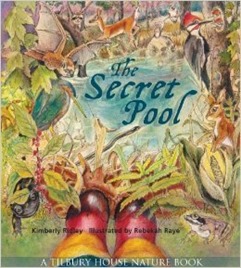
The Secret Pool by Kimberley Ridley, illustrated by Rebekah Raye

Vernal pools are easy to miss, but also necessary to the life of many animals.  This nonfiction picture book explores the amazing things that happen in vernal pools throughout the seasons.  It begins with defining what a vernal pool is and then quickly moves into spring.  The fascinating lives of frogs are described, including the way they make it through the winter.  Soon salamanders join them and breed in the pool.  Tiny fairy shrimp appear too.  As summer comes, the eggs of the salamanders and frogs hatch and soon there are tadpoles and larvae in the pools.  Now the race begins to see if they can climb ashore before the pool dries up.  The vernal pool disappears and the animals that live there and were born there move away.  They will return again with the spring and the vernal pools.

Ridley has nicely created a book that can be used at two levels.  The larger text can be shared as almost a story about the pools.  Then the smaller text provides deeper information about the vernal pools and the animals.  Her words work together well, the simpler text offers a poetic voice to the factual information that serves to remind us how amazing all of this actually is.

Raye’s illustrations are lush and minutely detailed.  She offers both larger scale images of the animals and then others done with finer lines that show more details and more animals on the page.  You never know what you will see on the next page, and I guarantee a jump of surprise when you see the bullfrog with the tadpole hanging out of his mouth like a tongue. 

This book reveals a world right under our feet that most children never knew existed.  Appropriate for ages 5-9.

Reviewed from library copy.

Balancing Act: Simple Fun and Math

9781442407572

Balancing Act by Ellen Stoll Walsh

Two mice put together a stick and rock to make a teeter-totter.  With one mouse on each end, they balance.  But when a salamander wants to join in, the teeter-totter tips, until another salamander comes along.  When one frog jumps in, the teeter-totter really tips, but balance is restored with another jumping frog coming on.  Trouble comes along though when a bird wants to join in too.  For a little while there is balance with all of the animals on one side and the bird on the other.  But then the weight is too much for the stick.  All of the animals except the mice head off to do something else.  The mice?  Well, they still have a stick and a rock…

Stoll Walsh has a way with simple stories that really allows them to shine.  Her use of very basic text allows her books to be used with very young children.  Her art is also simplicity itself with its paper collage on a white background.  She uses great color as the animals join in with a bright red salamander, teal frog and blue bird.  At the same time as she is giving an engaging story, she is also introducing the concept of balancing and how to add objects together to make two sides equal.  A book that offers basic math concepts in such a gentle and enjoyable way is very special.

A jolly picture book that offers equal story and concept for preschoolers.  Appropriate for ages 2-4.

Reviewed from library copy.

Big Night for Salamanders

Big Night for Salamanders by Sarah Marwil Lamstein, illustrated by Carol Benioff

On a rainy spring day, a young boy comes home hoping that this will be the Big Night.  After dinner, the boy gets his raincoat on and a flashlight covered in pink plastic to lessen the glare.  He and his parents head out to the wet road in the dark.  In the dark and the rain, the family help salamanders cross the road safely as they move from forest to pond to lay their eggs.  But some of the cars are going so fast that it is dangerous not only for the salamanders.  So the boy creates a sign that says “Go Slow, Salamander Crossing!”  It is indeed a Big Night.

The story of the boy is presented side-by-side with information on what the salamanders are doing.  Readers get insight into the animals, told in a much more poetic and flowing way than the human story.  It makes for a lovely contrast with one another where not just the font and the content tell the different stories but also the tone and writing style.

Benioff’s illustrations are equally at home with the humans and the salamanders.  It is a pleasure seeing a child of color in a story where there is no mention of it at all.  Her art is bold enough to work with groups, and this book as a whole is ideal for reading aloud in storytimes about spring or salamanders.  All children will reach the end of the book wishing that they too could shepherd salamanders across a road at night.

A lovely science story book, this book successfully marries science into a picture book story.  Appropriate for ages 4-6.

Reviewed from library copy.

Also reviewed by: