Review: Oh No! Not Again! by Mac Barnett

oh no not again

Oh No! Not Again! (Or How I Built a Time Machine to Save History) (Or at least my history grade) by Mac Barnett, illustrated by Dan Santat

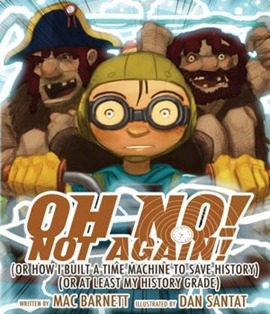
The sequel to Oh No! (Or How My Science Report Destroyed the World) takes on history class.  The female protagonist messes up her perfect score on a history test by missing the first question: In what modern country do we find the oldest prehistoric cave paintings?  So she figures out a simple answer to getting a perfect score: she builds a time machine to change history so that her answer of Belgium is correct.  When she finally reaches the right point in history, she is faced with two Neanderthals who aren’t really interested in creating art.  They’d much rather stick the paintbrushes up their nose or munch on the paint palette.  Spray paint worked even less well.  When our hero heads into the cave to do it herself though, the Neanderthals highjack her time machine.  What’s that going to do to her history grade?

Fans of the first book will enjoy this one as well.  It has the same zany, wild pacing of the first.  This time the romp is through history.  Happily, the book embraces a very simple sort of history to understand, so young readers will be able to get the humor and understand the juxtapositions that make up much of the story. 

Santat brings in physical humor too, giving the book his signature pizzazz and style.  I’m a fan of the color palette that hearkens back to an old film throughout.  It has a grainy texture and then there are the light-colored lines running vertically through the images.  Very school film on reels from my own childhood. 

A clever, funny and wild ride through history from the folks who brought us the robot rampage through science.  Appropriate for ages 6-8.

Reviewed from library copy. 

Review: Martin on the Moon by Martine Audet

martin on the moon

Martin on the Moon by Martine Audet, illustrated by Luc Melanson

Martin has just started school, but as he sits in class, his mind continues to wander.  His teacher reminds him of his cat due to her hair color.  Then he daydreams about the trip he and his mother took to the river and thinks about the water there.  He tries to pay attention, since it is the first day of school, but then his teacher reminds him of a seagull with the way she is moving her arms.  Martin remembers a time when he was out drawing and got to see a bolt of lightning in the sky.  When he shared that it looked like someone coloring outside the lines, his mother wanted to use the image in a poem. Martin then starts thinking about poems and kisses, until his teacher asks him who he’s blowing kisses to. 

Nominated for the Prix TD de littérature canadienne pour l’enfance et la jeunesse in its original French, this book works well translated into English.  The poetic language, the imagery and the creativity of young Martin all work together to create a beautiful unity.  This is a striking example of a picture book whose strength comes from its writing rather than its illustrations.  The writing is powerful, visual and uses imagery that children will easily relate to.  Tying in poetry itself to the story makes it all the more concrete.

Melanson’s illustrations have a soft texture and use a successful mix of vibrant and softer colors.  The illustrations don’t offer much detail, instead being more about color and texture than finer touches. 

Poetic and lovely, this picture book would work well in a unit on imagery or poetry.  I’d also get it into the hands of any young daydreamer.  Appropriate for ages 4-6.

Reviewed from library copy.

Review: Mom, It’s My First Day of Kindergarten by Hyewon Yum

mom its my first day

Mom, It’s My First Day of Kindergarten by Hyewon Yum

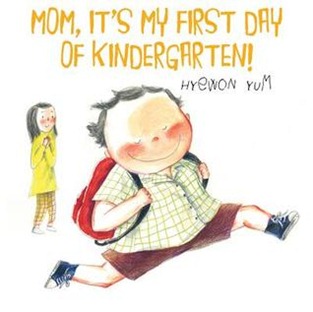
A little boy is all set for the first day of Kindergarten, eager to start.  His mother, on the other hand, is not quite to eager to see her little boy start school.  The boy runs to school with his mother trailing behind, worried and blue.  His mother frets about how big the school is, that they don’t know anyone there, but the boy is set to head in.  Then in the hall, things change and suddenly it is the boy who is smaller and bluer and more concerned and his mother is glowing and ready for him to start.  This book perfectly captures the mixed emotions of the first day of school for children and parents alike. 

Yum manages in a just a few words to really show the eagerness the boy feels and the reticence of the mother.  The boy is thrilled to be a big boy and head off to school, the mother is obviously seeing him a completely different light.  The book really comes into its own when the change happens and suddenly the mother feels confident and the boy is unsure.  It is that switch, that change that makes the entire book really work well.

Yum’s art also helps capture the emotions of the day.  At first, the boy is much larger than his mother, bright colored and dashing.  The mother is blue, almost wizened and delicate, worn away with worry.  When the change of attitude happens, the mother grows steadily in size and gains color as the boy shrinks to normal size and becomes bluer.  It’s a delight to watch the change come full circle by the end of the book where the day has ended and they are both large and bright.

A perfect pick for families facing their first day of Kindergarten this fall, this book will make a great jumping off place for discussions about the mixed emotions that everyone is sure to be feeling on the big day.  Appropriate for ages 4-6.

Reviewed from copy received from Farrar Straus Giroux.

Review: Captain Awesome to the Rescue by Stan Kirby

captain awesome to the rescue

Captain Awesome to the Rescue by Stan Kirby, illustrated by George O’Connor

Eugene’s family has just moved to Sunnyview and he has to start a new school.  Happily, Eugene is very courageous.  He has to be in order to transform into Captain Awesome.  Now if he can just find his cape, before he’s attacked by Queen Stinkypants, also known as his little sister!  When Eugene starts school, his teacher gives him the responsibility of caring for the class hamster, Turbo.  Eugene does a very careful job, until one day he discovers Turbo has been hamsternapped.   It may just take Captain Awesome to reveal what really happened to Turbo and save him from some villainous plot.

This beginning chapter book has the mass appeal of superheroes.  It also has a cheery tone and a light touch.  The humor has the right tone for this age group, and doesn’t push it over the top.  This is a book that parents and children can share together, something you want with first chapter books.  As with all early reading books, the story is simple and the characters are not complex.  Still, there is adventure, plenty of villains, and the making of friends to carry the book well.

While this makes a good choice for reluctant readers, it is also good for children who are reading early as well.  There is no content here to disturb parents of preschoolers who may be reading naturally on their own.

This is a great pick for children who will soon enjoy Captain Underpants but are not quite ready as readers.  Appropriate for ages 5-7, or younger if they are starting to read on their own.

Reviewed from library copy.

Review: Rosie Sprout’s Time to Shine by Allison Wortche

rose sprouts time to shine

Rosie Sprout’s Time to Shine by Allison Wortche, illustrated by Patrice Barton

Everyone thought that Violet was the best at everything.  She could run the fastest, sing the highest, and dress the fanciest.  But Rosie did not think that Violet was the best and was tired of hearing about Violet all the time.  When their teacher gave them an assignment to plant pea plants and care for them, Violet was sure that hers would be the best.  She decorated her pot with lots of sparkles.  Rosie’s plant was the first the pop up above the dirt, but Violet announced hers first.  So when Rosie came in early the next morning, she pushed soil over the top of Violet’s plant.  That day, they learned that Violet had chicken pox and would not be in for several days.  So Rosie started to care for both of their plants.  Rosie’s teacher told her that she was the best gardener she ever had in her class, as Rosie watered, rotated and sang to both plants. 

This book celebrates the quiet child, the one who is not the sparkliest or the loudest.  The book speaks to the need for all children to be praised and to be seen as being good at something.  Rosie definitely feels left out and jealous of Violet, and those feelings turn into action when she buries Violet’s plant.  But at the same time, that is the moment that the book turns around and Rosie starts to shine.  Happily, the jealous act is temporary and not the focus of the book.  Instead it is a much merrier book because of that.

The art work here has a wonderful softness to it that is very welcoming.  There is a freedom to the art as well that is very successful.  The lines are soft, the colors blend, and the effect is fresh.  The children in the classroom are multicultural, another small touch that makes the story all the more universal. 

A great book to share in the spring, when gardens start being planted, or when jealousies grow.  Appropriate for ages 4-6.

Reviewed from copy received from Random House Children’s Books.

Review: Wonder by R.J. Palacio

wonder

Wonder by R.J. Palacio

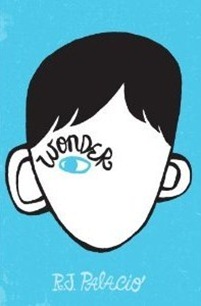
Auggie has never been to school, instead he’s been homeschooled his entire life.  It made it easier to work his schedule around his many surgeries for his facial anomaly.  Auggie was born looking differently than the rest of the world due to several genetic abnormalities coming together in one moment, something that only has a one in 4 million chance to happen.  But it happened to Auggie, and now he is getting ready to start 5th grade in a private school.  Auggie knows that he is just a regular kid hidden behind an uncommon face, but the question is whether his classmates will ever figure that out.

It’s amazing to think that this is Palacio’s first novel.  She writes with a natural flow and skill that makes the book read effortlessly.  It’s one of those books that gets into your head and won’t let go, that not only tells a story but asks things about you the reader.  It has you exploring your own relationship with beauty, the extent of your own kindness, and the truth behind being human. 

Auggie is such a rich character and such a winning one that I was surprised when the book first changed perspectives.  I had assumed that we would see through Auggie’s eyes for the entire novel.  But the different perspectives also show depth to all of the other characters in the book.  We get to see Auggie through his older sister’s eyes, ones that are loving but also despair at being paid enough attention by her parents.  The perspective shifts again and again to classmates, his sister’s ex-friend, and even his sister’s boyfriend.  Then we return to Auggie for the end of the book. 

This use of multiple perspectives works particularly well given the arc of the story, it all comes to a satisfying close that is built from those many perspectives and those many characters.  Things are not sugar-coated here.  People respond naturally to Auggie’s face, even those who had been informed about it beforehand.  There are bullies, friends who are true and those who come in and out, there is middle school drama.  There is also a real family portrayed here, struggling to give their exceptional son an honest life, trying to pay attention to both of their children, and consistently showing love and caring for one another laced with real humor.

I adored this book, wept at times, ached in the heart a lot, and laughed too.  It’s a book worth sharing, worth passing along, and one that will crossover effortlessly to adult readers.  This is a powerful, uplifting, luminous book.  Appropriate for ages 10-13.

Reviewed from library copy.

Review: Friends with Boys by Faith Erin Hicks

friends with boys

Friends with Boys by Faith Erin Hicks

Released February 28, 2012.

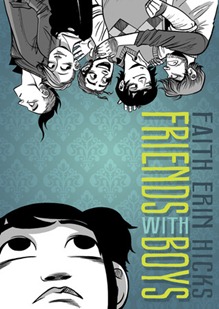
Maggie McKay has been homeschooled her entire life by her mother, who has left the family.  Now she has to start regular high school, just like her three older brothers have.  Maggie has never had any friends who were girls, happily being friends with just her brothers.  As Maggie starts high school, she discovers the boredom, the cliques, and the first tentative steps at real friendship, even one with a girl!  Add into the mix a tragic ghostly mystery complete with a female ghost who follows Maggie around, and you have an interesting mix of graphic novel, paranormal, and high school reality.

Hicks has created a very engaging graphic novel here with her mix of genres.  Her characters are fully-formed, with all of the major characters displaying real depth.  The relationships between siblings is a large part of the storylines in the novel.   I also appreciated a story about a homeschooled teen who may be hesitant to enter high school but is not specifically troubled by her previous schooling.

The graphic format is well-used here.  The images are regularly used to tell more of the story than the characters’ speech bubbles do.   Done in black and white, the use of shadow and light is very effective.  The story takes several surprising twists, which makes it all the more readable.

A graphic novel about a girl who is not particularly girly is just the right book to have in library collections.   Appropriate for ages 13-15.

Reviewed from copy received from First Second.

Review: A Few Blocks by Cybele Young

few blocks

A Few Blocks by Cybele Young

It was time for school, but Ferdie did not want to go to school.  He wasn’t done playing with his cars, his blocks, or his drawing.  In fact, he was not sure he ever wanted to go to school again.  But Viola held up his coat, called it his cape and invited him to blast off with his rocket-blaster boots.  They fought evil until Ferdie’s boots ran out of fuel.  Ferdie sat down and once again announced that he wasn’t going to school, maybe not ever.  Viola discovered a leaf in the gutter and invited Ferdie to hop on board the ship to find treasure.  Their trip to school continued, moving from one imaginary game to another, until suddenly it was Viola who isn’t sure that she can make it to school.  It was up to Ferdie now to get them that last block to school.

Young’s story is inventive and very readable.  The children going from one game to another is something we see in children’s books.  Viola is a patient leader, guiding Ferdie from one scenario to another despite grumpiness and even tears.  The joy of imagination is clear throughout the book.

The illustrations are exceptional.  They are eye-catching with their fine detail.  Outside of the imaginary worlds, the children and the objects around them are colorless and flat.  When they enter their imaginations, the illustrations are colorful, whimsical, and have dimensions and shadows.  They are sculptural and enticing.

This picture book takes the everyday trip to school and turns it into something extraordinary with its illustrations.  Appropriate for ages 4-6.

Reviewed from library copy.

Also reviewed by:

Review: Marshall Armstrong Is New to Our School by David Mackintosh

marshall armstrong

Marshall Armstrong Is New to Our School by David Mackintosh

Marshall Armstrong is the new kid at school and he is very different from everyone else.  His things are different.  He looks different with his birdseed freckles and ears like shells.  His arms are white with red bumps that he says are mosquito bites.  He even eats “space food” for lunch!  He can’t play during recess.  He stays out of the sun.  He doesn’t watch any TV.  So when Marshall Armstrong has a birthday party, everyone is sure that it is going to be awful.  But guess what, Marshall Armstrong’s house is different too!  Different in some great ways!

Mackintosh has created a picture book that speaks to what makes someone different from the rest of the class.  I really enjoyed the fact that while Marshall is different, so are all of the other kids in the class.  This is not a homogenous student body, but even in a diverse group Marshall is certainly unique.  Mackintosh reveals much in his illustrations which are quirky and modern, a striking mix of playful lines and bright colors. 

The story is straight forward but also filled with humor.  There are signals throughout that Marshall is a geeky kid (and I mean that in the best possible way, as mother to two geeks, married to another) and very modern.  He may be in a class of more normal kids, but some of us more geeky parents will also see ourselves in Marshall, our stuff, our obsessions.  It’s a lovely inside joke for those of us who were perpetually different like Marshall.

This picture book about being different takes the discussion beyond diversity and into a place where we are all different, just like Marshall.  A great pick for sharing at the start of a new school year. Appropriate for ages 4-6.

Reviewed from library copy.