Review: Eddie Gets Ready for School by David Milgrim

eddie gets ready

Eddie Gets Ready for School by David Milgrim

Eddie can get ready for school all on his own, but his routine is not what his mother would have done!  That’s for sure!  His healthy breakfast is spilled around so much that it becomes a way to take care of feeding the dog too.  He washes up with a diving mask on.  When he’s gotten dressed he has on a cape, no shirt, and his underwear is on his head.  Then comes watching cartoons and drinking root beer.  That is until his mother shows up!  His routine continues to be uproarious fun and he does make it onto the bus on time, even if he is carrying his clean underwear in his hand!

Milgrim taps into exactly what small children will find funny.  The underwear jokes are bound to get big laughs, but so is the idea that a school snack includes a whole watermelon.  Each page contains something that children would have loved to do themselves, therefore they will love to see what happens when Eddie tries it.  It is a very satisfying premise for a book.

Much of the humor is visual and told in Milgrim’s bright colored illustrations.  The white background on many of the pages make the colors really pop.  There is a feeling of enthusiasm within the illustrations and the story itself. 

Perfect for fans of the No, David! series, this book has the same zany humor and energy.  Appropriate for ages 4-6.

Reviewed from copy received from Scholastic.
Review: School for Bandits by Hannah Shaw

school for bandits

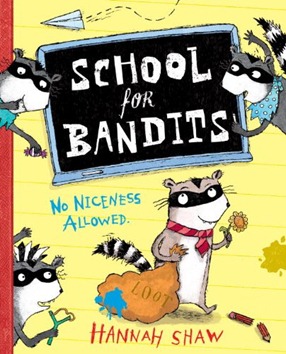
School for Bandits by Hannah Shaw

Ralph was not a normal raccoon.   He looked like any other raccoon, but he certainly didn’t act like them.  He was polite, clean, and tidy.  His parents were frustrated and so sent him to Bandit School where he could learn to be naughty, dirty and thieving.  Ralph had an awful time in school because he was just too nice.   When his teacher announced the Best Bandit in School competition, Ralph just knew that there was no way he would ever win.  He spent his break reading inside instead of causing trouble out on the streets like his classmates.  Can a nice raccoon ever come out ahead? 

Shaw captures the naughtiness of raccoons with glee.  They are shown with frizzy fur, bad breath, and are often playing pranks and taking other animals’ things.  Yet they are never frightening, despite the worry on other characters’ faces, they are rascals rather than being gang-like.  Children will love many of the touches here, including burping in class and brushing teeth with chocolate.

The text is simple and tells a good story, often crooked on the page.  The illustrations and text work well together, sometimes playing off of one another in style. 

This is a book that speaks to the importance of manners but in a way that remains fun and light-hearted throughout.  Appropriate for ages 4-6.

Reviewed from copy received from Alfred A. Knopf.

Also reviewed by:

Review: Mr. Putter and Tabby Ring the Bell by Cynthia Rylant

ring the bell

Mr. Putter and Tabby Ring the Bell by Cynthia Rylant, illustrated by Arthur Howard

When autumn arrives with apples, falling leaves and cool wind, Mr. Putter finds that he is missing school.  He wishes that he could return if only for one day.  Then he comes up with a solution:  visit a classroom along with Mrs. Teaberry and have Tabby and Zeke do tricks!  The only problem is that Tabby and Zeke really don’t do tricks.  But Mr. Putter is sure that they can be taught in time.  Unfortunately, it doesn’t all work out as Mr. Putter thinks it will.  It’s a complete disaster: but also completely funny. 

I have been a fan of Mr. Putter and Tabby for years.  They are at that reading level that is so hard, where the children are reaching towards chapter books but not quite there yet.  Rylant has taken a very unlikely character in Mr. Putter and turned him into a man that children will happily relate to.  Tabby on the other hand is easily beloved by young readers.

Howard’s illustrations are equally appealing, filled with plenty of color, lots of action, and more than a touch of silliness.  Readers from a broad range of ages will enjoy this new edition to the popular series. 

A great pick for when children are back at school, this book reads aloud well but works best when young readers tackle it themselves.  Look for the whole series and enjoy them all!  Appropriate for ages 4-6.

Reviewed from library copy.

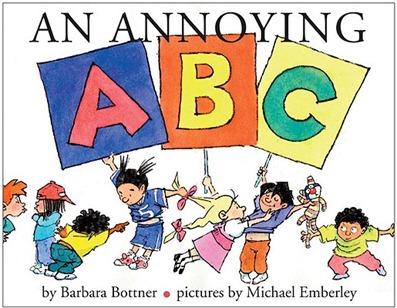
Review: An Annoying ABC by Barbara Bottner

annoying abc

An Annoying ABC by Barbara Bottner, illustrations by Michael Emberley

Take a very funny trip through the alphabet in a series of mishaps in this silly picture book.  When Adelaide starts the story off by annoying Bailey the chain of events carries all the way through the classroom from A to Z.  Children are crying, fuming, howling, and evening stumbling and tumbling before it reaches the end.  But then, when everything is done, Adelaide apologizes! 

Bottner has created a zany way to do the ABCs filled with plenty of action and nonsense.  This is a modern classroom filled with characters that are depicted in detail by Emberley.  He manages to imbue each of them with their own sense of personality and style, all 26 of them.  It is a book that races along thanks to the pacing of Bottner’s words, but readers who linger on each page will get a better sense of the story itself as told through the illustrations.  It’s a pleasant mix of words that are welcoming and fast, and pictures that are worth exploring.

A thrilling ABC, this is one of those books where children act like children and laughter abounds.  Appropriate for ages 3-5.

Reviewed from library copy.

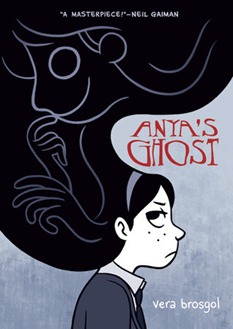
Review: Anya’s Ghost by Vera Brosgol

anyas ghost

Anya’s Ghost by Vera Brosgol

This debut graphic novel tells the story of Anya, a first generation American who has worked hard to fit in at school by losing her Russian accent and blending in with the other students.  But she can’t quite manage to be normal.  Falling down a well doesn’t help, and discovering a ghost in the bottom of the well isn’t a good start either.  But as she befriends the ghost, her life starts to become easier.  She gets help with tests, manages to connect with a cute boy she has been watching from afar, and gets clothing and makeup tips too.  Everything seems to be looking up, until Anya begins to figure out what is truly happening.

Told in black-white-and-gray illustrations, this graphic novel has a deep appeal.  Anya is a girl that readers will immediately relate to.  She has insecurities about her body, her school, and herself.  The strength of the novel comes in her character which rings very true and is written with a solid humanity.  The inclusion of the ghost lends a more fantasy tone to the book, offering an appealing foil to this very real protagonist.

The illustrations are clear and often very funny.  Emotions come through nicely and characters are depicted in ways that expand their character beyond the words on the page.  Anya is shown as a normal girl with curves, which makes her very relatable.  It doesn’t hurt that she is also sarcastic.

The storyline is strong, developing into a scary story that is hauntingly appealing.  Appropriate for ages 14-17.

Reviewed from library copy.

Also reviewed by:

Check out the book trailer too:

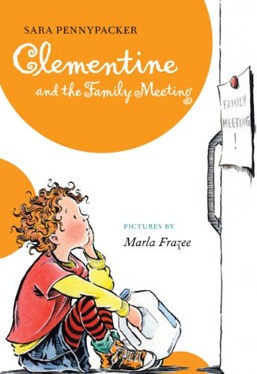
Review: Clementine and the Family Meeting by Sara Pennypacker

clementine and the family meeting

Clementine and the Family Meeting by Sara Pennypacker, illustrated by Marla Frazee

This is the fifth book in the wonderful Clementine series.  In this book, Clementine is very worried because the Family Meeting sign is hung up at home.  She just knows that she has done something wrong again.  So she goes out of her way to demonstrate how kind she is to her little brother, how neat she can be, and how she eats healthy foods.  Clementine is surprised to find out that none of those things are on the agenda, instead their family will have a new addition.  And it’s not the gorilla that Clementine has been asking for.  It’s a new baby!  Clementine knows how she feels about that.  She is not happy at all.  How in the world will their family ever be able to change from the perfection of four people into the odd number of five?

Pennypacker writes Clementine with such a surety and steadiness that readers who have enjoyed the previous books will immediately feel at home between the covers.  Clementine’s family may be changing in numbers, but readers who enjoy the deft parenting, the clever comments, and Clementine herself will be thrilled to know that those things have not changed at all.  In this book, Clementine’s relationship with her younger brother is shown as one of the growth points.  She continues to call him by vegetable names, but their relationship changes and matures too.

Frazee continues to depict a warm and wonderful family that embraces the quirkiness of one another.  From the springing curls on Clementine’s head to the ferocious scowl she gets on her face, Clementine is a vivacious and wonderful character.  My favorite image from the book is where Clementine’s mother and brother are asleep together on the couch with all of his trucks parked around them.  Perfection.

Another stellar addition to the Clementine series.  This is one series that you will want to read in its entirety, because everyone needs a Clementine in their lives.  Appropriate for ages 7-10.

Reviewed from library copy.

Also reviewed by:

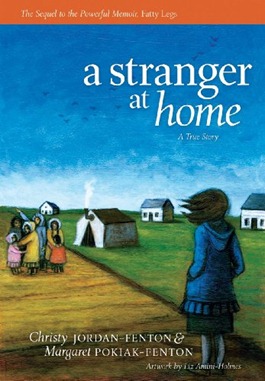
Review: A Stranger at Home by Christy Jordan-Fenton

stranger at home

A Stranger at Home: A True Story by Christy Jordan-Fenton and Margaret Pokiak-Fenton, illustrated by Liz Amini-Holmes

This sequel to Fatty Legs takes place after Margaret has spent two years at a residential school.  As Margaret finally returns home to her family, she does not expect her mother not to recognize her or for her transition back into the family to be so difficult.  She can’t eat the food her family eats because her stomach rejects it.  She has forgotten how to speak their language and can only talk in English.  The mukluks hurt her feet and she returns to wearing the canvas shoes she was given at school.  Slowly, she begins learn once again the culture that she had lost.  But then she faces the heartrending choice of whether to return to school with her little sisters or allow them to go alone.  This true story speaks to the tragedy of residential schools on Native peoples, an impact they are still recovering from.

A large part of the success of these books comes in their writing.  It is simply written with large, welcoming print.  The writing is matter-of-fact, not laden with imagery.  It is that straight honest writing that truly captures the loss and the pain.  It doesn’t allow a reader anywhere to hide, nowhere to duck away from the truth. 

The book does deal with subjects that are large and complex.  Yet the writing makes them infinitely readable and relatable.  Seeing the situation through Margaret’s eyes allows it to be personal and very effective.

The illustrations are an intriguing combination of historical photographs and drawings.  Where the photos are often in black and white, the illustrations themselves are done in deep colors that show the beauty of the landscape as well as the conflict within Margaret’s family. 

A strong sequel to the original, this book shows very clearly the lasting damage created by residential schools.  Appropriate for ages 8-12.

Reviewed from copy received from Annick Press.

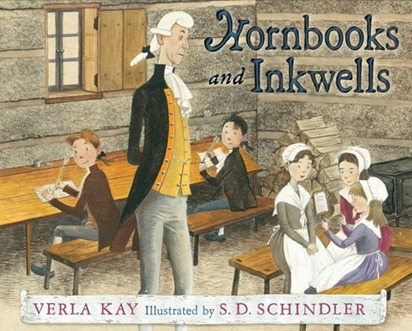
Review: Hornbooks and Inkwells by Verla Kay

hornbooks and inkwells

Hornbooks and Inkwells by Verla Kay, illustrated by S. D. Schindler

Head to school with brothers Peter and John Paul in this picture book that shows school days in the 18th century.  The one-room school has hard benches where the children learn math, history and their alphabet.  Punishments for misbehaving are being struck with the rod or wearing neck yokes, as both Peter and John Paul find out.  As winter comes, there is skating on the pond and hauling wood for the schoolroom fire.  With spring, the children are learning more and more, but leave school with the same bursts of energy they started with.

According to the Author’s Note, this book is based on Christopher Docks’ mid-1700s school.  He not only taught the normal courses, but included morals, safety, health, courtesy and social attitudes. The book is written in rhyming verse that reads easily.  The verse captures the activities of the days at school.

Schindler’s illustrations are detailed and really point out the differences between schools today and in the 18th century.   The illustrations have natural colors that offer a feel of life in the past.

A wonderful marriage of picture book and historical content, this book will be appreciated by children studying history as well as the history of studying.  Children returning to school this fall will also appreciate that they go to modern schools.  Appropriate for ages 6-9.

Reviewed from copy received from G. P. Putnam’s Sons.

Also reviewed by The Places You Will Go.

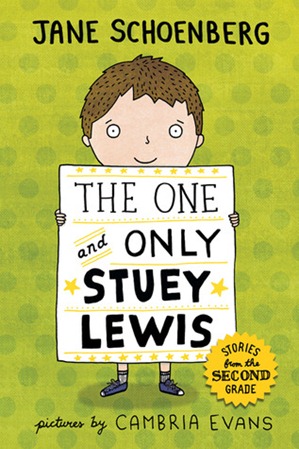
Review: The One and Only Stuey Lewis by Jane Schoenberg

one only stuey lewis

The One and Only Stuey Lewis by Jane Schoenberg, illustrated by Cambria Evans

This series of stories are about Stuey’s time in second grade.  Stuey is not a confident kid, often choosing to just not even try before has a chance to fail.  When he starts second grade, Stuey pretends to be sick because he can’t read as well as he thinks he should be able to.  But Stuey is also creative.  When his mother tells him he can only trick-or-treat on their block, he comes up with a cunning plan to get plenty of candy.  But things do go wrong, like when he doesn’t get put on the same soccer team as his  best friend and instead is put on a team with a girl in his class who drives him crazy.  But in the end, it all works out and second grade becomes something that Stuey never wants to end.  After all, who knows what will happen in third grade?!

Schoenberg has written this book at just the right level for young readers.  She has infused the story with humor, making the book very appealing to children.  It also helps that the chapters read almost as separate stories about Stuey, so it can be tackled one chapter at a time.  She also clearly sets the premise for each chapter, creating tension and driving new readers to figure out how the story ends.

Stuey is a very likeable character, filled with doubts and concerns just like any real kid.  He is also inventive, which gets him both in and out of scrapes.  Stuey shows steady growth through the stories and readers will not be surprised to find that he loves second grade by the end, even though the short book started with him dreading it.

Evans’ illustrations are fun-filled and friendly.  The black-and-white images do a lot to break up the text into more readable pieces. 

A great pick for readers who are leaving the beginning readers and ready to tackle chapter books.  Appropriate for ages 5-7.

Reviewed from copy received from Farrar Straus Giroux.

Also reviewed by: