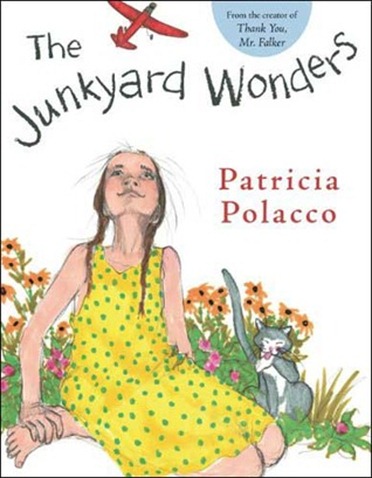
The Junkyard Wonders: Timely and Timeless

junkyard

The Junkyard Wonders by Patricia Polacco

Polacco tells another very personal story of an amazing teacher in this book.  Trisha thinks she has a fresh start when she moves to live with her grandparents and father.  She expects that she will no longer be in a special needs class anymore, but in her new school she is once again in a special class.  At this school, the class is known as The Junkyard.  Happily though, it has an incredible teacher in Mrs. Peterson.  Mrs. Peterson begins the school year talking about what genius is, and continues to lead the class forward by inspiring them every day.  She allows them to create their dreams, to realize that a junkyard is place of opportunity, and to achieve and grow.  When tragedy strikes the class, they persevere on with their efforts as a tribute. 

Polacco’s books are always heartfelt and vibrantly real.  Here readers see that differences are not disadvantages and friends are not always the most likely but can be the longest lasting.  The arc of the story takes readers through a wide range of emotions, from the dismay and shame of the special class to the achievements they realize to the loss they experience together.  Her tributes to teachers and the difference the great ones make in children’s lives could not be more timely and more timeless.

As always, Polacco’s illustrations are bright and evocative.  Obviously based on real people, the characters in the book are consistently portrayed and entirely unique from one another. 

Highly recommended for all children, whether in special classes or not.  I guarantee they will all long to be part of a Junkyard class by the end of the book.  This would make a great book for elementary classrooms discussing diversity and differences.   Appropriate for ages 6-9.

Reviewed from copy received from Philomel Books.

Also reviewed by:

There’s No Place Like School: Classroom Poems

9780060823382

There’s No Place Like School selected by Jack Prelutsky, illustrated by Jane Manning

Prelutsky has selected poems that focus on school in this funny and terrific collection of poetry.  The poems are written by thirteen poets and are filled with child appeal and an understanding of the mind of a child.  Turning from one to the next takes the reader through a school day, from heading out the door and the school bus ride to the show and tell and music class and eventually the ride back home.  The poems are well selected, offering a blend of different humor that makes moving from one poem to the next a delight. 

Manning’s illustrations offer a bright and colorful view of school.  She happily embraces the humor of each poem, from the strange foods at the school cafeteria to the delights of milk squirting out of a nose.  All are offered in a quirky and positive way.

An ideal book for the first days of school, this book will be appreciated by children of many ages.  Appropriate for ages 5-9.

Reviewed from library copy.


Enhanced by Zemanta

Pirate of Kindergarten

9781416950240

The Pirate of Kindergarten by George Ella Lyon, illustrated by Lynne Avril

Ginny could see two of everything.  She loved Reading Circle at school, but it was hard to get there because she saw double the number of chairs, so she always ran into some of them.  To read her own book, Ginny had to put her nose down close to the pages and even then she saw two of each of the words.  She could tighten her brain to remember to read each word only once, but even then she quietly said them a second time to herself.  Squinting at the pages helped, but her teacher asked her not to.  She had trouble cutting with scissors and ended up with a rabbit with three ears.  Everything changed the day that vision screening happened at school.  When it was Ginny’s turn to read from the chart, she read each letter twice.  The nurse there told her that she had to go to a doctor to see what could be done for her double vision.  And that’s how with an eye patch, Ginny became a pirate at Kindergarten. 

Lyon’s writing has a natural ease about it combined with a skillful pacing.  Readers are shown the way that Ginny sees the world through tangible examples that young children will understand and relate to easily.  The amount of text per page is just right for sharing with preschoolers and Kindergarteners.  Avril’s illustrations are bright and vibrant.  The pages filled with double vision allow readers to see through Ginny’s eyes.  The confusion of the jumble of chairs, the struggle with lines and scissors, and the doubling of words when she reads.  These are all demonstrated directly on the page. 

A cheery view of a child who sees the world differently than most, this book is appropriate for ages 4-6. 

Reviewed from copy received from Simon & Schuster.

Enhanced by Zemanta

Dotty

59515275

Dotty by Erica S. Perl, illustrated by Julia Denos

Wherever Ida goes, Dotty goes too.  Even on her first day of school, Dotty comes along: huge, horned and covered in red spots.  Once Ida is at school, she realizes that many of the others in her class have brought their own imaginary friends too.  But as the year goes on, the other children start to leave their imaginary friends behind.  Ida though is still connected to Dotty, still carrying the blue string that ties them together.  Eventually, the other children tease Ida about Dotty, even the children who had imaginary friends of their own just a few months ago.  When Ida reacts angrily and Dotty bashes into a girl who was once Ida’s friend, they have to write apologies to each other.  Ida’s teacher finds out about Dotty and turns out to be a kindred spirit, just what Ida needed.

This is a book that really embraces imaginary friends, tying it winningly with the first day of school and growing older.  Best of all is the ending of the book which took a turn that I had not been expecting.  It is a book that honors imagination and creativity, embracing being different and maturing at your own pace or just not maturing entirely at all.  Perl’s writing is charming and warm, really creating a world filled with imaginary creatures that dwindle away slowly.  Denos’ art is equally successful with a modern edge and children who are modern and yet not slick.  They look like the children I see every day.  She also has a great mix of ethnicities that is done effortlessly.

While this is a book about imaginary friends, I would also include it in any return-to-school unit because it addresses the larger issues of people being different in ways that are not immediately apparent.  Appropriate for ages 4-6.

Reviewed from library copy.

Also reviewed by:

Kindergarten Cat

Kindergarten Cat by J. Patrick Lewis, illustrated by Ailie Busby

When a kitten is found outside by the jungle gym, she is taken into the Kindergarten classroom.  They name her Tinker Toy and welcome her to the class.  She joins right in with the Kindergarten activities.  She even answers questions with a loud Me-ow.  When the children head out for recess, she makes a nice napping spot in the paintbrush drawer.  And when they go home in the afternoon, she stays in the classroom, tries to tidy up the markers, and then falls asleep on the capital C on a carpet square.  The entire book is a very friendly and charming way to show children what happens in a Kindergarten classroom.

This book is such an appeal package.  Lewis’ verse is kept very simple, making it ideal for sharing with young children.  The rhymes and rhythm keep the book moving along at a brisk pace that will keep young ears listening. 

Busby’s bright illustrations are equally engaging with their sunny palette.  The illustrations are done in collage allowing for interesting textures and patterns that add depth.  The round-faced people are from a variety of races, making for a modern classroom feel.

Although some will quibble about a pet being allowed in a school, the device really works well here.  Get this in the hands of hesitant Kindergarteners and Kindergarten teachers too.  Appropriate for ages 3-5.

Reviewed from copy received from Schwartz & Wade.

Also reviewed by:

Is Your Buffalo Ready for Kindergarten?

Is Your Buffalo Ready for Kindergarten by Audrey Vernick, illustrated by Daniel Jennewein

If your buffalo has a backpack, then he is certainly ready for Kindergarten!  This book takes a silly look at first-day Kindergarten jitters through the eyes of a student who is sure to be unique.  Buffalos may have trouble with certain rules, like No Grazing at recess, but your buffalo will also be great at hide-and-seek and serve as a comfy place to snuggle in to listen to stories.  He will also learn about sharing with others and not losing his temper and butting them with his head.  There’s a lot to learn in Kindergarten, especially if you are a buffalo!

This is a hilarious look at Kindergarten that is sure to have children giggling.  Ideal to share with Kindergarteners on that first day, or with your preschooler who is headed to Kindergarten.  Vernick has written the book with an eye towards laughter, but also shows the daily routines of Kindergarten and the various issues that can arise.  It is a very balanced look at Kindergarten done with a lot of humor.  Jennewein’s illustrations are comic and wonderful.  He captures the pure silliness of the huge buffalo at school using simple lines and nice strong colors.  The illustrations will work well with a group.

Highly recommended for all Kindergarteners and their parents, this is a great book to read in August to get your buffalo ready for school.  Appropriate for ages 4-6.

Reviewed from library copy.

Also reviewed by:

Griff Carver, Hallway Patrol

Griff Carver, Hallway Patrol by Jim Krieg

Griff Carver is a legend in school law enforcement, but he was expelled from his old school for going too far in the name of justice.  Now he’s at Rampart Middle School, a school that is perfect on the surface, but seething with crime underneath.  Griff is not a rookie.  He can sense littering out of the corner of his eye, nabbing the principal of the school on his first day on patrol.  Griff finds himself partnered with Tommy, a Camp Scout, who is unable to see past the thin veneer of respectability at his school.  Instead, Tommy accuses Griff of being the bad guy, resulting him getting him kicked off of Patrol Squad.  That won’t be enough to get Griff to stop seeking out the real bad guy who is running a fake hallpass scheme.

Tongue-in-cheek and riotously funny, this book takes the crime genre and sets it in middle school.  Fans of crime fiction and crime programs will love seeing some of the favorite tropes of the genre played with.  The lingo Griff uses is dead on, adding to the humor of the book.  The pairing of the veteran Griff with the naive Tommy is also directly out of the genre.  Adding to the feel is the use of recorded statements and Patrol Squad reports to form the storyline. 

The setting here is humorously drawn as well.  The middle school is depicted not in lengthy descriptions but through the eyes of hall patrol.  I especially enjoyed No Man’s Land, the area on the school grounds where the erasers are cleaned, forming a permanent fog of dust.  What could be more perfect for the genre than a meeting in the fog?

A great summer read, this book will have middle school readers laughing out loud, engaged with both the humor and the action itself.  Appropriate for ages 10-13.

Reviewed from copy received from Razor Bill.

Doodlebug

Doodlebug by Karen Romano Young

Dodo has been expelled from her last school because she tried to sell her Ritalin to other students in her class.  Now her family is moving from LA to San Francisco.  Her parents are hoping for a fresh start for their careers and for Dodo.  Her younger sister Momo is angry about the move, and Dodo is unsure that it will make any difference at all.  On the trip, Dodo discovers that she loves to draw, that doodling makes her calmer and better able to deal with the drive and the move.  Dodo starts a new school, changing her nickname to Doodlebug.  Her doodling is accepted in some classes and forbidden in others.  Momo is desperate to join the school’s choir, so she tries several stunts, like singing into the PA system of the school.  Both girls may have pushed it a bit too far in their new school.  Will Dodo be expelled again?

A fabulous combination of journal, graphic novel and story, this book allows readers to really understand what it is to be a visual learner and to have ADD.  Dodo is a great character, fully developed and complex.  Just as wonderfully drawn are her family members, even the new cat, Sven.  They are all complicated and interesting, portraying a real, multicultural family dealing with change and opportunity. 

Young’s creativity is fully on display here with pages filled with a variety of lettering, lots of drawings and plenty of forward momentum.  Several touches will resonate with young artists who will find the names of the pens used to make the black and white illustrations.  They will get plenty of inspiration to create their own journals, capture their own lives and adventures. 

Highly recommended, this book will be enjoyed by readers who enjoyed the Joey Pigza series, Amelia’s Notebook, and Diary of a Wimpy Kid.  Appropriate for ages 9-13.

Reviewed from copy received from Feiwel and Friends.

Also reviewed by:

Check out Karen Romano Young’s website.

Preschool Day Hooray!

Preschool Day Hooray! by Linda Leopold Strauss, illustrated by Hiroe Nakata

This friendly, bouncy book offers a glimpse at a preschool day that is perfect for children heading to preschool for the first time.  The book follows the course of a day in preschool.  It begins at the breakfast table, moves through arrival and drop off, crafts and playground play, snack and naptime, dancing and toys, to parents picking up the children.  Strauss’ verse is just right for small children with a happy cadence that is easy to read aloud. 

Nakata’s illustrations add to the friendly appeal of the book with their rosy-cheeked children who are often doing their own thing rather than acting as a group.  The illustrations are very child-focused and reveal the mess and exploration of preschool. 

My only issue in the book, which is filled with children of different colors, is that at the end of the book only Mommy is mentioned as picking children up after school even though the illustrations also show a father.  I’d rather have had Mommy changed to parents in the verse to show that Daddy is just as involved.

A very positive view of preschool, get this into the hands of new preschoolers!  It is printed on heavy pages with a sturdy binding, ideal for little eager hands.  Appropriate for ages 1-4.

Reviewed from copy received from Scholastic.