Review: Wildlife by Fiona Wood

wildlife

Wildlife by Fiona Wood

Set in Australia, this teen novel features the first person voices of two sixteen-year-old girls experiencing a semester in a school wilderness camp.  Sib has been in this school for a long time, so it surprises everyone, including herself, when she is selected as a model for a billboard and modeling campaign.  Suddenly instead of ignoring her, everyone is paying attention to her.  That includes Ben Capaldi, the cutest and most popular boy in school.  Sib has no idea how to deal with this new interest, but her best friend is very willing to guide her, perhaps too willing.  Lou is a new girl in school and is recovering from the loss of her boyfriend in an accident a year ago.  She has no interest in joining into school life or making new friends.  Instead she wants to be left alone, connect with her old friends, grieve and try to figure a way out of her extra counseling sessions.  But even as she walls herself away from the others at school, she finds herself getting drawn into the drama and life happening around her.  This story of two very different and equally compelling young women dives deep into romance, sexuality and friendship.

Wood has made recent news through her frank depiction of teen female sexuality.  This book stands out clearly with its positive but also nuanced and honest look at one girl’s first sexual experience.  With moments of humor throughout, the sex is shown with lots of heat, tons of desire, and then reality as well.  In the end, the character decides what is right for her, not what is right for all teens, but there is no shaming, no despair, no regret, just decisions going forward.  This is sex as teen girls experience it, done with intelligence and care.

The reason the sex in the book works so well is that Wood has created two main characters who are themselves intelligent, caring and fascinating.  Sib is dealing with suddenly breaking the role that she had been cast in, and being thrust into popularity for something that she sees no value in, modeling.  It’s a deft combination of feminism and pop culture.  She also has a manipulative best friend, a character who is beautifully drawn and one that readers will adore to dislike.  Lou too is a complex character with her grief but also her growing interest in those around her.  Her internal voice is wonderfully wry and funny, showing a spirit and intensity well before she reveals it to the world around her. 

Set in a clever parent-free wilderness setting, this book is smart, funny and just what fans of Rainbow Rowell are looking for.  Appropriate for ages 14-18.

Reviewed from library copy.

Review: Not My Girl by Christy Jordan-Fenton

not my girl

Not My Girl by Christy Jordan-Fenton and Margaret Pokiak-Fenton, illustrated by Gabrielle Grimard

Continue the story of When I Was Eight with this second picture book by the authors.  The picture book versions follow two highly acclaimed novels for elementary-aged children that tell the same story at a different level.  In this book, Margaret returns home to her native family from the outsiders’ school.  Her hair has been cut short, she has trouble speaking the language of her people, and her skills are more suited to school than life in the Arctic.  When her mother sees her for the first time, she exclaims “Not my girl!” and rejects her daughter.  Slowly, Margaret begins to rebuild her old life and relearn the ways of her family and their traditional life.  But it takes time to be accepted by her mother and to find her way around her newly reunited family.

The Fenton family writes all of their books from the heart, clearly creating a case for the damage of the white people and their schools on the lives of Native people and their children.  This book serves as the other side of the story from When I Was Eight, demonstrating that even when children were returned to their families it was not easy to integrate once again into that society because of the changes wrought by the schooling system.

Grimard’s illustrations show the Arctic landscape, the way Margaret doesn’t fit in with her clothing or her ways.  It also shows the love of her father, his patience and understanding and the slow thaw of her mother and her anger.  Grimard captures these emotions with a delicacy and understanding of all of them.

Another impressive entry into the story of Margaret and her childhood, this book should be paired with the first picture book to best understand Margaret’s story.  Appropriate for ages 5-7.

Reviewed from library copy.

Review: The Invisible Boy by Trudy Ludwig

invisible boy

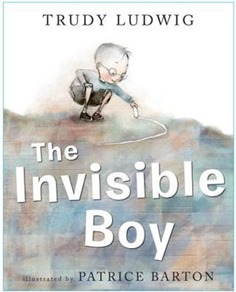
The Invisible Boy by Trudy Ludwig, illustrated by Patrice Barton

Brian is invisible.  His teacher never notices him in the classroom.  He doesn’t take up much space.  He never gets picked when kids choose kickball teams.  He isn’t invited to any parties.  Brian spends his time drawing dragons, pirates, aliens and superheroes.  Then Justin joins Brian’s class.  Justin uses chopsticks at lunch and eats different food than everyone else.  The other kids laugh at him and Brian feels happy being invisible.  Brian leaves Justin a drawing that says that Justin’s food looked yummy.  Justin talks with Brian about his art, but is quickly called away to play games with the others.  When a chance comes for them to work together on a class project, Brian starts to feel a lot more visible.

Ludwig paints a vivid picture of an isolated child here.  The true success on these pages is the capturing of very subtle forms of bullying rather than the overt type seen in so many picture books.  This is the type that involves exclusion from the group rather than physical violence.  Ludwig not only captures it, she also shows just how damaging being alone can be for a child.  At the same time, Brian is bright and creative and willing to connect.  Ludwig also shows how a single child can make a difference and bring someone who is invisible into the group.

Barton’s illustrations have a beautiful softness to them.  She incorporates paper art in her digitally painted work adding another dimension.  Brian starts out almost transparent and only done in pencil with no color at all.  As he starts to reach out to others, color comes to him and eventually he is just as fully colored as everyone else.  This visual transformation nicely captures what is happening emotionally.

A superb book about bullying and exclusion, this can be used to start discussions in a classroom or with a single child.  Appropriate for ages 4-6.

Reviewed from copy received from Random House Children’s Books.

Review: Openly Straight by Bill Konigsberg

openly straight

Openly Straight by Bill Konigsberg

Rafe is openly gay in his home town of Boulder, Colorado.  OK, he’s beyond out of the closet, he’s the guy that is asked to speak publicly about being gay, his mother is president of the local PFLAG chapter, and he speaks to high schools about tolerance.  So when he heads to a private all-boys school in New England, he decides to no longer be that out about being gay.  He just wants to be normal, be one of the guys, have guy friends and play soccer.  So he goes back into the closet.  He tells himself that it’s not a big deal, since sexuality is just one part of the whole person.  But things get complicated.  First, a boy on campus has a breakdown.  Then he has to start lying to people when they ask about his girlfriend or even when asked directly whether he is straight or gay.  And yeah, there’s this guy he likes, maybe even loves.  This smart, funny novel explores what happens when coming out at home was easy, but coming out a second time is beyond difficult.

Konigsberg writes such a wonderful character in Rafe.  Rafe is fairly confident on several levels but in so many other ways, he’s a complete mess.  I love that he is a boy who spoke out about tolerance, yet seems unable to tolerate the consequences of his being out and proud.  The idea of returning to the closet is one that adds a freshness to this story while the book still deals with all of the stereotypes and negativity that gay teens face.  I also appreciate the frankness with which this book handles gay teen sex, another refreshing aspect of the novel.

Throughout the book, the tension is created through Rafe’s lies and the growing relationship he finds himself in with his best friend.  Throughout one wonders if this is the moment he breaks his silence and frees himself, but Rafe continues to live in the cage he rebuilt for himself.  It’s a book that is funny yes, but equally tragic too. 

Beautifully written with wit and style, this book takes a new look at being gay and out.  Appropriate for ages 16-18.

Reviewed from copy received from Scholastic.

Review: When I Was Eight by Christy Jordan-Fenton

when i was eight

When I Was Eight by Christy Jordan-Fenton and Margaret Pokiak-Fenton, illustrated by Gabrielle Grimard

This is a lovely new picture book version of Fatty Legs that will share Olemaun’s story with younger readers than the original chapter book.  It follows Olemaun from her time with her nomadic family through her attending the “outsider’s school.”  There her hair is chopped short and her warm parka is replaced with thin and scratchy clothing.  Her name is even changed to Margaret.  Margaret wants most to learn to read, but the school is much more interested in getting the children to work hard rather than teaching them.  Margaret has a difficult relationship with one nun in particular who makes a point of humiliating her regularly.  In the end though, Margaret does learn to read all on her own.

This is a story that works really well as a picture book.  I really enjoyed both Fatty Legs and A Stranger at Home that were chapter books, but this younger version simplifies the story and keeps its quiet power.  As with the earlier books, I remain in awe at the strength that it took for Margaret to survive in the school and also the courage it takes to keep on telling her story.

Grimard’s illustrations echo the beauty of the Arctic but also capture the dullness and darkness of the school.  The nun character radiates scorn and anger on every page she appears in.  Margaret is shown usually isolated, but also as radiant in her resiliency.

A powerful look at residential schools on Native populations, this picture book version belongs in most libraries.  Appropriate for ages 6-9.

Reviewed from digital galley received from Netgalley and Annick Press.