Review: On a Beam of Light by Jennifer Berne

on a beam of light

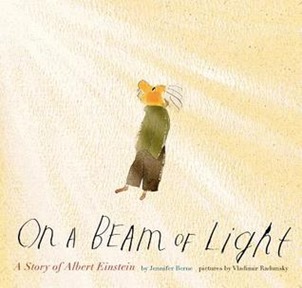
On a Beam of Light: A Story of Albert Einstein by Jennifer Berne, illustrated by Vladimir Radunsky

The author of Manfish: A Story of Jacques Cousteau (my review) returns with this picture book biography of Einstein.  It follows the story of Einstein from birth through his series of amazing discoveries about the universe.  The book begins with pages where Einstein as a small child does not speak until he is inspired to ask questions thanks to a compass which is given to him.  Einstein is also inspired by picturing his bicycle riding on beams of light, racing through space.  So he began to study science and numbers and after graduating from college wanted to be a teacher.  Instead, he found a job working in a government office where he had extra time to think.  That time to think turned into incredible discoveries about science and the nature of the universe until scientists and professors were seeking Einstein out to come and work with them.  The end of the book celebrates Einstein’s eccentricities as well as the discoveries that he made.  This is an inspiring look at a scientist who broke all the rules and decoded the universe.

Berne’s writing truly celebrates this amazing thinker.  The pacing is brisk, but the tone allows readers to linger and think if they wish to.  When she focuses on his odder behaviors, they are seen through a lens of what they meant for his genius rather than just being peculiar.  And who wouldn’t want to not wear socks and have ice cream too! 

Radunsky’s illustrations are done on textured paper that adds a soft yellow glow to the entire book, something wonderful to have in a book that speaks about rays of light.  His drawings are rough and have a wonderful sense of playfulness. 

A great read about a great man, this picture book biography should be welcomed by young scientists as well as in science classrooms.  Appropriate for ages 6-9.

Reviewed from library copy.

Review: Look Up! by Robert Burleigh

look up

LookUp! Henrietta Leavitt, Pioneering Woman Astronomer by Robert Burleigh, illustrated by Raul Colon

Henrietta had loved the stars ever since she was a little girl and spent hours gazing at them.  When she studied astronomy, she was one of the only women in her class.  After graduating, she worked at an observatory though she almost never got to look through the telescope.  Instead the women were there to do the calculations, to work and not think.  But Henrietta continued to study and to think, she was especially interested in a group of stars that seemed to dim and glow.  She discovered some new blinking stars that no one had ever found before.  As she studied, she found a pattern in the dimming and brightening of these stars: the blink time allowed her to measure the true brightness of any blinking star in the sky.  Her discovery led to a deeper understanding of the vastness of the universe and her life demonstrated that women are thinkers and scientists.

Burleigh’s writing is almost poetic here.  He speaks of the connection Henrietta felt to the stars: “Sometimes she felt the stars were trying to speak, to tell her what they knew.”  He writes with deep amazement at the vastness of the universe and also speaks of Leavitt’s discoveries in thrilled tones, giving her credit for the hard work and patience it took to find the patterns in the stars.  The book ends with several pages that outline her discoveries, names of other female astronomers, and also have a glossary and bibliography. 

Colon’s illustrations are simply gorgeous.  Done in watercolors and pencil, the illustrations are luminous, glowing with the light of the stars and with the light of the heroine herself.  Textured with swirling lines, the illustrations have a great depth to them as well.

This picture book biography invites children to follow their own passions and get involved in science as well.  Appropriate for ages 6-9.

Reviewed from library copy.
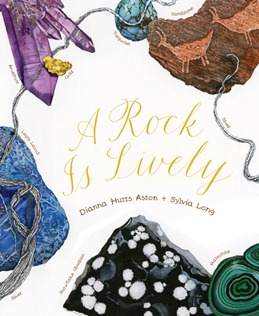
Review: A Rock Is Lively by Dianna Hutts Aston

rock is lively

A Rock Is Lively by Dianna Hutts Aston, illustrated by Sylvia Long

Another stellar collaboration by the team that created An Egg Is Quiet, A Seed Is Sleepy, and A Butterfly Is Patient, this nonfiction picture book focuses on rocks and minerals.  The book begins with rock melted as magma beneath the earth.  It talks about what makes up rocks and how old they are, as well as the rocks that we find in space.  Rocks as tools and weapons are explored, mixed in with the amazing rock interiors that surprise and delight. The different types of rocks finish off the factual piece of the book, but the bright and beautiful illustrations continue all the way to the final lapis lazuli endpages. 

Aston manages to write nonfiction as if each sentence is filled with delight.  Her enthusiasm for the subjects she writes about is evident in her writing, inviting young readers to get just as interested as she is.  The art carries that same enthusiasm in its bright colors and details.  Done in watercolor, the colors are surprisingly deep and lush. 

If you have the first three books from these amazing collaborators, this is a must-buy.  It should be on the shelves of any school or public library, sure to get young people exploring a new subject.  Appropriate for ages 7-9.

Reviewed from copy received from Chronicle Books.

Review: A Strange Place to Call Home by Marilyn Singer

strange place to call home

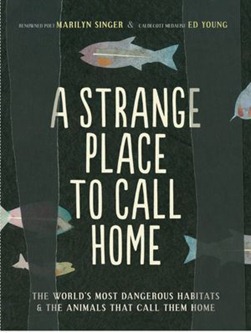
A Strange Place to Call Home: the World’s Most Dangerous Habitats & the Animals That Call Them Home by Marilyn Singer, illustrated by Ed Young

Through evocative poetry, this book explores habitats that you would never guess something could even survive in.  But they do!  There are creatures who live in places with no water, no warmth, little food.  And those are the creatures that star in this book, each of them celebrated in verse.  There are penguins, mountain goats, and camels, which may be the animals that came to mind.  But Singer looks deeper than that and introduces unlikely creatures to readers, including petroleum flies that hatch in oil, ice worms that live in glaciers, and blind cave fish from Texas and Mexico.  She takes these creatures, known and unknown, and gives us a glimpse of them and their habitat in a variety of poetry forms.  Each page is a discovery of a new animal and a new type of poetry.

Singer excels at creating poetry that is artistic and has depth and yet offers young readers an approach to verse that is welcoming.  She writes at their level yet doesn’t ever play down to them.  Since some of the haikus and other forms are quite brief, it’s nice that she offers paragraphs of information at the end of the book on each creature.  At the very end of the book, she also speaks to the variety of poetic forms she has employed in the book.

Young’s illustrations add another layer of beauty into the book.  Through his layered paper art, he creates a red forest of flamingo legs, a swirl of desert sands, foaming rivers, and an urban landscape among many others.  His work embraces the diverse habitats, recreating the harshness and the often subtle richness of these unknown worlds.

A great pick for poetry units or units on habitats, this book offers a perfect blend of verse, science and art.  Appropriate for ages 7-10.

Reviewed from copy received from publisher.

Review: I, Galileo by Bonnie Christensen

i galileo

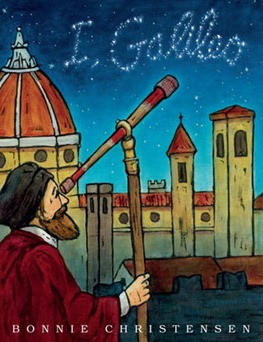
I, Galileo by Bonnie Christensen

Told in the first person, this look at Galileo’s life is made all the more personal through the unique point of view.   Galileo tells the tale from the house and walled garden he is imprisoned in.  Blind and aging, he recalls his childhood and the way that he helped his father with his musical experiments after leaving the university with no degree.  He was offered a teaching position in the same university a bit later, but he refused to be traditional and instead wore what he liked and tested Aristotle’s laws of physics.  He was soon let go of his teaching role and headed to another university where they were more interested in his experiments.  There he invented the compass and the telescope.  Looking through his telescope, Galileo discovered that the sun is the center of the universe.  It was then that his troubles truly began.  For seven years, he was bound to silence about his findings until a new man became pope.  When Galileo finally published his findings, they so incensed people that he was tried for heresy before the Inquisition.  And so the story comes back to the old man imprisoned in the walled garden.

Through a brief preface, Christensen sets the stage for the time period of Galileo’s life.  It will help modern children understand the technology that was not available in that day.   Her afterword is equally intriguing and helpful, explaining that it took almost four centuries (until 1992) for the Catholic Church to admit they were wrong to condemn Galileo.  Christensen paints a picture of the world around Galileo well.  His discoveries, his world of academia, the political and religious powers at play, and his mistreatment at their hands.  This book is exceedingly readable.

It is also lovely.  The illustrations are done in jewel tones that have a depth and richness.  They almost recall stained glass with their thicker black lines and the light that shines in each of them.  Even the image of Galileo before the Inquisition plays with light and color. 

A choice pick for libraries looking for a readable and interesting biography of this heroic scientist.  Appropriate for ages 6-9.

Reviewed from copy received from Random House Children’s Books.

Review: Ocean Sunlight by Molly Bang

ocean sunlight

Ocean Sunlight: How Tiny Plants Feed the Seas by Molly Bang and Penny Chisholm

Following her Living Sunlight book, this continues the story of how the sun makes life on earth possible.  Here, the focus is on the ocean and the role that sunlight plays even in the darkest depths of the sea.  The story starts with photosynthesis and food chains on dry land, then moves to the water.  Bang asks where the green plants in the ocean are except for the seaweed.  Then she shows the tiny phytoplankton that make up the plants of the sea.  The food chain is shown and the book then turns to the darkness of the deep and how the food chain works even in blackness.  It is beautiful science. 

Bang successfully combines poetry and science in this enticing picture book. Her tone is inviting, inquisitive and filled with wonder at the amazing things that happen due to our sun.  The book is written from the point of view of the sun itself and how its energy reaches everywhere on earth.  It is a celebration of the sun and of the oceans themselves too.

Chisholm’s art ranges from the glow of the yellow sun to the black deep of the ocean.  Everywhere, even in the darkness, you can see the energy of the sun.  When the phytoplankton are displayed, Chisholm shows them up close in all of their wonderful detail.  Then the energy of the sun dances above the waves in yellow dots.  The entire book sings with energy and light.

This book is a tribute to science and nature.  It’s a readable and very understandable look at the complex systems that make our lives possible.  Appropriate for ages 5-8.

Reviewed from library copy.

Review: Zig and Wikki in the Cow by Nadja Spiegelman

zig and wikki in the cow

Zig and Wikki in the Cow by Nadja Spiegelman and Trade Loeffler

This is the second Zig and Wikki book, featuring two little aliens who find their way to Earth.  In this book, the two friends lose their spaceship when they return Zig’s pet fly its native habitat.  On the way, the two discover that flies eat poop, that dung beetles use it as well, and that cows have multiple stomachs.  It’s all a matter of learning things up close and personal, right down to being swallowed by a cow.  This humorous mashup of scientific fact, alien appeal, and comic format makes for an engaging read for young readers.

It is really the blend that works so well here.  The writing is light and funny, combined with scientific facts that are highlighted with photographs.  Readers learn about food cycles, ecology and habitats without even realizing it.  Add in the humorous poop factor and the graphic novel format, and this is one appealing package.

A graphic novel series that is a lot of fun and also informational, this second book is a winner, winner, cow dinner.  Appropriate for ages 7-9.

Reviewed from copy received from Candlewick Press.

Review: Just a Second by Steve Jenkins

just a second

Just a Second: A Different Way to Look at Time by Steve Jenkins

Jenkins always manages to make science and nature even more fascinating than it usually is.  In this book, he shows the passage of time in unique and  intriguing ways that will get young scientists thinking differently.  What happens in one second?  Well, in that second a bat can make 200 calls or hummingbird beats its wings 50 times.  What happens in one minute?  In a minute a grizzly bear can charge up to one half-mile or a skydiver falls 2 miles during free fall.  How about an hour?  A day?  A week?  Longer?  For all of these, Jenkins selects intriguing examples of what happens during that time period that will have you thinking about time and what can be done in ways you never expected.

Jenkins’ paper collage art is on display here, vibrant against the plain backgrounds of the pages.  His exacting art uses pattern, subtle color changes and textures to great effect.  His collage work is done with such attention to detail that it often doesn’t look like cut paper work.  It is as beautiful as his work always is.

Jenkins has selected fascinating bits of trivia to put on display here.  This book will not give you the complete story of the natural examples, but will definitely open readers’ minds to new ways of looking at time and action.  It is one of those books that invites you to explore the ideas that capture your imagination further in other places. 

A great gateway book that broadens the mind, this nonfiction book is appropriate for ages 5-9. 

Reviewed from library copy.

Review: 11 Experiments That Failed by Jenny Offill

11 experiments that failed

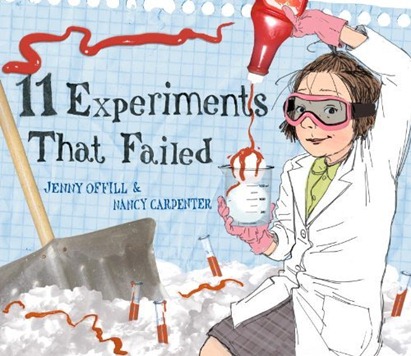
11 Experiments That Failed by Jenny Offill and Nancy Carpenter

A series of experiments take place in this book, each one funnier than the next.  They attempt to answer questions like: Can a kid make it through the winter eating only snow and ketchup?  Do dogs like to be covered in glitter?  Will a piece of bologna fly like a Frisbee?  The only way to find out is for the protagonist to test it scientifically.  That means trying to eat only ketchup and snow and observing the results.  Sprinkling her dog with glitter to see what happens.  Testing flight capabilities of bologna in the lunchroom of school.  All of the experiments have a question, a hypothesis, instructions, and results.  Budding scientists are sure to find plenty to laugh along with in this book, along with new ideas for experiments of their own.

This very funny book and also great fun to share.  The book design plays a big role in the fun.  Since the results are after a page turn, we enjoyed guessing what the results of the experiments would be.  Each experiment is unique, silly and entirely engaging.  The other winning part of the book is that this is a girl doing science, wearing her pink goggles and gloves, and her lab coat. 

The illustrations add to appeal.  The collage illustrations mix photographs and drawing.  They are quirky, colorful and glorious.

Get this one in the hands of science teachers who are teaching the scientific process.  Young scientists will also love it as well as any kid who enjoys silliness in their books.  But beware of flying bologna!  Appropriate for ages 5-8.

Reviewed from copy received from Schwartz & Wade Books.

Also reviewed by Pink Me and Young Readers.