Book Review: The Voyage of Turtle Rex by Kurt Cyrus

voyageturtlerex

The Voyage of Turtle Rex by Kurt Cyrus

Follow the story of a baby sea turtle starting with her hatching under the sand.  But there is something very special about this little turtle, she’s growing up surrounded by dinosaurs!  So what is a little turtle to do to survive?  She’s got to find safety and then grow, grow as big as she can.  She eventually grows into an enormous two-ton archelon.  Eventually something inside her calls her to return to the shore, so she leaves the safety of the silt at the bottom and heads back to land.  There she digs a nest for her eggs and buries them before returning to the sea.  The book then talks about modern shelled animals who are descendants of the great prehistoric sea turtles.

Cyrus, author of Tadpole Rex, has added another thrilling book that extends the landscape of the dinosaurs to include more creatures.  Here sea turtles are celebrated in rhymes that make the book very entertaining and fun to read.  Cyrus offers just the right mix of scientific fact and story line, keeping the book anchored in fascinating science but also fast-moving.

His illustrations are dramatic as the tiny turtle struggles to survive at sea after a harrowing crawl to the water near dinosaurs.  All of the many predators around her add to the interest and excitement both in the text and the illustrations.  Cyrus uses bold lines, effective textures and a surprisingly soft color palette to create the images. 

Perfect for both dinosaur and turtle fans, this book is sure to find an eager audience in elementary and public libraries.  Appropriate for ages 4-7.

Reviewed from library copy.

Also reviewed by Wrapped in Foil.

Book Review: The Little Plant Doctor by Jean Marzollo

littleplantdoctor

The Little Plant Doctor: A Story about George Washington Carver by Jean Marzollo, illustrated by Ken Wilson-Max

An old tree in Diamond, Missouri recounts its favorite story, a tale about George Washington Carver as a little boy.  When the tree met George, they were the same height, and George planted wildflowers around the tree.  He watched the flowers closely, moving them from sun to shade if they drooped.  George was bright, but was not allowed to go to school because he was African-American.  So he stayed home, continuing to study plants on his own.  Eventually, George did get to go to school and then to college.  Now the tree stands in the George Washington Carver National Monument, helping to tell the story of a young George Washington Carver who became one of the most famous scientists in history.

Marzollo has chosen a unique perspective from which to tell the story of George Washington Carver.  It makes it less of a biography, but still firmly roots the story in reality.  At times, the wording in the text can feel clunky and the use of the tree as narrator cumbersome.  This is especially true in the last part of the book.

Wilson-Max’s illustrations bring the book to life with their bright, deep colors that speak to the beauty of the plants, the strength of the tree, and the dedication of George to his pursuit of science.  They have a pleasing rustic quality to them that speaks to the natural setting.

This friendly book about George Washington Carver will entertain young children and is also educational about the famous scientist.  Appropriate for ages 5-8.

Reviewed from ARC received from Holiday House.

Argus: A Celebration of Being Different

argus

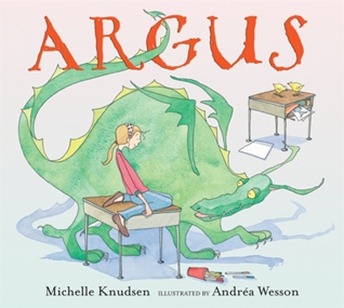
Argus by Michelle Knudsen, illustrated by Andrea Wesson

When her class at school does a science project with eggs, Sally’s egg looks very different from the regular white chicken eggs.  Hers is much larger and polka-dotted.  When the others eggs hatch, the fluffy yellow chicks emerge.  When Sally’s egg hatches, out comes something scaly and green.  Argus is completely different from the other chicks.  He doesn’t eat seeds, instead he’s rather eat the other chicks.  Perhaps even the students!  Sally finds herself longing for a yellow, fluffy, normal chick of her own.  But when Argus disappears, she realizes that he has become very special to her and that his own unique qualities are what make him himself.

Knudsen has created a picture book that is very funny.  She plays up the humor of a dragon emerging from an egg in a classroom.  I also enjoyed the role of the teacher, Mrs. Henshaw, who takes all of the differences and surprises in stride, managing all of the situations without getting flustered.  It is as matter-of-fact a book about a dragon as you are likely to find, which is a large part of its charm.

Wesson’s illustrations have a light touch and lots of details.  The yellow chicks are roly poly and jolly.  Argus is not.  Yet children will never be afraid of Argus because he wears a smile and has friendly yellow eyes.  Another touch from Wesson are the graphs and measurements that the class makes of their “chicks.”  Argus definitely does not conform.

A funny, wry book about differences and acceptance, this book will be welcome in libraries and classrooms as a way to discuss difficult subjects with humor.  Appropriate for ages 5-8.

Reviewed from library copy.

Also reviewed by:

Big Night for Salamanders

Big Night for Salamanders by Sarah Marwil Lamstein, illustrated by Carol Benioff

On a rainy spring day, a young boy comes home hoping that this will be the Big Night.  After dinner, the boy gets his raincoat on and a flashlight covered in pink plastic to lessen the glare.  He and his parents head out to the wet road in the dark.  In the dark and the rain, the family help salamanders cross the road safely as they move from forest to pond to lay their eggs.  But some of the cars are going so fast that it is dangerous not only for the salamanders.  So the boy creates a sign that says “Go Slow, Salamander Crossing!”  It is indeed a Big Night.

The story of the boy is presented side-by-side with information on what the salamanders are doing.  Readers get insight into the animals, told in a much more poetic and flowing way than the human story.  It makes for a lovely contrast with one another where not just the font and the content tell the different stories but also the tone and writing style.

Benioff’s illustrations are equally at home with the humans and the salamanders.  It is a pleasure seeing a child of color in a story where there is no mention of it at all.  Her art is bold enough to work with groups, and this book as a whole is ideal for reading aloud in storytimes about spring or salamanders.  All children will reach the end of the book wishing that they too could shepherd salamanders across a road at night.

A lovely science story book, this book successfully marries science into a picture book story.  Appropriate for ages 4-6.

Reviewed from library copy.

Also reviewed by:

Summer Birds

Summer Birds: the Butterflies of Maria Merian by Margarita Engle, illustrated by Julie Paschkis

Maria, a young girl living in Germany during the Middle Ages, disproves the ancient belief that butterflies, frogs and other small creatures spontaneously generate from mud.  Maria instead observes their transformations as they change from egg to caterpillar and finally to moth or butterfly.  She must study them in secret because others would accuse her of witchcraft for dealing with these insects that they believe are evil.  She paints what she sees, documenting the changes and her observations of their lives.  Readers will enjoy this marriage of science and art in a picture book format.

Maria can serve as an inspiration for us all.  She took a long-standing theory and through her own powers of observation and judgment disproved it.  Following her own interests of science and art, Maria was an explorer, a scientist and a discoverer.  The author’s note at the end of the book tells readers more of Maria’s story, including what she went on to do as an adult.  Charmingly, the picture book remains simple and straight forward, never getting bogged down in the mud.

Paschkis’ art has a folk-art feel that ties it naturally to the time period of the story.  Her use of strong, simple lines echoes the simple strength of the writing as well.  As a reader, I had expected to see more of Engle’s poetry in evidence here in her first picture book.  It was a pleasure to see that she excels at simple storytelling just as much as she does at imagery and poetry.

A powerful combination of art and science, just like Maria, this book is appropriate for ages 5-9.

Reviewed from copy received from Henry Holt.

Also on:

The Humblebee Hunter

The Humblebee Hunter: Inspired by the Life and Experiments of Charles Darwin and His Children by Deborah Hopkinson, illustrated by Jen Corace

Told from the perspective of Etty, one of Charles Darwin’s daughters, this book is an invitation into the lives of the Darwin family.  Etty does not want to stuck inside with her mother and Cook learning to make honey cake.  She would much rather be outside with her father helping with his scientific observations.  The children grew up asking questions just like their father.  They measured worm holes, experimented with seeds and salt water, counted snakes, and captured moths.  So when her father appeared at the door and asked her to bring out the flour shaker, Etty happily did so.  The question was how many flowers a humblebee would visit in a minute.  The flour would make the bees the children would be observing more easily seen.  And what is the answer to the question?  You will just have to read the book to find out or dust your own humblebee with flour!

I was immediately charmed by the illustrations of this book.  They have an old-fashioned feel merged with a modern edge.  The colors used are vintage and immediately place the story in the correct era, but the illustrations themselves are crisp and add interest.  Hopkinson’s text is equally successful.  The pacing is varied which makes for an interesting read.  From the slow pace when Etty is inside baking and remembering her father’s stories to the brisk pace and excitement of following a bee from flower to flower. 

This book will make every child want to have dust a bee with flour and observe them.  It is a book that has you itching to head outdoors and measure your own worm holes or capture moths.  Appropriate for ages 4-7.

Reviewed from library copy.

Also reviewed by Charlotte’s Library.

Reblog this post [with Zemanta]

Older Than the Stars

Older Than the Stars by Karen C. Fox, illustrated by Nancy Davis

Celebrate the age of your atoms with this dynamic nonfiction picture book.  Starting with the lines:

You are older than the dinosaurs.

Older than the earth.

Older than the sun and all the planets.

You are older than the stars.

You are as old as the universe itself.

Through a traditional folktale format of cumulative rhyming lines, this book can be read in several ways.  The rhymes serve as a structure for the book, but the real pleasure is in the scientific facts that are presented with flair and an eagerness that make them fun to read.  Young readers will learn about the Big Bang, how stars were created, and how our planet and humans came about.  The book ends with a colorful timeline and a glossary of terms.

Fox’s rhyming is catchy and sound.  Her scientific information is interesting and a pleasure to read.  Featuring strong colors, deep contrasts and vivid design, Davis’ illustrations are dynamic.  They have a timeless feel that is very appropriate for the subject, yet they are definitely modern in feel as well. 

A great nonfiction picture book on a subject that will intrigue young readers, this picture book will not sit still on shelves for long.  Appropriate for ages 4-8.

Reviewed from library copy.

2010 AAAS/Subaru SB&F Prize Winners

This award is given for excellence in science books. Here are the winners:

PICTURE BOOK

Living Sunlight: How Plants Bring the Earth to Life by Molly Bang and Penny Chisholm

MIDDLE GRADES

The Frog Scientist by Pamela S. Turner

YOUNG ADULT

Invisible Kingdom: From the Tips of Our Fingers to the Tops of Our Trash, Inside the Curious World of Microbes by Idah Ben-Barak


I’ve read the first two and they are amazing!  I’m sure the third is too.  Great choices.

Thanks to The Miss Rumphius Effect for the news.

The Story of Snow

The Story of Snow: The Science of Winter’s Wonder by Mark Cassino with Jon Nelson, PhD.

This book covers snow from the way it begins with a tiny speck and how it turns into a snow crystal.  Filled with delightful details like the types of things that form the tiny specks in the atmosphere. (It could be sea salt or plant leaf bacteria!) The book is a mix of drawings and snowflake photographs which works well.  The images of the crystals are stunning and will have readers poring over the pages and discussing their favorites.  The book talks about the different types of snowflakes, whether they are unique, and how you too can study their structure.

Snow is such an amazing weather phenomenon all on its own (or at least that is what I am repeating over and over again to myself as a winter storm bears down on Wisconsin.)  This book will mix well with fiction books about snow and winter, though it is one that children will want to hold and look closely at. 

Ideal for units on snowflakes and just for the pleasure of snow itself, this book has a place in all libraries.  Appropriate for ages 4-9.

Reviewed from library copy.

Also reviewed by A Patchwork of Books.