2 New Children’s Nonfiction Books about Scientists

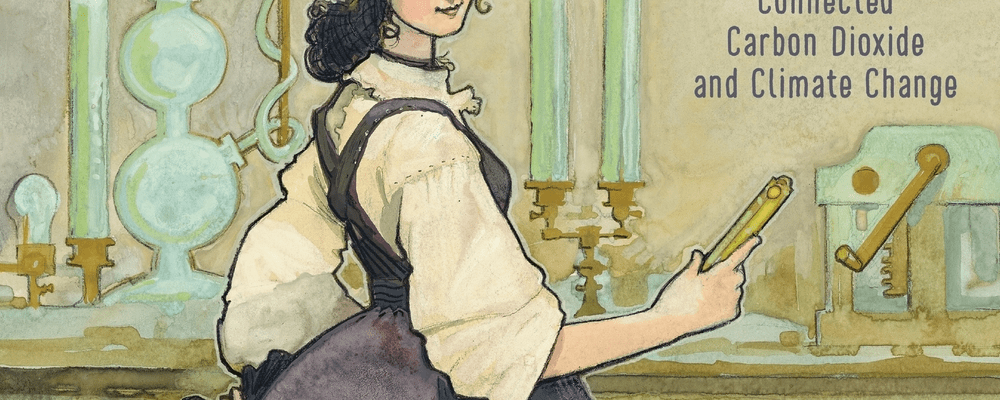
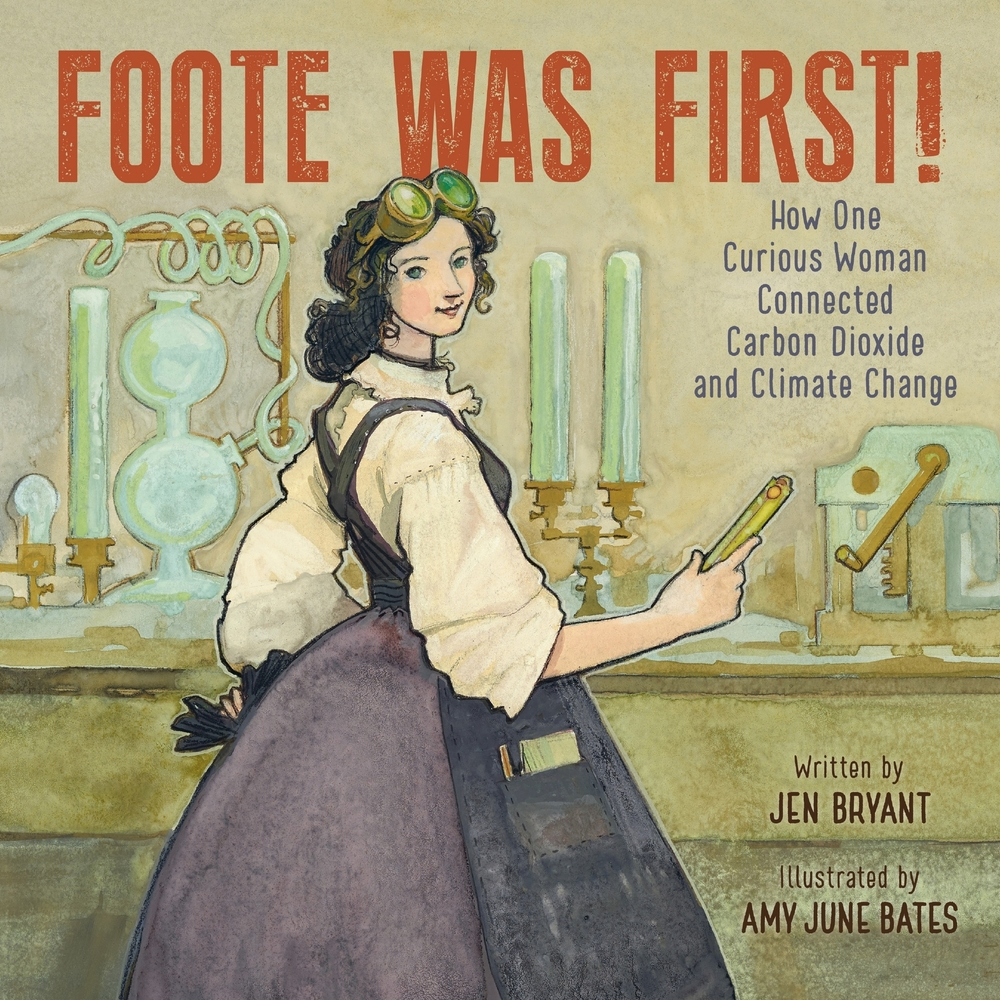
Foote Was First!: How One Curious Woman Connected Carbon Dioxide and Climate Change by Jen Bryant, illustrated by Amy June Bates

  • Publisher: Quill Tree Books
  • Publication Date: January 13, 2026
  • Reviewed from Edelweiss e-galley
  • ISBN: 9780062957061

Though an Englishman is credited with discovering that carbon dioxide traps heat, it was actually an American woman, Eunice Newton Foote, who did it first in 1856. Eunice grew up on her family farm and asked lots of questions. At age 17, she was sent to a girls school where she was taught science and able to use a laboratory. She grew up, married and had children and stayed curious. Never a professional scientist, she did science at home, learning about various gasses and their capabilities. When she wasn’t allowed to present her findings since she was a woman, a friend presented them on her behalf. She was the first to tie carbon dioxide to global warming, a foundational learning for our times. 

Offering just the right amount of information for young readers, this nonfiction picture book focuses on Foote’s curious mind and scientific studies. The illustrations are particularly striking with Foote in her wide hoopskirts engaged in long walks, scientific experiments and discoveries. They demonstrate how rarely we see women of this period engaged in scientific work. 

Inspiring and engaging. Appropriate for ages 7-10.
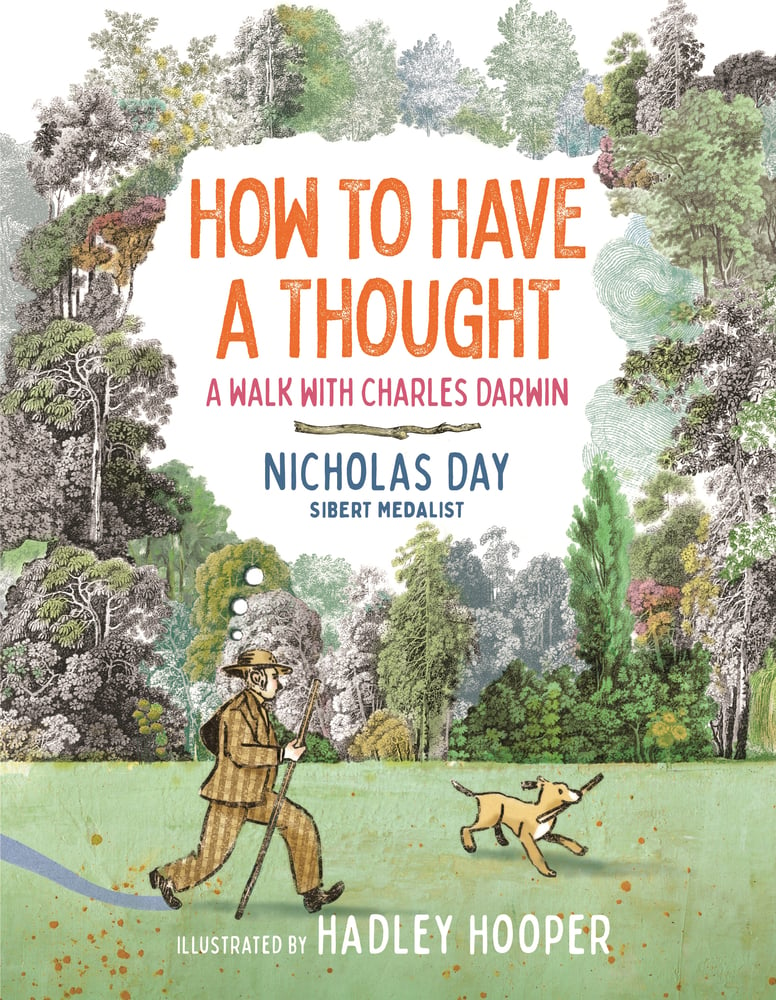
How to Have a Thought: A Walk with Charles Darwin by Nicholas Day, illustrated by Hadley Hooper

  • Publisher: Neal Porter Books
  • Publication Date: January 13, 2026
  • Reviewed from Edelweiss e-galley
  • ISBN: 9780823458509

Take a walk like Charles Darwin in this nonfiction picture book that reveals both Darwin’s thinking process and also his scientific discoveries. First find a rock or two, then a walking stick and then find a loop to walk. It could be a loop around the block or a loop around the world, like the one Darwin made on his ship. That’s when he discovered the fossil of a giant sloth, the variety of beaks on finches that lived on the Galapagos Islands, and the bones and skin of a rhea, a bird he’s been seeking but had been served for a meal. Then came the thinking. The why of it all. The walking in loops. The stacking of rocks to count the loops. What will you think of when you take your own walk?

The combination of encouragement to get outside, walk and think with the historical and biographical information on Charles Darwin creates an unexpected treat of a book. The book ends with the author explaining that walks that are celebrated tend to be extraordinary, full of vistas and beauty. That is not the sort of walk we are talking about. These are thinking walks, going the same way every time. And just look at the result. The illustrations play with the dichotomy of the book, sharing historical elements with paintings and offering a light-hearted feel. 

A real thinker of a book. Appropriate for ages 5-9.
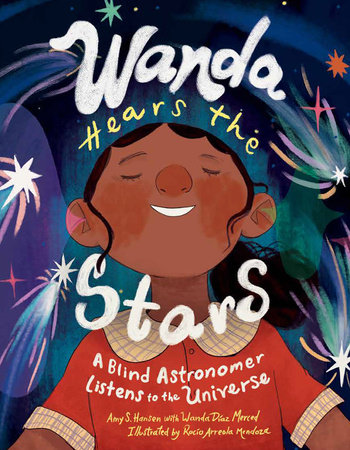
Wanda Hears the Stars by Amy S. Hansen with Wanda Díaz Merced – Book Review

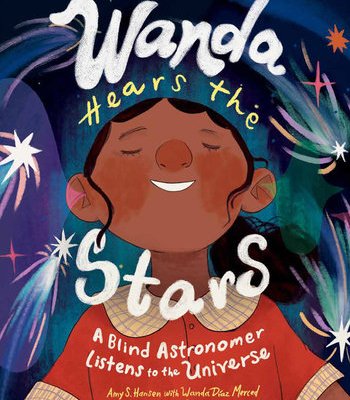
Wanda Hears the Stars: A Blind Astronomer Listens to the Universe by Amy S. Hansen with Wanda Díaz Merced, illustrated by Rocio Arreola Mendoza (9781623544874)

When Wanda was growing up in Puerto Rico’s rainforest, she couldn’t see the stars because of all the trees. She first truly saw the stars on a family fishing trip and she was entirely amazed by them. Wanda was a child who didn’t like school all that much and certainly didn’t like the shots she had to take for her diabetes. Eventually, she found out what she liked at school and decided to study physics in college. But at college, she started losing her eyesight due to her diabetes and eventually became blind. How could a blind person study the stars? Happily, she had friends around her to encourage her and one friend who was using sounds to study the stars. Now Wanda could listen to the stars and hear them. Wanda moved to the United States and continued to study the stars, making discoveries that only someone listening to the noises could have found. 

An amazing story of overcoming a disability in a field where it seemed impossible to go on, this nonfiction picture book shows Wanda’s perseverance, skill and also her willingness to accept help in order to find her way forward. The story itself is wonderfully written for young readers and the ending where the star noises are shared on the page is amazing in an entirely additional way. The illustrations are friendly and invite readers to engage with the material. 

A fascinating and inspiring true story. Appropriate for ages 6-9.

Reviewed from e-galley provided by Charlesbridge.

The Boy Whose Head Was Filled with Stars: A Life of Edwin Hubble by Isabelle Marinov

Cover image

The Boy Whose Head Was Filled with Stars: A Life of Edwin Hubble by Isabelle Marinov, illustrated by Deborah Marcero (9781592703173)

Born in the late 1800s, Edwin loved the stars from a young age. At eight, he was given a telescope by his grandfather, and they headed into the Missouri night to see the stars up close. Edwin was a good student who loved math and learning about the universe, but his father wanted him to do something else with his life. So Edwin studied law before becoming a high school teacher. It wasn’t until after his father’s death that Edwin felt he could study astronomy. His first job was at Mount Wilson Observatory, the world’s largest telescope. There, he spent years studying the Andromeda nebula, eventually proving that it was a separate galaxy. Edwin continued to classify and learn more about galaxies, discovering that they move away from each other and that the further away they are, the faster they move. Eventually, the Hubble Telescope was launched, named after this man who studied the stars and increased our understanding of the universe.

In her debut picture book, Marinov shows real skill in taking a lifetime of accomplishments and making them accessible for young readers. She writes with a tone that shares the facts of Hubble’s life but also shares his personality, his wonder at the universe and the hard work and resilience it took for him to make his discoveries. As Hubble and others ask big questions about the universe, these statements are done in a silver print that elevates them and will have the reader marveling along.

The illustrations are done in a whimsical style that uses fine ink lines to share small details of large telescopes and landscapes. Using the darkest of black ink, Marcero illuminates her pages with stars that sweep across the paper. One gatefold opens to reveal a series of nebulae to wonder at.

A strong and interesting look at one of the most famous astronomers. Appropriate for ages 6-8.

Reviewed from copy provided by Enchanted Lion.

The Secret Garden of George Washington Carver by Gene Barretta

The Secret Garden of George Washington Carver by Gene Barretta

The Secret Garden of George Washington Carver by Gene Barretta, illustrated by Frank Morrison (9780062430151)

George Washington Carver grew up to be a famous botanist and inventor. In 1921, he spoke before Congress, talking about how the humble peanut could be used to make so many different products. This famous man’s connection with plants and the earth came from an early age in the form of his own secret garden. Born into slavery in 1864, he was kidnapped as an infant along with his mother. His mother was never found, but George was brought back to slavery. George and his brother grew up on the farm, even after slavery was abolished. Every day, George headed to the woods and the garden he was growing there. He learned all about plants without being mocked or teased, soon helping people in the area with their sick plants. He grew up, got an education, and became an Agriculture professor at Tuskegee Institute He also traveled the United States working directly with farmers to answer their questions and improve their farms. 

Barretta’s picture book biography of this famous African-American scientist and genius is fascinating and filled with moments of wonder. The frightening kidnapping in his infancy, his start as a slave and then working on a farm for his previous owners, and his incandescent mind finding a way forward to learn and grow all add up to a remarkable life. The text is engagingly written for a compelling read. 

Morrison’s art is phenomenal. The browns of the days of manual labor on the farm contrast with the bright greens, growing shoots, and tall trees of George’s secret garden. The two parts of his life could not appear more different. 

A fascinating look at a remarkable man. Appropriate for ages 6-9.

Reviewed from library copy.

Review: The Bug Girl by Sophia Spencer

The Bug Girl by Sophia Spencer

The Bug Girl by Sophia Spencer with Margaret McNamara, illustrated by Kerascoet (9780525645931)

This is the true story of a little girl who loves bugs, written by her. She first fell for bugs at two-and-a-half years old when she visited a butterfly conservatory with her mother. She loved books about insects and noticed them everywhere she went. In kindergarten, everyone thought that bugs were cool too. Sophia started a bug hunter club at school and had her own collection of live insects on the porch at home. But in first grade, bugs weren’t cool anymore and the other kids started to call Sophia weird for liking them so much. Sophia was dejected and tried to stop liking bugs, but that didn’t work. So her mother went online and reached out to scientists about their own love of bugs. Stories poured in, supporting Sophia and her passion for insects. Sophia was now making news herself and also got her name on a scientific article, all because of being the bug girl.

Written in Sophia’s own voice, this picture book is entirely engaging. It demonstrates how finding one’s passion in life is a powerful thing, but that the world can also be less than encouraging if you are a girl exploring science and creepy crawlies like insects. The change from kindergarten to first grade is dramatic and impactful, even resulting in one dead bug, killed right in front of Sophia. The end of the book offers an example of the sort of bug book that Sophia would love to write, filled with information on a variety of insects. 

The art is bright and fresh, done in watercolors on white pages. They move from full-page illustrations to smaller ones that capture events in a brisk and friendly way. 

A book about following your bliss, particularly if it’s a trail of ants. Appropriate for ages 4-6.

Reviewed from e-galley provided by Schwartz & Wade.

Review: Evelyn the Adventurous Entomologist by Christine Evans

Evelyn the Adventurous Entomologist by Christine Evans

Evelyn the Adventurous Entomologist: A True Story of a World-Traveling Bug Hunter by Christine Evans, illustrated by Yasmin Imamura (9781943147663)

Born in 1881, Evelyn Cheesman did not conform to the expectations set for little girls. She loved to go on bug hunts and play outside. As she grew up, she hoped to become a veterinarian but women at the time did not attend college much less become vets. So Evelyn became a canine nurse. Evelyn heard about an opportunity at the London Zoo to run their insect house. She leaped at the opportunity, though no woman had ever done it before. She took their dilapidated and neglected insect house and created an engaging display. She then started traveling the world to gather new species and discovering unknown species along the way. She continued to work into her seventies, still traveling the world and climbing to find the insects she loved.

Evans has written this picture book biography with a frank tone that speaks directly to the societal barriers in place against women at the turn of the century entering the sciences. It is remarkable to watch Evelyn make her own way through those barriers, creating a space for herself to learn and explore. There is a joyous celebratory nature to the book as Evelyn reaches new levels in her careers and crosses boundaries both geographical and societal.

The illustrations are done in watercolor, featuring layered elements that really create the woods and other habitats beautifully on the page. The book then moves into the sterility of Evelyn’s time as a canine nurse with the colors becoming more muted. The vivid colors of the beginning of the book return as Evelyn heads into the field and re-enters nature.

A strong STEM biography for bug lovers. Appropriate for ages 4-7.

Reviewed from e-galley provided by Innovation Press.

Review: Starstruck by Kathleen Krull

Starstruck The Cosmic Journey of Neil DeGrasse Tyson by Kathleen Krull

Starstruck: The Cosmic Journey of Neil Degrasse Tyson by Kathleen Krull and Paul Brewer, illustrated by Frank Morrison (9780399550249)

This book rightfully starts with the Big Bang and then moves on to a young Neil Degrasse Tyson being inspired by the Hayden Planetarium. At age nine, Tyson was inspired to start investigating the stars and the universe around him. He began with binoculars and in a few years had his own telescope. He worked to get a better telescope and also started to build his library of science and astronomy books. In sixth grade, Tyson attended a class at the Hayden Planetarium, often one of the youngest people there. At fourteen, after drawing the attention of the education director at the planetarium, Tyson was taken on a journey to northwest Africa to view a rare solar eclipse. He attended the Bronx High School of Science and went on to start speaking publicly about astronomy. His hero, Carl Sagan, tried to get Tyson to attend Cornell University, but Tyson chose Harvard instead. Eventually after getting a PhD, he returned to the planetarium that had originally inspired him, becoming the director. It was there that the controversial but scientific decision to eliminate Pluto as a planet gained Tyson public attention, leading to him becoming one of the foremost speakers and authorities on astronomy in the nation.

Krull, a master nonfiction author, writes an inspiring story here, showing that from a single experience, a lifetime of enthusiasm and knowledge can be born. Throughout the book, Tyson’s drive and wonder at the universe is clear. Tyson’s willingness to be visible as an authority on astronomy is clearly depicted as he understands the power of media to reach people and demonstrate that people of color can be scientists too.

Morrison’s illustrations also demonstrate the wonder and awe that Tyson feels for the universe. The illustrations have a wonderful vibe to them with people frozen in action and Tyson shown as the heart of the book. There are shining pages filled with black sky and brilliant stars that are particularly striking.

A strong biography of a national science hero, this book will lead young people to dream and wonder. Appropriate for ages 5-8.

Reviewed from e-galley provided by Crown Books for Young Readers.


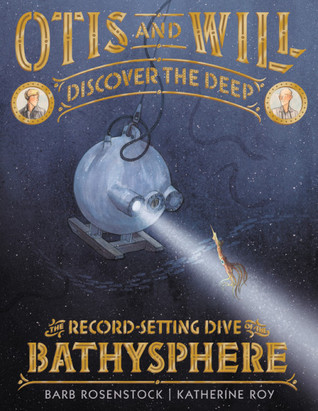
Review: Otis and Will Discover the Deep by Barb Rosenstock

Otis and Will Discover the Deep by Barb Rosenstock

Otis and Will Discover the Deep: The Record Setting Dive of the Bathysphere by Barb Rosenstock, illustrated by Katherine Roy (9780316393829)

Otis loved the ocean since he was a boy. He experimented with different ways to dive lower and lover in the water. Will didn’t discover the ocean until later in life, spending time in the woods, trekking the world and climbing volcanoes. Otis heard that Will wanted to dive deep into the ocean and with his background in machines knew that Will would need a very special submersible to survive. Otis reached out to Will again and again until Will agreed to see him. Otis built the machine and Will planned the expedition. The two tall men managed to squeeze inside the small space and then down they went into the deep. Lower and lower they went, creaking and remembering to breathe. They reached 800 feet and then returned to the surface, smiling.

Rosenstock has created a wonderful text for this book that captures the importance of teamwork and connecting with others who have a similar passion but different skills. The differences between the two men are highlighted and then it is even more powerful when the two come together and work on a common goal. I particularly enjoy Will supporting Otis as they descend into the depths. That same support of remembering to breathe is very effectively used to create drama as the depth increases, since readers too  may be holding their breath. The art by Roy is exceptional, adding to the drama of the tale by showing the Bathysphere as isolated, suspending in the dark water. The two men and the contortions they go through to fit and work together in the small space are also charmingly captured in the illustrations.

A winner of a science read. Appropriate for ages 7-9.

Reviewed from library copy.

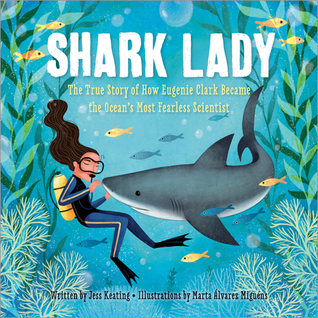
Shark Lady by Jess Keating

Shark Lady by Jess Keating

Shark Lady: The True Story of How Eugenie Clark Became the Ocean’s Most Fearless Scientist by Jess Keating, illustrated by Marta Álvarez Miguéns (9781492642046, Amazon)

Eugenie was a young girl when she first visited an aquarium and fell deeply in love with the creatures there, particularly with the sharks. But it was the 1920’s and girls were expected to become housewives or secretaries not scientists. Still, Eugenie never gave up on her dream and continued to study sharks at the library and join the local aquarium as a member. At the time, people thought that sharks were heartless and frightening killers, but Eugenie set out to prove them all wrong. Eugenie got her degree and earned a place on a scientific vessel to study marine life. That was just the beginning of a career that spanned many decades, led to several books and articles, and proved that women have a place in science.

Keating shows the growth of Eugenie’s scientific aspirations in this nonfiction picture book, moving from her childhood fantasies of swimming with sharks to the lack of support at school and finally to the discoveries that she made as her dreams became reality. The book has a tone of pure curiosity and joy where readers will cheer Eugenie as she overcomes the many obstacles standing in her way.

The illustrations are lighthearted and playful. Aquarium hallways are filled with floating sharks and fish as Eugenie dreams about them. They celebrate the beauty of the ocean and its lifeforms, showing sharks as graceful and amazing rather than dangerous.

A vibrant and celebratory nonfiction picture book that embraces women in STEM wholeheartedly. Appropriate for ages 5-8.

Reviewed from e-galley received from Edelweiss and Sourcebooks Jabberwocky.