Review: Inside Outside by Lizi Boyd

inside outside

Inside Outside by Lizi Boyd

This lovely wordless book explores the changing seasons in a subtle and engaging way.  The book starts on the inside of a house with a young boy and a little black dog.  The boy is planting seeds in pots while the dog watches and two white mice play.  Through the die cut windows, you can see the snowmen in the yard.  Turn the page and you are outside with those snowmen, the birds eating the seeds.  Turn again and you are inside once more, this time able to glimpse flowering trees out the window.  The plants in the pots are green and growing too.  The boy is hanging pictures on the walls about birds and snowmen melting.  Keep turning and the seasons change, marked by activities, the pictures on the walls, and what you can see through the windows. 

There is a wonderful organic feel to this book, partly thanks to the textured brown paper that serves as the background for all of the images.  That feel is also helped by the color scheme of greens, blues and terra cotta.  The die cuts are used very skillfully throughout, offering glimpses from inside to outside and back again.  The wordless nature of the book makes it a universal story, ideal for being shared with families who may use another language at home. 

Filled with small details that will have children looking back at previous pages when they discover something new, this book is perfect for lingering over on long trips or snuggled in someone’s lap.  Appropriate for ages 2-4.

Reviewed from copy received from Chronicle Books.
Review: Bear Has a Story to Tell by Philip C. Stead

bear has a story to tell

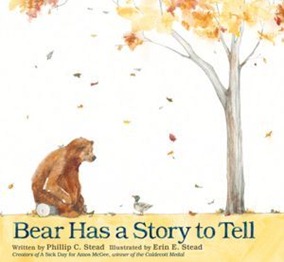
Bear Has a Story to Tell by Philip C. Stead, illustrated by Erin E. Stead

Fall was ending and winter was coming, but before he hibernated, Bear had a story to tell.  Unfortunately, the other animals were too busy to hear the story.  Mouse was gathering seeds and when Bear helped Mouse find lots of seeds, Mouse tunneled underground for the winter.  Duck was getting ready to fly south and all Bear had time to do was check the wind direction for him and say he would miss Duck before he flew off.  Frog too was looking for a warm place to sleep.  Bear helped dig a hole for him to sleep in.  Mole was already way underground and asleep.  So Bear too headed off to sleep.  When spring came, Bear still had a story to share.  Soon his friends were gathered around him to listen, and you will have to read the book to find out what story he shared!

The husband/wife team behind the Caldecott winning A Sick Day for Amos McGee have returned with a book that has a quiet, contemplative beauty that is haunting.  It’s one of those picture books that can be read as a quick bedtime story, but has so much more depth than that.  Bear’s rather lonely start to his hibernation also has a series of close connections to friends.  His spring wake up is filled with a warmth that echoes the seasonal change. 

The writing is gentle and filled with small details that really show the slowing nature of the start of winter.  There is time to count the clouds and look at the color of the leaves, at least for Bear.  The connections between Bear and his many friends are also written with a richness that adds much to the story.  The circular nature of the ending is also an invitation to start the book all over again.  One that readers will be happy to accept. 

Erin Stead’s illustrations have a beautiful delicacy to them.  The rounded shoulders of the very furry Bear show a patience and yet a weight too.  There are moments of celebration, when Bear is rolling in the newly lush grass that are filled with cheer.  It is especially remarkable near the lonely and poignant image of Bear alone as the first snow begins to fall.  Lovely.

It’s the perfect time of year to read this book, ease yourself into the winter months and quietly wish autumn farewell.  Appropriate for ages 4-6.

Reviewed from library copy.

Review: Outside Your Window by Nicola Davies

outside your window

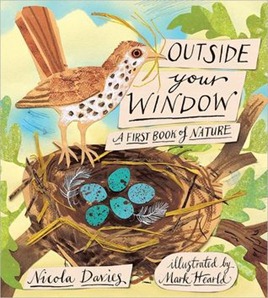
Outside Your Window: A First Book of Nature by Nicola Davies, illustrated by Mark Hearld (InfoSoup link)

Explore nature through the seasons in this lush book of poetry that starts with the first moments of spring with melting icicles and the green shoots of bulbs.  Summer is filled with butterflies, chickens, baby birds and bees.  Autumn comes with leaves, wind, geese and acorns.  And winter ends the year filled with snow, deer and ducks.  The poems range from merry verse with lighter tones to atmospheric pieces that make you stop and think.  It is this range of moods and depth that makes the book so very readable and enjoyable. 

Davies’ poems are all very child friendly, offering new perspectives on familiar things.  Her poem, “Night”, is one of my favorites of the book, though there are many to choose from that are incredible reads.  It capture the movement of the night, the feel of the quiet, and the sense of the world turning beneath you.  It’s quiet, beautiful, and captivating.

Add to these dynamic poems the art of Hearld and you have a real jewel of a book.  Illustrated with collage that combines paper cutout work, layers of texture, and realistic depiction of nature.  This realism emphasizes the beauty of nature, its diversity, and our own place in the world.  These are images that make you dream but also put your feet squarely on the earth and your connection to it.

Gorgeous illustrations combine with vibrant poems, creating a book to treasure.  Appropriate for ages 7-10.

Reviewed from library copy.

Review: A Leaf Can Be… by Laura Purdie Salas

11505

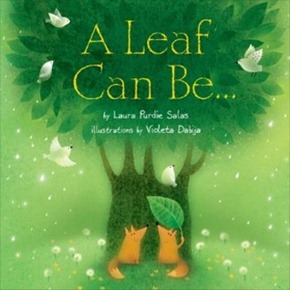
A Leaf Can Be… by Laura Purdie Salas, illustrated by Violeta Dabija

Explore leaves throughout the seasons in this work of poetry.  The book focuses less on the science of leaves and much more on their impact, their dance on the wind, the shade they spill, and the color they give.  Told in verse that will work very well with young children, this book captures the wonder of nature.  

This is a dance of a book with rhymes and rhythms that really sparkle.  Much of the book is done in two-word lines that encapsulate one aspect of leaves, “sun taker” and “food maker,” and then in the autumn, “pile grower” and “hill glow-er.” 

Dabija’s art is jewel-toned and dynamic.  Her work is infused with merriment and joy.  She uses layers and transparency to great effect, capturing the beauty of nature.  One particularly striking page is her “frost catcher” where the layers of her work shine and the details are luminous. 

A great book to use in a unit about trees, this is also a book that invites exploring a poem.  Exquisite writing is well matched with rich art in this book.  Appropriate for ages 3-6.

Reviewed from library copy.

Review: And Then It’s Spring by Julie Fogliano

and then its spring

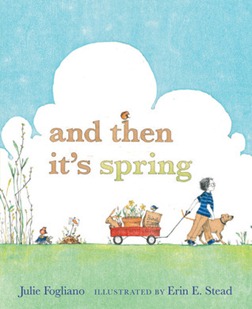
And Then It’s Spring by Julie Fogliano, illustrated by Erin E. Stead

This enchanting book starts with the brown of late winter.  It’s the brown that you have to plant seeds into in the hopes of green coming soon.  But then you have to wait for rain, hope that the birds didn’t eat the seeds, realize that the bears may have stomped too close to the seeds because they can’t read signs, and then you have to wait some more.  It stays brown, but even the brown starts to change and seem more hopeful and humming.  Then you wait some more, and then one day, if you are patient and keep caring for your newly planted seeds, you wake up to green!

Oh how I love this book!  In her poetic prose, Fogliano captures the patience of gardening, the drudgery of late winter, and the hope that must be invested in order to see seeds spring to life.  I had expected the birds eating the seeds, but the stomping bears led me to realize that this was more playful a book than I had originally expected, something I love to have happen in the middle of a picture book!  

Add to this the illustrations of Caldecott winner Stead and you have such a winning book.  Her art has a delicacy that is perfect for the whispers of early spring.  The boy in the story is thin, wear glasses, and by the time spring finally comes has created quite a garden with birdfeeders, signs, and plenty of lumps of dirt.  By far my favorite part comes at the end, where the garden does not burst into flowers but remains weedy and lumpy, but green.  Perfection.

Doing a spring story time soon?  Get your hands on this book!  Ideal for classes planting a garden or all of us longing for the green to return.  Appropriate for ages 3-6.

Reviewed from copy received from Roaring Brook Press.

Book Review: Seasons by Anne Crausaz

seasons

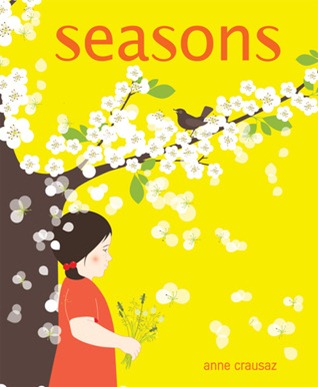
Seasons by Anne Crausaz

Explore and celebrate the seasons in this lovely picture book.  A little girl moves through the seasons, seeing each one through the changes in nature that occur.  She experiences them with all of her senses:  seeing the green of spring, smelling the tomatoes, basil, verbena and mint in the garden in summer, tasting the blackberries in fall, and feeling the cold of snow in winter.  This is a book that reminds all of us to treasure the time we currently in, to slow down and notice the seasons, to savor the tastes and smells around us.

Crausaz’s text is spare and poetic, allowing readers to experience the moments in the book without any excess words.  A few sentences per page at most, the book takes readers through a sensory journey where they too can remember the colors, smells, tastes, sounds and feels of each season. 

Her art is equally simple.  Using only a few lines to denote facial features, the illustrations are done in bright colors that play well against each other.  The horizon is done in colored bands, the sky and clouds in other colors, trees and leaves play against that background.  It is a stylized and very successful look for a picture book.

While the seasonal picture book shelf can get crowded, this fresh, poetic book should find a place there.  Appropriate for ages 3-5.

Reviewed from copy received from Kane Miller EDC Publishing.

Also reviewed by:

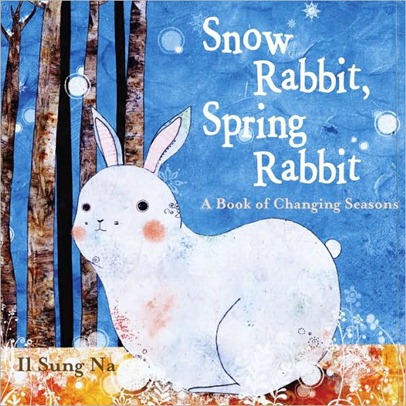
Snow Rabbit, Spring Rabbit: A Book of Changing Seasons

snowrabbit

Snow Rabbit, Spring Rabbit: A Book of Changing Seasons by Il Sung Na

The author of A Book of Sleep returns with another book filled with striking illustrations.  When winter comes, all of the animals know it.  Some fly to warmer places, others take a long sleep, some swim to warmer waters, and others grow a thicker coat.  The white rabbit leads readers through so many different types of animals and how they deal with the winter season.  Then spring comes and all of the animals know it’s a new season.  That includes our friend the rabbit who looks very different now!

Il Sung Na has created a book that celebrates changing seasons with a sense of joy and fun.  Readers will see migration, hibernation, and much more in this book.  The text remains simple and straight-forward, keeping the concepts to a preschool level nicely. 

The real impact is made by Il Sung Na’s incredible illustrations that are lush, vivid and at the same time laced with a real delicacy of line and pattern.  Created using handmade textures combined with digitally generated layers, this is a sort of illustration that is stylized, modern and still welcoming and friendly.

Highly recommended, this book is a beautiful exploration of changing seasons, ideal for welcoming spring.  Appropriate for ages 2-4.

Reviewed from copy received from Random House Children’s Books.

Also reviewed by:

Guyku: A Year of Haiku for Boys

guyku

Guyku: A Year of Haiku for Boys by Bob Raczka, illustrated by Peter H. Reynolds

A brilliant combination of haiku poems, clever humor, and engaging illustrations, this book is sure to appeal to its target audience of guys and also to girls.  Celebrating the small things in life, each haiku takes a moment in time and then offers a grin to the reader.  The poems are arranged in seasons, fitting because so many of them are about nature and a boy’s relationship with it.  Whether it is flying a kite, skipping rocks, leaf piles or snowball fights, children will relate easily to these vignettes about the things that make life fun. 

Raczka’s haiku are light-hearted and enjoyable.  Thanks to the brief nature of the format, the poems are easily shared aloud.  Nicely, the poems stand on their own or work together as a larger piece of writing.  Reynolds’ art is equally engaging.  It too has a great humor about it but also a sense that a moment is being captured. 

A celebration of seasons, play and boyhood, this book is a treat.  If librarians are looking for something to take with them for summer reading program visits, the summer haiku here would make a great thing to share with boys of many ages.  Appropriate for ages 6-9.

Reviewed from library copy.

Enhanced by Zemanta

The Village Garage


The Village Garage by G. Brian Karas

Follow the activities of the workers from the village garage as the seasons change.  In spring, the workers are cleaning up sticks, creating mulch, and washing the trucks.  In summer, they are fixing the roads, picking up garbage, and mowing the grass.  They even deal with the effects of a summer thunderstorm that takes out a bridge.  In autumn, they suck up the leaves.  In winter, work is slower until the snow starts and then they wish for spring to come again.  The book mixes the interesting tools and machines the workers use into the story.  Readers will learn what the machines are called and what they do.  This is a rare book that reads beautifully but also has lots of machinery for children to learn about.  Too often they read like lists of tools rather than stories.

Karas perfectly captures small town life along with garage work.  The use of the seasons to frame the story works particularly well with the seasonal nature of their work.  Karas’ art is friendly and also has that same small town feel and a genuine enjoyment for the machines themselves.  Karas incorporates women and people of color throughout his illustrations.  The book offers great sound effects to read aloud, which children will happily help with.  Chains rattle, the leaf truck sucks noisily.  He also weaves a nice sense of humor throughout the book with small touches. 

Ideal for machine story times, this book will also be a great addition to seasonal stories.  Appropriate for ages 3-5.

Reviewed from book received from Henry Holt.

Also reviewed by 100 Scope Notes.