Flying Lessons and Other Stories edited by Ellen Oh

flying-lessons-and-other-stories-by-ellen-oh

Flying Lessons and Other Stories edited by Ellen Oh (InfoSoup)

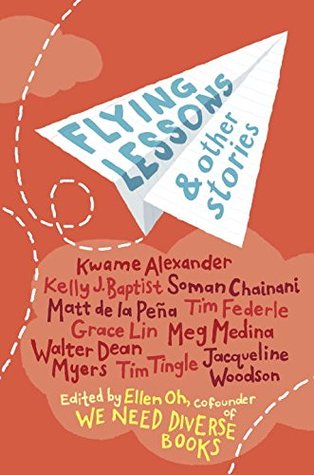
This is a simply incredible collection of stories that feature middle-school children from a variety of diverse backgrounds. The authors of the stories are the best in the children’s book business, including Kwame Alexander, Tim Federle, Matt de la Pena, Tim Tingle, Grace Lin, Meg Medina, and Jacqueline Woodson. The stories feed into one another, creating a quilt where the patches are of different colors and textures but the quilt is one unified structure. The stories feature children of color, children who are LGBT, and those who are differently-abled. It is a book about our differences and our similarities, a book about what makes each of us fly.

There are several stories that will stick with me. The one by Matt de la Pena has a gorgeous tone to it, almost oration where the reader is being spoken directly to about opportunities, hard work and taking risks. It’s all about basketball, the art of the game and the willingness to put yourself out there and play. Grace Lin’s is an wonderful mix of humor and drama, showing reading as a way forward into a life of adventure and individuality. Woodson’s story is spare and lovely, looking directly at racism and staring it down with friendship. The others are marvelous too, I could write about each of them in turn, each just as special and jeweled as the last.

This is a book that should be in all libraries, it speaks to the power of diverse books in our communities, their ability to transform all of us no matter what our background or color. Appropriate for ages 10-13.

Reviewed from e-galley received from Crown Books for Young Readers and NetGalley.
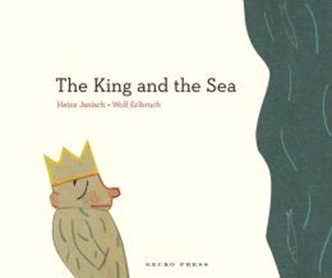
 

Review: The King and the Sea by Heinz Janisch

The King and the Sea by Heinz Janisch

The King and the Sea by Heinz Janisch, illustrated by Wolf Erlbruch

Told in 21 tiny stories, this is the life of a king as he moves through the world he rules and encounters the many ways in which a king is just as powerless as any human. The king declares again and again that he is king, but things like the ocean are not impressed and others like the queen bee assert their own authority over his. Other times, the king is reminded of more important things than power, like spending time in the sunshine, letting the rain wash over his face, and the importance of the stars in the sky.

This lovely picture book is stunningly effective. The short stories are wonderfully brief, all of them less than half a page of text. Each is profound in its own way, showing the importance of the here and now, the limitation of personal power over the universe, and a quiet acceptance of the way things simply are. Translated from the German, the short stories keep their quiet power and their truth.

Erlbruch’s illustrations are delightfully childlike and yet sophisticated too. The King is drawn as a cutout of construction paper drawn on with what looks like crayons. The background he is against in each dual page spread changes, sometimes with elegant vintage prints, other times with the blue of the sea and still others with the simplicity of white snow.

A completely surprising and amazing picture book, this one is perfect for sharing whether with one child or many and looking forward to the discussions it generates. Appropriate for ages 4-6.

Reviewed from library copy.

Review: Half a Creature from the Sea by David Almond

Half a Creature from the Sea by David Almond

Half a Creature from the Sea by David Almond

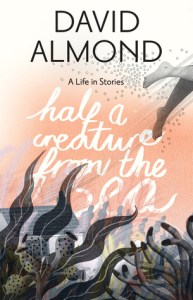
In a series of short stories, master author Almond takes readers back to the magical times of his childhood as well as our own. The stories are all set in the places that Almond grew up in. The stories range in topic, but each one offers glimpses of wonder and deep understanding. They also all speak to the power of stories in our lives, whether they are to reveal or to hide the truth. The eight stories in the book give us characters living normal yet extraordinary lives. There is the girl rejected by school and society who finds it easy to believe she comes from somewhere far away. There is the home with a monster hidden inside it where you can hear its noises if you put your ear on the wall outside. There are the boys who run miles and miles to swim in the sea on one perfect summer day. There are poltergeists mixed with soccer games, bullies mixed with heroes. It is a beautiful collection of stories which put together make up a glimpse of a world past that still is relevant in our modern one.

Almond’s writing is exceptional. This shorter form allows him to create little worlds of magic, astonishing moments of clarity, decisions that reverberate in the community. He invites us into his home, revealing in paragraphs before each story the way that the story ties to his childhood or to a place that is dear to him. It gives us a look at his process, a way to understand the fictionalizing of memories and the beauty of turning everyday into amazement. The fantasy elements are there, dancing under the cloak of faith but there still, explained but also not completely fictional. There is a delicacy to this writing and yet a robustness to the setting that work particularly well together.

One of the best short story collections I have read in a very long time, this collection is exceptional. Appropriate for ages 8-12.

Reviewed from ARC received from Candlewick Press.

Review: Once Upon an Alphabet by Oliver Jeffers

once upon an alphabet

Once Upon an Alphabet: Short Stories for All the Letters by Oliver Jeffers

This unusual and equally marvelous alphabet book surprises and delights with its 26 short stories, one for each letter of the alphabet.  From the very beginning at “A” readers will know they have entered a rather quirky and surreal world.  A is for Astronaut, but Edmund is an astronaut whose afraid of heights.  Even climbing the ladder to the rocket is a bit much for him.  B comes right in afterwards with a tale of a burning bridge where Bob and Bernard cannot get along and so burn the bridge between their houses, but oops, one of them is on the wrong side when he does it.  The book continues, one letter after another and one story after another each with funny, intriguing characters and situations that are snapshots of the oddities of this amazing world. 

Jeffers has created some of my favorite picture books for children and this new alphabet book completely revolutionizes the sing-song of other alphabet books for children.  It’s not exclusively for preschoolers, since elementary-aged children will adore these strange little stories and the quick journeys they take you on.  Rather like potato chips, you can’t read just one but find yourself going on and on.  Jeffers also ties in previous stories to later ones.  You have to be watching, because he does it with subtlety, but it’s a lovely touch.  I admit to cheering aloud when the Lumberjack for the Letter L appeared again.

Jeffers’ art has a loose feel that works well here.  He also has a quirk to his art that matches the tone of the story very nicely.  The line drawings combine with touches of color and watercolor.  He also plays at times with the page itself, showing characters turning the page or popping out from behind. 

A delight of an alphabet book, Jeffers has revolutionized the genre with his impressive, surprising and funny work. Appropriate for ages 4-7.

Reviewed from copy received from Philomel.

Review: Through the Woods by Emily Carroll

through the woods

Through the Woods by Emily Carroll

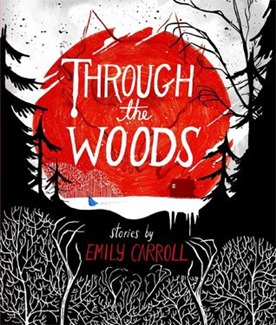
This graphic novel is haunted by authors like Neil Gaiman and the Brother Grimm.  The tales here are gruesome in the best possible way, frightening and oozy and delightful.  Our Neighbor’s House is a strange tale of a family that disappears one by one into the frigid snow following a man in a wide-brimmed hat until there is only one girl left.  A Lady’s Hands Are Cold tells of a women married into a loveless marriage who begins to hear voices calling from the walls and floors of the house.  His Face All Red is a story of murder and the undead. My Friend Janna tells of what happens when fakery of the occult becomes real and dangerous.  The Nesting Place will have your skin crawling, or perhaps it’s what lurks behind your skin.  Each story is a gem, strange and beautiful and entirely horrific.

Carroll does both the stories and the art here and they are married together so closely that they could not be extricated.  Though they are all clearly done by one person, the art changes from one to the next, definitively showing that you are entering a different place with different people.  There are old stories with coaches, horses and corsets as well as more modern tales too. 

Yet though they are clearly different, you start each one with that unease in your stomach that Carroll seems to be able to generate through her use of colors and the way that her characters gaze from the page.  Something is wrong in each of the stories and you can’t finish until you figure out exactly what it is.  The effect is haunting, haunted and wildly exhilarating.

A true delight of a read, this graphic novel for teens is completely disturbing and filled with horror.  In other words, it’s perfection for horror fans.  Appropriate for ages 12-14.

Reviewed from copy received from McElderry Books.

Review: Explorer: The Mystery Boxes by Kazu Kibuishi

mystery boxes

Explorer: The Mystery Boxes by Kazu Kibuishi

Released March 1, 2012.

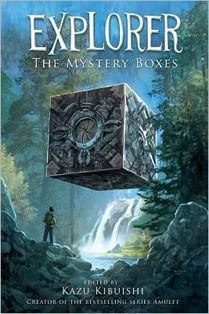
Kibuishi is the author of the Amulet series of graphic novels as well as the anthologist for Flight.  Here he has created an anthology for children that has seven short stories in graphic format that focus on a single subject: opening a mystery box.  The seven stories all take very different approaches to the focal subject, some of them approaching with humor, others with drama.  The differences deepen when the drawing style is factored in, some creating almost real images and others looking more like mainstream cartoons.  They all add up together to a whole that works well, the entire book rather like a mystery box since you never know what story is coming after the next turn of the page.

Kibuishi’s skill in anthologies is apparent here, weaving the seven individual stories together into a flow that works well.  Many of the stories focus on the boxes showing the characters more depth to their world than they ever knew existed.  There are dolls that come to life, spiritual worlds in modern suburbia, magicians searching for magical objects, war, aliens and treasure too.  Just like textual short stories, these are focused stories that get to the point and end up surprising and delighting thanks in part to their brevity.

This is a great addition to library collections and will offer glimpses of rich worlds to graphic novel fans.  Appropriate for ages 9-12.

Reviewed from ARC received from Amulet Books.

Zombies vs. Unicorns: How Short Stories for Teens Should Be Done!

7171748

Zombies vs. Unicorns edited by Holly Black and Justine Larbalestier

Before opening the book, I was firmly a Team Zombie type of gal.  Rotting flesh captures my attention a lot more than lovely white horses.  Sick, I know.   But by the end of this anthology of short stories, I’m leaning more towards those lovely and vicious white horses.

Created from a conversation on Holly Black’s and Justine Larbalestier’s blogs, these stories answer the age-old question of whether zombies or unicorns are better.  A group of bestselling authors of teen fiction joined the battle with their short stories.  The book reads in alternating stories.  One zombie, the next unicorn.  I was impressed by the level of the stories in the collection, offering such a range of takes on zombies and unicorns.  This book is sure to fly off of the shelves thanks to the zombies, the unicorns, and the tantalizing authors involved.  Those authors include, Scott Westerfeld, Margo Lanagan, Cassandra Clare, Libba Bray, and Meg Cabot.

Just as with any short story collection, there are some stories that stick with the reader longer.  Carrie Ryan’s Bougainvillea is a zombie story set in a world where the zombies have taken over almost completely.  Iza’s father took her and her mother to the safety of an island where he became dictator and kept the population alive.  The story is about control, heritage, and of course, life and death.   There is a wonderful tone to this story, an anchored feeling that remains even as the zombies emerge.  Another of my favorites is The Care and Feeding of Your Baby Killer Unicorn by Diana Peterfreund.    Wen saw her cousins slaughtered by a unicorn, now when she sees a captured unicorn at a side show, she is shocked to find herself connecting with it.  She returns the next day, drawn by something and ends up saving a new born unicorn from being killed.  Now she has to figure out what to do with the adorable but deadly creature.   Peterfreund builds a great story effortlessly here, offering a wry tone and another look at her take on killer unicorns.  Scott Westerfeld’s Inoculata offers a zombie tale with a twist.  Here the humans are barricaded against the zombie onslaught again, but something happens that changes everything.  Westerfeld is master of horror mixed with science and that is evident in this story as well.   The Third Virgin by Kathleen Duey tells the story of a unicorn who heals but also steals years of life away.  He is an addict, unable to stop killing or shortening lives.  He meets two virgins who bring him deeper into connection with emotions and happiness, but loses both of them.  Now he is seeking a third virgin.  He hopes that this one can either stop his pain altogether or kill him.  It is an achingly beautiful story with a cunning twist. 

A delight of a short story collection.  It turns out it doesn’t matter if Team Zombie or Team Unicorn wins the battle.  The people who really have won are the readers of the stories.  Appropriate for ages 14-17.

Reviewed from copy received from McElderry Books.

Reviewed across the blogosphere with far too many to link to. 

Enhanced by Zemanta

Lips Touch

Lips Touch: Three Times by Laini Taylor, illustrated by Jim Di Bartolo

In three stories, this book explores the power of a kiss and its ability to change one’s life.  The first story, Goblin Fruit, features a teen who has been raised by a family who still lives off the land and believes in the old stories.  But Kizzy longs to be loved, yearns to be noticed.  She is noticed by a beautiful new boy at the school.  Readers will immediately realize that this is too good to be real, but will Kizzy?  The second story, Spicy Little Curses, is set in India.  An elderly woman visits a demon in hell and negotiates for the lives of children.  In one deal, she trades the lives of over 20 children for a single curse.  That curse gives a young English woman who has been born and raised in India the most beautiful voice in the world.  The twist is that if she speaks, anyone who hears her will die.  In the final story, Hatchling, readers find themselves in a fairy tale that turns dark with the howling of wolves and a race of beings who collect children as pets, breed them for coloring, and have lost their souls. 

Taylor’s writing here is lush with imagery.  Her language is rich and sensual, dark and frightening.  She explores large, deep themes without hesitation, leading readers through explorations of lust, longing, and trust.  Through her skilled characterization, readers are captivated almost immediately by each story.  They are not linked stories, but are laced together loosely by theme and tone.  Taylor creates three distinct stories, each fascinating and complex.  The grouping of the three together is masterful with each of them becoming stronger by being next to another. 

These are short stories that will have teen readers asking for more.  Point them towards Margo Lanagan for more short stories that have dark themes.  Appropriate for ages 14-17.

Reviewed from ARC received from publisher.  ARC did not contain the bulk of the illustrations.

Also reviewed by Becky’s Book Reviews, Charlotte’s Library, and A Chair, A Fireplace and a Tea Cozy.