Review: The Day Louis Got Eaten by John Fardell

day louis got eaten

The Day Louis Got Eaten by John Fardell

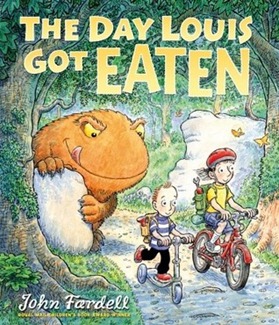
When Louis and his big sister, Sarah, were out in the woods, Louis got eaten by a Gulper.  Sarah didn’t panic, she got something she thought she might need and rode after them.  But just as she had almost caught them, the Gulper was eaten by a Grabular.  Sarah continued to follow but just as she almost reached the Grabular, it was eaten by an Undersnatch.  The Undersnatch was eaten by a Spiney-backed Guzzler.  The Guzzler was eaten by a Yumper.  Sarah approached the Yumper as it slept, but how in the world was she going to save Louis? 

Fardell delights in the ridiculous here and young audiences will too.  The series of monsters that feast on one another makes for a very silly read, each monster more strange than the last and larger too.  Sarah is a wonderful heroine and really the main character of the book.  As she chases the monsters, she slowly converts her bicycle into a new and amazing contraption that can paddle on water, run underwater, zoom with the wind, or even walk on stick legs.  She’s not only resourceful but she remains calm too. 

Fardell’s illustrations are detailed and wonderful.  He makes each monster unique and intriguing.  The illustrations are done in pen and ink and watercolor.  Fardell manages to get such detail in his illustrations that it’s a real surprise when the monsters appear against such a realistic background.  At the same time, the detail doesn’t remove any of the playfulness.  It just makes the illustrations all the more fun to linger with.

An ideal read-aloud, this book is one of those that you can use to settle wiggly kids.  They won’t be able to resist the storyline, the monsters, and a great ending.  Appropriate for ages 3-6.

Reviewed from library copy.
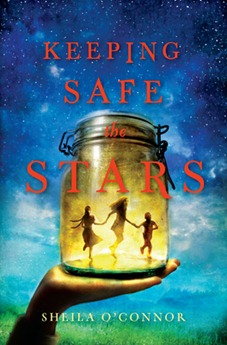
Review: Keeping Safe the Stars by Sheila O’Connor

keeping safe the stars

Keeping Safe the Stars by Sheila O’Connor

Pride and her two younger siblings, Nightingale and Baby, live with their grandfather, Old Finn.  They live on a remote property that Old Finn calls Eden.  But when Old Finn enters the hospital and is then transferred to Duluth for more serious treatment, it is left to Pride to care for her family.  She had been taught by Old Finn not to rely on charity from others, so she makes sure to not accept help that she can’t pay for.  She also knows that if anyone finds out that they are alone at Eden except for Miss Addie, an elderly woman who lives on the property but can’t care for them, they will be taken into foster care.  The three children had already been in care when their mother died, before Old Finn came and rescued them.  But even on their remote property, there are people who notice that something is wrong in Eden.  The question is whether Pride can keep her huge secret until Old Finn returns or not.

O’Connor is the author of Sparrow Road, which was one of my favorite middle school reads the year it came out.  She manages to write books that are ideal for tweens but read more like teen books, with pressing issues and serious consequences.  She populates her novels with remarkable characters, adult and child alike.  The three siblings here are all unique and read like human beings with their own points of view on everything that happens.  Seeing it all through Pride’s eyes is an important part of the story, offering her specific viewpoint and moxie about the entire situation.

Historical fiction, set during the Nixon resignation, this book is about the strength of family, resilience and the power of sheer determination.  At the same time, it is also about community and the importance of all of us being connected as neighbors and as a larger people.  O’Connor’s writing is beautifully done, gliding and light as life tumbles by unstoppable. 

A great pick for middle grade readers, this is the story of an unforgettable family.  Appropriate for ages 10-12.

Reviewed from copy received from G. P. Putnam’s Sons.

Review: Chloe, Instead by Micah Player

chloe instead

Chloe, Instead by Micah Player

When Molly heard that she was going to have a younger sister, she wanted one that was just like her.  But she got Chloe, instead.  Molly likes to color with crayons.  Chloe likes crayons too, but she likes to eat them.  Molly likes to read books.  Chloe likes books too, but she likes to rip them apart.  She won’t leave Molly’s things alone either.  So when Chloe pushes Molly a bit too far, she yells at her.  But then Molly thinks a bit and calls Chloe back to dance along with her music.  Suddenly, they feel just like true sisters.  In the end, Molly is happy that Chloe is not just like her, instead Chloe is herself and that’s wonderful.

As the narrator, Molly nicely explains exactly how her little sister drives her crazy.  Any older sibling will recognize these behaviors.   It’s good to see a child lose her temper in a picture book and then move on to regain her composure and become positive again.  The ending is too pat and easy, and I wish there was a glimpse of a bit of tension in the end.  That said, the connection formed over music really worked for me as a plot point. 

As you can see from the cover, Player has created a vibrant palette for this picture book.  The bright colors combine with a modern vibe, creating a book that is great fun to read.  The text is simple and quick with pictures that will work well with a crowd.

Modern, dynamic and addressing sibling issues, this book will be welcomed into many families and into story times about siblings.  Appropriate for ages 3-5.

Reviewed from copy received from Chronicle Books.

Review: Brothers at Bat by Audrey Vernick

brothers at bat

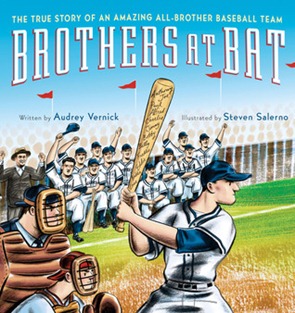
Brothers at Bat by Audrey Vernick, illustrated by Steven Salerno

In one family from New Jersey, there were 12 baseball-playing brothers: the Acerra brothers.  All of the brothers played high school baseball and their high school had an Acerra on it 22 years in a row!  In 1938, the oldest nine brothers formed their own semi-pro baseball team.  Their father coached the team and they played on dirt fields that were littered in rocks.   Each of the brothers had a different skill set than the others.  Some were slow runners but great players, others posed for the cameras naturally, one was a great pitcher that people still talk about today.  But all of them supported one another.  Then came World War II and the team disbanded as six of the brothers headed off to war.  Happily, all six brothers returned from war.  The brothers played their last game together as a team in 1952.  By that time, they were the longest-playing all-brother baseball team ever.  In 1997, the brothers were honored by the Baseball Hall of Fame.

Vernick shares this story of brothers who played together for most of their lives with a real sense of wonder and amazement at what they achieved.  The story celebrates their strong brotherhood and sense of family as well as the love of baseball.  Vernick offers all sorts of details that really create a vivid picture of the family dynamic and their lives. 

Salerno uses a vintage style for the illustrations that firmly roots this picture book in the time period.  They are colorful and action filled. 

A great non-fiction picture book for baseball fans, brothers, or people who enjoy a little sports with their history.  Appropriate for ages 6-9.

Reviewed from library copy.

Review: The Year of the Beasts by Cecil Castellucci

year of the beasts

The Year of the Beasts by Cecil Castellucci and Nate Powell

Told in chapters that alternate Castellucci’s writing with Powell’s graphics, this is the story of two sisters.  When the summer carnival comes to town, Tessa, her younger sister Lulu and her best friend Celina get to go to the carnival without their parents for the first time.  After meeting up with a group of boys they know, the three girls and the boys head to the sideshow tent with its darkness and opportunities.  But Tessa’s plans don’t quite work out, and the boy she has a crush on, Charlie, ends up entering the tent with Lulu instead.  Tessa is left to go in with Jasper, a boy who is known as a strange loner.  When they exit, Tess has rebuffed Jasper’s attempts to kiss her, but something has obviously happened between Charlie and Lulu that has sealed them together as a couple.  Now Tessa has to deal with her jealousies and their dark results.

Castellucci’s prose is lush and wild.  The emotions in the book sizzle, coming right off the page.  On page 97, there is a great example of this:

If there were such a thing as a dark cloud over someone’s head, Tessa had one.  It was a stormy little thing.  With hail and lightning and thunder.  And no silver lining.

She explores the feelings of confusing lust and potential love, the ability for those same feelings to alienate and discourage, and the intensity of sisterhood.  The book is character-driven with Tessa at its center in all of her confusion, desperation to not be jealous, and constantly feeling as if she is second best.  There are no easy answers here, nothing is let go of easily, and emotions twist and turn.  It is a beautiful storm of a book.

Then you have the other chapters done in graphic novel format that show Tessa as Medusa with her nest of snake hair.  The graphic portion moves along in advance of the text portion, foreshadowing things that are yet to come.  Medusa finds that her school is also filled with other monsters, her best friend is a mermaid, and Charlie is a centaur.  She has turned her parents to stone with her gaze and now must live with the consequences of that unless she is able to reawaken as a human again. 

The pairing of these two makes this book even more original and powerful.  It also makes the book much more welcoming for reluctant readers or those who have discovered Castellucci through her graphic novels. 

An emotional ride of a teen novel done with beauty and power, this book has an innate appeal thanks to its graphic novel portion and the dynamic writing.  Appropriate for ages 13-16.

Reviewed from copy received from Roaring Brook Press.

Review: Another Brother by Matthew Cordell

another brother

Another Brother by Matthew Cordell

Davy was an only child for four years.  His parents paid close attention to everything he did and loved it all.  It all changed when Davy got a little brother, Petey.  Petey distracted Davy’s parents from everything he did!  And if Petey wasn’t bad enough, more little siblings started to arrive until Davy had 12 brothers!  All of them copied whatever Davy did.  They played with the same toys, had the same things for breakfast, walked like he did, and even ran after him when he tried to escape.  It drove Davy crazy.  But what would happen when those same little brothers decided not to copy Davy anymore?  It just might be worse!

Cordell’s zany book has an awesome sense of humor.  The book takes having a little brother to an extreme with an entire flock of brothers messing up Davy’s life.  Children with younger siblings will immediately recognize the truth of the story behind all of the humor.  Add in the references to vomiting, potty and burping and you have a picture book that is sure to be a hit when read aloud. 

Cordell’s illustrations are fine-lined and detailed.  They will work best with small groups or one-on-one since much of the humor is visual.  The rainbow-dotted sheep, the small details of their lives, and the touches like the balloon in front of the moon towards the end of the book all add up to a book that is designed to be adored and read again and again.

An outstanding pick for children dealing not with new infants but with the annoying little brother that follows them everywhere, though the humor alone will give it universal appeal.  Appropriate for ages 4-6.

Reviewed from copy received from Feiwel & Friends.

Review: Glory Be by Augusta Scattergood

glory be

Glory Be by Augusta Scattergood

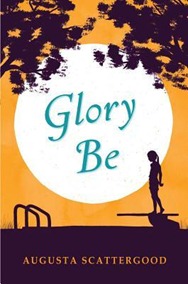
In Hanging Moss, Mississippi, summer is filled with swimming at the pool, visits to the library, and just trying to stay cool.  But for Glory, the summer of 1964 when she turned 12, was a very different summer.  Now her older sister Jesslyn, doesn’t want anything to do with her.  She is interested in boys more than in playing games with Glory.  Her best friend Frankie has always been easy to get along with, but now things are strained.  Glory does have a new friend, a girl from the north whose mother is helping set up a clinic where everyone is welcome.  Desegregation has come to Hanging Moss, and the pool is closed rather than stop being segregated, tempers are high, and neighbors and families are torn.  In this setting, it is Glory who shines, growing into a young woman with passion and a voice to match.

Scattergood’s debut novel is a gem of a novel.  She manages to write with a distinct point out view without negating the fears of the time but still firmly standing against any racism.  It’s a difficult thing to do, but because she manages it, the book is much stronger.  While the book is about civil rights, it also explores the complicated relationship of sisters, who are by turns drawn together and then pushed away.  The book is intelligent, explores the complexity of the day fully, and remains very human.

Glory is a great heroine, one who is confused at times about what is happening around her, but also one who sees when a stand must be taken.  Her growing confidence along with the support of her father and sister, create a compelling story of a young woman finding her voice.  The growth of Glory throughout the book is clear and natural.

This is a book that could be shared in the classroom, but I think it would read best on a blazing hot day near a swimming pool to remind everyone of what human rights are.  This is one strong, dazzling debut.  Appropriate for ages 9-12.

Reviewed from ARC received from Scholastic.

Review: Friends with Boys by Faith Erin Hicks

friends with boys

Friends with Boys by Faith Erin Hicks

Released February 28, 2012.

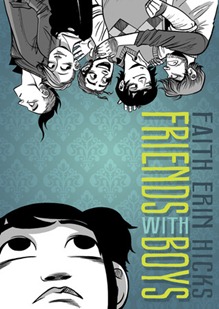
Maggie McKay has been homeschooled her entire life by her mother, who has left the family.  Now she has to start regular high school, just like her three older brothers have.  Maggie has never had any friends who were girls, happily being friends with just her brothers.  As Maggie starts high school, she discovers the boredom, the cliques, and the first tentative steps at real friendship, even one with a girl!  Add into the mix a tragic ghostly mystery complete with a female ghost who follows Maggie around, and you have an interesting mix of graphic novel, paranormal, and high school reality.

Hicks has created a very engaging graphic novel here with her mix of genres.  Her characters are fully-formed, with all of the major characters displaying real depth.  The relationships between siblings is a large part of the storylines in the novel.   I also appreciated a story about a homeschooled teen who may be hesitant to enter high school but is not specifically troubled by her previous schooling.

The graphic format is well-used here.  The images are regularly used to tell more of the story than the characters’ speech bubbles do.   Done in black and white, the use of shadow and light is very effective.  The story takes several surprising twists, which makes it all the more readable.

A graphic novel about a girl who is not particularly girly is just the right book to have in library collections.   Appropriate for ages 13-15.

Reviewed from copy received from First Second.

Review: A Few Blocks by Cybele Young

few blocks

A Few Blocks by Cybele Young

It was time for school, but Ferdie did not want to go to school.  He wasn’t done playing with his cars, his blocks, or his drawing.  In fact, he was not sure he ever wanted to go to school again.  But Viola held up his coat, called it his cape and invited him to blast off with his rocket-blaster boots.  They fought evil until Ferdie’s boots ran out of fuel.  Ferdie sat down and once again announced that he wasn’t going to school, maybe not ever.  Viola discovered a leaf in the gutter and invited Ferdie to hop on board the ship to find treasure.  Their trip to school continued, moving from one imaginary game to another, until suddenly it was Viola who isn’t sure that she can make it to school.  It was up to Ferdie now to get them that last block to school.

Young’s story is inventive and very readable.  The children going from one game to another is something we see in children’s books.  Viola is a patient leader, guiding Ferdie from one scenario to another despite grumpiness and even tears.  The joy of imagination is clear throughout the book.

The illustrations are exceptional.  They are eye-catching with their fine detail.  Outside of the imaginary worlds, the children and the objects around them are colorless and flat.  When they enter their imaginations, the illustrations are colorful, whimsical, and have dimensions and shadows.  They are sculptural and enticing.

This picture book takes the everyday trip to school and turns it into something extraordinary with its illustrations.  Appropriate for ages 4-6.

Reviewed from library copy.

Also reviewed by: