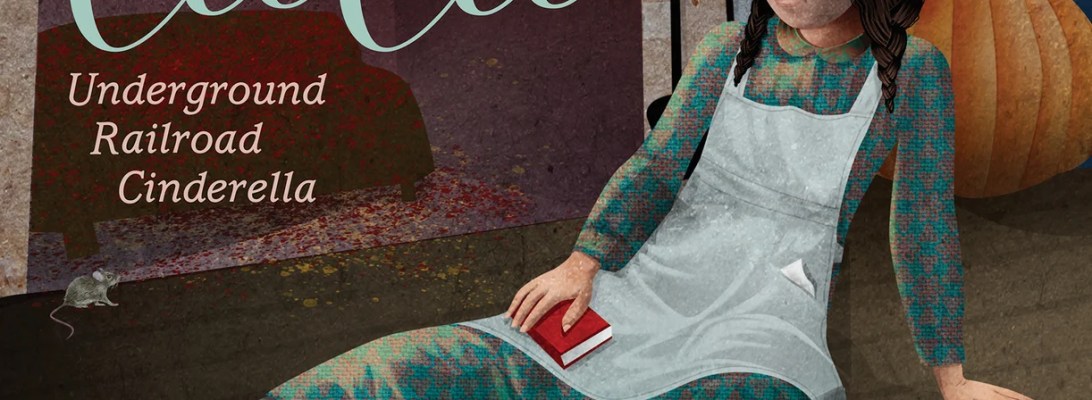
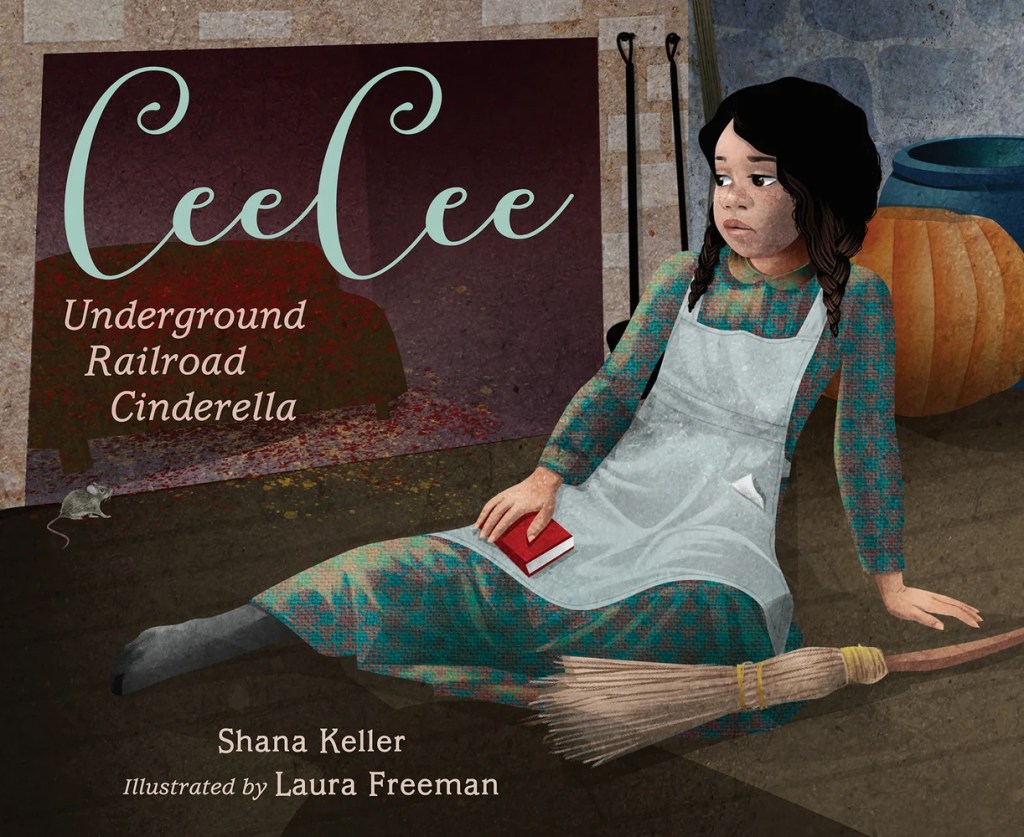
CeeCee was first called Cecelia, then Celia and finally CeeCee, but she remembered the name her mother had given her. She was a slave on a plantation in Maryland, working constantly though the daughters of the house never worked. CeeCee longed to learn to read and when she was caught looking at books was punished by being locked in the attic. It was after one of those incidents that she learned from the plantation cook about Moses, who could lead her to freedom. After months of preparation and planning, CeeCee put her plan in action.
Told with simple frankness, this picture book demonstrates the power of names, the way changing names was used to dehumanize enslaved people, and the importance of connection to one’s family even when pulled apart. Using the structure of the Cinderella story works particularly well. The digital illustrations capture the emotions of each moment on the page, inviting readers to experience them too.
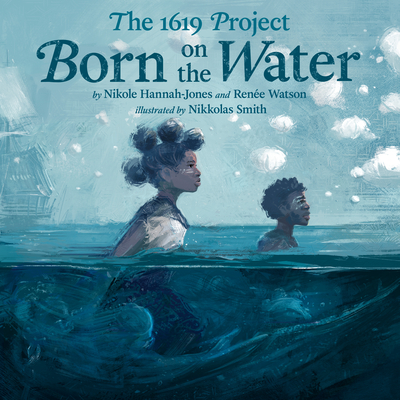
This picture book forms a way for younger children to benefit from the information shared in The 1619 Project. In this story, a Black girl is given an assignment in class to trace her family history. She can only trace three generations back and tells her grandmother that she is ashamed. So her grandmother shares the history of her family before slavery when they lived in West Central Africa. Her family spoke Kimbundu and were good with their hands and used them for growing things, inventing, mixing herbs, building tools, and caring for babies. They danced to offer worship, to share joy, and to mourn. Then they were stolen, taken from their families and lands, stamped with new names. They fought back, some refused to eat and chose to die on the journey, others survived. They had to learn a new language, form a new people, and survive the brutality of slavery. From that history have come generations of Black Americans who have changed our nation for the better. There is nothing to be ashamed of, take pride in this history of resilience and hope.
The focus of this picture book is to share the history of Black Americans in this country, showing how a deep history in the cultures of Africa are their origins. The book doesn’t flinch from the darkness of the Middle Passage or the horrors of slavery. These are also sources of pride for children reading the book, who may have been made to feel ashamed of where they came from. Written with a poetic touch, the entire book is filled with hope even in its darkest points. Throughout there is a sense of resilience and power, a knowledge that ancestors survived.
The illustrations carry readers through history. They show the rich cultures in Africa and the beauty of what was lost. They show slavery but not without hope shining in the sky above. They share connections, new families forming, and children who are a promise for the future. They show resistance, an insistence on change, a focus on the future continuing to carry us forward.
Powerful and important, this book belongs in every library. Appropriate for ages 6-9.
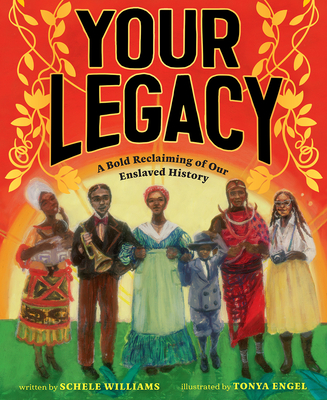
This picture book honors the history of African Americans in America. Looking at Africa first, as a place of pride, filled with a long history of heritage and kingdoms. When Africans were loaded onto ships and taken into slavery, they brought so many of the qualities that they had in Africa. Their freedom was taken into a brutal system, but their intelligence allowed them to bridge their different languages with music. They loved one another as family, secretly learned to read, and smuggled messages for one another. Some managed to escape with determination and bravery. Black Americans were inventors of engines, farm equipment, and furniture, though they rarely got credit for their ideas. They created jazz, ice cream, peanut butter, and the blood plasma bank. The book ties all of these qualities to modern figures who exemplify them, showing how the heritage carries through ancestors to today.
Filled with a sense of pride from the very first pages, this picture book offers a way to speak to children about slavery without creating shame. There is a strong sense of resilience throughout the book, of people who not only endured but survived and continued to invent and create. The book allows space for slavery as part of African American history, but frames it in terms of the qualities of character it took to survive. This is history that is not shared in schools that then turns to the accomplishments of Black Americans throughout our history.
Engel’s illustrations are full of connection and joy. She uses deep and bright colors, creating scenes where African Americans stand shoulder to shoulder in solidarity, work side by side, and sing together.
A necessary purchase for public and school libraries looking for a way to teach African American history in a better way. Appropriate for ages 5-8.
Reviewed from e-galley provided by Abrams Books for Young Readers.
Amber & Clay by Laura Amy Schlitz, illustrated by Julia Iredale (9781536201222)
The Newbery-Medal winner brings us into the world of ancient Greece with her new novel. Rhaskos is a slave working in a Greek household where he spends his days picking up horse manure. He doesn’t mind the hard work, but he’d much rather be drawing the horses around him. He works in secret, steadily building his craft, inspired by a painting his master owns. Melisto is a girl hated by her mother, abused by her, but someone who has grown up used to wealth and luxury. She is precious, particularly for the connections she will make when she marries. She is selected to serve the goddess Artemis for a year, living wild and free for the first time in her life. By the time our two protagonists meet, one of them has died, though their destinies are entwined with one another.
Schlitz has created a masterpiece of a novel where she blends verse and prose, moving freely between the two. It is a complex novel with elements of Greek society explained, wars imminent and friendships being forged. Schlitz adds the voices of the god Hermes to the mix, also including the philosophical musings of Socrates who appears as himself in the novel. The book is marvelous, each of the elements working to support the whole and weaving together into a tantalizing tale that is surprising and fascinating.
Schlitz’s writing is exceptional. She explores ancient Greece along its dusty paths and roadways, showing readers how it felt to be these characters in these times. She speaks as Hermes and Socrates in voices that are unique to them and feel perfectly suited. The question of the value of a life runs throughout the book along with looking closely at suffering and pain. These deep questions and philosophies are ideally suited to the world Schlitz has created. They are enhanced by the illustrations that show various Greek artifacts and explain what they were used for.
Deep, dramatic and classical, this book is the best of historical fiction for children.
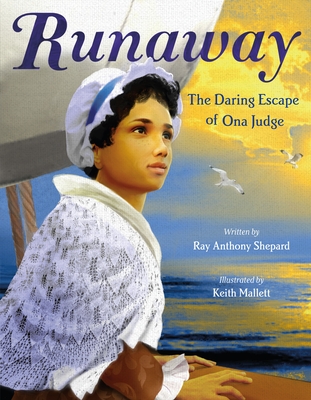
Ona Judge was a slave in the household of George and Martha Washington. While Washington worked to free the fledgling union from the British, he depending upon slaves in his household. Ona began working in slavery for Martha Washington at age 10, often playing with their grandchildren and sometimes being mistaken for one of them. The book explores the posh lifestyle that Ona lived amongst and yet was not truly part of. She was treated well, but still enslaved. When she was given to one of the granddaughters, Ona decided to escape. She chose the difficult life of a fugitive slave over than of the slavery.
Shepard uses a particularly successful structure in this picture book. He frames Ona’s story by asking repeatedly why she ran? He points out the opulence she lived in and the remarkable moments in history she saw. Shepard thoroughly explains exactly why Ona escaped, showing her being taken from her mother at a young age, being treated as more of a pet than a person, and being given to the haughty granddaughter. The structure leads to the clear answers of why she needed to escape.
Mallett’s illustrations beautifully evoke the historical period. They are filled with carriages, women’s clothing, fire places and some images of famous historical figures. It is Ona though who glows on the page, her face always lit from within and filled with the potential of freedom.
A picture book that brings the shamefulness of slavery forward, showing that everyone needs to be free. Appropriate for ages 6-8.
Reviewed from e-galley provided by Farrar, Straus & Giroux.
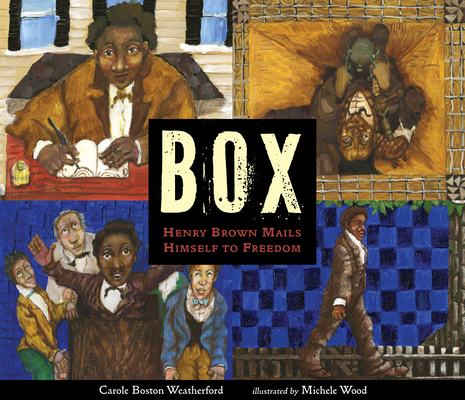
Told in brief poems, this nonfiction picture book explores a daring escape to freedom in the face of loss and brutality. Born in 1815, Henry Brown was born into slavery in Richmond, Virginia. He worked from the time he was a small child, passed from one generation of his owners to the next. Despite a series of promises by various owners, Henry Brown’s family is sold away from him multiple times, even when he paid money to keep them near. Hearing of the Underground Railroad, he decides to make a dangerous escape to the North, mailing himself in a wooden box.
Weatherford builds box after box in her poetry where each six-lined poem represents the number of sides of Henry Brown’s box. Each of the poems also shows the structure of oppression and the trap that slavery sets for those caught within it. Still, at times her voice soars into hope, still within the limits she has created but unable to be bound.
Wood’s illustrations are incredibly powerful, a great match to the words. She has used a color palette representative of the time period, creating her art in mixed media. The images are deeply textured, moving through a variety of emotions as the book continues. The portraiture is intensely done, each character looking right at the reader as if pleading to be seen.
Two Coretta Scott King winners collaborate to create this powerful book about courage, resilience and freedom. Appropriate for ages 7-10.
Freedom Bird by Jerdine Nolen, illustrated by James H. Ransome (9780689871672)
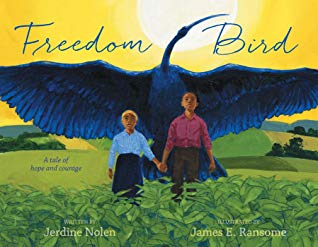
John and Millicent were slaves on a plantation in the south. The siblings’ parents were sold away from them, never to be seen again. But before they left, they made sure that their children knew about freedom, hoping that it would come in time for them. The two worked hard labor on the plantation from dawn to night. One day, a great black bird flew over the field only to be shot down and left for dead. The two children head out after dark to see if the bird survived and rescue it. But the next morning, John is hired away to another farm, likely to be gone for many months. Millicent continued to care for the bird, keeping it alive and quiet until John returned. Reunited, the two hear of plans to sell John away and decide to act and choose freedom.
The cruelties and horrors of slavery are front and center in this picture book. The dismantling and breaking of families, the threats and violence, the backbreaking work day after day. The addition of the bird adds a symbol of hope to the book, clearly offering it as a representation of freedom that must be looked after and tended. The text is dense for a picture book, but important as it explains slavery, freedom and the importance of seeing a better future.
Ransome’s illustrations are paintings that play with perspective, looking at the world from the bird’s perspective, seeing its shadow long before it appears, and glimpsing the two children entering the dark field to rescue the bird. One illustration in particular is powerful and dramatic with Meredith and the bird stretching arms and wings together.
A folktale look at freedom and the evils of slavery. Appropriate for ages 6-9.
This new book from a Coretta Scott King Award winner is a stunning look at slavery and freedom. Told over the course of a week, the book depicts the monotony and toll of the grueling work that never changes or abates. On each day, the bell rings to wake them and the narrator’s older brother indicates that he is going to leave and run away to freedom. Each touch of his hands says it, he says it aloud and he leaves her a gift. When he does run, the days become even harder, being unable to eat and unable to stop crying because he is missed and he is in danger. When the other boys who ran away with him are brought back and whipped, he is still free. And another week begins.
Ransome is a master storyteller and his skill is evident the verse in this picture book. Told with a spareness that allows readers no ability to look away or take solace in niceties, the book lays bare the human cost of slavery and what it takes to escape to freedom. The book is abundant in family love with all of the family taking time to be kind to one another and love one another through difficult and impossible situations.
The illustrations are just as powerful as the text. They illuminate the lives of this family, focusing on the people who are enslaved. Many of the scenes are filled with love and grace. But they are all shadowed by slavery and lack of freedom.
A harrowing look at slavery and freedom, this picture book reveals the truth of our American history. Appropriate for ages 6-8.
Isabella grew up in slavery, sold away from her mother when she was nine. She did hard labor for years, sometimes with no shoes in the winter and other times with no sleep at night because of the work expected of her. One year after she had been forced to marry a man and had five children, she was promised her freedom. But freedom didn’t come and so she escaped with her baby. She arrived at the home of two kind people, who stood by her in her escape and paid for the freedom of Isabella and her baby. When her son was sold away by her old master, Isabella went to court to have him returned to her. As time went by, she took the name Sojourner Truth and started to speak publicly against slavery. She fought many battles for equality, standing tall and speaking the truth.
This book aches with pain, loss, and grief. The book is broken into sections, each starting with an evocative phrase about slavery, that shows what is ahead. These poetic phrases add so much to Sojourner Truth’s biography, pulling readers directly into the right place in their hearts to hear her story. Schmidt’s writing doesn’t flinch from the damage of slavery and its evil. He instead makes sure that every reader understands the impact of slavery on those who lived and died under it.
Minter’s art is so powerful. He has created tender moments of connection, impactful images of slavery, and also inspiring moments of standing up for what is right. The images that accompany Schmidt’s poetic phrases are particularly special, each one staring right at the reader and asking them to connect.
A riveting biography of one of the most amazing Americans in our history. Appropriate for ages 7-10.
Reviewed from copy provided by Roaring Brook Press.



 Waking Brain Cells