Review: Etched in Clay by Andrea Cheng

etched in clay

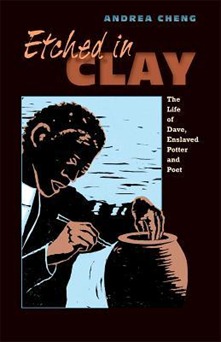
Etched in Clay: The Life of Dave, Enslaved Potter and Poet by Andrea Cheng

Told in virtuoso verse, this is the true story of the life of Dave, an enslaved potter who lived in the years before and after Emancipation.  Dave was an artist, most likely making over a thousand pieces of pottery in his lifetime of work of which only 170 survive today.  He inscribed some of his pieces with either his own name, his master’s name and also poetry that he wrote, brief verses that offer a glimpse into his world.  The amount of bravery that small act took is monumental, since Dave faced potential death because he was demonstrating his ability to read and write in a time when it was forbidden for slaves in South Carolina to do so.  Dave serves both as an example of the injustice and brutality of slavery and also as a remarkable example of the artistry and strength of human beings. 

Cheng tells Dave’s story in very short poems.  They are not all in Dave’s voice, sometimes instead being in the voice of his owners, his wife, or his children.  Cheng does not soften the harshness of slavery, offering poems that speak directly to the separation of families through selling them apart and the brutality of the punishments inflicted.  I would not call it unflinching, because one can sense Cheng flinching alongside the reader as she captures the moment but also makes it completely human and important. 

Cheng also did the woodcuts that accompany the poetry.  They are a harmonious combination with the subject matter thanks to their rough edges and hand-hewn feel.  Done only in black and white, they share the same powerful message as the poems.

This powerful book informs middle grade readers about a man who could have been one of the many lost faces of slavery but who through art and bravery had a voice.  Appropriate for ages 12-15.

Reviewed from digital galley received from Lee & Low Books.

Review: Unspoken by Henry Cole

unspoken

Unspoken: A Story from the Underground Railroad by Henry Cole

Every now and then an illustrator takes an amazing risk and it works so beautifully that it’s a masterpiece.  That’s what Cole has done in this remarkable picture book.  Don’t expect to see the bright colors of his work in books like Moosetache or even the more subtle but equally bright And Tango Makes Three.  Instead Cole has turned to the medium of simple paper and pencil to create a book that is wordless and powerful.  It’s the story of a farm girl who discovers a runaway slave in their barn soon after seeing a group of men on horseback.  She is startled and unsure, but over the course of the evening decides to help him.  It is a story of gifts given and also received.

Cole’s delicacy of line and details are notable here.  He keeps the illustrations very child-friendly, but they are also mysterious, shaded in darkness.  He plays with light, as you can see from even the cover image.  These wordless pages build tension and roll like a film before your eyes.  I’m thinking that the skill shown with simple materials and the strength of this book could mean a Caldecott consideration.

This is a profound book that speaks volumes about the importance of personal courage and the difference that one individual can make.  This is not a wordless book for preschoolers.  It’s more appropriate for ages 7-9 who will understand the history better.

Reviewed from library copy.

Review: Words Set Me Free by Lesa Cline-Ransome

words set me free

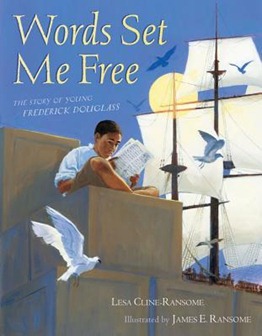
Words Set Me Free: The Story of Young Frederick Douglass by Lesa Cline-Ransome, illustrated by James E. Ransome

This picture book tells the story of Frederick Bailey, who would grow up to become the great Frederick Douglass.  His biography is also the story of the power of the written word and the ability to read.  Born a slave, Frederick was separated from his mother early in life and sent to live with his Grandmamma.  His mother would walk 12 miles at night to see him while he slept.  At age 8, Frederick was sent to work for another master in Baltimore.  It was there that he first learned his letters, until his mistress was told to stop teaching him as it would make him unfit to be a slave.  Daring white children to write better than him, Frederick continued to learn to read.  Returned to his home, Frederick taught the other slaves to read too, eventually writing his own way free from slavery.

A glimpse at an amazing mind and leader, this book takes us back to his childhood.  It is a testament to the damage and horrors of slavery, as readers see Frederick taken away from one person after another in his life.  It is also a celebration of the human spirit and the power of writing to change a life.  Cline-Ransome’s writing is exemplary.  She tells the story with wonderful detail, rich with meaning, and plenty of depth.  The book has more words than most picture books, but the story being told needs those words to shine best.

The illustrations are also rich.  There is such an aching feel to the image of the slave mother visiting Frederick that it is a portrait in heartbreak.  Other illustrations capture emotions beautifully as well.  The soaring nature of Frederick hidden up high and reading a newspaper rises against a purple-blue sky. 

The author and illustrator have created a wonderfully cohesive work with soaring prose and powerful illustrations.  Appropriate for ages 7-10.

Reviewed from library copy.

Review: Ellen’s Broom by Kelly Starling Lyons

Ellens Broom

Ellen’s Broom by Kelly Starling Lyons, illustrated by Daniel Minter

After slavery ended, Ellen’s parents’ marriage would finally be recognized by law.  Until then, no slave marriages were seen as legal.  The broom had always hung over the fireplace mantel in their home and all of the children knew the story of their parents jumping the broom and becoming man and wife.  When the family set off to make the marriage legal, all four children came along and Ellen was honored to carry the broom.  As their parents were about to be married, Ellen and her sister ran outside and decorated the plain straw broom with flowers and her mother carried the broom as a bouquet.  When her parents were married, Ellen knew that the ceremony wasn’t complete until they had once again jumped the broom together as a couple. 

This lovely picture book looks at Reconstruction, a period not often featured in picture books.  The depiction of a loving family who have survived slavery and are rejoicing in their new rights and freedoms is the center of the book.  Lyons does not shy away from showing the lingering shadows and effects of slavery, though they are shown more as memories and concerns, making them appropriate for the young audience.

Minter’s illustrations have such a delicate line that at first they do not seem to be block prints, but they are.  The bright colors and play of light and shadow make for a vivid read.  The wood grain of the walls alone are a masterpiece of line and color.

This picture book embraces family, tradition and looks to the future.  It is a gorgeous book that addresses a time in history that is often overlooked for young readers.  Appropriate for ages 5-7.

Reviewed from copy received from G. P. Putnam’s Sons.

Review: I Lay My Stitches Down by Cynthia Grady

i lay my stitches down

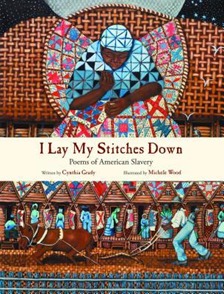
I Lay My Stitches Down: Poems of American Slavery by Cynthia Grady, illustrated by Michele Wood

This collection of poems tell the story of slavery in America from the points of view of many different slaves.  There is the poem of the house slave who breaks some dishes, the story of the Underground Railroad, children being sold away from their parents, whipping, and much more.  Still, Grady manages to also weave into the stories softer moments of learning, art, and music.  They all focus around slavery and its ugliness, despite the beauty that the slaves create.  The message is the same in the illustrations, a wrenching mix of brutality and beauty that speaks directly to the difficult subject matter.

Grady’s poems are built with references in each poem to spiritual, music and quilting.  The poems are brief and powerful, filled with language that soars and lifts despite the horror of the subjects.  This dance of harshness and loveliness makes the poems particularly compelling.  Following each poem is a paragraph or two of explanation about that aspect of slavery or references made in the poem.

The illustrations are done in paint, but directly reference quilts.  Quilt patterns form the ground, walls, water and sky.  The people are woven into the quilts, surrounded by the art form.  It conveys a certain beauty as well as a sheltering feeling that would be missed if the illustrations had a bareness or minimalist nature.

Brutal, beautiful and educational, this book uses poetry to create a memorable book about slavery in America.  Appropriate for ages 9-12.

Reviewed from copy received from Eerdmans Books for Young Readers.

Book Review: Underground by Shane W. Evans

underground

Underground by Shane W. Evans

Using only the shortest of sentences, the smallest of words, Evans has created a picture book that captures the fear and hope of escaping slaves on the Underground Railroad.   The well-chosen words add to the tension, keeping it taut with danger.  It reads as if the author too is trying to be quiet, near silent and to escape notice. 

The palette is one of darkness with bright whites of eyes shining, the colors capturing the oppression of slavery.  As freedom nears, the colors change, almost glowing with the light and brightness of freedom.  The art here is what makes the book so special.  The images are collage mixed with the texture of brushstrokes, all evoking a rustic, roughness.  Yet in the faces there is a nobility, a grace, a hope that shines through.

A beautiful, evocative book that is haunting and ever so strong.  It will work beautifully for elementary aged children learning about the Civil War and slavery.   Appropriate for ages 7-10. 

Reviewed from copy received from Roaring Brook Press.

Dave the Potter: Artist, Poet, Slave

51rAQjGiR L

Dave the Potter: Artist, Poet, Slave by Laban Carrick Hill, illustrated by Bryan Collier

Dave the Potter was an outstanding artist, poet and potter whose influence is still evident in South Carolina pottery.  He lived in the 1800s and created his pottery with amazing skill, building enormous pots that could up to 40 gallons.  He was one of only two potters known to have the strength and skill to create such large pieces.  Dave was also a poet, inscribing his verse on his pottery, offering two lines of poetry and then a date.  His poems have the beauty and simplicity of Haiku and offer a unique perspective of a poet surviving in slavery.  This is a picture book that makes an important figure in history come alive, revealing his art and poetry for children. 

Hill has created a free verse of his own to tell the story of the life of Dave.  Hill’s verse is simple and striking, drawing together the connections between the simple ingredients of the clay and what it can become and the simple life of a slave and the wonder of what Dave created.  The poem leads children through the stages of making a pot from the gathering of the clay to the magic and work of creating pottery.  The book ends with more of Dave’s poetry as well as an author’s note and an illustrator’s note.  All of them speaking to the influence and importance of Dave the Potter.

Collier’s art work here is stunningly beautiful.  His watercolor and collage art speaks to the strength of Dave, the skill of his hands and the glory of his work.  The colors are rich and deep, filled with a warm earthiness that evokes pottery and clay. 

A radiant tribute to an artist, this picture book echoes the transcendent artist that Dave was.  Appropriate for ages 5-8.

Reviewed from library copy.

The Firefly Letters

The Firefly Letters by Margarita Engle

I have adored Engle and her poetry since first reading her Poet Slave of Cuba.  This historical novel told in verse tells the story of early Swedish feminist Fredrika Bremer and her travels in Cuba.  While in Cuba she inspires and changes the lives of two women, a slave named Cecilia and a wealthy young woman named Elena.  At first amazed and shocked by the freedom Fredrika demonstrates, Elena warms to her as she begins to understand that the future could be different than just an arranged marriage.  Cecilia finds in Fredrika a woman who looks beyond her slave status and a role model for hope.  Told in Engle’s radiant verse, this is another novel by this splendid author that is to be treasured.

As with all of her novels, Engle writes about the duality of Cuba:  the dark side and the light, the beauty and the ugliness.  Once again she explores the horrific legacy of slavery without flinching from its truth.  Against that background of slavery, she has written a novel of freedom.  It is the story of a woman who refused to be defined by the limitations of her birth and her sex, instead deciding to travel and write rather than marry.  Fredrika is purely freedom, beautifully contrasted with the two women who are both captured in different ways and forced into lives beyond their control. 

Beautifully done, this book is an excellent example of the verse novel.  Each poem can stand on its own and still works to tell a cohesive story.  At times Engle’s words are so lovely that they give pause and must be reread.  This simply deepens the impact of the book.  Engle also uses strong images in her poems.  In this book, fireflies are an important image that work to reveal light and dark, as well as freedom and captivity.

Highly recommended, this author needs to be read by those who enjoy poetry, those who enjoy history, and those who simply are looking for great writing.  Appropriate for ages 11-14.

Reviewed from library copy.