Review: And Then It’s Spring by Julie Fogliano

and then its spring

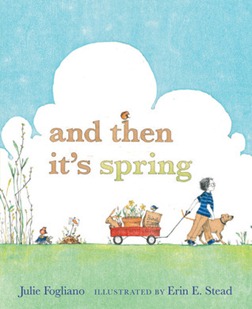
And Then It’s Spring by Julie Fogliano, illustrated by Erin E. Stead

This enchanting book starts with the brown of late winter.  It’s the brown that you have to plant seeds into in the hopes of green coming soon.  But then you have to wait for rain, hope that the birds didn’t eat the seeds, realize that the bears may have stomped too close to the seeds because they can’t read signs, and then you have to wait some more.  It stays brown, but even the brown starts to change and seem more hopeful and humming.  Then you wait some more, and then one day, if you are patient and keep caring for your newly planted seeds, you wake up to green!

Oh how I love this book!  In her poetic prose, Fogliano captures the patience of gardening, the drudgery of late winter, and the hope that must be invested in order to see seeds spring to life.  I had expected the birds eating the seeds, but the stomping bears led me to realize that this was more playful a book than I had originally expected, something I love to have happen in the middle of a picture book!  

Add to this the illustrations of Caldecott winner Stead and you have such a winning book.  Her art has a delicacy that is perfect for the whispers of early spring.  The boy in the story is thin, wear glasses, and by the time spring finally comes has created quite a garden with birdfeeders, signs, and plenty of lumps of dirt.  By far my favorite part comes at the end, where the garden does not burst into flowers but remains weedy and lumpy, but green.  Perfection.

Doing a spring story time soon?  Get your hands on this book!  Ideal for classes planting a garden or all of us longing for the green to return.  Appropriate for ages 3-6.

Reviewed from copy received from Roaring Brook Press.

Review–In Like a Lion Out Like a Lamb by Marion Dane Bauer

bauerlionlamb

In Like a Lion Out Like a Lamb by Marion Dane Bauer, illustrated by Emily Arnold McCully

Bauer has created a poetic picture book that explores the concept of March coming in like a lion and going  out like a lamb.  A lion enters a boy’s home and tromps mud across the floor.  But when the air turns warmer, the lion sneezes mightily.  On that breeze, a lamb comes in and the grass turns green.  But what will happen to the snowy lion now that spring has arrived?  Will he disappear?  Not him!  Meanwhile, the lamb is frolicking and bringing in new babies to greet the spring.

The verse is light and free, creating a poetic, friendly picture book for young children.  The idea of the lion not leaving, but instead lingering in a warm patch of sun and purring is a lovely one.  While the lamb is breezy and light, the lion asleep happily is what lingers with me afterwards, waiting for winter to return.

McCully’s art echoes the freedom of the verse and the lightness of the subject.  She uses a light touch on her lines, a freedom in her colors, and a lushness as spring returns. 

Welcome spring and the end of March with this book and hope along with all of us in Wisconsin that the snow will finally come to an end!  Appropriate for ages 4-6.

Reviewed from copy received from Holiday House.

Also reviewed by BooksForKidsBlog.

Review–Spring Is Here by Will Hillenbrand

springisherehillenbrand

Spring Is Here by Will Hillenbrand

Mole wakes up and tries to figure out if spring has arrived.  He sniffs the air, tiptoes past Bear’s room and then squishes mud under his feet.  He knows that spring is here.  But when he tries to wake up Bear to let him know, Bear just keeps on snoring.  So Mole comes up with a way to get Bear to wake up.  It involves gathering eggs, milking a cow, churning the milk, pouring, mixing, and baking.  When he presents Bear with his surprise though, Mole is the one so tired from his efforts that he is snoring.

Hillenbrand has created a charming picture book from a very simple concept, making a book that is ideal to share with toddlers.  Sounds have been sprinkled nicely throughout the book, energizing the story.  With only a few lines per page, the pacing of the book will work well read aloud to small children.   Towards the end, the pacing picks up even more as Mole works on his idea to wake up Bear.

The artwork in the book adds to the story’s cozy feel.  The mixed media illustrations have a warmth thanks to their soft lines and homey subject.  Filled with small touches, a complete world is created where friendship between a mole and bear makes perfect sense.

Add this to your spring story time pile, especially if you read to the smallest of children.  Appropriate for ages 2-4.

Reviewed from library copy.

Big Night for Salamanders

Big Night for Salamanders by Sarah Marwil Lamstein, illustrated by Carol Benioff

On a rainy spring day, a young boy comes home hoping that this will be the Big Night.  After dinner, the boy gets his raincoat on and a flashlight covered in pink plastic to lessen the glare.  He and his parents head out to the wet road in the dark.  In the dark and the rain, the family help salamanders cross the road safely as they move from forest to pond to lay their eggs.  But some of the cars are going so fast that it is dangerous not only for the salamanders.  So the boy creates a sign that says “Go Slow, Salamander Crossing!”  It is indeed a Big Night.

The story of the boy is presented side-by-side with information on what the salamanders are doing.  Readers get insight into the animals, told in a much more poetic and flowing way than the human story.  It makes for a lovely contrast with one another where not just the font and the content tell the different stories but also the tone and writing style.

Benioff’s illustrations are equally at home with the humans and the salamanders.  It is a pleasure seeing a child of color in a story where there is no mention of it at all.  Her art is bold enough to work with groups, and this book as a whole is ideal for reading aloud in storytimes about spring or salamanders.  All children will reach the end of the book wishing that they too could shepherd salamanders across a road at night.

A lovely science story book, this book successfully marries science into a picture book story.  Appropriate for ages 4-6.

Reviewed from library copy.

Also reviewed by:

Mama Is It Summer Yet?

Mama, Is It Summer Yet? by Nikki McClure

This lovely, gentle book shows the slow approach of summer through the spring as buds appear on trees, seeds are planted in the garden, trees blossom, and baby ducks follow their mothers.  Focused on the natural world and the seasonal changes around us, this book has a wonderful connection to the earth.  McClure’s stunningly detailed cut-paper illustrations add to the appeal with subtle colors warming the black and white.  A great read aloud for a toddler story time on spring or summer, or a great book to snuggle together with on a wintry day and dream of the warm days to come.

This book features charming, brief writing that offers information on the seasons and ties directly in to what the illustrations are showing.  The relationship of the mother and child throughout the book is very organic and loving.  The illustrations are so deftly done that it is sometimes hard to even imagine that they are cut paper.  The detail would be impressive enough with pen and ink. 

A pleasure of a book, share this with children who are enjoying summer right now but make sure to pull it out to warm up cooler days as well.  Appropriate for ages 2-4.

Reviewed from library copy.

Also reviewed by:

The Easter Egg

The Easter Egg by Jan Brett

Jan Brett turns her prodigious talents to an Easter story!

Hoppi the rabbit is now old enough to participate in the egg decorating competition.  Each year the rabbits decorate Easter eggs and the winning bunny got to help the Easter Rabbit hide the eggs.  But Hoppi needs a great idea for his egg, so he hops around to visit the other rabbits.  Each bunny is doing something unique and interesting and inspires Hoppi to try their technique.  As he visits, each rabbit offers him a scrap of material or a tool as well as ideas.  Hoppi tries to come up with the perfect idea, but is distracted by the distressed calls of some robins.  One of Mother Robin’s eggs fell out of the nest on onto the forest floor.  Hoppi knew just what he had to do and sat gently down on the egg with his warm fur.  Hoppi sat and sat and sat on the egg, unable to create an egg of his own for the Easter Rabbit.  But the Easter Rabbit knows just what makes the perfect egg for Easter!

Done in her signature style with one main image on a two-page spread and two smaller images on each side, this book celebrates Easter, spring, art and creativity.  It is also about self-sacrifice and giving to the community.  Brett has created a book that never becomes overly sweet.  A large part of this is her attention to minute details that make the rabbits realistic, the forest come alive, and the individual eggs masterpieces.  I also appreciate her use of wild plants and flowers as the framing for the illustrations.  Brett’s use of repetition as Hoppi travels the village of rabbits allows for a real surprise when Hoppi discovers Mother Robin and the egg. 

This book will work well with a group, though the tiny details are worth lingering over and discussing within a family or very small group of children.  Appropriate for ages 3-7.

Reviewed from copy received from Penguin.

Kitten’s Spring

Kitten’s Spring by Eugenie Fernandes

Take a walk along with Kitten as Kitten explores a farm in spring.  As Kitten goes through the farm, readers will see pairings of adult and baby animals.  These include frogs and tadpoles, birds and eggs, chickens and chicks, ducks and ducklings, a cow and calf, pig and piglet, sheep and lamb, and owl and owlet.  The book is written in rhyme that adds to the appeal.  The illustrations are eye-catching and lovely with a real dimensional feel to them that will offer young children lots to pore over.

Fernandes is a well-known Canadian author.  Her ability to create a book with a specific feel and theme shines here.  Using only a few words per page, she writes with a simplicity that is welcoming for very small children.  Her art is equally warm and friendly, filled with tiny details that make it fun to visit again and again.  It is done in clay, acrylic paint and collage.

This book would be perfect to add to a toddler story time about spring, farms or cats.  Its small size is also very inviting for lap reading and children will love to talk about the animal noises and the other things they see in each picture.  Appropriate for ages 1-4.

Reviewed from copy received from publisher.

Also reviewed by Becky at Young Readers.

Little Chick

Little Chick by Amy Hest, illustrated by Anita Jeram.

This is a picture book that creates a world with just a few words, great characters, and wonderful illustrations.  Little Chick has three stories in this book.  One involves a small carrot, the second a stubborn kite and the third the wonder of stars.  Hest works with repetition that links all three stories together as well as a gentle style that is happy and warm.  The two characters of Little Chick and Old-Auntie (a big hen) are classic and yet fresh here.  The relationship between the two is lovely to read as Old-Auntie understands Little Chick and gently guides her to try another way. 

Hest has just the right amount of text here which is presented in a nice big font.  The book reads aloud well and though it has three stories in it is the length and size of a regular picture book.  Jeram’s illustrations are light, energetic and simply delightful.  They capture the vivacious little bird, the security and stature of the hen, and the beauty of garden, hillside and night while retaining their fresh light approach.

The perfect spring book, these stories are classic, gentle and lovely.  Appropriate for ages 3-5.