Review: This Is Not My Hat by Jon Klassen

this is not my hat

This Is Not My Hat by Jon Klassen

I never expected to see a sequel to I Want My Hat Back but I am so thrilled that Klassen saw things differently.  This second book has a similar theme to it with a stolen hat, but it has entirely different characters.  This time the story is set underwater with fish playing the major roles.  One little fish has stolen a hat from a big sleeping fish.  He knows it was wrong, but justifies it by the fact the hat looks so much better on him and fits better too.  As he flees to the thick reeds to hide, he thinks to himself about how clever he has been, that the fish would never notice it missing, that he wouldn’t know where to look for the thief, on and on.  And with each sentence, the readers will see that he’s wrong, very wrong.

This sequel has the same understated style of the first and the same wonderful sense of humor that is exquisitely funny.  Klassen maximizes the humor with his flawless ability to tell one story in the words and an entirely different one with the action of what really happens. 

For all the fans of the first book, this is one that works best if you have read the first, but also stands on its own completely.  Appropriate for ages 4-6.

Reviewed from library copy.
Review: Take What You Can Carry by Kevin C. Pyle

take what you can carry

Take What You Can Carry by Kevin C. Pyle

This graphic novel explores connections between generations and across races, in an innovative way.  It is the story of two teenage boys.  One is a Japanese American who is sent to the internment camps during World War II.  His part of the story shows the displacement of his family, the loss of their rights, and the realities of the camps.  In alternating chapters, we also get the modern story of a teenage boy who moves to a new community and gets in with the wrong group of boys.  Soon he is robbing stores and eventually ends up in real trouble.  The man whose store he robs was the Japanese teen, who also resorted to stealing in the camps. 

At first, readers are not sure how the two stories will ever come together into one, or if they ever will.  They seem so remote and separate from one another.  Then when they do, there is a great satisfaction is realizing why the modern boy is given a chance to remedy what he has done.  It is a story that deals with two very personal stories, but that also has a more universal message about displacement, theft and redemption.  Both of the teen boys find ways to make things right in their lives, to accept their conditions, to rise above. 

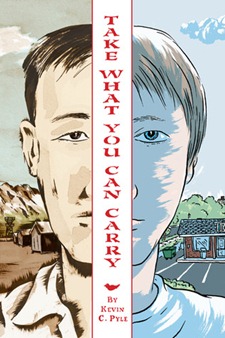
Pyle’s two stories are shown in different color palettes as you can see from the cover.  The sepia tones work well for the historical story, also emphasizing the wasteland of the internment camps.  The blues of the modern story give it a cool feeling that suits a story where a boy is not making the right choices and where his world is devoid of warmth. 

This intriguing graphic novel is a compelling read that will show young readers not only about history but also about themselves and their own choices.  Appropriate for ages 12-14.

Reviewed from copy received from Henry Holt.