Big Bob, Little Bob by James Howe

big-bob-little-bob-by-james-howe

Big Bob, Little Bob by James Howe, illustrated by Laura Ellen Anderson (InfoSoup)

When Big Bob moves in next door, Little Bob’s mother is happy that he will have a friend so close by. But the two boys are very different in more than just their size. Big Bob likes to roughhouse, play sports, and zoom trucks around. Little Bob likes to spend time quietly reading, play with dolls, and sometimes wears girl clothes. Big Bob teases him for a lot of these things until a new girl moves into the neighborhood and tells Little Bob that boys don’t play with dolls. Big Bob stands up to her and soon the three of them are playing in whatever way they like best, because both girls and boys can play with whatever they choose.

While the message here can get a little heavy handed at the end, this is an important book. It shows that gender norms are a spectrum, that boys who play with dolls don’t have to be given any additional labels unless they identify in a different way. It also embraces that girls too sometimes prefer playing games or choosing toys that are traditionally masculine. There is a broad acceptance here with children being given the space and time to realize that they were viewing the world through a limiting lens.

Anderson’s illustrations are playful and bright. The neighborhood is quirky and welcoming with plenty of place to play separately and together. The use of wild colors adds to the appeal with trees of tangerine and lemon/lime and garlands of flowers and hearts dangling from them.

A book about accepting differences, learning to get along and finding new friends, this picture book is strong pick for library collections. Appropriate for ages 4-6.

Reviewed from library copy.


Painting Pepette by Linda Ravin Lodding

Painting Pepette by Linda Ravin Lodding

Painting Pepette by Linda Ravin Lodding, illustrated by Claire Fletcher (InfoSoup)

Josette lives in 1920s Paris with her toy rabbit, Pepette. At home, their great room’s walls were covered with paintings of the family, including Josette and her sisters as well as their dog. But there was no picture of Pepette! So the two of them set off to Montmartre where the best artists painted. Josette finds one famous painter after another to paint her toy bunny, but none of the paintings is quite right. Picasso gives the bunny too many ears and noses. Salvador Dali makes him too droopy. Chagall has Pepette flying in the clouds. Matisse painted him in the wrong colors. Finally, Josette heads home, realizing that it is up to her to create an appropriate portrait of her beloved rabbit.

Lodding’s glimpse of the wonder of Paris and the incredible artists at work all at once at Montmartre is very enticing. It will help for the adults reading the book to guide children through the artists afterwards, allowing them to understand who the artists were and how their signature styles are reflected in their portraits of Pepette. It is a lovely introduction to those painters for young children and may be ideal before a visit to a museum. Josette herself is a wonderful young character as well, showing real determination to get the right portrait of her toy and yet also showing respect to the artists and their unique vision.

The watercolor illustrations by Fletcher are a huge success. They have their own artistic quality and also capture the styles of the other artists as well. The watercolors have a vintage style that works particularly well in showing 1920s Paris, allowing the light to play across the colors of the city where Josette stands out with her red bow, polka dot dress and striped stockings.

A lovely historical picture book that invites readers to explore Paris and art. Appropriate for ages 4-6.

Reviewed from copy received from Little Bee Books.

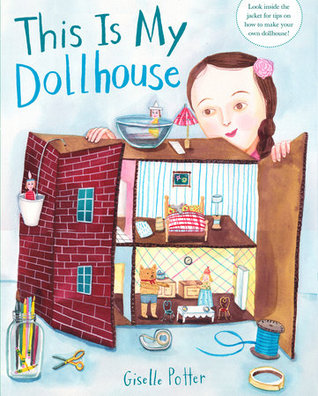
This Is My Dollhouse by Giselle Potter

This Is My Dollhouse by Giselle Potter

This Is My Dollhouse by Giselle Potter (InfoSoup)

Released on May 10, 2016.

A little girl shows readers the dollhouse she has made from a cardboard box. It is filled with inventive furniture, food made from string and paper, and a set of dolls that don’t all match. The house has an elevator on the side and even a swimming pool on the roof. Then she sees her friend Sophie’s dollhouse where everything matches. The dolls all look the same, all of the rooms match with furniture that is all perfect. But when the girls play a little with the dollhouse, it doesn’t really work. When Sophie comes over, the girl is very nervous about showing her the handmade dollhouse, but soon the two girls are playing together in a way that they never did with Sophie’s perfect dollhouse.

I absolutely adored this book. It captures the wonder of creating your own toys and your own world of play. The cardboard dollhouse and all of the art supplies allows a little girl’s imagination to really soar. The book does include instructions for making your own dollhouse out of a box. And the story also shows how to make furniture from blocks and a TV from a small silver box. Children will be inspired to make their own.

The illustrations here are such an important part of the story. They clearly show that there is a warmth and homeyness to the handmade dollhouse. When the girls play with the perfect purchased one, readers will immediately feel the chill of that dollhouse and realize all that it is missing. This plays so beautifully against children’s own expectations too.

A grand picture book that will inspire creative play and the building of a place for adventures of your own. Appropriate for ages 4-6.

Reviewed from digital galley received from Schwartz & Wade and Edelweiss.

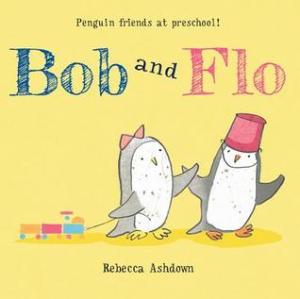
Review: Bob and Flo by Rebecca Ashdown

Bob and Flo by Rebecca Ashdown

Bob and Flo by Rebecca Ashdown (InfoSoup)

In a story perfect for small children starting daycare or preschool, this picture book shows how to make new friends and share. Bob really likes Flo’s pink bucket that she brought with her to school. When Flo is busy painting a picture, her bucket disappears. She looks for it everywhere. She notices that Bob has a new pink hat at one point. Then she sees him making a tall tower of blocks standing on something pink. She sees him playing a pink drum. And then at the playground, she finally spies her bucket by the slide. Bob is there too, stuck at the top of the slide. Happily, Flo knows just what to do to help and all it takes is a good pink bucket.

Such a simple book but told so very well. Ashdown perfectly captures the unique ways preschool children interact with one another, often playing alongside each other than right together. She weaves in the humor of Flo seeing her bucket over and over again and not recognizing it. That plays nicely against the creativity that Bob uses when playing with the bucket on each page. Toddler audiences will love spotting the bucket on each page spread.

Ashdown’s illustrations are cheery and bright. The sunny yellow background allows the grey and white penguins to shine on each page. The basic toys around them, evoke every preschool or daycare around. Then the penguins themselves have texture and patterns that give them personality and also make them seem more real and more childlike.

Perfect for returning to preschool in the fall, this picture book is just as much fun as a bucket. Appropriate for ages 2-4.

Reviewed from library copy.

Review: I Don’t Like Koala by Sean Ferrell

I Don't Like Koala by Sean Ferrell

I Don’t Like Koala by Sean Ferrell, illustrated by Charles Santoso

When Adam opens his gift and discovers Koala inside, he is not pleased. After all, Koala is “the most terrible terrible.” He has bright yellow eyes that follow Adam around the room. So Adam decides that he must get rid of Koala, but it’s not that easy. Every night Adam puts Koala away in different places all over the house and happily goes to be alone. But when he wakes up, Koala is right there on his pillow, every morning. His parents think that he loves Koala, even though Adam tells them that he hates Koala. Then comes the day that Koala seems to have eaten Adams snack! So Adam hikes up into the forest and leaves Koala there. But Koala is waiting for him at home when he returns. One night though, frightening things loom in the dark and Koala is right there to protect Adam and make him feel safe. But someone else might just be being freaked out by Koala too.

Ferrell captures the creepiness and the appeal of strange stuffed animals. He creates a horror vibe that is just right for young readers with the way that Koala appears in bed in the morning and can’t be left behind anywhere. It’s a funny riff on scary movies, something that some special stuffed animals can evoke with ease. The parents don’t understand or step in to protect their son in the story at all, adding to that eerie feeling throughout that makes the book such fun.

Santoso creates the ultimate creepy stuffed animal in Koala, a strange beast who readers will also grow to love as the book progresses. The expressions on Adam’s face are priceless as he tries to explain why he hates Koala so very much and when he discovers Koala’s return again and again. The use of dark colors for both Koala and Adam unite them as a pair in the book even as Adam struggles to be separate. Santoso’s illustrations continue the dark eerie feel of the story.

An exceptionally dark picture book, this book is great fun and reads aloud well. Share it with children ready for a little fright with their stuffed animals. Appropriate for ages 4-6.

Reviewed from copy received from Atheneum Books for Young Readers.

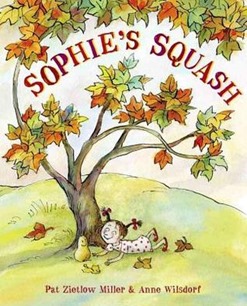
Review: Sophie’s Squash by Pat Zietlow Miller

sophies squash

Sophie’s Squash by Pat Zietlow Miller and Anne Wilsdorf

Released August 6, 2013

When Sophie and her family go to the farmer’s market, Sophie helps pick out a lovely squash.  However, it is not a squash that she wants to eat!  Instead she names it Bernice and takes it everywhere with her.  Her parents offer to cook Bernice so that she won’t rot, but Sophie is scandalized.  Soon though, Bernice is starting to show her age with “freckles” on her skin.  So Sophie heads back to the farmer’s market to ask how to help Bernice not rot.  The farmer suggests, “Fresh air.  Good, clean dirt.  A little love.”  Sophie heads home and plants Bernice in the garden, tucking her into that good dirt.  That night, the snow starts to fall and Sophie has to be very patient.  Her parents get her a fish to keep her company, but he’s not as interesting as Bernice.  With spring come some surprises that will delight and satisfy.

This picture book does not read like a debut book, instead having a confident tone and a quirky premise of more veteran authors.  The story is completely satisfying, offering a conclusion that brings the book full circle and along the way plenty of squash bonding time.  So many children bond with objects in their childhood that this will speak to many children.  Both the humor of it being a squash and the seasonal nature of the story make this a joyful pick.

Wilsdorf’s illustrations reflect the quirkiness of this title beautifully.  The bond between girl and squash is perfectly rendered and while humorous, the images never laugh at Sophie and her new friend.  The warm and loving family is depicted in their kitchen and home, ready to eat the squash but also ready to let Sophie decide. 

Pick this one for your next autumnal storytime though it will also make a nice addition to any garden-themed unit too.  Appropriate for ages 4-6.

Reviewed from digital copy received from Edelweiss and Random House.

Review: Toys in Space by Mini Grey

toys in space

Toys in Space by Mini Grey

A group of toys are left outside overnight for the first time.  There is Wonderdoll, a robot, a cowboy and horse, a dinosaur, a sheep, and a rabbit.  All of them left in the dark, gazing up into the starry sky.  They are all scared, but then Wonderdoll starts to tell a story.  It is a story of seven toys left out at night under the stars, but then one star gets bigger and bigger until they can see that it is actually a spaceship!  The seven toys are beamed aboard the spacecraft and meet a glove-shaped alien who is missing his own favorite toy.  He has gathered toys from all around the world and kept them, but has not found his toy yet.  The seven toys help the alien figure out that he has to return the toys to earth and even throw him a party to cheer him up.  But will the alien ever find his own Cuddles again?

This picture book has the winning touch of Mini Grey.  She is always fearless in her storytelling and deeply understands the connection between child and toy as shown in her Traction Man books as well.  It also has the great combination of toys and aliens!  The story is wonderfully playful and children will wonder if it really happened right up to the very end. 

Grey’s art adds to the playful feel.  Each toy has its own personality visually but the seven together make quite the team.  She nicely incorporates speech bubbles into the story, giving it a comic feel that works well with the light-hearted art. 

Sure to be a hit with its combo of aliens and toys, this book will work well at a story time, or for cuddling after all the favorite toys are tucked in too.  Appropriate for ages 3-5.

Reviewed from copy received from Random House Children’s Books.

Review: The Boy and the Airplane by Mark Pett

boy and the airplane

The Boy and the Airplane by Mark Pett

This wordless picture book tells the story of a young boy who is merrily playing with his brand-new red airplane.  He runs with it, runs around it pretending to be a plane himself, and eventually throws it up into the air.  It lands on the roof where the boy where the boy is unable to reach it using a ladder or anything else that he tries.  He sits in discouragement under a tree and then is inspired when a maple seed drifts down and lands in his hand.  He plants the seed, watching it grow through the seasons and the years.  The ending is satisfying and lovely.  This book is about patience and dedication, but is also open to interpretation thanks to its wordless design and flowing storyline.

Pett manages to create a truly timeless book here.  The art is done in sepia tones with just a dash of red for the toy airplane.  The characters are even dressed in clothes that are universal.  The book has a great cyclical quality to it that works particularly well with the timeless feel.  The illustrations also have a contemplative feel to them that permeates the entire work.  This is a book that slows you down and gets you considering other options.

A great gift book for adults, this book will also be appreciated by young children who will see the humor in the boy’s solution.  Appropriate for ages 3-5.

Reviewed from copy received from Simon & Schuster Books for Young Readers.

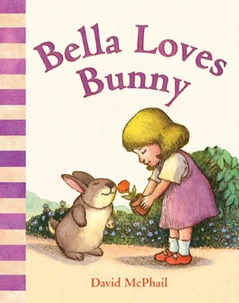
Review: Bella Loves Bunny and Ben Loves Bear by David McPhail

bella loves bunny ben loves bear

Bella Loves Bunny by David McPhail

Ben Loves Bear by David McPhail

A pair of charming board books from veteran author and illustrator McPhail, these casebound books closely echo picture book structure but have sturdy board pages that will stand up to toddler use.  The stories mirror each other, following the child from waking up for a day of play through to bedtime. 

Bella’s story feels more passive than Ben’s, but I think that is because Bunny is not depicted as energetically as Bear is.  Children who have favorite stuffed animals who accompany them throughout their day will find kindred spirits on these pages.  The stuffed animals are living and breathing here, the story filled with a quiet imagination.  As always, McPhail’s illustrations have a wonderful depth of color and fine lines.  They manage to be dreamy but realistic at the same time.

Good additions to library board book collections, these are books that are gentle and joyful.  Appropriate for ages 1-3.

Bella Loves Bunny was received from Abrams for review.  Ben Loves Bear was reviewed from library copy.