Review: Luna & Me by Jenny Sue Kostecki-Shaw

Luna and Me by Jenny Sue Kostecki Shaw

Luna & Me: The True Story of a Girl Who Lived in a Tree to Save a Forest by Jenny Sue Kostecki-Shaw

This is a picture book version of the real-life heroism of Julia Butterfly Hill, a woman who lived for two years in the branches of Luna, a great redwood tree in order to save the grove from logging. In this picture book, Butterfly is shown as a girl rather than an adult. She spends many of her days exploring nature and then discovers Luna and climbs up into her branches. When she realizes that Luna is going to be chopped down, she stays in the branches. That starts her adventure high in the canopy where she has to withstand storms and cold. Butterfly stayed up in Luna for two years, figuring out how to make a home high in a tree and sharing Luna’s story with whomever she could. Until finally Luna and her entire grove her saved and made into The Luna Preserve.

As Kostecki-Shaw notes in her Author’s Note, she has simplified the political situation that the real Julia Butterfly Hill was dealing with as well as the initial response that included a group of environmental activists taking turns sleeping in Luna’s branches. This makes for a picture book that is easily understood by young readers and that hints at larger issues happening. It will serve to inspire young readers that they can individually make a difference in the world around them and protect what is invaluable to all of us.

The illustrations in this book are done in a variety of media including acrylics, watercolor and pencil. They capture the beauty of nature with dappled light through leaves, the texture of tree bark, and the dwarfed size of Butterfly against the world. They also delightfully show the other animals and creatures living in Luna with one magical page displaying a space inside her trunk.

A very special book about an environmental heroine, this picture book will be inspiring for young readers. Appropriate for ages 4-6.

Reviewed from copy received from Henry Holt & Co.
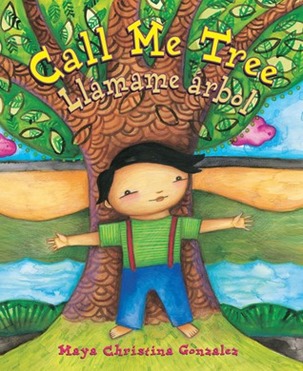
Review: Call Me Tree by Maya Christina Gonzalez

call me tree

Call Me Tree: lámame árbol by Maya Christina Gonzalez

Released November 1, 2014.

This poetic picture book combines a celebration of trees with one of human diversity.  A boy starts to grow under the earth, reaching his arm up to break the surface of the ground.  His arm and fingers becomes a trunk and branches and soon he too is up in the air next to his tree.  Just as trees have freedom, so does he.  Just as each tree is different from another, he is different from the other people too.  Yet they all have roots and they all belong on the earth and in the world.

This very simple book is written like a free verse poem in both English and Spanish, closely tying biodiversity to human diversity in a clever way.  The connection of humans and trees is beautifully shown as well, in a way that ties each person to a tree like them.  It’s a book that is radiant in its delight in our connection to nature and the way that nature’s diversity reflects on our own.

Gonzalez both wrote and illustrated this picture book.  Her illustrations are colorful with deep colors that leap on the page.  The characters on the page are bold and different, each with their own feel of exuberance or quiet contemplation or strength.  Along with each different child, there is a tree connected to them that equally reflects their personality.  It’s a very clever way to clearly tie humans to nature.

This book could serve as inspiration for children to draw their own personal trees that express themselves or it can be a lullaby to dreams of blue skies and green leaves.  Appropriate for ages 3-5.

Reviewed from digital galley received from Edelweiss and Children’s Book Press.

Review: Sequoia by Tony Johnston

sequoia

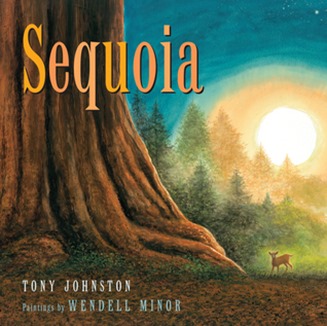
Sequoia by Tony Johnston, illustrated by Wendell Minor

This is a poem about Sequoia, a giant and ancient tree and how he lives through the year.  As the seasons change, Sequoia opens his arms and gathers different things to him.  He gathers owls to him in the springtime when he is cloaked in green.  When fires come in the heat of summer, he gathers flames to him.  As the birds fly away in the autumn, he gathers one last crow.  In the winter, he gathers snow.  He also listens quietly and deeply to the nature around him and shares stories that he has gathered over time with the smaller cedars.  This picture book is a celebration of ancient trees and this one sequoia in particular.

Johnston uses repetition very skillfully in his poem.  It is enough of a structure to allow children to have something to lean on when reading, but the poem is also free too.  It’s a strong mix of structure and freedom that is perfect for a tree poem.  As the seasons change, children will see nature change as well.  There is a joy to this work, a dedication to preservation of trees like this, and a thrill in the wildness of nature.  Johnston uses gorgeous imagery throughout that further ties the wild to this tree and how he feels.

Minor’s illustrations are exceptional.  They carry the beauty of the verse to new heights as readers get to see the glory of this single sequoia standing so tall above everything else.  Yet Minor also makes sure that Sequoia is part of the nature around him.  The light is beautiful in these images streaming through the trees in beams, bright dawn on other pages, and the softness of twilight at others. 

A wild and beautiful poetic celebration of a tree, this book is less about the facts of sequoia trees and more about the experience of one.  Appropriate for ages 4-6.

Reviewed from copy received from Roaring Brook Press.

Review: The Promise by Nicola Davies

promise

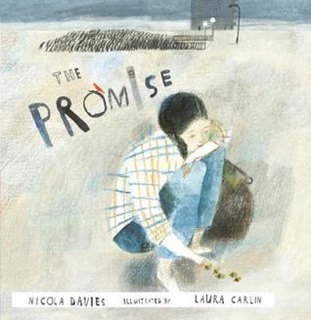
The Promise by Nicola Davies, illustrated by Laura Carlin

In a gritty city filled with dust and yellow wind, a girl survives by stealing from other poor people.  Her life was just as dust filled and ugly as the city around her.  Then one night, she saw an old frail woman with a fat bag walking along.  She would be an easy mark, so the girl tried to get the bag away from her.  The old woman held on tightly, but eventually asked the girl to promise to plant them and she could have the bag.  The girl promised.  In the bag were only acorns, nothing to eat, no money to spend, but a wealth of trees.  So the girl started planting them one by one, and nothing changed for a long time.  Then green sprouts started to appear, then trees grew and green returned to the broken city.  But the girl had already left, going to other cities that needed a forest too.  Until one night she had her fat bag of acorns with her, and a young person tried to steal it from her.  All it took was another promise and she let them have the bag.

This allegory is lovely.  The setting is hauntingly familiar, a war zone where all that is left behind is the dust and rubble of war and people who cannot escape the city or see a future beyond it.  The transformation of the theft of property into a promise is stunning.  Simple and profound, it is courage, passion and change all wrapped into a single act.  I also love the moments before the trees appear, the anticipation, the question of whether it will work, the effort before the payoff.  And then the fact that the girl leaves to go to other cities, makes this entire story less about her than about her deeds.  It’s one intelligently written book that works so well.

Carlin’s illustrations are done in muted grays and sands, they are images that suck the color out of the day, cover you in their dust.  And yet, they are also filled with hope.  When that first green hits the page, it’s like you can smell it in the air.  Then the transformation that is so colorful, so fresh. 

This radiant allegory would be appropriate for classrooms learning about allegories or about peace.  Appropriate for ages 7-9.

Reviewed from library copy.

Review: Oliver’s Tree by Kit Chase

oliver's tree

Oliver’s Tree by Kit Chase

Oliver, Charlie and Lulu are three best friends who love to play together outside.  When they play hide-and-seek though, Oliver doesn’t have as much fun as the others.  Lulu is a bird who loves to hide in the trees and Charlie the rabbit does too.  But Oliver is an elephant, and he doesn’t like trees at all, since he can’t climb them.  So the three friends set out to find a tree that will work for Oliver.  The low trees are too small for him.  Trees with big branches are too tall.  When they finally find a big low branch, Oliver is thrilled.  But then the branch breaks.  Oliver has had enough and runs off to be on his own.  He settles down on a huge tree stump and dozes off.  That’s when his friends have one great idea that saves the day and creates a tree that even an elephant can love!

Chase sets a pitch-perfect tone here for young children.  It’s a pleasure to see three children playing together in a picture book that is not about jealousy.  This instead is a book that celebrates differences and has children who work together to solve a problem in a creative way.  The result is a jolly book that has a fast pace and a cheery personality.

Chase’s illustrations have the same bounce as the text of the book.  They have a friendly quality that children will immediately respond to as well as a sweet humor that is cheerful.

It’s perfect tree climbing season right now, even if you are an elephant!  Appropriate for ages 2-4.

Reviewed from copy received from Putnam.

Review: Under the Freedom Tree by Susan

under the freedom tree

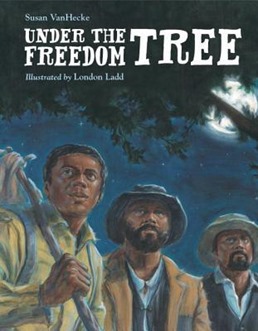
Under the Freedom Tree by Susan VanHecke, illustrated by London Ladd

Told in free verse, this picture book is the story of how the first contraband camp formed during the Civil War.  It all started with three runaway slaves who escaped across a river to a Union-held fort.  Though the Confederate Army tried to demand their return, the general at the fort declared them “contraband of war” and offered them protection and a place to live.  The three were quickly joined by a flood of people crossing the line into Union territory and they began to build a home for themselves near the fort.  The freedom tree is the Emancipation Oak which stood witness to the events that unfolded, including the Emancipation Proclamation, which set all of the residents of the camp free.

VanHecke’s verse is loose and beautiful.  She captures the danger the slaves faced in crossing the Confederate line, the risks they took asking for shelter, and the clever solution found by the general.  She offers an author’s note in prose to give more historical context to the camp and the Emancipation Oak. 

Ladd’s illustrations are lush and detailed.  His paintings capture the hope of emancipation, the darkness of escape by water and night, and the beauty of the oak.  The illustrations clearly honor the first three men who escaped to the fort, showing them as they wait for the judgment of whether they must return to slavery or not. 

A little-known part of the history of the Civil War, this book in verse pays homage to the courage of the men who created the contraband camp.  Appropriate for ages 6-10.

Reviewed from copy received from Charlesbridge.

Review: Maple by Lori Nichols

maple

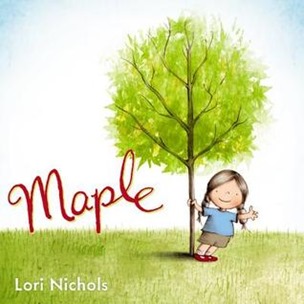
Maple by Lori Nichols

This is one amazing debut picture book.  Maple loved her name.  When she was a baby, her parents had planted a maple tree in their yard.  It was tiny just like her and as Maple grew so did the maple tree.  Her tree never minded if she was loud even though her parents did sometimes.  Maple loved to be outside with her tree.  She would sway along with it, pretend to be a tree and spend time gazing up into its branches and leaves.  When the tree lost its leaves in the fall, Maple gave it her coat to keep it warm.  Throughout the winter, the two played together.  Then in the spring, there were new surprises!  A new tree in the ground and a new baby in the family.  It is Maple who figures out exactly what to do to keep her new sister happy.

Clever and very satisfying, this book is an exceptional debut.  Nichols sets just the right tone with her prose.  From the very first page, you know that she understands children’s books and the way to structure and write them.  The story is clearly presented and the arc of the tale is nicely plotted and designed.  One knows that it is building towards something, but the book is willing to take the right amount of time to get there.  The book reads like a veteran author wrote it. 

The illustrations are also impressive.  They have a lovely softness to them that is very pleasing.  The colors are muted but very effective.  My favorite pages are when Maple looks up into the tree and you see her through the leaves.  It is all beautifully done.

Take it from someone who named one of her children after a tree and then planted one for him to grow up with, this book captures children, love for nature and new siblings with grace and style.  Appropriate for ages 3-5.

Reviewed from copy received from Nancy Paulsen Books.

Review: The Tree Lady by H. Joseph Hopkins

tree lady

The Tree Lady by H. Joseph Hopkins, illustrated by Jill McElmurry

Kate Sessions is the woman who made San Diego into the green city that it is today.  She was a pioneering female scientist who grew up in the forests of Northern California.  After becoming the first woman to graduate with a degree in science from the University of California, she moved to San Diego to be a teacher.  San Diego was a desert town with almost no trees at all.  So Kate decided to change all of that and began to hunt for trees that survive and thrive in a desert.  Soon trees were being planted all over San Diego, but that was not enough for Kate who then worked to fill entire parks with her trees and gardens.  Kate Sessions was a remarkable woman who helped San Diego become the great city it is today.

Hopkins takes a playful approach to this picture book biography.  From the beginning he uses a format that ends each new event in Kate Session’s life with “But Kate did.”  Not only does this create a strong structure for the story, but it shows Session’s determination to not be swayed by what others thought was possible.  From the beginning, she was a unique person with a unique vision.  It is that vision and her strength in the face of societal opposition that made her so successful.

McElmurry’s illustrations add a beauty to the book.  She captures the lush green of the California forests and then allows readers to experience the transformation of San Diego from a barren desert to the lush green of Session’s many trees.  She also shows all of the hard work that it took to make that transformation possible.

Sessions will be a newly found historical figure for most of us, and what an inspiration she is!  Appropriate for ages 4-6.

Reviewed from copy received from Beach Lane Books.

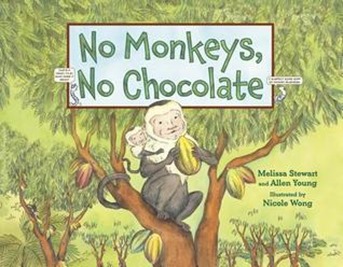
Review: No Monkeys, No Chocolate by Melissa Stewart

no monkeys no chocolate

No Monkeys, No Chocolate by Melissa Stewart and Allen Young, illustrated by Nicole Wong

A close-up look at the favorite sweet treat of chocolate, this nonfiction picture book explains exactly what it takes to get chocolate.  The book quickly moves to the tropical rain forests of Central and South America and the cocoa beans that grow there and how they are treated to get cocoa powder from them.  The book then moves to explaining cocoa pods, cocoa flowers, and cocoa leaves, but animals quickly come into the process from the midges that pollinate the cocoa flowers as they lay their eggs to the maggots of the coffin flies that take over the brains of the leaf-cutter ants.  Lizards and monkeys play a role too, but the monkeys are tantalizingly left to the end of the book.  Told in factual information, the book also offers asides by two funny bookworms who wonder along with the reader what in the world monkeys have to do with chocolate!

This is a fascinating look at the complexities of something that many of us take for granted.  Stewart, author of over 150 nonfiction books for children, worked with Allen Young, the world specialist on cocoa tree pollination and growth.  The result is a book that is enticing both in its premise and its execution.  Turning pages lets you learn more and the entire process is both odd and amazing.

The art by Wong has a wonderful lightness to it that fits the subject particularly well.  The clever little bookworms add a whimsical note to the entire book with their ballooned speech bubbles, ballcap, flower and skirt. 

A winner of a nonfiction picture book, this is one sweet addition to any library.  Appropriate for ages 6-8.

Reviewed from copy received from Charlesbridge.