Review: Picture a Tree by Barbara Reid

picture a tree

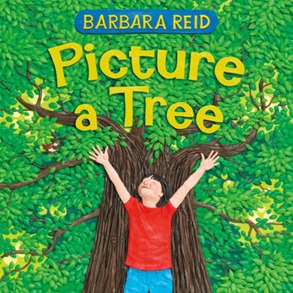
Picture a Tree by Barbara Reid

How do you picture a tree?  Do you see a drawing on the sky?  A tunnel?  An ocean?  A sun umbrella to stop on your hot walk home?  What do you see?  These are just some of the ideas that Reid puts forward in her picture book that pays homage to trees and their ever-changing beauty.  Starting with the spring and moving through all of the seasons, this book will have you looking into the trees around you and noticing them even more.

Reid’s text here is simple but very effective.  She gets you dreaming of your own answers and also seeing trees from all angles and all seasons.  The true focus here though is her art.  Done entirely in Plasticine clay, they have a wonderful three-dimensional quality to them and are anything but simple.  In fact, the detail is amazing and will keep readers gazing long after they complete the words on the page.

An awesome addition to any Arbor Day, Earth Day, tree-related or seasonal story time or unit, this book should inspire all of us to wonder about trees.  Appropriate for ages 4-6.

Reviewed from library copy.

You can also see the trailer for the book for a glimpse of Reid’s art and words:
Review: The Family Tree by David McPhail

family tree

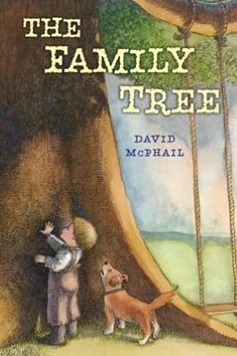
The Family Tree by David McPhail

This is the story of a very special tree.  It was left standing when the rest of the space was cleared to build a house many years ago.  This tree would shelter the little house.  It witnessed many changes over the years as horse and wagon changed to cars.  There were births and deaths on the farm, until finally it was the great-great grandson of the original building of the home who lived there.  The tree still stood, strong and straight.  But then it was threatened as a new road was planned that would run right through it.  The grandson refused to let the tree be cut down, and wild animals join him to keep it from happening.  So the road plans must be changed and the tree continues to grow now by the large bend in the road.

There is something to be said about a picture book that decides to tell the story that feels right, the one that resounds in your bones, rather than the one that would happen in real life.  When I saw the bulldozers in the book, I braced myself for heartache, or for the story to turn into that of growing a new tree from an acorn that originated with this tree.  But instead McPhail told a story for tree lovers of all ages, who wish that there were bends in the big highways to keep huge old trees alive. 

McPhail’s writing is simple and straight-forward.  He tells the story with a great matter-of-fact tone that belies the wildlife appearing and the wonder of the tree standing.  His art is signature McPhail with its fine ink lines and watercolor softness.  It has both the clarity of the modern day and the softness of memories.

Get this into the hands of those who hug trees.  They are guaranteed to love it.  Appropriate for ages 3-5.

Reviewed from copy received from Henry Holt and Company.

Review: The Conductor by Laetitia Devernay

conductor

The Conductor by Laetitia Devernay

This wordless picture book is tall and narrow, just like the trees featured within.  A man enters a forest of trees that are shaped like lollipops with long trunks and round tops.  He climbs to the very top of one tree and raises his hands.  Suddenly, birds start to appear, formed from the leaves of the trees.  They fly off leaving holes in the tree leaves shaped like them.  The leaf patterns are on their wings and they fly above the conductor in a variety of formations.  Until eventually they are gone, and all that are left are the blank trees.  The man climbs down and plants a seed that quickly grows into a tree.  As he is planting, the birds return to the trees, covering them once again in leaves.  The man leaves the forest just as he has found it, but with one more small trees.  It’s a beautiful look at the environment and the impact humans can have if they choose.

The art here is wonderfully done.  It has a limited palette of just yellow, green, black and white.  The juxtaposition of tree leaves and flying birds is spectacular visually and surprising at first.  It lifts the book to a more surreal place, a world where you are unsure what could possibly happen next.  The fine lined art, the scale of the book and the gentle theme all work well together, creating a memorable whole.

A surprising wordless picture book that is a work of art, this book would work well in art curriculum or as a quiet, beautiful book to share.  Appropriate for ages 3-5.

Reviewed from copy received from Chronicle Books.

Review: House Held Up by Trees by Ted Kooser

house held up by trees

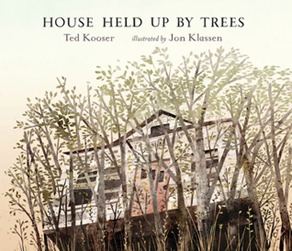
House Held Up by Trees by Ted Kooser, illustrated by Jon Klassen

This is the story of a family and a house.  When the house was new, it stood upon a newly planted lawn where the trees had been removed.  It was bare, not even a stump left behind.  On either side of the bare lot were trees of all sorts, the kind that spread seeds and scents.  Two children lived in the new house and often played in the trees at the edges, watching their father care for the lawn.  Their father mowed down all of the small tree seedlings before they could get started at all.  But the children grew up, the man moved away to be closer to them, and the house was left alone.  Alone except for the trees, which grew and took over the barren lawn, and eventually lifted the house high on their shoulders.

Kooser writes with amazing depth here, each sentence resonant with meaning and feeling.  While the book can be read more lightly, the joy here is in that dark deep that lies behind the lines.  The story plays with man vs. wilderness, the American obsession with lawns, children being pulled to the edges to find their own wild spaces, and the return to nature in the end.  The writing is beautiful because of that ever-present ache that is there, the tug of the trees, the dance of the seeds.

Klassen has illustrated this book with such delicacy that it shows he feels that same amazing pull.  He lets us peek at the house from the shelter of the woods, our eyes almost aching with the bareness in the sun.  He captures the tree seeds in flight from high above, allowing us to fly with them and plant ourselves too.  He plays with light, shadow and darkness, just as Kooser does. 

This book is poetry, without the stanzas.  It is a picture book that has depth, courage and looks deeply into our relationship with nature and with our families.  Beautiful.  Appropriate for ages 7-10.

Reviewed from library copy.

Review: A Leaf Can Be… by Laura Purdie Salas

11505

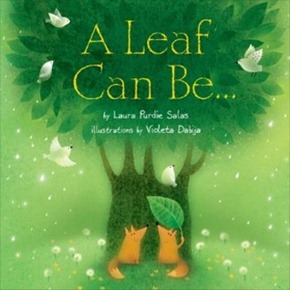
A Leaf Can Be… by Laura Purdie Salas, illustrated by Violeta Dabija

Explore leaves throughout the seasons in this work of poetry.  The book focuses less on the science of leaves and much more on their impact, their dance on the wind, the shade they spill, and the color they give.  Told in verse that will work very well with young children, this book captures the wonder of nature.  

This is a dance of a book with rhymes and rhythms that really sparkle.  Much of the book is done in two-word lines that encapsulate one aspect of leaves, “sun taker” and “food maker,” and then in the autumn, “pile grower” and “hill glow-er.” 

Dabija’s art is jewel-toned and dynamic.  Her work is infused with merriment and joy.  She uses layers and transparency to great effect, capturing the beauty of nature.  One particularly striking page is her “frost catcher” where the layers of her work shine and the details are luminous. 

A great book to use in a unit about trees, this is also a book that invites exploring a poem.  Exquisite writing is well matched with rich art in this book.  Appropriate for ages 3-6.

Reviewed from library copy.

Review: Celebritrees by Margi Preus

celebritrees

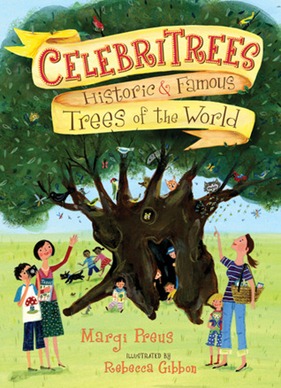
Celebritrees: Historic and Famous Trees of the World by Margi Preus, illustrated by Rebecca Gibbon

This book carries readers through the stories of fourteen “celebritrees” which have made a name for themselves.  Many of the tress are very old, some are special in different ways, and all are fascinating.  Here you will visit Methuselah, the oldest known single living organism on earth, and General Sherman, the biggest living inhabitant of earth, and Hyperion, the tallest tree in the world.  There are trees famous for events around them, trees that have objects stuck in them, and even a tree that owns itself.  This is an inviting book of trees that is a pleasure to spend time in.

Preus paints pictures of moments in history to help tell the amazing stories of these trees.  From the events they witnessed to the events they were at the heart of, the trees are much more than simply largest, oldest, and tallest.  Here they have stories that bring them fully to life. 

Gibbon’s art has a simplicity that is almost that of folk art.  There is a richness to the color palette and a flatness to the perspective.  The trees are central to the art, as they should be, and the book celebrates them in browns and greens.

It is great fun to wander through this a veritable forest of famous trees.  Enjoy the journey, I certainly did!  Appropriate for ages 7-10.

Reviewed from library copy.

Book Review: The Mangrove Tree by Susan L. Roth

mangrove tree

The Mangrove Tree: Planting Trees to Feed Families by Susan L. Roth and Cindy Trumbore

This book tells the true story of Dr. Gordon Sato in picture book format.  The village of Hargigo in the African country of Eritrea was dry and the animals could not find enough to eat.  Dr. Sato had the idea of planting mangrove trees on the shore of the salty Red Sea.  The trees can survive the salt and would give women in the village a way to earn money close to home from planting the trees.  The trees also help by giving off oxygen too.  The goats and sheep ate the leaves from the trees and grew stronger, living longer and having healthier babies.  The mangrove trees also changed the habitat along the shore, creating hiding places for sea creatures that helped the fish grow larger and the fishermen improve their catch.  This is the story of Dr. Sato, who through science changed the lives of people not only in Hargigo, but around the world.

Trumbore has written a clever dual story here.  On one side of the page, a simple cumulative story is told of the mangrove trees by the sea.  On the other side, readers get much more detailed information about the science and impact of the planting of the trees.  Finally, at the end of the book, readers can see photographs of the actual villagers, the trees and Dr. Sato. 

Roth’s illustrations are eye-catching and inventive.  Using collage, she has created such texture, color, and natural feel.  Her illustrations have depth, showing the people at work, giving individual coats to the sheep and goats, and celebrating the bright colors the people wear.  It is a very rich illustration that celebrates the setting and the work that went into the project.

Highly recommended, this book is a beautiful mix of nonfiction and picture book that is ideal for elementary science about the environment.  It celebrates the impact that one man can have on the world, inspiring youth to think about what they can contribute too.  Appropriate for ages 5-8.

Reviewed from library copy.

Also reviewed by BookDragon.

Book Review: Little Mouse’s Big Secret by Eric Battut

littlemousesbigsecret

Little Mouse’s Big Secret by Eric Battut

When Little Mouse discovers a juicy red apple on the ground, he decides that it will be his secret.  So he hides it in a hole in the ground.  Once it is safely hidden, his friends appear one-by-one and ask him what he’s hiding.  Little Mouse insists to each animal that he will not tell because it’s his secret.  As Mouse talks with animal after animal, his back is to the apple and the hole he hid it in.  Soon a sprout appears from the hole, then a stalk and finally a tree.  Apples appear on the tree just as Little Mouse declares that he will keep his secret forever!  Then the apples fall to the ground.  All of the animals reappear and Little Mouse discovers that some secrets are even better when shared.

Battut has created a picture book perfect for very young children.  From the simple, friendly illustrations that have plenty of whitespace to the repetition built into the animals asking what the secret is, this book has lots of child appeal.  Each double-page spread has only two lines of text on their own page, creating a book that is quite engaging and fast moving.

Children will immediately get the humor of a fast-growing apple tree that the mouse is completely oblivious to until the apples fall around him.  The book also has a high cute factor, with the animals dwarfed by the growing tree, all bright-eyed and merry.  They are on a buttery-yellow background that adds to the coziness of the title.

Add this book to your autumn and apple book lists.  The very little mouse and other animals make it more appropriate for small groups or individual sharing.   Appropriate for ages 2-3.

Reviewed from library copy.

Also reviewed by

The Tree House: Wordless and Wonderful

treehouse

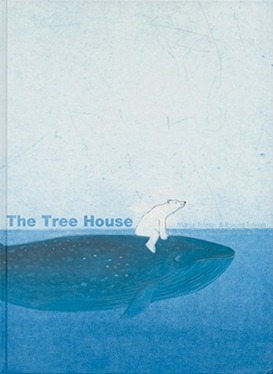
The Tree House by Marije Tolman and Ronald Tolman

This is a wordless picture book by a father/daughter team who have created a magical immersive experience.  A polar bear swims towards a tree house that stands alone in the water.  Later, a brown bear arrives in a boat.  The two bears stay together in the tree house, reading books as the sea below turns pink with a flock of flamingos.  As the flamingos pass, more animals arrive, including a rhino who bashes the trunk of the tree, two pandas, some owls, a hippo, and a peacock.  Another bear arrives via balloon and takes the peacock away.  The other animals head off, leaving the two original bears together in the tree house.

My synopsis doesn’t capture the beauty of this picture book at all, as is often the case with wordless picture books, the story is so much more about the pictures than anything that can be summarized in words.  The illustrations are simple and beautiful.  The tree house itself is unchanging, printed in exactly the same way from page to page.  It offers a consistency while the world changes around it.  The level of the water rises and falls, the sky changes colors, the seasons move.  The tree house stands, staying constant through it all, even as it supports so many animals.

There is a lovely gentle mood throughout the book.  A sense of playfulness and unexpectedness fills the story as well.  The surprise of the suddenly pink page when the flamingos arrive is visually arresting and very effective.  The colors are deep, from a blue that is almost black and perfect captures late evening to a canary yellow that sings. 

This is a book of wonder, a beautiful place to spend some moments with someone in a tree house out in the water.  Appropriate for ages 3-5.

Reviewed from copy received from Lemniscaat.

Also reviewed by: