The Cat from Hunger Mountain by Ed Young

the-cat-from-hunger-mountain-by-ed-young

The Cat from Hunger Mountain by Ed Young (InfoSoup)

On Hunger Mountain, there lived a great lord who was wealthy and had anything he ever dreamed of. He lived in the tallest pagoda, had his rice washed in the stream, ate only the first half of his food, and wore the most beautiful fabrics. Then drought came to his land, yet the lord did not stop his consumption. A second year of drought and famine came and the others left his land. The lord finally realized he would starve alone in his pagoda so he left the mountain and tried to find food. When he met two beggars, they told him of a generous monk who would give others food. The monk gave the lord food and the cat realized that this was lovely grain and some of the best he had ever eaten. He asked the monk where he had gotten the rice and was told that it was washed down the river from Hunger Mountain where a wealthy lord had wasted it.

Young writes this story with real precision. He keeps his prose short and child-friendly with a tone of a storyteller who offers just enough detail yet keeps the pace brisk. Young allows the story itself to stand, not adding judgment in the text about what should be learned from it.

The illustrations are the opposite of the pared down text with a rich opulence built from layered collage. Some of the collage is patterned paper while others are photographs of fur, water or mountains. They have a serious energy to them, filled with motion and expression.

A vibrant picture book that looks at waste, consumption and humility. Appropriate for ages 5-8.

Reviewed from library copy.
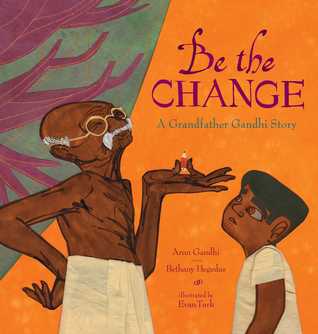


Be the Change by Arun Gandhi

be-the-change-by-arun-gandhi

Be the Change: A Grandfather Gandhi Story by Arun Gandhi and Bethany Hegedus, illustrated by Evan Turk (InfoSoup)

Arun lives in a village with his grandfather. The purpose of life in the ashram was to work in service for one another. For Arun, that meant following his grandfather’s rules as well and the hardest for Arun was not to waste. One day, Arun grew tired of his vow not to waste and threw an almost worn out pencil away into the grass. When he asked for a new pencil that night, his grandfather said that he had had a fine pencil just that morning. He went on to explain that the thing of importance was not the pencil but Arun himself. So Arun set off after dark to find the pencil nub in the grass. Still, it would take more teachings from his grandfather for Arun to finally connect wasting nothing with nonviolence as Arun works to define what passive violence actually is.

In a lesson ideal for our time of large consumption and rude political discourse, this picture book is a gentle salve. It speaks of small moments of choice actually shaping our persona and our ideas. One small pencil nub is actually a decision to live without excess and without damaging others. The message is delivered through the curious eyes of a young boy who asks the questions that readers will also have. This is a lovely and accessible look at the teachings of Gandhi.

Turk’s illustrations are lush and patterned. He uses collage at times, fabric folds popping off the page. Gorgeous colors fill nature with purple trees, silver rimmed clouds, the glow of orange understanding after a darkness of shadow.

This second picture book about Grandfather Gandhi is a treat and offers opportunity for discussions about waste and care for others. Appropriate for ages 5-7.

Reviewed from copy received from Atheneum.