Wanda Hears the Stars by Amy S. Hansen with Wanda Díaz Merced – Book Review

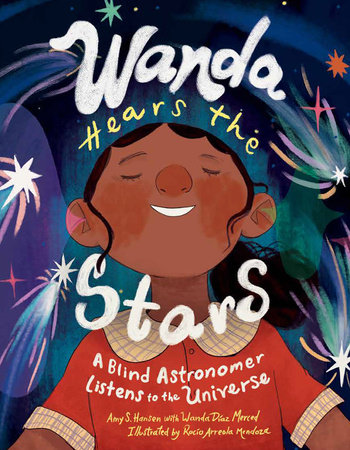
Wanda Hears the Stars: A Blind Astronomer Listens to the Universe by Amy S. Hansen with Wanda Díaz Merced, illustrated by Rocio Arreola Mendoza (9781623544874)

When Wanda was growing up in Puerto Rico’s rainforest, she couldn’t see the stars because of all the trees. She first truly saw the stars on a family fishing trip and she was entirely amazed by them. Wanda was a child who didn’t like school all that much and certainly didn’t like the shots she had to take for her diabetes. Eventually, she found out what she liked at school and decided to study physics in college. But at college, she started losing her eyesight due to her diabetes and eventually became blind. How could a blind person study the stars? Happily, she had friends around her to encourage her and one friend who was using sounds to study the stars. Now Wanda could listen to the stars and hear them. Wanda moved to the United States and continued to study the stars, making discoveries that only someone listening to the noises could have found. 

An amazing story of overcoming a disability in a field where it seemed impossible to go on, this nonfiction picture book shows Wanda’s perseverance, skill and also her willingness to accept help in order to find her way forward. The story itself is wonderfully written for young readers and the ending where the star noises are shared on the page is amazing in an entirely additional way. The illustrations are friendly and invite readers to engage with the material. 

A fascinating and inspiring true story. Appropriate for ages 6-9.

Reviewed from e-galley provided by Charlesbridge.

4 Nonfiction Picture Books Featuring Amazing Women

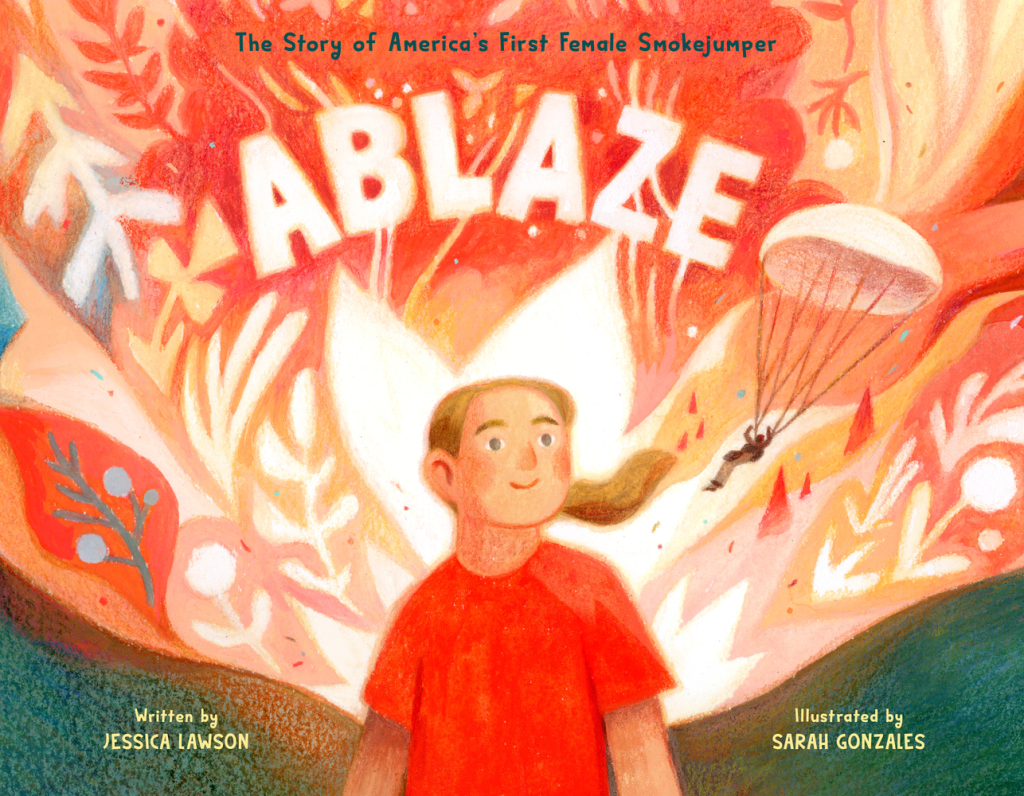
Ablaze: The Story of America’s First Female Smokejumper by Jessica Lawson, illustrated by Sarah Gonzales (9780593463659)

Deanne loved spending time in nature with her family as a young child. It was a love that continued throughout her life. When wildfires started spreading in California, Deanne applied for a job with the U.S. Forest Service. She was hired by them to fight fires. She had found exactly what she loved. It was a physical job with long hours and risks. But Deanne wanted to do more: she wanted to become a smokejumper. So, at age 26, she started taking the required physical tests. She passed them, but was found to be too small for their requirements. Deanne fought the decision, filing a formal complaint. Months later, she was allowed to take the tests and soon passed them to become the first female smokejumper in the nation.

Deanne is the epitome of resilience and determination. The book focuses on her willingness to take risks but also on her level-headed approach to gaining new skills as she pushes the envelope of society’s biases toward women. The writing here is approachable and evocative. It shares how Deanne was feeling as she hit each obstacle and overcame them. The illustrations are full of flame colors, smoke and fire. It brings the dangers and the drama directly to the reader. 

Bravery, resilience and character are all on display in this great picture book biography. Appropriate for ages 4-8.

Reviewed from e-galley provided by Penguin Young Readers.

The Black Mambas: The World’s First All-Woman Anti-Poaching Unit by Kelly Crull (9798765627259)

The Black Mambas are an anti-poaching unit that works in South Africa on the Olifants West Nature Reserve. The unit was started when animals in the reserve began to disappear, particularly rhinos and pangolins. The unit is the first all-women anti-poaching unit in the world and despite doubts from family members became very successful. The book explores how the unit was created, what sorts of training they go through, and what they do on a daily basis to protect the wildlife in the reserve. One particularly dramatic series of images shows the women tracking poachers and successfully stopping them. Told via photographs, the book celebrates the impact these women have had on their community and the success of the reserve.

A stirring tale of women successfully stepping out of traditional roles. Appropriate for ages 5-10.

Reviewed from library copy.

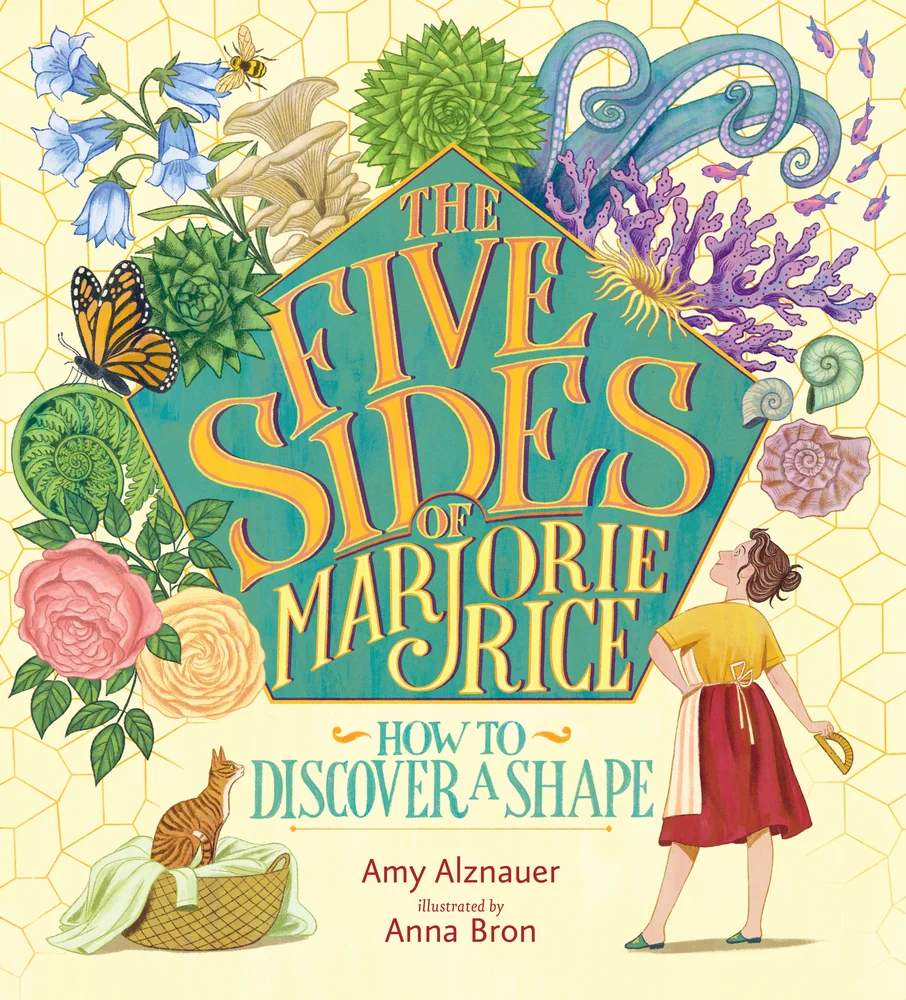
The Five Sides of Marjorie Rice: How to Discover a Shape by Amy Alznauer, illustrated by Anna Bron (9781536229479)

Marjorie Rice grew up loving shapes, enchanted by the golden rectangle. She studied art and geometry, but her parents wanted her to be a secretary. Meanwhile, others were discovering five-sided shapes that could fit together, creating a seamless pattern. They each declared they had found them all. Majorie was raising children, doing art, helping with math, and discovered the question of five-sided shapes in her son’s Scientific American magazine. Marjorie started to work on the problem, despite it being declared as solved. Her first discovery was declared the tenth tiling pentagon, but she wasn’t done yet! 

This picture book tells the story of an amateur mathematician who discovered tiling shapes that others couldn’t. These were questions from the beginning of math and design, solved by a mother of five working out of her home. It is an inspiring story of resilience, tenacity and patience. The illustrations in the book invite readers to look at five-sided shapes themselves, seeing them elongate and shrink and they fit together.

It’s a book that makes mathematics something tangible and beautiful. Appropriate for ages 5-9.

Reviewed from library copy.

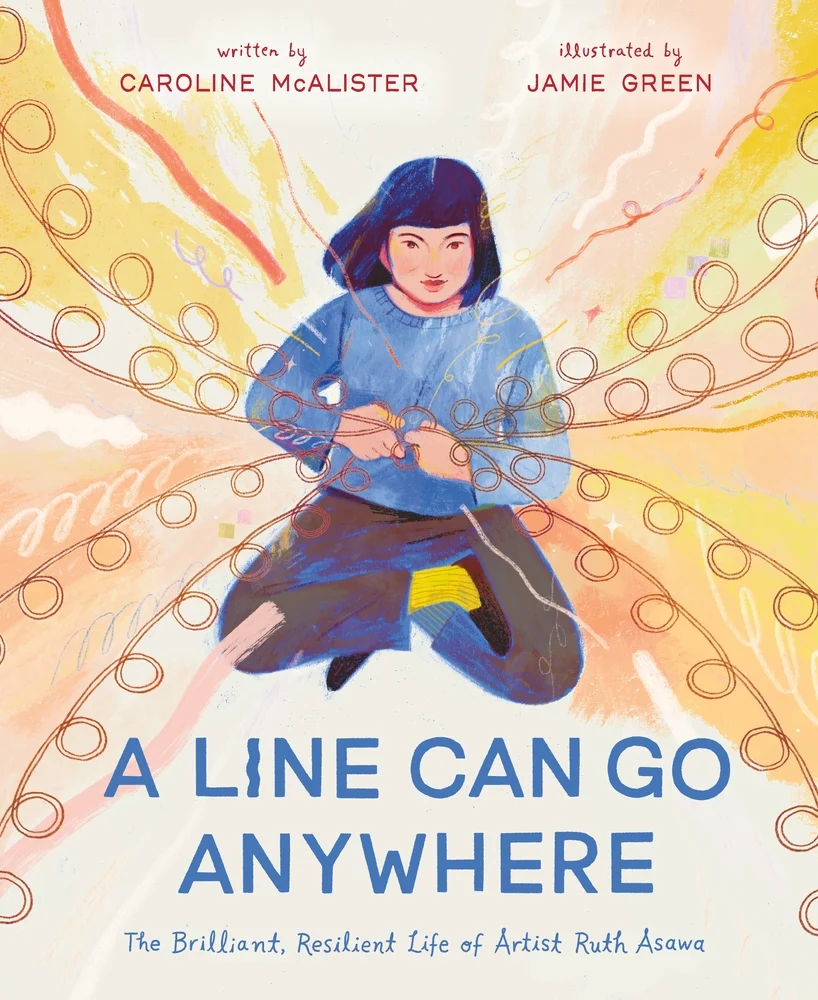
A Line Can Go Anywhere: The Brilliant, Resilient Life of Artist Ruth Asawa by Caroline McAlister, illustrated by Jamie Green (9781250310378)

Ruth Asawa was raised on her family’s vegetable farm in California. She attended Japanese school on Saturdays and won an award in her regular school for a poster she made of the Statue of Liberty. Her life was divided in half, but soon that was to become even more clear. When Pearl Harbor was attacked, her father was taken away. Two months later the rest of the family entered imprisonment. Ruth started to draw her life in the camps. At age 20 after the end of the war, she started to create the wire sculptures that she would become known for. Eventually she was asked to create the memorial for those imprisoned in the Japanese internment camps. 

Told in poetic language that uses the image of lines repeatedly, this nonfiction picture book pays a deep and respectful homage to this Japanese-American artist. Asawa rises again and again, despite the racism that impacted her childhood and teen years. The use of art to create conversation and connection is clear in this book. The illustrations are done in charcoal, watercolor and digital media. They capture the lines, the wire, the connectivity and the inhuman conditions of the camps.

A book that celebrates survival and the way art can carry a spirit through its darkest days. Appropriate for ages 5-9.

Reviewed from e-galley provided by Roaring Brook Press.

Lighthouse Ladies by Kris Coronado – Book Review

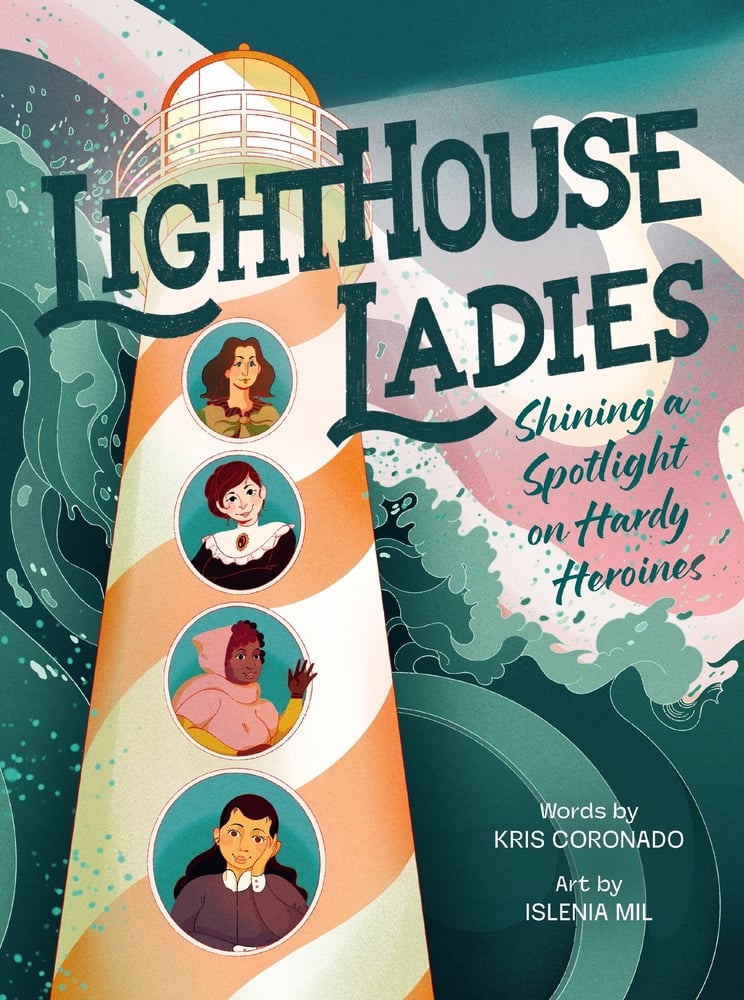
Lighthouse Ladies: Shining a Spotlight on Hardy Heroines by Kris Coronado, illustrated by Islenia Mil

This nonfiction picture book shares the stories of four women from history who worked in lighthouses across the United States. The jobs were a challenging mix of boredom, dedication and danger in tight quarters, often wearing long dresses. Ida Lewis worked a lighthouse in Rhode Island and was known for rescuing people whose boats had capsized. Juliet Nicols in California was challenged by the fog and her resilience and strength alone kept the fog bell sounding. Venus Parker worked in Virginia with her husband. She had to carry on despite terrible ice and her husband’s unexpected death. Julia Toomey worked in Hawaiian lighthouses with her parents. When her father died saving the lighthouse, Julia had to manage to carry on. 

These stories of women and girls facing impossible tasks to save strangers from wrecking their ships and boats on the rocks capture the fraught nature of working in a lighthouse. The stories capsize the image of lighthouses as peaceful icons and instead show the risky work close up. They also ruin the tales that are often told of men having these sorts of roles rather than women. The illustrations are friendly and approachable, filled with curving stairs and beautiful lighthouses until the pages turn dark with storms and the dramatic moments happen. 

A glorious look at women facing danger head on with skill and resilience. Appropriate for ages 7-10.

Reviewed from e-galley provided by Clarion Books.

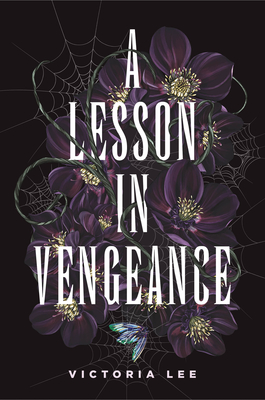
A Lesson in Vengeance by Victoria Lee

Cover image for A Lesson in Vengeance.

A Lesson in Vengeance by Victoria Lee (9780593305829)

Felicity is returning to Dalloway School after the tragic death of her girlfriend ended her previous senior year early. But it’s not easy to return to the ivy-covered school that is filled with dark legends that Felicity finds herself drawn to. The early days of the school date to the witch trials and five Dalloway students died early in the schools history, their deaths filled with connections to witchcraft. As Felicity starts her senior year again, she meets a compelling new student, a young novelist who is working on her second book. When Ellis reveals her book is going to be about the Dalloway Five, Felicity agrees to help her with her research. As the two research documents, they also form their own coven and begin to explore the occult. There is so much history filled with questions, and that includes the death of Felicity’s girlfriend a year ago too.

This book is beautiful and delicious. I love that it has its own distinct vintage style too, combining elbow patches and fifties sweaters with cell phones. The witch elements of the story are an invigorating mix of real history with existing covens but also may be covering up more realistic reasons for the deaths of the five girls. The setting itself is marvelously isolated and allows the characters a lot of freedom. These are wealthy girls, who flaunt their privilege at times and deny it at others.

The book is layered and complex. It turns from being a gothic, vintage witchcraft tale to something even darker. As Felicity’s mental health destabilizes, the truth emerges in fits and starts. The book becomes far more about the power of young women, the way society has frowned upon them gaining agency in the world, and what that means today. Beautifully, that doesn’t mean that the bloody nature of the book goes away. Far from it.

Dark, dangerous and delightful. Appropriate for ages 14-18.

Reviewed from e-galley provided by Delacorte Press.

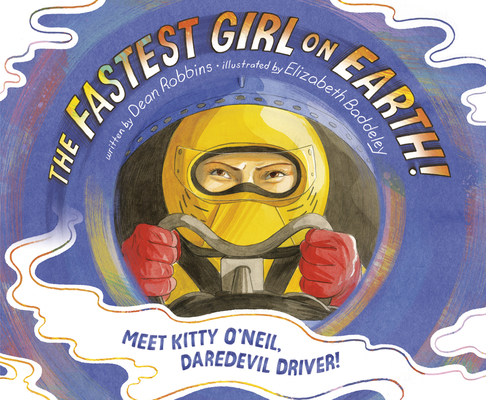
The Fastest Girl on Earth! Meet Kitty O’Neil, Daredevil Driver by Dean Robbins

Cover image for The Fastest Girl on Earth.

The Fastest Girl on Earth! Meet Kitty O’Neil, Daredevil Driver by Dean Robbins, illustrated by Elizabeth Baddeley (9780593125717)

As a child, Kitty O’Neil loved to go fast. She loved running, riding on the lawn mower with her father, and swimming and diving. Though she lost her hearing due to a childhood fever, it never slowed Kitty down. Kitty grew up to be a stuntwoman in movies. She also set records as the fastest water skier and boat racer. Then Kitty set her sights on being the fastest driver. Her car was called the Motivator and it was rocket powered, capable of going over 300 mph, if Kitty could steer it at that speed. The woman’s land speed record at the time was 308 mph. Kitty went 618 mph! She became an American hero in the 1970’s even having an action figure made in her likeness. Kitty continued to be a champion of children with disabilities and held records in an incredible range of sports.

Robbins’ book about Kitty O’Neil is just as fast paced as her records. His writing is brisk, opening the book with Kitty in her rocket car and closing the book with her record drive. This frames the story very successfully, as young readers will want to know what happens on that historic drive. Robbins also captures the breathlessness of the countdowns, the danger of the drive, and Kitty’s own fearlessness. It’s a marvelous rocket read of a book just right for the subject.

The art, done in pencil, watercolor, acrylic and digital, get readers right into the cockpit with O’Neil. They capture her joy at going fast and breaking records. With bright colors, they also show the dynamic moments of the countdowns, the acceleration, the determination and the eventual win.

A wild ride of book about a deaf woman driver who became a hero. Appropriate for ages 4-8.

Reviewed from e-galley provided by Alfred A. Knopf Books for Young Readers.

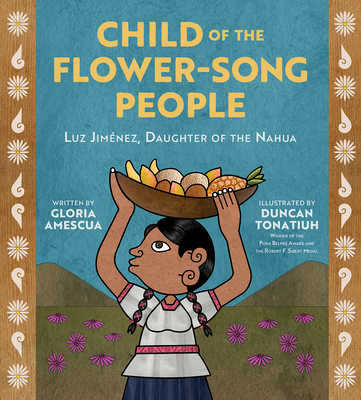
Child of the Flower-Song People by Gloria Amescua

Cover image for Child of the Flower-Song People.

Child of the Flower-Song People by Gloria Amescua, illustrated by Duncan Tonatiuh (9781419740206)

Luz Jiménez was a child of the flower-song people, the Aztecs. She had listened intently to the stories told by the elders about their sacred mountains and streams and also about how the Spaniards had taken their lands away. Luz learned how to do the traditional work of her people, grinding corn on a metate, twisting yarn with her toes, weaving on a loom. She learned about the plants around her and what herbs were medicine. Luz longed to go to school, but it was forbidden for native children. Then the law changed and required schooling in the ways of the Spanish. Luz was a good student and learned much, still keeping the traditional tales alive as she shared them with the other students. At age 13, Luz was forced to flee the Mexican Revolution and live in Mexico City. There Luz became a model for artists, sharing her traditions in paintings and photographs. She longed to be a teacher, but was denied that opportunity. Instead she taught in a different way, through modeling, sharing her tales, and being a living link to the Aztecs.

This beautiful picture book pays homage to Luz Jiménez, a humble woman who became the face of her people. Amescua’s lovely Author’s Note shows the detailed research that went into this biographical picture book. That research is evident in the lovely prose she uses to share Luz’s story with a new generation. Her writing uses metaphors and evocative phrases to really show the impact that Luz’s presence has had as well as her strong connection to her heritage.

Tonatiuh’s art is always exquisite. Done in his own unique style, his illustrations mix modern materials with a folkloric feel. They work particularly well for this subject.

A stellar biographical picture book of a true teacher and heroine. Appropriate for ages 7-10.

Reviewed from e-galley provided by Abrams Books for Young Readers.

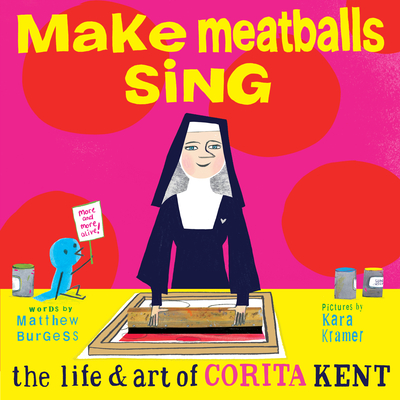
Make Meatballs Sing: The Life and Art of Sister Corita Kent by Matthew Burgess

Cover image for Make Meatballs Sing.

Make Meatballs Sing: The Life and Art of Sister Corita Kent by Matthew Burgess, illustrated by Kara Kramer (9781592703166)

Corita Kent was a remarkable pop-artist who was also a nun, a teacher and an activist. From a small child, Corita showed kindness and empathy for others and also a love of art and creativity. Her father wanted her to do something original, and Corita certainly did. She surprised her family by becoming a nun, discovering a love of teaching and training new teachers. She joined the art faculty at Immaculate Heart College, where she discovered a love of silkscreen printing. Soon her art was winning competitions. Corita continued to teach classes and make her own art, which spoke to social justice and against poverty and war. She transformed a rather formal celebration into one of bright colors and activity. Not everyone approved of what Corita was doing, and she surprised the people around her once again, asking to be released from her religious vows. She found places for her largest work, painted on a gigantic tank, and her smallest, a rainbow postage stamp.

While Kent may not be a household name, many of us have seen her work on the iconic postage stamp. This picture book embraces her unusual life, celebrating the decisions she made, the art she created and her voice for social change. The book cleverly pulls out elements of how Kent taught and created her art, offering unique perspectives gained by seeing the world in a fresh way. The writing here is engaging and offers a tone of delight as Kent continues to surprise and amaze.

The bright and vibrant art in the book shares elements of Kent’s own work. Her play with lettering and words appear throughout the illustrations of the book, filling tree trunks, coloring margins, and as posters on the walls. The entire book is a delight of collage, typography and riotous color.

A positive and affirming look at an artist who should be better known. Appropriate for ages 6-9.

Reviewed from copy provided by Enchanted Lion.

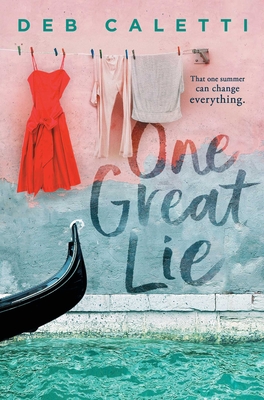
One Great Lie by Deb Caletti

One Great Lie by Deb Caletti (9781534463172)

When Charlotte wins a scholarship to an elite writing workshop given by her favorite author, Luca Bruni, she is thrilled. The workshop takes her to Venice, Italy and a summer spent on a private island with a small group of other college students and Bruni himself. The trip also gives Charlotte a chance to investigate a family legend that one of her female ancestors actually wrote a very famous poem. As Charlotte explore her heritage, looking for clues to a woman who has disappeared into history, she meets Dante, a college student working at the library who works to save flood-ravaged pages. As Charlotte falls for both Venice and Dante, the attentions of Bruni begin to become more problematic. After one girl leaves the program and another has clearly been hurt, Charlotte gains his unwanted attentions and finds herself alone with him. Charlotte must now face her own powerful mentor and decide whether to keep his secrets or not, just as her ancestor and so many women have done before her.

Award-winning author Caletti has created a book that shows exactly why we see music, poetry, painting and more as male dominated throughout history. She highlights real female poets and artists from the 1400s-1600s at the beginning of each chapter, showing how they were quickly either muted, disparaged or killed. She uses these women and the warning signs of Bruni’s behavior throughout the book to foreshadow what is about to happen to Charlotte. It’s terrible to wait for the predator to turn his attentions to her and then strike.

The darkness throughout the book is broken by the accomplishments of some of the historical female figures and also with Charlotte finding her own voice and demanding change. Nothing though is done without cost and loss, there is nothing simple in this novel, no easy way out. The writing is exquisite, dark and rich, with room for a good man like Dante to emerge as a worthy partner for Charlotte.

Feminist, ferocious and full of fight. Appropriate for ages 16-19.

Reviewed from copy provided by Atheneum.

Shaped by Her Hands: Potter Maria Martinez by Anna Harber Freeman

Cover image for Shaped by Her Hands.

Shaped by Her Hands: Potter Maria Martinez by Anna Harber Freeman and Barbara Gonzales, illustrated by Aphelandra (9780807575994)

Maria played in the fields while her parents worked, making clay bowls. When all of them cracked in the sun, she sought help from her Aunt Nicolasa who showed her the ancient Tewa way of making pots using clay mixed with volcanic ash and thanking Mother Earth for sharing clay with them. Maria practiced making pots for months before she was ready to have one fired with her aunt’s. Some pots don’t survive firing, so Maria was pleased when hers came out perfectly from the blaze. Maria grew up, married and had children, never stopping working with clay and pots. In 1908 an archaeologist asked if she could create a pot based on an ancient shard of pottery. Though Maria had never seen such a polished and black pot, she decided to try. After many attempts, her pot came out shiny and black. Maria was able to sell her pottery for the first time and soon they were selling as many as they could create, employing her entire family.

This picture book biography tells the story of an important Native American artist who served as a vital ambassador for the Tewa people and the ancient ways of making pottery. The book is written by one of Maria’s great grandchildren and an art teacher author. Their deep knowledge of Maria and art are evident on the pages with the details shared and the homage to Maria’s dedication for learning and teaching.

The illustrations glow with the sun of New Mexico, combined with deep blue skies and green plants. The illustrations are a stirring combination of the characters and beautiful landscapes full of sunset pinks, purples and oranges.

A lovely tribute to an important Native woman artist. Appropriate for ages 5-9.

Reviewed from e-galley provided by Albert Whitman & Company.