Review: Night Job by Karen Hesse

Night Job by Karen Hesse

Night Job by Karen Hesse, illustrated by G. Brian Karas (9780763662387)

Released on September 11, 2018.

On Friday nights, a little boy goes with his father to work. They leave after dark on his father’s motorcycle, head across the bridge, and enter the closed school. His father has a big ring of keys to open the door. They clean the gym first, while the little boy plays basketball. They bring a radio with them from room to room, listening to baseball games. At ten at night, they eat the lunch they brought with them. While his father cleans the library, the boy falls asleep reading on the couch. His father wakes him at four in the morning to head back home, across the bridge. The two fall asleep together curled in the big recliner.

Newbery Medal winner Hesse captures the wonder of going to work with a parent and brings in the beauty of being out at night as well. Along the way, the work of a parent who has a night job is honored. As a child of a teacher, I enjoyed the empty hallways of a school closed for the weekend or summer. It’s a beautiful thing to have those areas be silent and just for you. That feeling is shown here clearly, as the boy makes the spaces his own.

The connection between father and son is a focus of the story and the illustrations. The pictures by Karas are done in his signature style and use darkness and light cleverly. The father and son are shown as a pair throughout the book, highlighting their special time together whether in the bright gym or on the dark road.

A quiet book about jobs, connections and families. Appropriate for ages 3-5.

Reviewed from copy provided by Candlewick Press.


Review: Front Desk by Kelly Yang

Front Desk by Kelly Yang

Front Desk by Kelly Yang (9781338157802)

When Mia and her family first moved to the United States from China, she expected to live in a big house with a car and have plenty of money. But her parents have struggled from the beginning to find jobs. When they become caretakers of a motel, the job gives them free rent, but requires one of them to be on duty at all times and Mia’s parents to spend all of their time doing laundry and cleaning the rooms. Mia steps up to help by manning the front desk. She gets to know the “weeklies” who are the people who stay at the motel long term. Her family quickly realizes that the man who owns the motel is dishonest but Mia has a plan to help her parents get off of the roller coaster of poverty. All she needs is to write a perfect letter in English and somehow find $300.

Based on her own childhood growing up as a family managing motels, Yang tells a vibrant story of hope in the face of crushing poverty. It is a book that shows how communities develop, how one girl can make a big difference in everyone’s life and how dreams happen, just not in the way you plan. Yang’s writing is fresh, telling the tale of Chinese immigrants looking for the American dream and not finding it easily due to prejudice. She valiantly takes on serious issues of racism and poverty in this book.

Mia is a great protagonist. She never gives up, always optimistic and looking for a new way to problem solve. Her own desire to be a writer plays out organically in the novel, showing how someone learning a new language can master it. The examples of her editing and correcting her own writing are cleverly done, showing the troubles with American expressions and verb tenses.

A great read that embraces diversity and gives voice to immigrant children. Appropriate for ages 9-12.

Reviewed from ARC provided by Scholastic.

Professional Crocodile by Giovanna Zoboli

Professional Crocodile by Giovanna Zoboli

Professional Crocodile by Giovanna Zoboli (9781452167008, Amazon)

This detailed, wordless picture book shares the story of one professional working crocodile’s day. Crocodile is awakened from his dream of floating in a swamp by his alarm clock. He gets ready for work, uses the bathroom, brushes his teeth and selects an appropriate tie. He has jam and bread for breakfast and heads out. He window shops on his walk to work and takes the subway. He picks up flowers, the newspaper and a treat from the bakery. He finally reaches his destination, the zoo, and takes his place in the exhibits after changing out of his clothes.

This book plays up the mundane little activities in life, making them all the more important. Clearly European, this book captivates, showing small details of life and then suddenly switching into wild animals at the zoo with a satisfying ending. The illustrations are filled with little details, like other animals on the streets and subway, and humans looking just a tad nervous as they see Mr. Crocodile near them.

It is the use of human life details with the crocodile character that work so well here. That tension plays throughout the picture book, making it a look at humanity and our lives just as much as being a crocodile. There is a real appeal to the illustrations and the story line that draws the reader in and will have them leaning over the page to see more.

Great illustrations and a whimsical crocodile character make this a winner. Appropriate for ages 3-5.

Reviewed from copy received from Chronicle Books.


Raymond by Yann & Gwendal Le Bec

Raymond by Yann & Gwendal Le Bec

Raymond by Yann & Gwendal Le Bec (9780763689506, Amazon)

Raymond was just a regular family dog, adored by his family. Then he thought one day about joining the family at the table as they ate. Raymond was soon walking on two legs and becoming more and more human. He got a job at DOGUE magazine, being a reporter and soon became an anchor on a dog news show on TV. Raymond didn’t have time for his family anymore and they only got to see him on his show when they tuned in. Finally, his family persuaded him to take some time off. Can Raymond find a way back to being more of a dog and less of a workaholic?

This witty book shows how even a family dog can be drawn into the work life too deeply. Using a family dog as the main character is a smart choice, playing against the typical dog roles. Throughout the book, there is a criticism of our modern work culture that is presented at a level that children will understand. Adults and children alike will cheer when Raymond rediscovers his love for life and ear scratches.

The illustrations have a zing to them as well. From the cover with Raymond carrying a to-go coffee. There is a lovely parallel world of dogs and humans in the images, showing a rich world that Raymond gets caught up in. For their modern touches, the illustrations still have a vintage appeal to them in their flat colors and lines.

A modern fable of the balance of life and work and the joy of chasing balls and spending quiet time together. Appropriate for ages 4-6.

Reviewed from library copy.

Review: Who Put the Cookies in the Cookie Jar? by George Shannon

who put the cookies in the cookie jar

Who Put the Cookies in the Cookie Jar? by George Shannon, illustrated by Julie Paschkis

Lots of hands can take the cookie from the cookie jar, but even more are involved in getting the cookies there in the first place.  There are the hands that mix the dough and put it on the cookie sheet.  Then there are the ones that made the cookie sheet and oven mitts too.  Hands feed and milk the cow that makes the milk. Hands churn the butter.  Hands plant and harvest the wheat.  Hands feed and gather the eggs.  Many hands doing important work, make that cookie arrive in the cookie jar.

This is a great spin on a traditional song.  I’d pair it with the more traditional version in a program to get kids to see it from both sides.  Shannon celebrates all of the hard work that goes into things that we take for granted.  He focuses on their efforts but also on all of us being part of a larger global community that really matters. 

Paschkis’ illustrations have a warm feel to them.  They hearken back to more traditional images yet depict a modern and multicultural world.  Their bright colors really make the book pop and will work well with a large group.

Perfect for a cookie story time, I’d advise having some cookies to share when reading this and other cookie books.  Yum!  Appropriate for ages 2-4.

Reviewed from copy received from Henry Holt & Company.

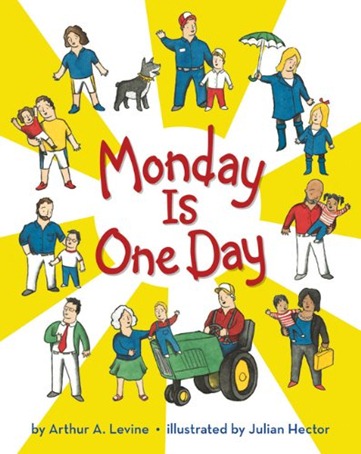
Book Review: Monday Is One Day by Arthur A. Levine

monday is one day

Monday Is One Day by Arthur A. Levine, illustrated by Julian Hector

As families wake up to the new week, the hardest part is being away from each other.  Follow the days of the week here for a celebration of how working families can connect and spend time together throughout the week.  The days continue to move forward from Monday to Tuesday, filled cuddles and puddles.  Then come Wednesday and Thursday with raspberry kisses and dinosaur growls.  Friday’s the last day of the workweek, so help pick out a tie.  Then comes the fun of Saturday and Sunday for families to spend together. 

Levine has written such a simple book that even the youngest of children will be able to relate to it.  The rhymes are easy and feel natural when read aloud.  This book is just what working families need to celebrate their own connections and family relationships. 

The illustrations add diversity and a modern feel to the book.   It is packed full of different types of families, all enjoying connections with their children.  There are families of different colors, gay parents, and grandparents caring for grandchildren.  Happily, nothing is pointed out about the families that are different than the stereotypical norm.  Instead this book just celebrates everyone with ease and style.

The illustrations are done in bright, merry colors with plenty of white space.  They have a gentle, vintage tone to them that works well for this subject matter.  It makes it even more special to have such diverse families depicted in a timeless way.

A positive and welcoming book that will have families rejoicing.  Appropriate for ages 3-5. 

Reviewed from copy received from Scholastic Press.

Also reviewed by

The Village Garage


The Village Garage by G. Brian Karas

Follow the activities of the workers from the village garage as the seasons change.  In spring, the workers are cleaning up sticks, creating mulch, and washing the trucks.  In summer, they are fixing the roads, picking up garbage, and mowing the grass.  They even deal with the effects of a summer thunderstorm that takes out a bridge.  In autumn, they suck up the leaves.  In winter, work is slower until the snow starts and then they wish for spring to come again.  The book mixes the interesting tools and machines the workers use into the story.  Readers will learn what the machines are called and what they do.  This is a rare book that reads beautifully but also has lots of machinery for children to learn about.  Too often they read like lists of tools rather than stories.

Karas perfectly captures small town life along with garage work.  The use of the seasons to frame the story works particularly well with the seasonal nature of their work.  Karas’ art is friendly and also has that same small town feel and a genuine enjoyment for the machines themselves.  Karas incorporates women and people of color throughout his illustrations.  The book offers great sound effects to read aloud, which children will happily help with.  Chains rattle, the leaf truck sucks noisily.  He also weaves a nice sense of humor throughout the book with small touches. 

Ideal for machine story times, this book will also be a great addition to seasonal stories.  Appropriate for ages 3-5.

Reviewed from book received from Henry Holt.

Also reviewed by 100 Scope Notes.