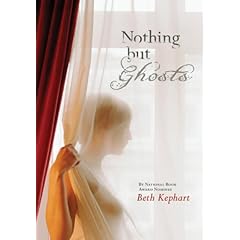
Nothing but Ghosts

Nothing but Ghosts by Beth Kephart

After her mother’s death, Katie lives alone in their big old house with her father who is a bit of a mad genius.  Her summer job is to work in the gardens at the estate of Miss Martine, a recluse who hasn’t been seen by the public in decades.  As the gardeners are told to dig for a new gazebo, Katie realizes that something else may be going on.  They just may be digging for something in particular.  She begins to do research at the local library, hoping to solve the mystery of why Miss Martine disappeared.  Just like her own mother disappeared after her death.  Will solving this mystery help Katie cope with the sorrow and loss of her mother?

There are many ghosts in this book, hovering at the edges of the story, never fully viewed, but felt in every line.  Kephart’s background as a poet shows through her exquisitely written prose.  She manages to create nuance, pain, grief and wonder through her writing, capturing emotions at their most poignant.  Here is one of my favorite lines of the novel, describing the estate they are working at:

Miss Martine’s is quiet as the stones down in the stream, quiet as the robin’s nest that Danny found the other day, which had been lived in, then abandoned.

What imagery, evoking a world unmoving in the river of life, empty, still and immovable.  Yet paired with the fragility and hope of a bird’s nest.  Just this one line offers multiple readings.  The entire novel is like this.

Kephart has also created a mystery that is not a mystery.  The mystery of Miss Maritine is not what this book is about.  It is instead about Katie herself, her personal loss, her mother, her father and how she will find a way to continue beyond her paralysis of grief.  So the mystery is secondary, another ghost in the story, that is useful to chase after but not the real reason we are here.

Katie is a great heroine.  A girl who works as hard as the men, unafraid of dirt, who flies down dark roads on her bike without incident, and who is as brave as anyone could be when surrounded by the past.  She breaks into unique territory as a heroine, a girl who is strong but not masculine, grief-stricken but not tragic.  As a character, she is a testament to the delicacy of Kephart’s writing.

Highly recommended, this book is exceptional.  It is one of the most well-written books of the year, worthy of National Book Award and Printz attention.  Appropriate for 15-18 year olds.

Also reviewed on Charlotte’s Library and The Compulsive Reader.

Al Capone Shines My Shoes

Al Capone Shines My Shoes by Gennifer Choldenko

Released September 2009.

Return to the world of Moose and his family and friends living on Alcatraz.  Moose’s sister Natalie is heading out to her special school that she got into after Moose asked Al Capone to help.  Now Moose finds a note in the pocket of his shirt after it has returned from the laundry.  The note says, “Your turn.”  Now Moose must decide whether to tell his parents what he did or to do exactly what Capone asks of him.  And where would the fun be in telling your parents?

Choldenko’s Al Capone Does My Shirts is used in classrooms across the country for historical fiction.  This sequel will make teachers across the country very happy, because it has all of the same things everyone loved about the first book.  This novel has the same strong voice of Moose as the first.  It is written with such a great tone and spirit as to make it unmistakably the continuing tale of Moose. The characters are vividly written and remain true to themselves even when they are developing and maturing.  As with the first novel, the setting of Alcatraz is integral to the story.  Choldenko has created another fine piece of historical fiction, expertly rendering a complex setting and large set of characters with such panache that she makes it seem simple.  Her writing is worthy of applause, especially with the challenge of a sequel.

Perfection for tweens, this book has a fleeting kiss but nothing more.  Great for historical fiction units and perfect to put right into kids’ hands without hesitation, this book will be gobbled up by anyone who opens it.

Also reviewed by Welcome to My Tweendom and Sarah Miller.

A-Freyed So

James Frey has sold a series of YA books to HarperCollins.  The first book, I Am Number Four, is in a planned series of six.  Frey submitted the first novel anonymously.  The series will be primarily written by Jobie Hughes, though the idea originated with Frey.

The film rights for the series have already been purchased by DreamWorks.

That’s Why We Don’t Eat Animals

That’s Why We Don’t Eat Animals: A Book about Vegans, Vegetarians, and All Living Things by Ruby Roth.

A friendly introduction to veganism and vegetarianism for elementary-age children, this book focuses more on the evils of factory farming than eating animals.  This slant makes it more appropriate for the young audience.  The animals are portrayed as whimsical characters.  The pigs have huge nostrils, the chickens stay round as an egg, and the cows are lanky with long-lashed eyes.  Animals are shown in family groups, demonstrating what their natural lives would be like.  This is contrasted with the misery they find on factory farms combined with the environmental toll as well.  The book makes a sound, green argument for reducing animal consumption as well as eliminating factory farms.

This book deserves a place in most public libraries alongside all of those farm animal books.  It offers another perspective that is missing from children’s sections in libraries.  As adults learn that vegetarian and vegan diets are healthier for people as well as animals, parents will turn to libraries to help explain this to their children.  It is a pleasure to find such a well-done book on the subject that provides information without the shocking images that would be too much for children.

Roth has done an admirable job of creating a book on a subject that could easily confuse and upset young readers.  This book instead talks about nature, the importance of kindness, and gives children a way to make a difference right now.  Her illustrations help to keep the subject from being too bleak with their cartoony feel.

Highly recommended for all public library collections, this book will be appreciated by vegetarians, vegans and others who are exploring their eating options.  Appropriate for ages 8-12.

The Dunderheads

The Dunderheads by Paul Fleischman, illustrated by David Roberts

Miss Breakbone hates children.  She is harsh, rude, and cruel.  But worst of all, she is also a teacher.  She calls her class Dunderheads, and one day goes too far in taking away a broken cat from one of the children.  His nickname was Junkyard and he had found it in the trash, a perfect gift for his feline-loving mother.  When Miss Breakbone basically dared Junkyard to try to get it back, the class turned to Einstein, a boy with a brilliant mind for figuring things out and the narrator of the story.  The children all had talents that they are nicknamed for.  Together they formed the perfect set of skills to break into Miss Breakbone’s castle of a house and retrieve the cat.

This book is a marvelous mix of impossible mission intrigue and school misfits.  Fleischman has created characters that are unique, strange and great fun.  His text is simple, perfect for readers in first and second grades who want a book with pizzazz but are more comfortable with lots of illustrations.  Roberts’ illustrations are a large part of the book.  Much of it is done with panels like a graphic novel, enhancing the feel that the book is for slightly older children than most picture books.  Roberts illustrations are dramatic, silly, and suit the subject perfectly.  His towering and glowering Miss Breakbone is a frightening figure indeed.  The danger is heightened by his illustrations rather than diminished, much to the delight of readers.

Highly recommended, this book fits a niche for picture books that will be of great interest to newly independent readers.  It is also a wonderful read aloud, filled with tension, drama and humor galore.  Appropriate for ages 5-6 as a read aloud, but also appropriate for ages 6-8 as a self-read.

Also reviewed by Young Readers, 100 Scope Notes, and Books4yourkids.

My Little Round House

My Little Round House by Bolormaa Baasansuren.

Jilu was born into a round world.  His cradle was round and soft.  His home, a ger, was round with a round hole at the top.  And the nest he rode in when they moved was round.  Jilu lives in a nomadic Mongolian family, moving each season.  Each time they move, they rebuild their round home, living there until another season has passed.  When summer comes around again, Jilu is a year old, happily playing under the largest roundness of all, the sky.

This book is a vivid depiction of a culture we know far too little about.  Created by Baasansuren, a native Mongolian, the illustrations are filled with small details of daily life.  Resembling folk art, they are warm, familial and colorful.  The words of the book are simple and a pleasure to read, offering the same rhythm as the seasons.  There is a sense of time here that is unusual in our culture as well as a connection to the earth.  People in the U.S. are struggling to find this sort of easy relationship with time and our world.  Here is a picture book that exemplifies a culture where that is simply a part of daily life. 

Highly recommended as a great glimpse into another culture and way of living, this book is appropriate for ages 5-7.