Book Review: The Great Big Book of Families by Mary Hoffman

great big book of families

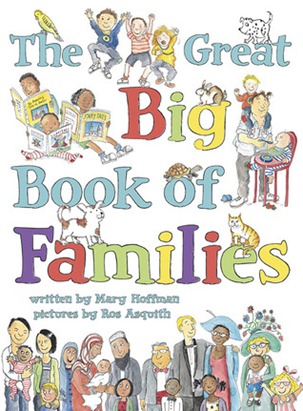
The Great Big Book of Families by Mary Hoffman, illustrated by Ros Asquith

This book celebrates all of the different sorts of families there are.  It starts with a stereotypical family of blonde, white mom and dad, two kids (a boy and a girl), a dog and a cat.  They even come complete with the picket fence and apple tree.  Turn the page and you are in reality with families of different colors, single parents, grandparents, two mothers, two fathers, and adoptive families.  The book then moves on to family sizes, different homes, different ways to go to school, different ways parents work, the holidays families take, the food we eat, clothes, pets, hobbies, and much more.  The book ends by expressing a very important message that families change.  So what does your family look like today?

Another facet of this book is the celebration of families of different incomes and wealth.  Nothing is put down, just mentioned as different from one another.  Children may not notice the differences, but if you are a child struggling with poverty, it is good to see yourself represented here matter-of-factly and honestly.  Hoffman’s entire text is written in this straight forward way, she is inclusive, expansive and above everything non-judgmental. 

Asquith’s illustrations have a nice sense of humor that keeps the book from being too earnest.  They have a quirky feel, a silliness that makes the book a pleasure to read.

Every library needs a copy of this warm, welcoming book where all children will see parts of themselves represented.  Appropriate for ages 4-7.

Reviewed from copy received from Dial Books.

Book Review: Catch That Baby by Nancy Coffelt

catch that baby

Catch That Baby! by Nancy Coffelt, illustrated by Scott Nash

Starting from the title pages, Rudy’s mom has to catch him to get him into the bath.  But once the bath is over, the real chase begins as “Nudie Rudy” runs through the house.  Mom tries to catch him, but he runs into the living room.  His Mom and brother run after him, but he’s into the kitchen.  Now the dog, his father, and his sister join the chase.  But Rudy is off into the back of the house, filled with plants.  Now grandma and grandpa help look, because Rudy has disappeared.  What in the world could he be up to now?

Coffelt’s text ties this wild naked baby chase closely with The Gingerbread Man as more and more characters join in trying to catch Rudy.  The story telling is split between narrative and dialogue, shown in speech bubbles.  This keeps the pace of the story racing along with Rudy from page to page.

Nash’s art has bright colors and a comic book feel to its lines.  He uses objects and the dog to cleverly block any frontal nudity from view, instead showing chubby legs, flying feet, and a bare bottom. 

There is a real humor to the book, so much so that you can almost hear the giggle of this naked little racing boy.  The twist at the end is endearing and a natural part of the story.  A great pick for toddlers, this book is appropriate for ages 2-4.

Reviewed from copy received from Aladdin.

Book Review: The Mangrove Tree by Susan L. Roth

mangrove tree

The Mangrove Tree: Planting Trees to Feed Families by Susan L. Roth and Cindy Trumbore

This book tells the true story of Dr. Gordon Sato in picture book format.  The village of Hargigo in the African country of Eritrea was dry and the animals could not find enough to eat.  Dr. Sato had the idea of planting mangrove trees on the shore of the salty Red Sea.  The trees can survive the salt and would give women in the village a way to earn money close to home from planting the trees.  The trees also help by giving off oxygen too.  The goats and sheep ate the leaves from the trees and grew stronger, living longer and having healthier babies.  The mangrove trees also changed the habitat along the shore, creating hiding places for sea creatures that helped the fish grow larger and the fishermen improve their catch.  This is the story of Dr. Sato, who through science changed the lives of people not only in Hargigo, but around the world.

Trumbore has written a clever dual story here.  On one side of the page, a simple cumulative story is told of the mangrove trees by the sea.  On the other side, readers get much more detailed information about the science and impact of the planting of the trees.  Finally, at the end of the book, readers can see photographs of the actual villagers, the trees and Dr. Sato. 

Roth’s illustrations are eye-catching and inventive.  Using collage, she has created such texture, color, and natural feel.  Her illustrations have depth, showing the people at work, giving individual coats to the sheep and goats, and celebrating the bright colors the people wear.  It is a very rich illustration that celebrates the setting and the work that went into the project.

Highly recommended, this book is a beautiful mix of nonfiction and picture book that is ideal for elementary science about the environment.  It celebrates the impact that one man can have on the world, inspiring youth to think about what they can contribute too.  Appropriate for ages 5-8.

Reviewed from library copy.

Also reviewed by BookDragon.

Book Review: Addie on the Inside by James Howe

addie on the inside

Addie on the Inside by James Howe

Addie Carle, the only girl in The Gang of Five, is the center of this third story in The Misfits series.  Addie is an outspoken and opinionated person, but the verse here shows her to have many more doubts and concerns than she might show on the outside.  As her year of seventh grade continues, Addie has to deal with some big issues: the death of one of her cats, the breakup of her first relationship, teasing by other girls in school, and finding her own voice, even though she is talking all the time.  Addie shows herself to be thoughtful, caring, involved, and much more than others see on the outside, she just has to find the confidence to let her real self show.

Howe’s verse works on several levels.  First, it tells the story of Addie and her growth.  Second, it is poetry that truly functions as individual poems as well.  He plays with rhyme inside his lines at times, while other poems are more narrative and still others are haiku.  It is a fresh look at a verse novel that shifts from lighter to deeper tones easily.

Addie is a fascinating character, a girl who is smart, involved, vocal and entirely human.  While I’m not sure everyone will have this response, she was like listening to my own middle-school inner voice.  Addie’s point of view is uniquely her own, yet she spoke to me completely.  I finished the book with tears rolling down my face, just because of the understanding for my younger self I had found.

A beautifully written book featuring a strong yet human protagonist, this is one amazing read.  Appropriate for ages 9-12.

Reviewed from copy received from Atheneum.